The AI project lifecycle: a practical guide for project managers in Malaysia
The AI project lifecycle is the iterative process that converts a business problem into a deployed, maintained AI system — moving through seven core phases: problem framing and scoping; data acquisition and exploration; data preparation and feature engineering; model development and training; model evaluation and validation; deployment and operationalisation; and monitoring with continuous improvement. As PMI’s guidance on AI projects makes clear, these phases are not a one-way conveyor belt. Teams regularly loop back when performance data reveals gaps in the original framing or when new data changes what is feasible. Salesforce defines AI lifecycle management as creating repeatable processes and clear ownership across every phase to support traceability and compliance — a discipline that matters as much in Kuala Lumpur as anywhere else. Sentient Concepts structures every engagement around this lifecycle, maintaining accountability from the first scoping workshop through to managed operations, so nothing falls through the gaps between teams.
Key takeaways
Managing an AI project successfully requires explicit success metrics, versioned data pipelines, systematic experimentation, formal validation gates, and automated monitoring from day one.
Point | Details |
Define success before data work | Set measurable, business-anchored KPIs in the scoping phase; every subsequent decision depends on them. |
Version data and transformations | Treat datasets and feature engineering steps as artefacts, versioned alongside model code for full reproducibility. |
Use validation gates | Require formal sign-off against acceptance criteria at evaluation and deployment; do not let technical metrics substitute for business approval. |
Automate monitoring from go-live | Deploy drift detection and alerting at launch; a model without automated monitoring is not production-ready. |
Sentient Concepts for end-to-end delivery | Sentient Concepts covers strategy through managed operations, maintaining accountability across every lifecycle phase for Malaysian enterprises. |
Table of Contents
How do you frame the problem before writing a single line of code?
Where does your data come from, and what must you check first?
How do you run model experiments without losing track of what worked?
What metrics actually matter, and when is a model ready to deploy?
What does a safe, production-ready deployment actually look like?
Who is responsible for what, and how should a PM run the project?
What should you budget for, and how long does each phase take?
Sentient Concepts covers the full lifecycle, from strategy to managed operations
What does the AI project lifecycle actually cover?
The seven phases below form the backbone of any machine learning project workflow, whether you are running a document-processing pilot in a Malaysian bank or scaling a predictive-maintenance system across a manufacturing plant. Each phase has a defined objective, a set of primary outputs, and a natural point at which teams may need to revisit earlier decisions.
Phase 1 — Problem framing and scoping: Define the business objective, set measurable success criteria, and confirm feasibility. Deliverable: scoping document with KPIs and constraints.
Phase 2 — Data acquisition and exploration: Identify, access, and document data sources; run exploratory data analysis (EDA). Deliverable: data inventory and EDA report.
Phase 3 — Data preparation and feature engineering: Clean, transform, and version datasets; build reproducible pipelines. Deliverable: versioned, pipeline-ready dataset.
Phase 4 — Model development and training: Run baseline experiments, track hyperparameters, and produce reproducible training artefacts. Deliverable: experiment log and candidate model artefacts.
Phase 5 — Model evaluation and validation: Measure against business KPIs, run fairness and robustness checks, and apply acceptance gates. Deliverable: validation report with sign-off.
Phase 6 — Deployment and operationalisation: Package, integrate, and release the model into production with safe rollout controls. Deliverable: deployment playbook and release notes.
Phase 7 — Monitoring and continuous improvement: Track drift, alert on degradation, and trigger retraining or rollback. Deliverable: monitoring dashboard and retraining runbook.
Three themes cut across every phase and should never be treated as end-of-project activities: governance and compliance (including Malaysia’s Personal Data Protection Act, or PDPA), ethics and fairness, and stakeholder change management. Treating any of these as an afterthought is where enterprise AI projects most commonly stall or fail.
How do you frame the problem before writing a single line of code?
Problem framing is the phase that determines whether the rest of the project is worth doing. A poorly scoped objective — “use AI to improve customer service” — produces a model that no one can evaluate or approve, because there is no agreed definition of success.

The right starting point is a business-terms objective with a measurable outcome. Instead of “improve customer service,” the objective becomes “reduce average handling time for loan enquiries within a realistic timeframe, measured against the current baseline of average call duration.” That framing immediately surfaces the data you need, the performance threshold the model must clear, and the stakeholder who owns the outcome.
Feasibility checks to complete before committing resources:
Confirm that sufficient labelled data exists or can be obtained within the project timeline. Assess whether the use case involves personal data under Malaysia’s PDPA — if it does, consent mechanisms and data-processing agreements must be in place before data collection begins. Evaluate stakeholder readiness: do the business owners understand what AI can and cannot do, and are they prepared to act on model outputs? Finally, define a minimum viability performance threshold — the floor below which the model is not worth deploying, regardless of how much effort has gone in.
Scoping checklist:
Use-case fit: is this problem well-suited to a statistical model, or is a rules-based system more appropriate?
Data sources: are they identified, accessible, and legally permissible?
Performance threshold: what accuracy, precision, or latency does the business require?
Baseline approach: what is the current process doing, and what does “better” mean in measurable terms?
Assumptions to validate: what must be true for the model to work, and how will you test those assumptions?
Pro Tip: Run a 30-minute calibration session with your primary business stakeholder before the scoping document is finalised. Ask them to describe what a “wrong” model output would cost the business. That single question surfaces risk tolerance, edge-case priorities, and hidden constraints that no requirements template will capture.
The Hands-On ML project checklist reinforces this discipline: framing the problem and defining success criteria are the first two steps, and every subsequent decision depends on getting them right.
Where does your data come from, and what must you check first?
Data acquisition is where many enterprise projects encounter their first serious delays. The data that looks available on a spreadsheet often turns out to be incomplete, inconsistently labelled, or subject to access restrictions that take weeks to resolve.
Document the following for every data source before any modelling work begins: the data owner and their approval process; the access mechanism (database query, API, file export); the retention period and whether historical data is available; and the licensing or contractual terms governing use. Data can accelerate early exploration, but they require the same provenance checks as internal sources — licensing terms, geographic representativeness, and whether the population the data describes matches your deployment context in Malaysia.
EDA activities that surface problems early:
Check for missing values by column and by time period — a sudden increase in missingness often signals a system change, not random noise.
Examine class distributions; severe imbalance (for example, fraud detection where 0.1% of records are positive) requires specific sampling or weighting strategies.
Plot feature distributions and flag outliers that may reflect data-entry errors rather than genuine signal.
Identify potential proxy variables — features that correlate with protected characteristics such as ethnicity or gender — before they enter a model.
Confirm that label definitions are consistent across the dataset, particularly when labels were applied by multiple annotators or systems over time.
Malaysia PDPA callout: Any dataset containing personal data — names, identification numbers, financial records, health information — is subject to the PDPA. Before acquiring such data, confirm that the data subject’s consent covers the intended AI use, that processing agreements are in place with any third-party data vendors, and that cross-border data transfers comply with the Act’s transfer restrictions. These checks belong in the data acquisition phase, not in a legal review after the model is built.
How do you build pipelines that do not break in production?
Data preparation consumes more calendar time than any other phase in a typical enterprise AI project. The gap between a clean notebook and a production-ready pipeline is where technical debt accumulates fastest.
Keep the original data immutable. All cleaning, deduplication, imputation, and transformation steps should operate on copies, with the raw source preserved and versioned. This is not a theoretical best practice — it is the only way to reproduce a model’s behaviour six months after it was trained, when a regulator or an internal auditor asks why a particular decision was made.
Feature engineering decisions deserve the same rigour as model hyperparameters. Domain features (ratios, thresholds, business-rule-derived flags), temporal features (rolling averages, lag variables, seasonality indicators), and aggregations (customer-level summaries from transaction-level data) all encode assumptions about the problem. Record those assumptions alongside the code that implements them.
Automation checklist for data pipelines:
All transformations are scripted, not performed manually in a spreadsheet.
Each transformation function has a unit test that catches regressions when upstream data changes.
The pipeline is orchestrated (Apache Airflow, Prefect, or a comparable tool) so it runs on a schedule without manual intervention.
Dataset versions are tracked with a tool such as DVC or Delta Lake so any model artefact can be traced back to the exact dataset it was trained on.
Pro Tip: Treat data transformations as hyperparameters. Version them alongside the model artefact in your experiment tracker. When a model’s performance degrades in production, the first question is usually whether the input data has changed — and the only way to answer it quickly is to have a complete record of what the training data looked like.
The GSA AI lifecycle guide highlights data wrangling as a phase that teams consistently underestimate, both in effort and in its downstream effect on model reliability.
How do you run model experiments without losing track of what worked?
Model development is the phase that looks most like the Kaggle competitions that data scientists trained on — and that resemblance is misleading. Enterprise model development requires systematic experiment management, not creative exploration.
Start with a simple baseline. A logistic regression, a decision tree, or even a rule-based heuristic gives you a performance floor. Any complex model that cannot beat the baseline on your business metric is not worth deploying.
Define your data splits before running any experiments. Training, validation, and test sets must be fixed at the start. Leaking test-set information into model selection is one of the most common causes of production underperformance.
Log every experiment. Record the model architecture or algorithm, hyperparameters, random seeds, training dataset version, and the resulting metrics. Tools such as MLflow, Weights & Biases, or Neptune.ai make this tractable at scale.
Use cross-validation for small datasets. For larger datasets, a single held-out validation set is usually sufficient, but document the choice and the rationale.
Containerise training runs. A Docker image that captures the Python environment, dependencies, and entry point ensures that any experiment can be reproduced by any team member on any machine.
Evaluate compute options deliberately. Cloud-based GPU instances (AWS, Azure, or Google Cloud, all available in Malaysia) are cost-effective for short training runs. On-premises compute may be preferable when data cannot leave a regulated environment. Transfer learning from pre-trained models — particularly large language models for document-processing tasks — can reduce training time and data requirements significantly in enterprise settings.
The MLOps.org end-to-end ML workflow groups model engineering as a distinct discipline from data engineering and code engineering, a separation that helps teams assign clear ownership and avoid the situation where everyone assumes someone else is managing reproducibility.
What metrics actually matter, and when is a model ready to deploy?
Metric selection must be anchored to the business decision the model supports.
Technical metric | Typical business KPI | Decision threshold guidance |
Precision | Cost of false positives (e.g., wrongly flagging a legitimate transaction) | Set high when false-positive cost is significant |
Recall | Cost of false negatives (e.g., missing a fraudulent claim) | Set high when missing a true positive is costly |
F1 score | Balance between precision and recall for imbalanced classes | Use when both error types carry comparable cost |
AUC-ROC | Ranking quality across all classification thresholds | Useful for comparing models; less useful as a standalone deployment gate |
Latency (p95) | User experience or SLA compliance | Define the maximum acceptable response time before modelling begins |
Validation gate checklist before deployment approval:
Performance on the held-out test set meets or exceeds the minimum viability threshold defined in scoping.
Results are statistically stable — not driven by a lucky random seed or a small test set.
Robustness tests confirm the model degrades gracefully on out-of-distribution inputs rather than failing silently.
Fairness assessment: demographic parity and disparate impact checks have been run across relevant subgroups, with results documented.
Stress tests confirm behaviour under peak load and with missing or corrupted input features.
Explainability: for high-stakes decisions (credit, insurance, hiring), SHAP values or LIME explanations are available and interpretable by a business user.
Acceptance criteria are signed off by the business owner, not only the data science team.
Document every validation decision in a validation report. That report is the audit trail that regulators, internal risk teams, and future engineers will rely on when the model needs to be updated or challenged.
What does a safe, production-ready deployment actually look like?
Deployment is where the gap between a prototype and a production system becomes visible. A model that performs well in a notebook can fail in production because of schema mismatches, latency constraints, or integration points that were never tested.
Choosing the right deployment pattern:
Batch scoring jobs suit use cases where predictions are consumed periodically — overnight credit-risk scoring, weekly churn propensity updates. Model API serving (REST or gRPC endpoints) is appropriate when predictions must be returned in real time, such as a fraud-detection check at transaction submission. Edge deployments, where the model runs on a device rather than a central server, apply to manufacturing quality-inspection systems where network latency is unacceptable. Embedded models, compiled into application code, are used when the deployment environment has no runtime infrastructure.
CI/CD and packaging checklist:
The model is packaged in a container image with a pinned dependency list.
The model artefact is registered in a model registry (MLflow Model Registry, AWS SageMaker Model Registry, or equivalent) with version, training dataset reference, and validation report attached.
Automated integration tests confirm that the serving endpoint returns correctly shaped outputs for a set of known inputs.
Smoke tests run against the production environment before traffic is switched.
Performance tests confirm that p95 latency meets the SLA under expected load.
Release controls: A canary release routes a small percentage of traffic to the new model while the previous version continues to serve the majority. Blue/green deployment maintains two identical environments and switches traffic atomically. Both patterns require a rollback procedure — a documented, tested runbook that any on-call engineer can execute within minutes if the new model produces unexpected outputs. Define the rollback trigger (a latency spike, a prediction distribution shift, an error rate threshold) before go-live, not during an incident.
How do you know when your model is no longer working?
Production models degrade. The question is not whether degradation will happen, but whether your team will detect it before the business does.
A monitoring dashboard for a production AI system should track at minimum: the distribution of model predictions (are outputs clustering in unexpected ranges?); the distribution of input features (has the data the model receives changed since training?); key business performance metrics tied to model outputs; inference latency and throughput; and error rates from the serving infrastructure.
Drift detection checklist:
Data drift: Statistical tests (Population Stability Index, Kolmogorov-Smirnov) compare current input distributions against the training baseline. Alert when drift exceeds a predefined threshold.
Concept drift: The relationship between inputs and the correct output has changed — detectable when ground-truth labels become available and model performance on recent data drops below the validation gate threshold.
Model performance degradation: Direct metric tracking against business KPIs, with automated alerts when performance crosses the minimum viability threshold set in scoping.
Retraining trigger: Define whether retraining is triggered automatically (for low-risk, high-volume models) or requires human approval (for high-stakes decisions). Document the trigger conditions, the retraining pipeline, and the re-validation steps required before the retrained model replaces the current one.
As MLOps.org’s workflow guidance describes, monitoring acts as the feedback mechanism that feeds back into planning and data collection — closing the loop between production behaviour and the next iteration of the lifecycle. Logging every prediction with its input features, timestamp, and model version is not optional; it is the foundation of both audit compliance and drift detection.
How do you embed governance and ethics across every phase?
Governance is not a phase. It is a set of responsibilities that must be active from the first scoping conversation to the last retraining run. Research published in Patterns argues that embedding ethics and risk assessment throughout the lifecycle is the only reliable way to avoid deployment delays and reputational damage — a finding that applies with particular force in regulated industries such as finance and insurance.
Cross-phase governance checklist:
Data lineage is documented from source to model input, with access controls enforced at each stage.
Third-party data vendors and cloud providers have signed data-processing agreements that comply with PDPA requirements.
Model decisions in high-risk use cases (credit scoring, insurance underwriting, HR screening) are explainable and subject to human review gates before automated action is taken.
Audit trails capture who approved each phase transition, what the acceptance criteria were, and what evidence was reviewed.
A model card is produced for each deployed model, recording its intended use, known limitations, training data characteristics, and fairness assessment results.
Ethics and fairness checks:
Demographic parity testing confirms that the model’s positive prediction rate does not differ materially across protected groups. Disparate impact analysis checks whether a facially neutral model disproportionately disadvantages a particular demographic. For high-risk use cases, a human review gate should sit between the model’s output and any consequential decision — not as a formality, but as a genuine check with documented criteria for override.
Malaysia PDPA compliance note: Personal data processed for AI purposes must have a lawful basis under the PDPA. Consent must be specific to the AI use case — general consent for data collection does not automatically extend to model training. Cross-border data transfers to cloud providers with servers outside Malaysia require that the destination country provides a comparable level of data protection, or that contractual safeguards are in place. These requirements should be confirmed with legal counsel before data acquisition begins, not after a model is built.
Who is responsible for what, and how should a PM run the project?
AI projects fail at handoffs. A data engineer builds a pipeline, hands it to a data scientist, who hands a model to an MLOps engineer, who hands a deployment to a product team — and at each transition, context, assumptions, and accountability are lost. Salesforce’s lifecycle management framework identifies clear ownership as the primary mechanism for preventing this fragmentation.
RACI for a typical enterprise AI project:
Role | Problem framing | Data acquisition | Model development | Evaluation | Deployment | Monitoring |
Project manager | Accountable | Responsible | Consulted | Accountable | Accountable | Accountable |
Data engineer | Consulted | Responsible | Consulted | Informed | Responsible | Responsible |
Data scientist | Responsible | Responsible | Responsible | Responsible | Consulted | Consulted |
MLOps engineer | Informed | Informed | Consulted | Consulted | Responsible | Responsible |
Product owner | Accountable | Consulted | Informed | Accountable | Informed | Informed |
Legal/compliance | Consulted | Responsible | Informed | Responsible | Consulted | Consulted |
PM checklist for delivery rhythm:
Two-week sprint cadence with a demo at the end of each sprint, even when the output is a data report rather than a model.
Validation gates at the end of phases 1, 5, and 6 require formal sign-off from the business owner and, where applicable, legal/compliance.
Risk reviews at the start of each phase surface new constraints before they become blockers.
Stakeholder communications follow a fixed cadence: a weekly status update for the project sponsor and a monthly steering committee report with phase progress, risks, and decisions required.
PMI’s AI project guidance is direct on this point: success depends equally on technical delivery and organisational change management. A PM who focuses only on model metrics and ignores the readiness of the business to act on model outputs will deliver a technically sound system that no one uses. Measure PM success by delivery predictability (phases completed on schedule), time from scoping to production, business outcome alignment at six months post-deployment, and post-deployment stability (number of incidents and retraining events in the first quarter).
For a deeper treatment of the change management dimension, the AI change management guide covers what business leaders must do to prepare their organisations for AI-driven process changes.
What should you budget for, and how long does each phase take?
Timeline and cost expectations vary considerably by project complexity, but the ranges below reflect a medium-complexity pilot (a single use case, one data source, a team of four to six people) versus an enterprise programme (multiple use cases, complex data integration, cross-functional team of ten or more).
Typical phase durations:
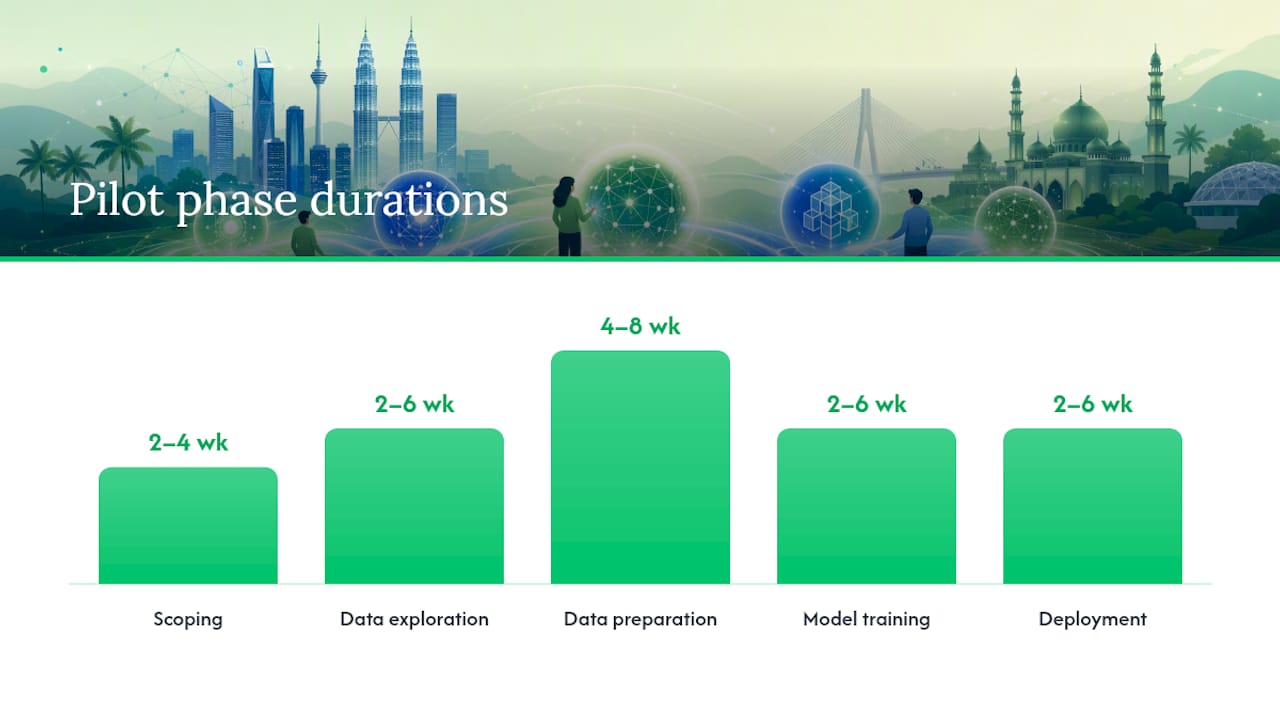
Problem framing and scoping: two to four weeks for a pilot; four to eight weeks for an enterprise programme.
Data acquisition and exploration: two to six weeks, depending on data access complexity and the number of sources.
Data preparation and feature engineering: four to eight weeks — consistently the longest phase in calendar time for enterprise projects.
Model development and training: two to six weeks for a pilot; longer for programmes requiring multiple model variants or large-scale compute.
Evaluation and validation: one to three weeks, including stakeholder sign-off.
Deployment and operationalisation: two to six weeks, driven by integration complexity and release management processes.
Monitoring setup and handover: one to two weeks for initial configuration; ongoing as a managed operation.
Primary cost drivers:
Data labelling: manual annotation for supervised learning tasks is expensive and time-consuming; budget for quality-control rounds and inter-annotator agreement checks.
Compute for training: GPU instances for deep learning or large language model fine-tuning can accumulate significant costs during experimentation; set budget alerts.
Integration effort: connecting a model to production systems (CRM, ERP, document management) often costs more than building the model itself.
Compliance and legal: PDPA assessments, data-processing agreements, and legal review of model outputs in regulated use cases add cost that is easy to underestimate.
People: specialist data engineers and MLOps engineers command a premium in the Malaysian market; factor in recruitment or consultancy costs from the outset.
Sample deliverables per phase:
Phase 1: scoping document, use-case feasibility assessment, success metrics register.
Phase 2: data inventory, data-access agreements, EDA report with quality findings.
Phase 3: data pipeline code repository, versioned dataset, feature engineering specification.
Phase 4: experiment log, candidate model artefacts, training reproducibility guide.
Phase 5: validation report, fairness assessment, signed acceptance criteria.
Phase 6: deployment playbook, container image, model registry entry, release notes.
Phase 7: monitoring dashboard specification, alerting runbook, retraining procedure.
As practical ML workflow guides note, enterprise projects require substantially more effort for data governance, integration, and change management than a prototype suggests — a gap that catches teams off guard when they extrapolate from a proof-of-concept timeline.
How does an agile, accountable lifecycle work in practice?
The difference between an AI project that reaches production and one that stalls at prototype stage is rarely the quality of the model. It is the presence or absence of a single accountable party who owns the entire journey.
Sentient Concepts structures delivery around an end-to-end accountability model that removes the handoffs where context and responsibility are typically lost. A single engagement covers strategy and scoping, data readiness assessment, solution engineering, deployment, and managed operations — with the same team maintaining continuity across phases rather than passing work between separate vendors or internal silos.
How the phased delivery model works in practice:
The engagement opens with a structured scoping and AI strategy and roadmap session that produces a scoping document, a prioritised use-case list, and a success metrics register before any data work begins.
Data readiness and diligence follows, assessing source quality, PDPA compliance posture, and integration feasibility — the findings directly shape the data acquisition and preparation plan.
Solution engineering covers model development, evaluation, and deployment, with governance gates at each phase transition and a validation report signed off by the client’s business owner.
Managed AI operations take over post-deployment, covering monitoring, drift detection, retraining, and incident response under a defined SLA.
The Agile AI development lifecycle approach that underpins this model delivers working outputs at the end of each sprint, so stakeholders see progress continuously rather than waiting for a big-reveal deployment.
What actually works in enterprise AI delivery
The most consistent finding across enterprise AI engagements is that the projects which reach production share three characteristics — and they are not the ones most teams focus on.
Clear, business-anchored success metrics set before any data work begins are the single strongest predictor of a project reaching production. Not because they make the model better, but because they give every phase a shared definition of “done.” Without them, evaluation becomes a negotiation, and deployment becomes a political decision rather than a technical one.
Early integration planning is the second. Teams that treat integration as a deployment-phase concern routinely discover, at the point of go-live, that the production system cannot accept the model’s output format, that the latency requirement was never tested, or that the business process the model was designed to support has changed. Integration constraints belong in the scoping document, not the deployment playbook.
Automated monitoring is the third, and it is the one most often deferred. A model without automated drift detection and alerting is not a production system — it is a prototype that happens to be running in production. The cost of a model silently degrading over a significant period before anyone notices is almost always higher than the cost of building the monitoring infrastructure at deployment.
Pro Tip: The most effective defence against scope creep in AI projects is a written, signed definition of the minimum viability performance threshold from Phase 1. When a stakeholder requests a new feature or an expanded use case mid-project, the question is not “can we do this?” but “does this change the threshold we agreed to hit, and if so, what does that cost in time and data?” That framing converts a scope conversation into a trade-off conversation, which is one a PM can manage.
Sentient Concepts covers the full lifecycle, from strategy to managed operations
The gap between a well-run AI project and a poorly run one is not the algorithm. It is the structure around it: clear ownership, phase-level governance, and a team that stays accountable after go-live. Sentient Concepts delivers exactly that for enterprise clients across finance, manufacturing, logistics, and insurance in Malaysia.
The service model maps directly to the lifecycle phases covered in this guide. Strategy and roadmap engagements handle problem framing and use-case prioritisation. Data and platform engineering services build the pipelines and infrastructure that make model development reproducible and production-ready. Custom AI and GenAI solution engineering covers model development through deployment, with governance gates at every phase transition. And managed AI operations take over post-deployment, providing monitoring, drift detection, retraining, and incident response so the model continues to deliver value long after the initial build is complete.
If you are planning an AI project in Malaysia and want a structured, accountable approach from scoping to production, speak with the Sentient Concepts team to map your use case to a delivery plan.
Sources
FAQ
What are the main stages of an AI project lifecycle?
The AI project lifecycle typically runs through seven stages: problem framing and scoping, data acquisition and exploration, data preparation and feature engineering, model development and training, model evaluation and validation, deployment and operationalisation, and monitoring with continuous improvement. The process is iterative — teams regularly revisit earlier stages as production data reveals new constraints.
What is the difference between data drift and concept drift?
Data drift occurs when the statistical distribution of input features changes after deployment, meaning the model receives data that looks different from its training set. Concept drift occurs when the underlying relationship between inputs and the correct output changes, so the model’s predictions become less accurate even if the input data looks similar.
How long does a typical AI project take from scoping to production?
A medium-complexity pilot typically takes four to six months from scoping to initial deployment, with data preparation and integration consuming the most calendar time. Enterprise programmes with multiple use cases and complex data integration commonly run twelve months or longer.
What does Malaysia’s PDPA require for AI projects?
Under Malaysia’s Personal Data Protection Act, any AI project processing personal data requires a lawful basis for that processing, specific consent for the AI use case, and data-processing agreements with third-party vendors. Cross-border data transfers must meet the Act’s transfer restrictions, which should be assessed with legal counsel before data acquisition begins.
When should a project manager engage an external AI consultancy?
Engaging an external consultancy is most valuable when the internal team lacks MLOps or data engineering capability, when the use case involves regulated data requiring compliance expertise, or when the organisation needs a structured lifecycle framework rather than ad hoc experimentation. Sentient Concepts provides end-to-end engagement covering strategy through managed operations, which is particularly suited to Malaysian enterprises running their first or second production AI system.
Recommended