AI readiness assessment: a practical guide for UK organisations

What is an AI readiness assessment, and why does it matter?
An AI readiness assessment is a structured evaluation of an organisation’s capacity to adopt and implement AI technologies effectively across multiple dimensions. It examines strategy, data quality, technology infrastructure, governance, talent, and culture, producing a clear picture of where the organisation stands and what must change before AI investment can deliver returns.
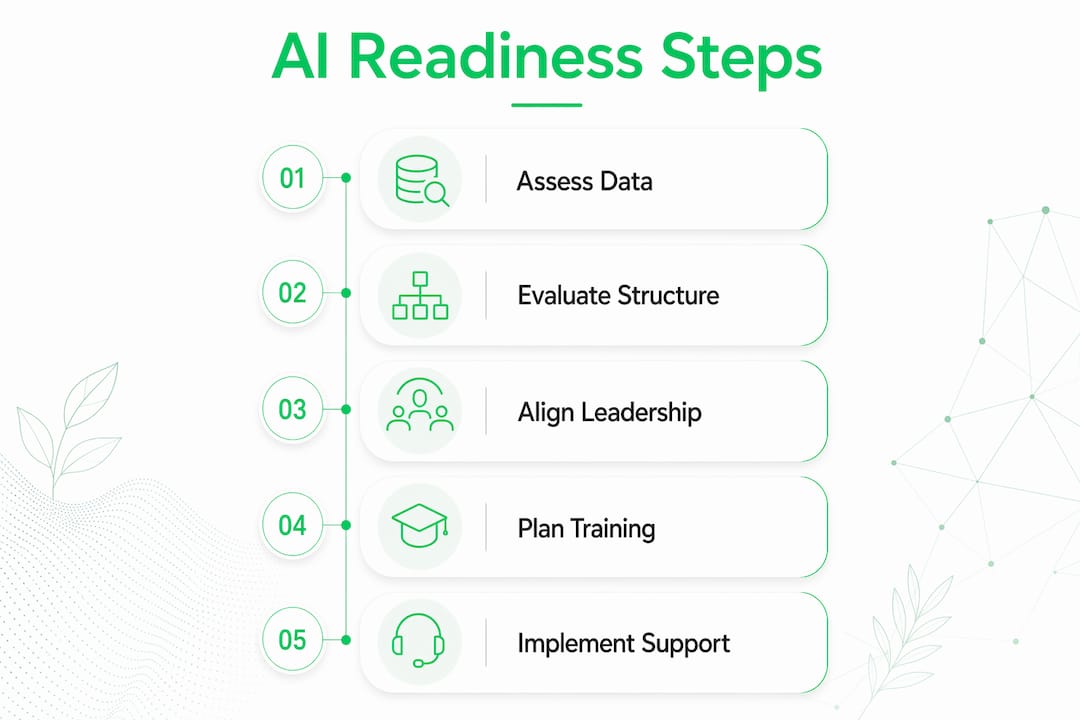
For UK organisations, the stakes are concrete. Gartner reports that through 2026, 60% of AI projects will be abandoned primarily due to lack of AI-ready data, not model quality, not team skill, and not technology immaturity. That figure reframes the entire conversation: the bottleneck is almost never the AI itself.
A well-executed assessment addresses the following before any implementation begins:
Whether organisational data is findable, accessible, structured, fresh, and permitted for AI use
Whether leadership has aligned on a clear AI strategy with measurable business objectives
Whether governance frameworks meet UK regulatory standards, including the UK AI Safety Institute’s guidance and GDPR obligations
Whether the workforce has the skills and cultural readiness to work alongside AI systems
Whether technology infrastructure can support the computational and integration demands of AI deployment
Skipping this evaluation does not save time. It transfers the cost of unpreparedness to the implementation phase, where it compounds.
Table of Contents
What do effective AI readiness assessments actually cover?
The most effective assessments evaluate six interconnected pillars rather than treating data or technology in isolation. Each pillar carries its own criteria, and weakness in one can undermine strength in another.
Strategy alignment: Does the AI initiative connect to specific business outcomes, with executive sponsorship and defined success metrics?
Data readiness for AI: AI-ready data differs fundamentally from traditionally well-managed data. It must represent patterns, outliers, and emergent phenomena needed to train or run a model reliably. Standard data quality metrics are insufficient on their own.
Technology infrastructure: Can existing systems support model training, inference, and integration at the required scale and latency?
Governance and compliance: Are model monitoring, bias detection, and human escalation paths in place? Over 40% of AI agent initiatives risk abandonment without proper governance frameworks.
Talent and skills: Does the organisation have data scientists, ML engineers, and domain experts, or a credible plan to acquire them?
Culture and change readiness: Will teams adopt AI-assisted workflows, or will resistance erode the investment?
Assessments that produce a maturity score against each pillar, rather than a single overall rating, give decision-makers the granularity to prioritise remediation efforts where they will have the greatest impact. Scoring systems aligned to industry and organisation size, such as the approach used in AI readiness diagnostics, make that prioritisation defensible rather than intuitive.
Why UK organisations gain a measurable advantage from this process
Conducting a thorough assessment before committing capital to AI implementation produces advantages that go well beyond risk avoidance.
Reduced project failure risk: Identifying data and governance gaps upfront prevents the pattern where pilots produce unreliable outputs, teams lose confidence, and projects are quietly shelved.
Stronger ROI alignment: 97% of leading AI adopters have clear, measurable use-case definitions guiding their investments. Organisations that sequence use cases by value and feasibility consistently outperform those that greenlight projects without this discipline.
Regulatory confidence: UK organisations operate under GDPR, the UK AI Safety Institute’s voluntary frameworks, and sector-specific obligations in finance and healthcare. An assessment maps compliance gaps before they become enforcement risks.
Cost control: Knowing which data systems require remediation before signing a vendor contract prevents expensive mid-project pivots.
Cultural preparedness: Assessing change readiness early allows leadership to design communication and training programmes that reduce resistance rather than react to it.
The assessment also surfaces the organisational bottlenecks that technology cannot fix. Most readiness gaps are structural: unclear ownership, fragmented data stewardship, or absent executive sponsorship. Identifying these early is the difference between a pilot that scales and one that stalls.
How to structure your AI readiness framework

A practical framework for UK organisations covers six assessment pillars, each with defined criteria and scoring thresholds.
Pro Tip: Treat your framework as a diagnostic instrument, not a checklist. The goal is to surface the two or three constraints that will most limit AI performance, then sequence remediation around those.
Strategy pillar: Assess whether AI use cases are tied to measurable business outcomes, whether investment sequencing is defined, and whether the board has been briefed and has approved resource allocation.
Data readiness pillar: Apply DRAI metrics covering timeliness, volume, completeness, feature relevance, class balance, and fairness. Standard quality checks miss AI-specific requirements such as labelled training data and bias exposure. Evaluate data against the five-level readiness pyramid: basic hygiene, integration, labelling, governance, and observability.
Infrastructure pillar: Evaluate compute capacity, API connectivity, data pipeline latency, and the ability to support MLOps practices including model versioning and continuous regression testing.
Governance pillar: Map existing data stewardship policies against AI-specific requirements: model access controls, audit trails, bias testing protocols, and compliance with the EU AI Act where applicable to UK organisations with EU operations.
Talent pillar: Identify skill gaps across data science, ML engineering, and domain expertise. Assess whether hybrid skills combining data science and regulatory awareness exist or can be developed within a realistic timeframe.
Culture pillar: Survey leadership alignment, middle-management buy-in, and frontline attitudes toward AI-assisted workflows. Culture assessments often reveal the most consequential gaps. You can explore AI maturity evaluation approaches that connect these pillars to a coherent digital transformation strategy.
Planning, training, and migration steps before implementation
Preparation is where most organisations underinvest. The assessment findings should feed directly into a structured preparation plan with defined ownership and timelines.
Secure executive sponsorship: AI initiatives without board-level commitment rarely survive the first setback. Sponsorship must be active, not nominal.
Define measurable milestones: Set specific goals at 30, 60, and 90 days covering data remediation, infrastructure readiness, and pilot scope. Vague objectives produce vague accountability.
Upskill the workforce: Training programmes should address both technical skills and the practical realities of working alongside AI systems. Staff who understand how a model reaches its outputs are more likely to trust and use them correctly.
Design a phased migration: Connecting AI tools to live systems before data pipelines are stable creates compounding errors. A phased approach, starting with read-only capabilities such as analysis and insight generation, reduces disruption while building confidence.
Clarify data ownership: Organisational weaknesses in AI readiness most often stem from unclear ownership rather than technology gaps. Assign named data stewards to each key data domain before any vendor contract is signed.
Prepare your data foundation: Data readiness does not mean perfect data. It means data that is findable, accessible, structured, fresh, and permitted for AI use. Most teams discover weaknesses on one or two of these dimensions, which is usually enough to stall a pilot.
For organisations in finance or manufacturing, understanding how agentic AI enters workflows before implementation begins is particularly relevant to this planning stage.
Quality assurance, security, and ongoing support after deployment
Deployment is not the finish line. AI systems degrade when the data they depend on changes and nobody notices. Sustaining performance requires deliberate post-deployment practices.
Continuous performance testing: Establish baseline performance metrics at launch and run continuous regression tests to detect model drift. A model that performed well at go-live may produce unreliable outputs six months later if input data patterns shift.
Security protocols for AI systems: AI introduces specific attack surfaces including adversarial inputs, data poisoning, and model inversion. Security testing must address these alongside conventional penetration testing.
Bias monitoring: Deploy monitoring tools that flag distributional shifts in model outputs across demographic or operational segments. Bias that was absent at training can emerge as real-world data evolves.
Human escalation paths: Define the conditions under which AI outputs are reviewed by a human before action is taken. This is both a governance requirement and a practical safeguard against compounding errors.
Change management: Technology adoption without cultural support degrades over time. Regular communication, feedback loops, and visible leadership engagement sustain adoption beyond the initial launch period.
Quarterly reassessments: AI readiness should be treated as a dynamic, recurring process. Regulatory landscapes, data environments, and AI capabilities all evolve. A quarterly check-in against the original assessment framework identifies emerging gaps before they become project risks.
Accessibility considerations in AI-facing interfaces also warrant attention as part of ongoing quality assurance. Common accessibility oversights in digital deployments can affect compliance and user adoption in ways that are easy to overlook until they become problems.
Advanced challenges and best practices for UK enterprises

Beyond the foundational pillars, UK enterprises face a set of challenges that standard frameworks do not fully address.
Data silos are the most common structural obstacle. When customer records, operational data, and financial data live in separate systems with no integration layer, even a well-governed dataset cannot support cross-functional AI use cases. Resolving this requires both technical integration work and organisational agreement on a single source of truth for each key data type.
Gartner finds that through 2026, 60% of AI projects will be abandoned due to lack of AI-ready data, making data readiness the single most consequential factor in AI project success.
AI readiness is also a dynamic state, not a fixed score. An organisation that passes its initial assessment may find itself unprepared twelve months later as regulatory requirements tighten or data volumes shift. Building observability into data pipelines, so that quality drops are detected before models degrade, is what separates organisations that sustain AI value from those whose pilots quietly deteriorate.
Leadership alignment deserves more attention than it typically receives in readiness frameworks. Organisations where the board understands AI’s data dependencies and governance requirements make better investment decisions and respond more effectively when problems arise. The AI strategy and roadmap work that precedes implementation is where this alignment is built, not assumed.
Finally, investment sequencing matters. Starting with the use case that fits your strongest data, rather than the use case you most want to pursue, produces early wins that build organisational confidence and generate the labelled data needed for more complex capabilities later.
Key takeaways
A successful AI readiness assessment addresses data governance, organisational structure, and leadership alignment before any implementation begins, making it the most consequential investment a UK organisation can make ahead of AI adoption.
Point | Details |
Data readiness is the primary risk | 60% of AI projects through 2026 will be abandoned due to poor data readiness, not model or technology failure. |
Six pillars structure the assessment | Strategy, data, infrastructure, governance, talent, and culture must each be scored to identify the constraints that matter most. |
Organisational gaps outweigh technical ones | Unclear ownership and absent executive sponsorship cause more AI failures than technology limitations. |
Readiness is dynamic, not a one-time score | Quarterly reassessments keep governance, data quality, and regulatory compliance aligned as environments evolve. |
Sentientconcepts covers the full lifecycle | Sentientconcepts delivers readiness and data diligence through to managed AI operations, maintaining accountability across every stage without handoffs. |
Sentientconcepts: from readiness assessment to working AI
Most organisations that commission an AI readiness assessment face the same problem afterwards: a detailed gap analysis and no clear path to closing it. Sentientconcepts is built specifically to close that gap. As an end-to-end AI firm, Sentientconcepts takes organisations from initial readiness and data diligence through strategy, engineering, deployment, and ongoing managed operations, without the handoffs between separate agencies that typically erode accountability and delay results.
For UK enterprises in finance, manufacturing, logistics, and insurance, Sentientconcepts has delivered measurable operational cost reductions through document process automation, conversational agents, and predictive analytics, each grounded in the kind of data and governance work that readiness assessments reveal as necessary. The difference is that Sentientconcepts does not stop at the report. If your assessment has identified gaps in data infrastructure, AI strategy, or operational readiness, the practical next step is a conversation with the Sentientconcepts team. Reach out via the AI strategy and roadmap service to define what implementation actually requires for your organisation.
Recommended