Build vs buy AI: the enterprise decision guide
For most UK enterprises, the right default in 2026 is to buy or boost a pre-built AI platform rather than build from scratch, unless you can articulate a clear proprietary moat in a single sentence before writing a line of code.
Two structural realities shape this verdict:
Foundation models from providers such as OpenAI, Anthropic, and Google Cloud have commoditised the base-model layer, making custom training economically irrational for the vast majority of enterprise use cases.
UK GDPR and sector-specific regulations (FCA, NHS Digital, ICO guidance) impose data-residency and governance obligations that affect how you buy or build, not whether you should avoid AI altogether.
The primary rationale is straightforward. Buying delivers working capability in weeks rather than months, at a fraction of the capital outlay. Building only pays when your organisation holds proprietary data, has an 18-month runway to establish defensible feedback loops, and can articulate a competitive advantage that no vendor can replicate. For everything else, the cost compounds without a corresponding return.
Three immediate actions for any executive reading this:
Run the 60-second decision path in the next section before any further investment discussion.
Assess your AI maturity to understand whether your data and team are ready for a build commitment.
Schedule the 6-step evaluation workshop within the next five working days.
Table of Contents
Should you build or buy AI? A 60-second decision path
This decision path is designed to be run mentally, on a whiteboard, or on a single slide. Work through the steps in order and stop at the first definitive answer.
Can you state your competitive moat in one sentence? If the answer is no, or if the moat is simply “we will use a better model,” stop here. Buy or boost a vendor solution.
Do you hold proprietary data that no vendor can access or replicate? If yes, continue. If no, the differentiation argument for building collapses.
Does a regulatory or data-residency requirement prevent you from sending data to a third-party API? If yes, self-hosting a pre-built open model is usually the answer, not training a foundation model from scratch.
Is your time-to-market window longer than 12 months? If no, buy. A build programme rarely reaches production-grade quality in under a year.
Do you have, or can you hire, the engineering and ML operations capability to maintain a custom system for at least three years? If no, buy. Maintenance debt accumulates faster than most executives anticipate.
Branch outcomes:
Buy: Steps 1, 2, or 4 resolved negatively. Prioritise vendor evaluation, SLA negotiation, and a boosting strategy using retrieval-augmented generation (RAG).
Hybrid (buy-to-build): Steps 1 and 2 resolved positively but step 5 is marginal. Buy the foundation, build the application layer and proprietary feedback loops on top.
Build: All five steps resolved positively. Proceed to the 6-step evaluation workshop and define your pilot criteria before committing budget.
Pro Tip: The moat test is the single most clarifying question in the entire decision. Write the sentence on a whiteboard before the meeting ends. If the room cannot agree on it in five minutes, the organisation is not ready to build.
Why the build vs buy AI decision changed in 2026
The economics of AI shifted more dramatically between 2022 and 2026 than in any comparable four-year period in enterprise software history. The decision is structurally different now, and applying the old build/buy logic from the ERP or CRM era will produce the wrong answer.
The most consequential change is that the base model is no longer a source of competitive advantage for most organisations. API pricing has fallen significantly since 2022, which means that the cost of accessing frontier-grade intelligence through a vendor API is now much lower relative to the engineering cost of replicating it. The implication: differentiation lives at the application and distribution layers, not in the weights of a model.
Several structural shifts define the current environment:
Foundation-model economics: Training a frontier model costs between $100 million and $1 billion, a research bet reserved for well-capitalised labs and sovereign AI projects. Enterprises that attempt it without that capital base will be outcompeted before they reach production.
API commoditisation: OpenAI, Anthropic, and Google Cloud all offer enterprise-grade APIs with SLAs, data-processing agreements, and UK data-residency options. The switching cost between them has fallen as abstraction layers mature.
RAG as the default: For the majority of use cases, prompt engineering combined with retrieval-augmented generation often outperforms full fine-tuning on cost, latency, and maintenance burden. Fine-tuning is no longer the obvious path to relevance.
Multi-provider abstractions: Frameworks such as LangChain, LlamaIndex, and vendor-agnostic orchestration layers allow organisations to swap underlying models without rewriting application logic, reducing lock-in risk materially.
Agent tooling: SDKs such as Google’s Agent Development Kit (ADK) have lowered the engineering barrier for building reliable production agents, making application-layer builds more accessible than they were 18 months ago.
For UK enterprises specifically, two regulatory factors add further weight to the buy-or-boost default. The ICO’s guidance on AI and data protection requires documented lawful bases for processing, and several FCA-regulated firms face additional constraints on where model inference can occur. These requirements affect procurement clauses and data-residency choices, but they do not, in most cases, require building a model from scratch.
The UN’s Independent International Scientific Panel on AI noted that compute infrastructure, evaluation expertise, and data are concentrated where AI is built, leaving most organisations dependent on systems they cannot fully inspect or adapt. That dependency is manageable with the right procurement and governance approach; it is not a reason to attempt a frontier build.
How to run the 6-step evaluation workshop this week
Run this workshop to convert opinion-based AI investment discussions into evidence-based decisions in two to three days. It produces a scored recommendation, not a slide deck of possibilities.
Catalogue use cases. List every proposed AI use case. Assign each a one-sentence description of the expected business outcome and the data it requires.
Map critical vs commodity features. For each use case, ask: does this capability appear in a vendor product today? If yes, it is commodity. If the capability requires your proprietary data or workflow logic to function, it is a candidate for building.
Assess data readiness. Score each use case on data availability (0–3), data quality (0–3), and data governance maturity (0–3). A total below 5 out of 9 is a build risk flag.
Map compliance constraints. Identify UK GDPR obligations, sector-specific rules (FCA, NHS, ICO), and data-residency requirements for each use case. Flag any that prohibit third-party API processing.
Estimate cost and time-to-value. For each use case, produce a rough-order-of-magnitude estimate for buy (vendor licence + integration) vs build (engineering, infrastructure, MLOps, governance). Include a 12-month and 36-month total cost of ownership view.
Define pilot criteria. Agree on a measurable success threshold for a 90-day pilot: a specific accuracy target, a cost-per-transaction reduction, or a manual-effort reduction percentage.
Workshop scorecard
Dimension | Score (0–3) | Weight | Weighted score |
Proprietary data advantage | 0–3 | ×3 | Max 9 |
Regulatory / residency constraint | 0–3 | ×2 | Max 6 |
Time-to-market pressure | 0–3 (3 = urgent) | ×2 | Max 6 |
Engineering capability | 0–3 | ×2 | Max 6 |
Long-term feedback loop potential | 0–3 | ×2 | Max 6 |
Vendor solution maturity | 0–3 (3 = mature) | ×1 | Max 3 |
Score interpretation: 28–36 points suggests a strong build case. 18–27 points suggests a hybrid approach. Below 18 points, buy or boost.
Stakeholder interview prompts:
“What data does this system need that no vendor holds?” (reveals moat)
“Who owns the model in production, and who fixes it when it degrades?” (reveals operational burden)
“What happens if the vendor changes the model or discontinues the API?” (reveals lock-in tolerance)
“What is the compliance team’s position on data leaving UK infrastructure?” (reveals residency constraints)
A score below 18 with no compliance constraint is a clear buy signal. A score above 28 with strong data readiness and an 18-month runway is a defensible build case. Everything in between is hybrid territory, and the pilot criteria from step 6 become the deciding gate.
When does building your own AI actually make sense?
Build when you can state, in a single sentence, a proprietary competitive advantage that depends on data or workflow logic no vendor can replicate. Without that sentence, the investment case does not hold.
Concrete criteria that justify a build commitment:
You hold a proprietary dataset accumulated over years that is not available to any vendor or competitor.
Your use case generates a continuous feedback loop (user actions, outcomes, corrections) that will compound model quality over time, creating a widening advantage.
Regulatory or data-residency requirements prohibit sending the relevant data to any third-party API, and a self-hosted open model does not meet your performance requirements.
The AI capability is a core product feature that customers pay for directly, making IP ownership commercially material.
Your distribution advantage means even a marginally better model, trained on your data, will reach users faster than any vendor equivalent.
Red flags that suggest building will fail or be overpriced:
The team cannot name the proprietary data asset that will differentiate the model.
The runway is under 12 months. Defensible feedback loops typically require an 18-month horizon to establish.
The differentiation argument is “we will use a better model” rather than “we will train on data no one else has.”
There is no dedicated ML engineering team, and the plan is to hire one after the budget is approved.
The use case is a commodity workflow (document summarisation, meeting transcription, basic classification) that multiple vendors already solve at production quality.
“If the competitive advantage is just the model, the project will likely be outcompeted by well-funded labs. Successful builds rely on defensible feedback loops.” — Gradient, 2026.
Operationally, a genuine build commitment requires a cross-functional team: ML engineers, data engineers, a product owner with domain expertise, an MLOps function, and a governance lead. The minimum viable team for a production build is typically five to eight people, and the first production-grade system rarely ships in under nine months. Factor that timeline and headcount into the cost model before the board approves the programme.

When buying AI is the rational choice for UK enterprises
Buy when speed, predictability, and low maintenance burden matter more than product differentiation. For the majority of enterprise AI use cases, that is the correct starting position.
MIT Sloan’s framework categorises the options as buy, boost, and build, and is explicit that buying is faster to market while boosting (adding proprietary data to a vendor solution) increases relevance without requiring a full build commitment. Most UK enterprises will find their first two or three AI use cases sit firmly in the buy or boost category.
Scenarios where buying is the right call:
The capability is a commodity feature (summarisation, classification, translation, code assistance) that multiple mature vendors already offer.
Time-to-market pressure is acute and a vendor solution can be live within weeks.
The organisation lacks proprietary data that would meaningfully improve on a vendor baseline.
Engineering capacity is constrained and the team cannot sustain a build programme alongside existing delivery commitments.
The use case has predictable, stable scale requirements that a vendor SLA can cover.
Enterprise procurement checklist for buying AI:
Confirm data-residency options and whether UK or EEA processing is available and contractually guaranteed.
Require a data-processing agreement (DPA) compliant with UK GDPR, including clear data-deletion provisions.
Negotiate model-change notification clauses: the vendor must give advance notice before deprecating or materially altering the model your workflows depend on.
Define exit terms: data portability, API deprecation notice periods, and the right to export any fine-tuned weights or embeddings you have created.
Agree security assurances: SOC 2 Type II, ISO 27001, or equivalent, and confirm whether your data is used for vendor model training.
Establish SLAs for latency, uptime, and support response times that match your operational requirements.
Boosting a vendor solution with proprietary data via RAG is often the most cost-effective middle path. It adds domain relevance without the maintenance overhead of fine-tuning, and for roughly 90% of use cases, RAG outperforms fine-tuning on cost, latency, and maintenance. Fine-tuning carries its own cost implications: compute bills, re-training cycles when the base model updates, and the governance overhead of managing a custom model version.
What do practical hybrid AI architectures look like?
Hybrid patterns are the pragmatic default for many enterprises, particularly those with a mix of commodity and proprietary use cases. The goal is to buy speed and reliability at the foundation layer while building differentiation at the application layer, where proprietary data and workflow logic actually live.
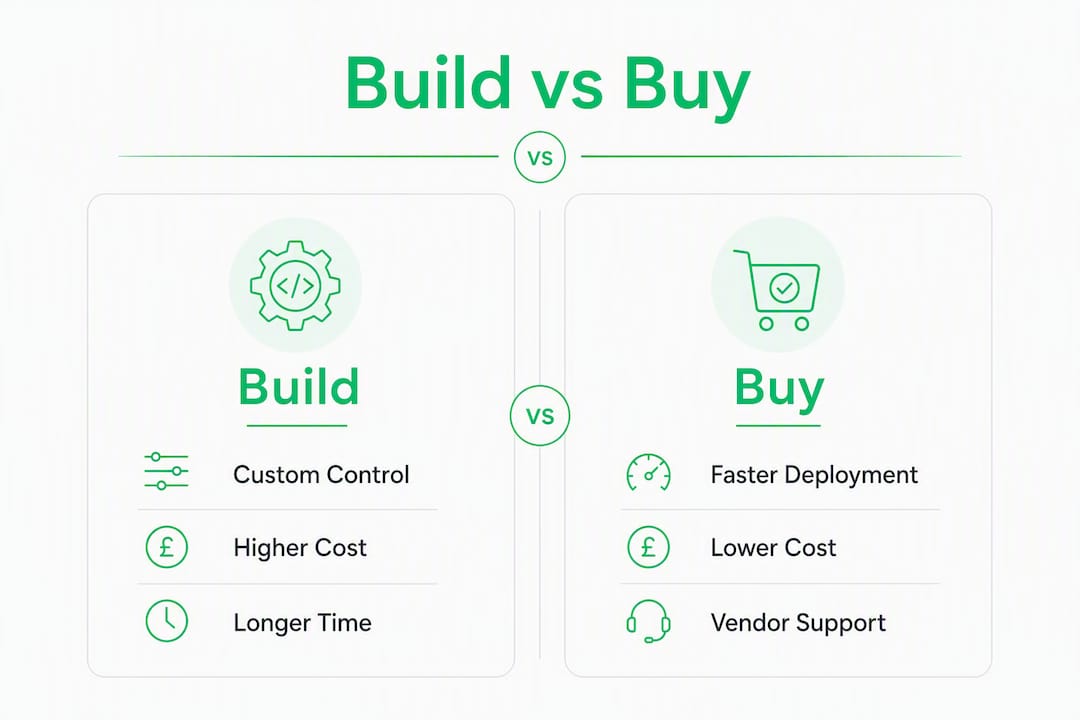
Three repeatable hybrid patterns:
Buy and boost. Use a vendor API (OpenAI, Anthropic, Google Cloud) as the inference engine. Layer proprietary data retrieval via RAG on top. The application logic, prompt engineering, and retrieval pipeline are owned by the enterprise. This pattern delivers vendor-grade model quality with domain-specific relevance, and the switching cost between underlying models remains low because the application layer is decoupled from the model weights.
Buy-as-foundation, build application layer. The enterprise licences a foundation model or platform (for example, Azure OpenAI Service or Google Vertex AI) and builds the product experience, orchestration logic, and feedback collection on top. Agent frameworks such as Google’s ADK accelerate the scaffolding of production-grade agentic workflows. The proprietary moat lives in the application layer and the feedback data it accumulates, not in the model itself.
Self-hosted model for regulated workloads. For use cases where data cannot leave UK infrastructure (certain FCA-regulated processes, NHS patient data, defence-adjacent workflows), the enterprise deploys an open model (Llama, Mistral, or similar) on its own infrastructure or a UK-region cloud instance. This preserves data residency without the cost of training a frontier model from scratch.
Operating model considerations for hybrid approaches:
Assign clear ownership of the model evaluation function. Someone must run automated evaluations on every vendor model update to detect silent performance degradation.
Define a multi-provider strategy from day one. Abstraction layers that decouple application logic from a specific vendor API reduce lock-in and give the organisation negotiating leverage at renewal.
Set a migration trigger: agree in advance on the conditions (cost threshold, performance degradation, vendor risk event) that would prompt a move from buy to build or from one vendor to another.
Establish an evaluation cadence: quarterly model performance reviews are a minimum; monthly is preferable for customer-facing systems.
Pro Tip: Run parallel pilots on two vendor solutions for the first 90 days before committing to a single provider. The cost of running two pilots is modest relative to the cost of a poorly negotiated three-year contract. Parallel pilots also produce the comparative data you need to negotiate SLAs with confidence.
For a deeper view of how agentic AI fits into enterprise workflows before committing to a hybrid build, the operational considerations are worth reviewing before the architecture is finalised.
How an end-to-end delivery partner reduces risk across the lifecycle
An end-to-end AI partner reduces the risk of the build/buy/hybrid decision by maintaining accountability from initial evaluation through to managed operations, eliminating the handoff gaps where most enterprise AI programmes stall or fail.
The most common failure mode is not a bad technology choice. It is a governance gap between the team that evaluated the vendor, the team that integrated it, and the team that is supposed to maintain it 18 months later. A partner that owns the full lifecycle closes that gap structurally.
Operational checklist for a credible delivery partner:
Conducts a structured data-readiness and AI-maturity assessment before recommending a path.
Produces a scored build/buy/hybrid recommendation with documented rationale, not a vendor preference.
Manages vendor procurement, DPA negotiation, and SLA review on behalf of the enterprise.
Delivers integration and architecture work that decouples application logic from specific vendor APIs.
Establishes MLOps pipelines, monitoring dashboards, and automated model-evaluation runs from day one of production.
Provides managed operations with defined SLAs for model performance, incident response, and periodic optimisation reviews.
Documents handover materials so the enterprise can take ownership of the system at any point.
Measurable outcomes from well-structured engagements:
Reduction in manual document-processing effort, typically measured as a percentage of FTE time reclaimed per process.
Reduction in total cost of ownership at the 24-month mark compared to the pre-AI baseline.
Time from pilot approval to production deployment, measured in weeks rather than quarters.
Model accuracy and drift metrics tracked continuously, with agreed remediation thresholds.
“The organisations that get the most value from AI are not the ones that built the most; they are the ones that governed the most carefully and iterated the fastest.” — Sentient Concepts delivery experience
ROI validation in live engagements requires pre-agreed baselines. Before any pilot begins, document the current cost per transaction, the error rate, and the manual effort in hours per week. Without that baseline, the post-deployment ROI claim is an estimate, not a measurement.
How to estimate AI cost, time-to-value, and the 30% rule
Estimate total cost of ownership across a 36-month horizon before committing to any path. The 30% rule, as applied in enterprise AI decisions, is a useful heuristic: if the ongoing operational cost of a built system (maintenance, monitoring, personnel, re-training) exceeds 30% of the original build cost per year, the TCO case for building weakens materially relative to a vendor subscription.
Cost estimation template
Cost category | Buy (year 1) | Build (year 1) | Build (year 3 cumulative) |
Upfront development / integration | Low to moderate | High | High |
Infrastructure (compute, storage) | Included in licence | Separate | Separate + scaling |
Model usage / API fees | Per-call or subscription | Self-managed | Self-managed |
Maintenance and updates | Vendor-managed | Internal team | Internal team |
Governance and compliance | Shared with vendor | Full internal burden | Full internal burden |
Personnel (ML, MLOps, data) | Integration team only | Full ML team | Full ML team + retention |
Exit / migration costs | Moderate (data portability) | Low (you own it) | Low (you own it) |
Worked illustrative example. A UK financial services firm evaluating an AI document-processing use case estimates a vendor buy-and-boost solution at approximately £150,000 in year-one integration and licence costs, with ongoing costs of roughly £60,000 per year for licences, monitoring, and a part-time integration resource. A build programme for the same capability, requiring a team of six engineers over nine months, carries a year-one cost well above £500,000 before infrastructure and governance overhead. At the 36-month mark, the build option may achieve lower per-transaction costs if volume is high enough, but for most enterprise use cases the break-even point rarely arrives before month 30. AI implementation costs are immediate while benefits accrue over time, which is why the 36-month TCO view is more honest than a year-one comparison.
Hidden costs that most enterprise budgets omit:
Model deprecation: the cost of re-integrating or re-training when a vendor deprecates a model version or when an open model you self-host is superseded.
Evaluation infrastructure: automated model-evaluation pipelines are not free to build or run, and they are non-negotiable for production systems.
Monitoring and observability: logging, alerting, and drift detection for a production AI system add meaningful ongoing cost.
Personnel continuity: ML engineers and data scientists carry a premium salary and high attrition risk; factor in recruitment and knowledge-transfer costs.
Exit costs: migrating from a vendor API to a self-hosted or alternative solution requires engineering time and a parallel-running period.
Training large frontier models costs between $100 million and $1 billion, which is why the build decision for most enterprises should target the application layer, not the model layer. The economics of building at the application layer are far more favourable, particularly when the foundation model is accessed via a vendor API.
Governance, security, and UK regulatory requirements
UK GDPR is the baseline governance requirement for every AI system that processes personal data, and it affects the build vs buy decision in concrete ways: it determines which vendors you can use, where data can be processed, and what contractual protections you must have in place before going live.
UK-specific considerations for every AI procurement or build decision:
UK GDPR and the ICO: Any AI system processing personal data requires a documented lawful basis, a data-protection impact assessment (DPIA) for high-risk processing, and compliance with data-subject rights. Vendor DPAs must reflect UK GDPR requirements, not just EU GDPR.
Data residency and cross-border transfers: Post-Brexit, transfers of personal data to non-UK countries require an adequacy decision, standard contractual clauses (SCCs), or another approved transfer mechanism. Confirm whether your vendor’s UK-region processing option is contractually binding, not just a default setting.
Sector-specific rules: FCA-regulated firms must consider operational resilience requirements and third-party risk management obligations. NHS organisations processing patient data face additional constraints under the Data Security and Protection Toolkit. Insurance firms must consider Solvency II model-risk governance requirements.
Procurement constraints: Central government and many public-sector bodies must follow the Procurement Act 2023 and associated AI procurement guidance from the Government Digital Service (GDS).
Procurement clauses to require from any AI vendor:
Data-use restrictions: confirm the vendor cannot use your data to train or improve their general models without explicit consent.
Model-change notifications: require a minimum notice period (90 days is a reasonable starting position) before any material model change or deprecation.
Data deletion: specify the timeline and method for data deletion upon contract termination.
Indemnity provisions: clarify liability for IP infringement claims arising from model outputs.
Audit rights: reserve the right to audit the vendor’s data-handling practices or require third-party attestation.
“Regulated workloads in healthcare, defence, and certain finance processes often require self-hosting or strict data-residency approaches. The answer is usually self-hosting a pre-built open model rather than training a foundation model from scratch.” — Gradient, 2026
For built systems, the governance burden falls entirely on the enterprise. That means maintaining model cards, audit logs, bias-monitoring pipelines, and a documented process for responding to model-performance incidents. The AI operating model must define who owns each of these responsibilities before the system goes live, not after the first incident.
What should executives do in the next week and 90 days?
Sign off on a one-week decision sprint this week. The goal is a scored build/buy/hybrid recommendation, not a further round of vendor briefings.
One-week checklist:
Run the 60-second decision path from Section 2 with your CTO and a senior business sponsor. Document the outcome.
Schedule the 6-step evaluation workshop for days 3 to 5. Assign a facilitator and confirm stakeholder availability.
If the decision path points to buy or boost, shortlist two to three vendors and request DPA drafts and data-residency confirmations.
If the decision path points to build or hybrid, commission a data-readiness assessment and a rough-order-of-magnitude cost estimate for a 90-day pilot.
Confirm the compliance team’s position on data residency and third-party API processing for the specific use case.
90-day roadmap:
Days 1–30 (Pilot initiation): Complete vendor selection or architecture design. Agree pilot success criteria, baselines, and governance documentation. Begin integration or build sprint.
Days 31–60 (Pilot execution): Run the pilot in a controlled environment. Collect performance data against agreed baselines. Run parallel vendor comparison if applicable.
Days 61–90 (Evaluation and go/no-go): Score the pilot against success criteria. Produce a TCO comparison at 12 and 36 months. Present a go/no-go recommendation with a migration or scale-up plan.
Decision gates and metrics:
Gate 1 (end of week 1): Scored build/buy/hybrid recommendation with documented rationale.
Gate 2 (end of month 1): Pilot design approved, baselines documented, governance sign-off obtained.
Gate 3 (end of month 3): Pilot results reviewed, TCO model validated, scale-up or exit decision made.
The metric that matters most at Gate 3 is not accuracy in isolation. It is cost per correct output relative to the pre-AI baseline, measured against the volume the system will handle at full production scale.
Key takeaways
For most UK enterprises, buying or boosting a pre-built AI platform is the correct default in 2026, with building reserved for organisations that hold proprietary data, can sustain an 18-month feedback-loop horizon, and can state their competitive moat in a single sentence.
Point | Details |
Default is buy or boost | Most UK enterprises should start with a vendor API and add proprietary data via RAG before considering a build programme. |
Build requires a moat | Only commit to building when you can state a one-sentence proprietary advantage tied to data or workflow logic no vendor can replicate. |
TCO over 36 months | The 30% annual maintenance rule and hidden costs (model deprecation, evaluation, personnel) make build economics unfavourable for most use cases before month 30. |
UK GDPR shapes the choice | Data-residency requirements and sector regulations determine which vendors you can use and when self-hosting a pre-built open model is the right answer. |
Sentient Concepts end-to-end | Sentient Concepts covers strategy, build, integration, and managed operations in a single engagement, eliminating the handoff gaps where most AI programmes stall. |
The case for governance over ambition
There is a persistent temptation in enterprise AI programmes to treat the build decision as a statement of strategic intent. Building feels like commitment; buying feels like dependency. That framing is wrong, and it is expensive.
The organisations that have extracted the most measurable value from AI in the past three years are not the ones that trained the most models. They are the ones that governed the most carefully, iterated the fastest on real user feedback, and kept their options open by avoiding deep lock-in at the model layer. The proprietary moat, when it exists, is almost always in the data and the feedback loop, not in the architecture of the model itself.
The 60-second decision path in this article is not a simplification. It is a forcing function. Most build programmes that fail do so because no one asked the moat question clearly enough, early enough. The answer to “should we build or buy AI?” is almost always “buy first, and earn the right to build later” by accumulating the proprietary data and operational experience that makes a build investment defensible.
One hard-won lesson from delivery experience: the governance conversation should happen before the vendor conversation, not after. Organisations that start with a vendor demo and work backwards to the DPA are the ones that discover, six months into an integration, that their data cannot legally be processed where the vendor runs inference. Start with the compliance constraints, then evaluate the vendors that fit within them.
Sentient Concepts supports your build, buy, or hybrid decision
Organisations that have spent months in vendor evaluation cycles without a clear recommendation understand the cost of an inconclusive process. Sentient Concepts delivers a structured path from decision to production, covering AI strategy and roadmap through to custom AI and GenAI solutions engineering and ongoing managed operations, without the handoffs that typically fragment accountability.
The practical difference is continuity. The team that runs your evaluation workshop is the same team that designs your architecture, delivers your pilot, and monitors your production system. For UK enterprises in finance, manufacturing, logistics, and insurance, that continuity means faster time-to-value and a governance model that holds across the full lifecycle.
Two services that are directly relevant to the decision you are making right now:
AI strategy and roadmap: — a structured engagement that produces a scored build/buy/hybrid recommendation, a data-readiness assessment, and a prioritised use-case roadmap your board can approve.
If you are ready to move from evaluation to action, book a discovery call with the Sentient Concepts team this week.
Useful sources and further reading
The sources below are the most authoritative references for teams running a build/buy/hybrid evaluation or preparing a board-level recommendation.
Buy, boost, or build? Choose your path to generative AI — MIT Sloan: the clearest published framework for categorising the three paths and their trade-offs, with particular depth on the boost option.
Preliminary Report of the Independent International Scientific Panel on AI — United Nations: authoritative international perspective on AI governance, compute concentration, and the risks of dependency on systems organisations cannot inspect or audit.
Advantages and disadvantages of AI — Tableau: a balanced overview of AI benefits and material drawbacks, including maintenance costs and model degradation, useful for TCO planning.
AI maturity assessment — Sentient Concepts: a practical framework for assessing whether your organisation’s data, team, and governance are ready for a build commitment.
AI operating model design — Sentient Concepts: guidance on MLOps, governance, and operational controls for enterprises running AI in production.
FAQ
What is the build vs buy decision in AI?
The build vs buy AI decision is the choice between developing a custom AI system using your own engineering team and data, purchasing a pre-built platform or API from a vendor, or combining both in a hybrid approach. MIT Sloan’s framework adds a third category, “boost,” which means using a vendor solution enhanced with proprietary data via fine-tuning or retrieval.
What is the 30% rule for AI?
The 30% rule is a practical heuristic for assessing build economics: if the annual ongoing cost of maintaining a custom-built AI system (personnel, monitoring, re-training, governance) exceeds 30% of the original build investment per year, the total cost of ownership over 36 months typically makes buying a vendor solution more economical for most enterprise use cases.
What is buy vs build in the age of AI?
In the current environment, the decision has shifted decisively towards buying or boosting for most organisations because foundation-model training costs between $100 million and $1 billion, API pricing has fallen dramatically since 2022, and differentiation now comes from proprietary data and application-layer logic rather than from the model itself. Building is rational only when a clear proprietary moat exists and the organisation can sustain an 18-month feedback-loop horizon.
When should a UK enterprise self-host an AI model?
Self-hosting is appropriate when data-residency requirements under UK GDPR or sector-specific regulations (FCA, NHS) prohibit sending data to a third-party API, and when a self-hosted open model meets the performance requirements of the use case. Gradient’s analysis recommends self-hosting a pre-built open model for regulated workloads rather than training a frontier model from scratch.
How does Sentient Concepts help with the build vs buy decision?
Sentient Concepts runs a structured evaluation workshop that produces a scored build/buy/hybrid recommendation, then delivers the chosen path from architecture and integration through to managed operations, maintaining accountability across the full lifecycle without the handoffs that typically cause enterprise AI programmes to stall.
Recommended