Contact centre automation: the UK enterprise guide
Updated: Sep 6
Contact centre automation is the orchestration of conversational AI, robotic process automation (RPA), and intelligent workflow software to reduce manual handling costs, raise first-contact resolution (FCR), and make agents measurably more effective. The right implementation does not replace your agents; it positions AI as a copilot that handles retrieval, summarisation, and routine triage so that agents focus on complex, high-value interactions. For UK enterprises in finance, manufacturing, logistics, and insurance, the immediate next step is to scope a focused pilot with an end-to-end partner who can take you from strategy through build to managed operations without handing the project off mid-delivery.
Before commissioning that pilot, confirm you have the following components in scope:
Conversational AI and natural language understanding (NLU) for voice and digital channels
Interactive voice response (IVR) and intelligent call routing (ICR/ACD)
Agent copilot: real-time knowledge retrieval, automated call summarisation, and sentiment detection
RPA connectors for back-office tasks (data entry, document retrieval, status updates)
CRM and telephony integration with event-level data capture for measurement
Sentient Concepts delivers each of these layers, from readiness assessment through to managed AI operations, under a single accountability model that eliminates the handoff risk that derails most enterprise programmes.
Table of Contents
What does contact centre automation actually involve technically?
How does automation apply across finance, manufacturing, logistics and insurance?
What are the UK data protection and regulatory requirements?
How do roles and the operating model change with AI as copilot?
What practitioners get wrong about contact centre automation
Sentient Concepts: from readiness assessment to managed operations
What does contact centre automation actually involve technically?
Contact centre automation is best understood as a platform approach rather than a collection of point tools. The architecture combines cloud telephony, machine learning models, API-first integration layers, and decisioning engines that route, respond, and escalate in real time.
The core technical components are:
Conversational AI (NLU/NLG): Interprets customer intent across voice and text channels and generates contextually appropriate responses via virtual agents or chatbot interfaces.
IVR/ACD/ICR: Routes inbound contacts to the right queue, virtual agent, or human agent based on intent, customer history, and predicted outcome.
Agent copilot: Surfaces relevant knowledge articles, compliance scripts, and prior interaction summaries to the agent in real time, then auto-generates after-call notes.
RPA for back-office tasks: Executes structured data entry, document retrieval, and status updates across legacy systems without requiring full API integration.
Analytics and MLOps: Monitors model performance, detects drift, and feeds continuous improvement cycles.
Pro Tip: Prefer API-first modules with documented data contracts over point-to-point integrations. Brittle direct connections between telephony, CRM, and AI models are the single most common cause of failed contact centre programmes at scale.
Which KPIs should you expect automation to move?
Strategic automation can deliver significant cost reductions in contact centre operations when applied across workflow and staffing. The metrics that matter most to enterprise leaders are:
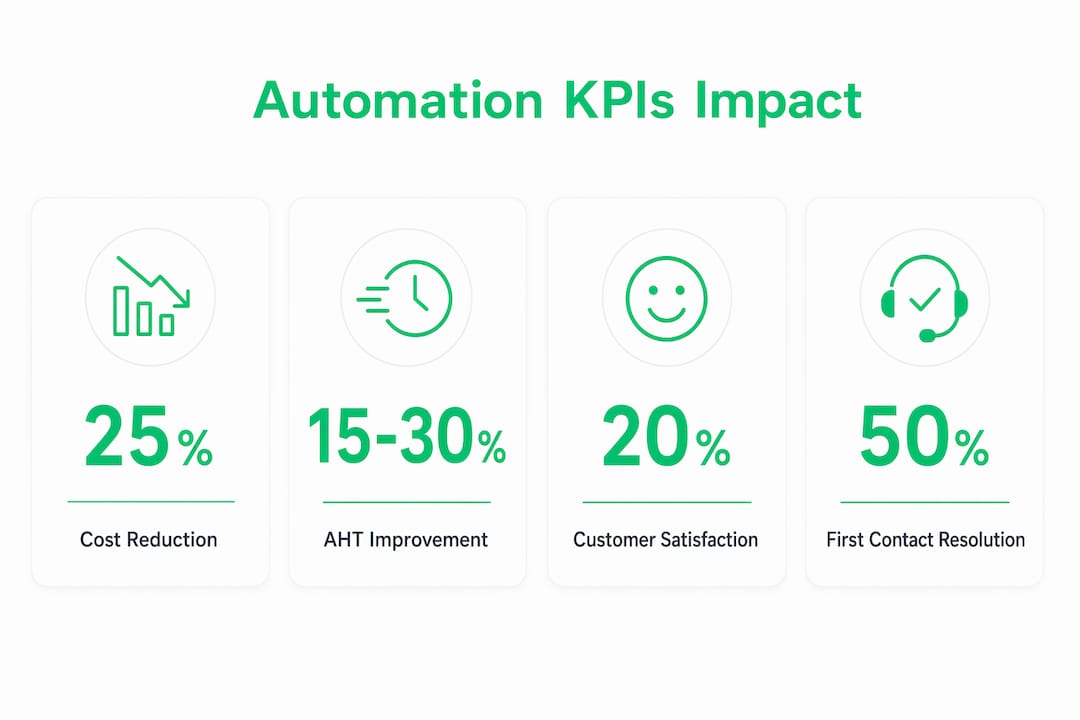
KPI | Typical improvement range | Measurement cadence |
Average handle time (AHT) | measurable reduction | Weekly during pilot |
First contact resolution (FCR) | noticeable improvement | Fortnightly |
After-call work (ACW) | substantial reduction | Weekly |
Cost per contact | meaningful reduction | Monthly |
Agent occupancy | improved occupancy rates | Weekly |
To measure reliably, you need a baseline period of at least four weeks before any automation goes live, event-level data from your cold call tracker telephony and CRM platforms, and a control group of contacts handled without automation. Without a clean baseline, any improvement claim is unverifiable and your business case collapses under scrutiny.
Predictive behavioural routing and conversational AI also improve customer satisfaction scores by matching contacts to the most compatible agent or virtual flow, reducing unnecessary transfers and repeat contacts.
How does automation apply across finance, manufacturing, logistics and insurance?
The value of automation is not uniform across sectors. Each industry has a distinct set of high-volume, low-complexity interactions where AI delivers the fastest return.

Finance: Automated KYC pre-screening reduces the time agents spend collecting and verifying identity documents before a case can progress. Payment dispute triage routes contacts by dispute type and value, reserving human agents for complex or high-value cases. Supplier document automation in banking reduces manual document touches and accelerates processing throughput. The primary metric that moves is AHT, alongside a reduction in compliance risk from inconsistent manual handling.
Manufacturing: Warranty claim intake automation captures structured data at the point of first contact, eliminating re-keying into case management systems. Supplier document processing, tied to field-service scheduling, reduces the lag between a reported fault and a dispatched engineer. The buyer metric here is fewer manual touches per claim and faster mean time to resolution.
Logistics: Shipment status enquiries are among the highest-volume, lowest-complexity contacts in any operation. Automating ETA updates and exception notifications via conversational AI removes these from the agent queue entirely. Returns automation and proactive outbound alerts further reduce inbound contact volume. For supply chain operations, the primary gain is contact deflection rate.
Insurance: Claims intake automation captures first notification of loss data through structured conversational flows, reducing ACW and improving data quality for downstream processing. Agentic AI applied to underwriting reduces repetitive data extraction tasks and accelerates decisioning for routine cases. The metric that moves is claim throughput and underwriting cycle time.
What does a realistic implementation roadmap look like?
A credible programme runs in four phases, each with clear exit criteria before the next begins.
Readiness and use-case prioritisation (4–6 weeks): Audit data sources, telephony architecture, and CRM integration points. Score candidate use cases by volume, complexity, and data availability. Agree success criteria and baseline metrics.
Pilot build and validation (8–12 weeks): Build the minimum viable automation for one or two prioritised use cases. Run in parallel with existing flows. Measure against the agreed baseline using a control group.
Integration and scale (3–9 months): Extend to additional channels, use cases, and back-office connectors. Harden data contracts and API integrations. Conduct user acceptance testing with agents and quality assurance teams.
Run and optimise (ongoing): Monitor model performance, retrain on new interaction data, and manage drift. Govern with regular model evaluation cycles and defined escalation paths.
Pro Tip: Start with agent-copilot pilots that reduce ACW before scaling to fully automated customer-facing flows. Agents who experience a tangible reduction in post-call admin become advocates for broader automation, which accelerates adoption across the programme.
What are the UK data protection and regulatory requirements?
UK GDPR and the Data Protection Act 2018 govern how personal data is processed in contact centre environments. For regulated firms, the FCA’s expectations around record-keeping, audit trails, and fair treatment of customers add a further compliance layer that must be designed into the architecture from the outset, not retrofitted.
Practical controls to build in from day one:
Data classification: Identify which interaction data constitutes personal data or special category data before any model training begins.
Lawful basis and consent: Document the lawful basis for processing under UK GDPR for each automation use case, particularly where AI generates inferences about customer behaviour.
Data residency: Confirm that all model training data, interaction logs, and PII remain within UK or approved jurisdictions. Cloud platform selection must reflect this.
Encryption and access controls: Enforce encryption in transit and at rest, with role-based access controls and full audit logging for all AI-generated outputs.
PII redaction in copilot contexts: Agent copilot systems that surface customer data must apply purpose limitation strictly. Redact PII from training datasets and enforce human-in-the-loop escalation for any AI-generated output that influences a regulated decision.
For enterprises considering agentic AI in regulated workflows, governance frameworks must define clearly where AI can act autonomously and where human authorisation is mandatory.
How do roles and the operating model change with AI as copilot?
AI works most effectively as a copilot that augments agent capability rather than a system that replaces headcount. The operating model shifts accordingly.
Agents move from information retrieval and note-taking to judgement, empathy, and complex problem resolution. AI ops and MLOps engineers take responsibility for model performance, retraining schedules, and incident response. Data stewards govern training data quality and compliance. Business owners define the acceptance criteria for each automation and own the escalation policy.
Change management checklist:
Train agents on copilot tools before go-live, with shadowing sessions that demonstrate real time-saving
Update KPI frameworks to reflect the new division of labour (agents are not penalised for deflected contacts)
Align incentives with quality outcomes, not just volume metrics
Phase supervision: start with full human review of AI outputs, then reduce oversight as confidence builds
Pro Tip: Make copilot suggestions transparent and easy to override. Agents who feel the AI is a tool they control, rather than a system that controls them, adopt it faster and use it more effectively.
How should you evaluate an implementation partner?
The difference between a successful programme and a failed one often comes down to whether the partner can deliver end-to-end, from strategy through build to ongoing operations, without fragmenting accountability across multiple vendors.
Vendor checklist:
End-to-end delivery capability: strategy, data platform engineering, AI build, deployment, and managed operations under one contract
MLOps and run capability: the partner must be able to monitor, retrain, and govern models post-deployment
Data platform skills: integration with legacy telephony, CRM, and back-office systems requires genuine data engineering depth
Sector experience in finance, manufacturing, logistics, or insurance
Demonstrable ROI from prior engagements, not just reference clients
Questions to ask during selection:
How do you handle data contracts between the AI layer and our existing CRM and telephony systems?
What is your SLA for model performance degradation, and how do you detect and respond to drift?
Who owns the programme after go-live, and how is team continuity guaranteed?
Can you show a prior engagement where you measured AHT or FCR improvement against a control group?
Red flags to watch for: a partner who cannot demonstrate data governance practices, has no managed operations capability, or promises full automation without a structured pilot phase is not ready to deliver at enterprise scale.
What does a pilot cost and how do you model the ROI?
Cost components vary by scope, but the primary drivers are integration engineering, data platform work, model operations, and change management. Licence or subscription costs for underlying AI platforms are typically a smaller proportion of total programme cost than the engineering and run layers.
Phase | Typical cost drivers | Expected outcome |
Pilot (8–12 weeks) | Integration engineering, data readiness, model build | Validated AHT/FCR improvement against baseline |
Scale (3–9 months) | Additional integrations, channel expansion, MLOps | Up to around 25% cost-per-contact reduction |
Run (ongoing) | Managed operations, retraining, monitoring | Sustained performance and compliance |
A credible ROI model requires: a documented baseline for AHT, ACW, and cost per contact; an agreed uplift assumption grounded in pilot results; a fully loaded cost of the automation programme including run; and a realistic timeline to break-even that accounts for the integration and change management phases. Assumptions that are not grounded in your own baseline data will not survive board scrutiny.
What proof points support these outcomes?
Sentient Concepts has delivered supplier document automation for banking and finance clients, reducing manual document touches and improving processing throughput. In insurance, agentic AI applied to underwriting workflows has reduced repetitive data extraction tasks and accelerated decisioning for routine cases.
Industry research supports these outcomes. Strategic automation applied across workflow and staffing can deliver significant reductions in contact centre operating costs. Conversational AI and predictive routing, when implemented with clean data and clear escalation paths, consistently improve FCR and reduce unnecessary agent transfers.
Key takeaways
Contact centre automation delivers measurable cost and quality improvements when built on clean data, clear governance, and an end-to-end partner who owns the programme from strategy through to managed operations.
Point | Details |
Start with agent copilot | Reducing ACW and retrieval time builds agent trust and delivers fast, measurable ROI before full automation. |
Baseline before you build | A four-week baseline period for AHT, FCR, and cost per contact is the minimum for a credible business case. |
Data readiness is the critical path | UK GDPR compliance, data residency, and clean CRM integration must be resolved before model training begins. |
Cost reduction is achievable | Strategic automation can deliver up to around 25% reduction in contact centre operating costs. |
Sentient Concepts delivers end-to-end | From readiness assessment through build to managed AI operations, Sentient Concepts maintains accountability across the full programme lifecycle. |
What practitioners get wrong about contact centre automation
The most persistent mistake in enterprise automation programmes is treating the technology decision as the hard part. It is not. The hard part is data readiness, integration architecture, and operating model change, and most programmes that fail do so because a vendor delivered a capable AI model into an environment where the data was not clean, the CRM integration was brittle, or the agents were never genuinely prepared for the shift.
There is also a tendency to over-automate too early. Deploying fully automated customer-facing flows before the underlying models have been validated against your own interaction data is a governance risk and a customer experience risk simultaneously. The copilot-first approach, where AI assists agents rather than replacing them, produces more reliable outcomes in the first twelve months and creates the evidence base needed to justify broader automation investment.
The governance sprint is underused. Before any model goes near a production environment, a focused two-week sprint to define data contracts, escalation policies, and model acceptance criteria will prevent the majority of post-deployment incidents. It is not glamorous work, but it is the work that determines whether the programme survives its first operational quarter.
Sentient Concepts: from readiness assessment to managed operations
For enterprise leaders in finance, manufacturing, logistics, and insurance, the gap between a promising automation pilot and a programme that delivers sustained cost reduction is almost always an accountability gap. Sentient Concepts closes it by owning the full delivery lifecycle: AI strategy and roadmap, data platform engineering, AI and GenAI solutions build, deployment, and managed AI operations post go-live. There are no handoffs between strategy and build, and no separation between the team that designs the system and the team that runs it.
The result is a programme where the ROI model is grounded in your own baseline data, the integration is built to your architecture, and the models are monitored and retrained by the same team that built them. If you are ready to scope a readiness assessment or define the success criteria for a focused pilot, contact Sentient Concepts to begin the conversation.
Useful sources
UK GDPR guidance, ICO: The Information Commissioner’s Office is the primary UK authority on data protection obligations relevant to contact centre AI deployments.
FCA operational resilience guidance: Relevant for regulated firms in finance and insurance building AI into customer-facing operations.
Contact Center Automation: Benefits, Tools and Best Practices, GoTo: Industry overview of automation architecture and the cost reduction evidence base used in this article.
Is AI Making Call Center Agents Better Or Replacing Them?, Forbes: Analysis of the AI-as-copilot model and its impact on agent performance and customer satisfaction.
Is This the Year AI Redefines the Call Centre?, CMSWire: Coverage of predictive routing and conversational AI trends and their effect on FCR and CSAT.
Sentient Concepts: Agentic AI for Underwriting: Case narrative on agentic AI applied to insurance underwriting workflows.
Sentient Concepts: Supplier Document Automation, Banking and Finance: Case study on document processing automation outcomes in financial services.
FAQ
What is contact centre automation?
Contact centre automation is the use of conversational AI, RPA, and intelligent routing to handle routine customer interactions, assist agents in real time, and automate back-office tasks, reducing cost per contact and improving FCR.
How much can automation reduce contact centre costs?
Strategic automation applied across workflow and staffing can deliver up to around 25% reduction in contact centre operating costs, depending on the volume of automatable interactions and the quality of the underlying data.
Should AI replace agents or assist them?
AI works most reliably as a copilot that augments agent capability with real-time knowledge retrieval, automated summarisation, and sentiment detection, rather than as a direct replacement for human agents in complex interactions.
What UK regulations apply to contact centre AI?
UK GDPR and the Data Protection Act 2018 govern personal data processing. For regulated firms, FCA expectations around audit trails, record-keeping, and fair customer treatment must be designed into the architecture from the outset.
How does Sentient Concepts support contact centre automation programmes?
Sentient Concepts delivers end-to-end programmes covering AI strategy, data platform engineering, AI build, deployment, and managed operations, maintaining accountability across the full lifecycle without fragmenting delivery across multiple vendors.
Recommended