Databricks vs Snowflake: the 2026 enterprise decision guide
Databricks wins for engineering and ML workloads; Snowflake wins for SQL-first analytics and managed simplicity. That is the verdict for most UK enterprises, and it holds across the majority of procurement decisions. The practical exception: organisations with mature data teams and mixed workloads often run both, using Databricks to build and Snowflake to serve. Independent analysis confirms this split, with SQL-first analyst teams achieving faster return on investment on Snowflake and engineering- or ML-first teams achieving it on Databricks.
30-second shortlist
Platform | Best for | Compute model | Storage format |
Databricks | Data engineering, ML/MLOps, streaming, lakehouse | Spark clusters + serverless SQL (DBUs) | Delta Lake (native), Iceberg (supported) |
Snowflake | SQL analytics, BI, governed data sharing, analyst teams | Virtual warehouses, serverless (credits) | Iceberg (native), Parquet, internal format |
Both | Mixed enterprise: engineering + analytics at scale | Separate compute per workload | Open formats (Iceberg/Delta) as the bridge |
Quick decision signals
Your primary team writes SQL and uses Tableau or Power BI daily: choose Snowflake.
Your team runs Spark jobs, trains models, or builds streaming pipelines: choose Databricks.
You need to query structured, semi-structured, and unstructured data together without copying it: choose Databricks or a lakehouse pattern.
You want the lowest operational overhead for a pure analytics workload: Snowflake’s managed compute is the simpler path.
You are building a production ML platform with experiment tracking, a feature store, and model serving: Databricks has the more mature native tooling.
Pro Tip: Watch the table format clause in your contract. Choosing a proprietary storage format without an export path is the single most consequential lock-in decision in either procurement. Negotiate open-format access (Delta or Iceberg) before signing.
Key takeaways
Databricks suits engineering and ML workloads; Snowflake suits SQL-first analytics teams, and most large UK enterprises run both on open table formats to avoid lock-in.
Point | Details |
Platform verdict | Databricks for engineering and ML; Snowflake for SQL analytics and managed simplicity. |
Table format matters | Choose Delta Lake or Apache Iceberg from day one to preserve portability across engines and vendors. |
Cost traps | Idle clusters (Databricks) and warehouses without auto-suspend (Snowflake) are the most common sources of unexpected spend. |
Migration effort | Mid-market migrations typically take 3–6 months; transformation logic and SQL dialect differences drive the timeline, not data volume. |
Sentient Concepts | Sentient Concepts provides end-to-end data platform engineering, from scoping and architecture to migration, MLOps, and ongoing optimisation. |
Table of Contents
How do compute models and table formats affect your lock-in risk?
How do the data engineering and streaming capabilities compare?
Which platform gives you a stronger ML and MLOps foundation?
How do governance, security, and data sharing work in practice?
How do you migrate, and can you run both platforms together?
How Sentient Concepts helps you move from decision to delivery
What are Databricks and Snowflake, and how do they differ?
Databricks is a unified data and AI platform built on Apache Spark, designed around the lakehouse architecture. Its core storage layer is Delta Lake is an open-source transactional table format that sits on cloud object storage., Azure Data Lake Storage, or Google Cloud Storage). The platform combines data engineering, SQL analytics, machine learning, and streaming in a single environment, with MLflow for experiment tracking, a Feature Store, and Unity Catalog for governance. Databricks positions itself as the platform where data teams build, train, and serve models on the same data without duplication.
Snowflake is a cloud-native data warehouse built for SQL-first analytics. It separates compute (virtual warehouses) from storage completely, manages nearly all infrastructure on behalf of the user, and delivers a polished SQL experience that analyst teams can adopt with minimal configuration. Snowflake has added Iceberg table support, broadening its portability story, and its Data Cloud marketplace makes governed data sharing across organisations straightforward.
Both vendors have converged considerably since 2022. Snowflake now supports Iceberg and has improved its ML capabilities through Snowflake Cortex. Databricks has invested heavily in Databricks SQL and the Photon query engine, narrowing the SQL performance gap. The convergence is real, but the underlying DNA still matters. Snowflake remains warehouse-first, and Databricks remains lakehouse-first.
Snowflake’s cloud services layer handles query optimisation, metadata, and security automatically.
Databricks requires more configuration but gives engineers direct control over Spark, cluster sizing, and runtime.
Both now support open table formats, but the depth of that support and the default behaviour differ meaningfully.
How do the architectures actually differ under the hood?
The most consequential architectural difference is who controls the storage layer. Databricks writes data to cloud object storage that you own, using Delta Lake’s transaction log to provide ACID guarantees. Your data files live in your S3 bucket or ADLS container; Databricks is the compute and metadata layer on top. Snowflake, by contrast, manages its own internal storage format. You can export data, but the default path keeps data inside Snowflake’s managed layer, with Iceberg tables offering a route to open-format storage.
The metadata and control plane differ just as sharply. Databricks Unity Catalog is the governance and metadata layer, tracking lineage, access policies, and table definitions across workspaces. Snowflake’s cloud services layer handles query parsing, optimisation, metadata, and access control as a single managed service. The Snowflake model reduces operational burden; the Databricks model gives engineers more flexibility and portability.
Latency and scaling behaviour follow from these choices. Snowflake virtual warehouses spin up in seconds and auto-suspend on idle, which keeps costs predictable for intermittent analyst workloads. Databricks Spark clusters take longer to start (though serverless SQL clusters are faster), and all-purpose clusters that stay running accumulate cost quickly. Recovery from failure is simpler on Snowflake because the managed layer handles it; on Databricks, teams configure checkpointing and cluster restart policies themselves.
The Microsoft Fabric decision guide for lakehouse vs warehouse frames this well: a warehouse suits T-SQL developers who need full ACID and multi-table transactions in a familiar SQL model, while a lakehouse suits teams handling structured and unstructured data together with Delta format and Spark or no-code tooling. The same logic applies when choosing between Snowflake and Databricks.
Architecture trade-offs at a glance
Databricks: you own the storage, giving portability and flexibility; you also own the operational complexity.
Snowflake: the vendor manages storage and compute infrastructure, reducing overhead but increasing dependency.
Delta Lake’s transaction log is open source; Snowflake’s internal format is not, though Iceberg tables provide an open exit path.
Serverless SQL on Databricks has closed much of the cold-start gap, but Spark cluster startup latency remains a consideration for interactive workloads.
Which teams and workloads fit each platform best?
The practical decision for most enterprises comes down to the primary workload and the skills already on the team. SQL-first analyst teams achieve faster time-to-value on Snowflake; engineering- and ML-first teams achieve it on Databricks. Large enterprises commonly run both, with Databricks handling the engineering and ML layer and Snowflake serving the analytics and reporting layer.
Role | Best-fit platform | Why |
Data analyst / BI developer | Snowflake | SQL-native UX, fast virtual warehouse spin-up, direct BI tool connectivity |
Data engineer (batch ETL) | Databricks | Spark-native transformations, Delta Lake, medallion architecture support |
Data engineer (streaming) | Databricks | Structured Streaming, Delta Live Tables, low-latency pipeline patterns |
ML engineer | Databricks | MLflow, Feature Store, GPU cluster support, distributed training |
Data platform / SRE | Databricks (complex) / Snowflake (simple) | Depends on operational maturity and cluster management appetite |
Analytics engineer (dbt) | Either | Both support dbt; Snowflake is simpler to configure for pure SQL transforms |
Use-case mapping follows the same logic. Dashboards and time-series analytics on structured data: Snowflake. ETL pipelines that ingest raw JSON, Parquet, or CSV into a medallion architecture: Databricks. Feature engineering and model training on production data without copying it: Databricks, because the lakehouse pattern is designed precisely for this. Governed data sharing across business units or external partners: Snowflake’s Data Cloud has a more mature marketplace model.
For UK enterprises in finance, insurance, or manufacturing, the team composition question is often the deciding factor. Hiring Spark engineers is harder and more expensive than hiring SQL analysts; if your current team is SQL-dominant, the operational overhead of Databricks will slow you down before it pays off.
How do compute models and table formats affect your lock-in risk?
Compute models differ in both billing unit and operational behaviour. Snowflake bills in credits, with virtual warehouses consuming credits per second of active compute. Auto-suspend is configurable and defaults to a short idle period, which controls cost for intermittent workloads. Databricks bills in Databricks Units (DBUs), with the rate varying by cluster type: interactive clusters cost more per DBU than job clusters, and serverless SQL sits between the two. Cloud infrastructure costs (EC2, Azure VMs, GCS) are charged separately on top of DBUs, which makes total cost of ownership harder to model upfront.
Table format is the more consequential procurement variable. Delta Lake is Databricks’ native format: open source, ACID-compliant, and readable by Spark, Trino, Presto, and other engines. Apache Iceberg is the emerging open standard, supported natively by Snowflake and increasingly by Databricks. Parquet is the underlying file format for both. The practical portability question is whether your chosen format allows another engine to read your data without a full export.
Format | Native platform | Multi-engine access | Portability |
Delta Lake | Databricks | Spark, Trino, Presto, DuckDB (via Delta Kernel) | High — open source, widely supported |
Apache Iceberg | Snowflake (native), Databricks (supported) | Spark, Trino, Flink, Snowflake, Dremio | Very high — open standard, broadest engine support |
Snowflake internal | Snowflake | Snowflake only | Low — requires export to move data |
Parquet (raw) | Both | Any engine | Very high — but no ACID, no metadata layer |
Pro Tip: If your organisation’s long-term architecture includes multiple query engines or a potential cloud migration, standardise on Apache Iceberg as the table format from day one. Both platforms support it, and it gives you the cleanest exit path from either vendor.
What does the SQL and BI experience look like for analysts?
Snowflake’s SQL experience is its strongest differentiator for analyst teams. Virtual warehouses spin up in seconds, auto-suspend on idle, and scale independently of storage. The SQL dialect is ANSI-compliant with minimal quirks, and the web-based Snowsight editor provides query history, result caching, and a worksheet interface that analysts adopt quickly. Snowflake’s managed design centralises the cloud services layer, which means query optimisation, metadata management, and access control happen automatically without analyst intervention.
Databricks SQL (powered by the Photon engine) has improved substantially and now delivers competitive performance for interactive queries. The SQL editor in the Databricks workspace is functional, and serverless SQL warehouses reduce cold-start latency. The gap with Snowflake on pure SQL UX has narrowed, but Snowflake still wins on analyst onboarding speed and day-to-day operational simplicity.
BI tool connectivity is strong on both platforms:
Tableau, Power BI, and Looker connect natively to both via JDBC/ODBC or native connectors.
dbt Core and dbt Cloud work with both; Snowflake is the more common dbt target for pure SQL transformation workflows.
Apache Superset connects to both, though Snowflake’s connector is more widely documented in the community.
Databricks Partner Connect simplifies integration with a curated set of BI and ETL tools.
The most common analyst onboarding error on Snowflake is leaving virtual warehouses running without auto-suspend configured, which compounds cost quickly. On Databricks, analysts who spin up all-purpose clusters for ad hoc queries rather than using SQL warehouses generate the same problem. Both platforms reward governance guardrails set at the platform level rather than relying on individual discipline.
How do the data engineering and streaming capabilities compare?
Databricks is the stronger platform for data engineering, particularly for teams building complex pipelines, handling diverse data formats, or running near-real-time workloads. Structured Streaming on Spark provides exactly-once semantics and integrates natively with Delta Lake, making it the natural choice for streaming ingestion into a medallion architecture (bronze → silver → gold). Delta Live Tables adds a declarative pipeline framework with automatic dependency management and data quality constraints.
Snowflake’s streaming story centres on Snowpipe for continuous ingestion and Streams and Tasks for change-data-capture and scheduled transformations. These are simpler to configure than Spark streaming but offer less flexibility for complex event processing or sub-minute latency requirements. For organisations whose streaming needs are primarily CDC from operational databases into an analytics layer, Snowpipe and Streams are often sufficient.
A typical enterprise pipeline on Databricks involves raw data landing in cloud object storage, ingested into a bronze Delta table, followed by Spark transformations producing silver and gold tables, with Databricks SQL or a BI tool serving the gold layer. The same pipeline on Snowflake replaces Spark with SQL-based transformations and Snowpipe for ingestion, which is simpler to operate but less capable for unstructured or semi-structured source data.
Engineering checklist for operational costs and support
All-purpose Databricks clusters left running overnight are the single most common source of unexpected spend; configure cluster auto-termination policies.
Snowflake Tasks that run on large virtual warehouses without result caching accumulate credits faster than expected; right-size warehouses per task.
Medallion architecture on Databricks requires careful partitioning strategy to avoid small-file problems at scale.
Snowpipe latency is typically in the range of minutes; for sub-minute streaming, Databricks Structured Streaming or a dedicated message broker (Kafka, Event Hubs) is the appropriate path.
Which platform gives you a stronger ML and MLOps foundation?
Databricks has a materially more mature ML platform. MLflow, which Databricks created and open-sourced, provides experiment tracking, model registry, and deployment management. The Feature Store enables feature sharing across teams and ensures training-serving consistency. AutoML in Databricks generates baseline models with a single API call. GPU cluster support and distributed training via Horovod or PyTorch Distributed make large-scale model training practical without leaving the platform. For teams building production ML systems, the lakehouse architecture means training data and feature engineering happen on the same data as production pipelines, eliminating the copy-and-transform overhead that inflates cost and introduces drift.
Snowflake Cortex brings LLM-powered functions directly into SQL, which is genuinely useful for teams that want to add text classification, summarisation, or embedding generation without leaving the SQL environment. Snowflake ML Functions and Snowpark ML provide a Python-based ML workflow, but the tooling is less mature than Databricks’ stack for full model lifecycle management.
ML capability | Databricks | Snowflake |
Experiment tracking | MLflow (native, open source) | Snowflake ML (limited) |
Model registry | MLflow Model Registry | Snowflake Model Registry (improving) |
Feature store | Databricks Feature Store | Snowflake Feature Store (Snowpark) |
AutoML | Databricks AutoML | Snowflake Cortex (LLM-focused) |
GPU / distributed training | Yes (native cluster support) | Limited |
Foundation model / LLM inference | Mosaic AI Model Serving | Snowflake Cortex (SQL-based) |
Model serving / real-time inference | Mosaic AI serving endpoints | Snowflake Model Serving (improving) |
Pro Tip: If your 12-month roadmap includes production model serving, a feature store, or distributed training, choose Databricks as the ML platform from the outset. Retrofitting MLOps onto Snowflake after building analytics there is possible but requires significant additional tooling investment.
How do governance, security, and data sharing work in practice?
Unity Catalog is Databricks’ unified governance layer, providing fine-grained access control, column and row-level masking, data lineage, and audit logs across all workspaces and clouds. It is the most significant governance improvement Databricks has made in recent years, bringing it closer to Snowflake’s historically stronger governance story. Snowflake’s role-based access control (RBAC) model is mature and well-documented, with column masking, row access policies, and dynamic data masking available natively.

Lineage and audit trails matter for enterprises operating under GDPR, FCA requirements, or ISO 27001 frameworks. Both platforms provide query history and access logs; Databricks Unity Catalog adds column-level lineage that tracks data from source to consumption, which is valuable for data impact analysis and compliance reporting. Snowflake’s Access History feature provides a similar audit trail for SQL-based workloads.
Data sharing differs more sharply. Snowflake’s Data Cloud and Secure Data Sharing allow organisations to share live data with external partners without copying it, using a marketplace model that is well-established across financial services and healthcare. Databricks Delta Sharing is an open protocol for sharing Delta and Parquet data across platforms and organisations, with the advantage of being vendor-neutral. For UK enterprises that need to share data with partners who are not on Databricks, Delta Sharing’s open protocol is often the more practical choice.
Security checklist for UK enterprises
Confirm data residency: both platforms offer UK-region deployments (AWS eu-west-2, Azure UK South), but verify that all metadata and control-plane traffic stays within the region for sensitive workloads.
Enable network policies and private link / VNet injection to prevent data exfiltration via public endpoints.
Configure column masking and row access policies before onboarding analyst teams, not after.
Review encryption key management: both platforms support customer-managed keys (CMK) for organisations with strict key custody requirements.
Audit service account permissions regularly; over-privileged service principals are the most common governance gap in both platforms.
What drives the cost, and where do the surprises come from?
Snowflake bills in credits. Each credit maps to a virtual warehouse size and a per-second consumption rate. Storage is billed separately at a per-terabyte monthly rate. The model is predictable for steady, well-governed workloads but can spike when warehouses are left running or when large queries run on oversized warehouses. Databricks bills in DBUs, with rates varying by workload type (jobs, interactive, SQL, ML). Cloud infrastructure costs are additional, which means the total bill is the sum of DBU charges and the underlying cloud provider compute costs.
FinOps analyses of both platforms consistently highlight the same cost traps: on Databricks, all-purpose clusters used for development that are never terminated; on Snowflake, virtual warehouses without auto-suspend or with warehouse sizes set too large for the actual query profile. Governance and guardrails are the cheapest control mechanism in both cases.
Cost driver | Databricks | Snowflake |
Idle compute | All-purpose clusters without auto-termination | Virtual warehouses without auto-suspend |
Query inefficiency | Poorly partitioned Delta tables, full scans | Large warehouse running small queries |
Storage egress | Cross-region data movement | Cross-region data movement |
Development overhead | Interactive cluster DBUs (highest rate) | Full-size warehouse for ad hoc queries |
Licensing model | DBUs + cloud infra (two bills) | Credits (one bill, but opaque at scale) |
Two illustrative cost scenarios
Small analytics team (5–10 analysts, primarily SQL dashboards): Snowflake on a medium virtual warehouse with auto-suspend is typically the lower-cost path. The managed model eliminates cluster configuration overhead, and the SQL workload does not justify Spark infrastructure.
Mixed engineering and ML team (data engineers + data scientists, streaming + model training): Databricks is usually more cost-effective for the engineering and ML layer, but the total bill requires careful DBU budgeting. Running Snowflake alongside for analyst-facing reporting is common and adds a second cost line that must be modelled explicitly.
UK-specific notes: Both platforms offer UK-region deployments. Azure Databricks in UK South and Snowflake on AWS eu-west-2 or Azure UK South are among the common configurations for enterprises in the UK region. Regional pricing for cloud compute (Azure VMs, EC2) affects Databricks’ total cost more directly than Snowflake’s, since Databricks passes cloud infrastructure costs through. Data residency requirements under UK GDPR should be confirmed at the workspace or account level, not assumed from the platform’s general availability.
Which cloud providers and UK regions are supported?
Both platforms are available across AWS, Azure, and Google Cloud Platform. For UK enterprises, the most common deployment configurations are:
Databricks on Azure (Azure Databricks): deeply integrated with Azure Active Directory, Azure Data Lake Storage Gen2, Azure DevOps, and Microsoft Purview. UK South and UK West regions are available. Azure Databricks is the preferred path for organisations already invested in the Microsoft ecosystem.
Databricks on AWS: available in eu-west-2 (London). Integrates with AWS IAM, S3, Kinesis, and Glue Catalog.
Snowflake on AWS: available in eu-west-2 (London) and eu-west-1 (Ireland). Strong integration with AWS PrivateLink for private connectivity.
Snowflake on Azure: available in UK South. Integrates with Azure Active Directory and Azure Private Link.
Practical deployment considerations
For organisations using Azure Active Directory as their identity provider, both Azure Databricks and Snowflake on Azure support SSO and SCIM provisioning natively.
VNet injection (Databricks) and Private Link (Snowflake) are the standard patterns for preventing public internet exposure of data plane traffic; both require configuration and are not enabled by default.
On-premises connectivity typically uses Azure ExpressRoute or AWS Direct Connect as the network layer, with Databricks or Snowflake connectors sitting on top.
Managed variants (Azure Databricks, Snowflake on Azure) simplify identity and networking integration for Microsoft-centric enterprises but do not eliminate the need for platform-level governance configuration.
How do you migrate, and can you run both platforms together?
Running both platforms is the most common enterprise pattern at scale, not a compromise. Polyglot architecture is normal at this level: Databricks handles ingestion, transformation, and ML; Snowflake serves the analytics and reporting layer. The governance layer and open table formats determine how painful dual-platform operations become. If both platforms read from the same Iceberg or Delta tables in cloud object storage, the duplication risk is low and the operational overhead is manageable.
Typical migration timeline estimates
Small migration (single domain, low transformation complexity, fewer than 50 tables): 4–8 weeks, primarily query translation and connector configuration.
Mid-market migration (multiple domains, moderate stored procedure complexity, 50–300 tables): 3–6 months. Transformation logic and SQL dialect differences dominate the effort, not raw data movement.
Large enterprise migration (complex stored procedures, custom UDFs, cross-domain dependencies, 300+ tables): 6–12 months minimum, with a phased coexistence period.
Migration effort is most often dominated by transformation logic, stored procedures, and SQL dialect differences rather than raw data volume. Snowflake’s SQL dialect and Databricks SQL are both ANSI-compliant but diverge on window functions, semi-structured data handling, and procedural extensions. Testing parity between source and target query results is the most time-consuming phase.
Migration checklist
Catalogue all stored procedures and UDFs before scoping the migration; these are the highest-effort translation items.
Map SQL dialect differences early: Snowflake’s VARIANT type for semi-structured data has no direct Databricks equivalent; plan the transformation.
Use open table formats (Iceberg or Delta) as the interoperability layer between platforms during coexistence.
Validate row counts and aggregation results between source and target before decommissioning the source system.
For Delta-to-Iceberg migration paths, the UniForm feature in Databricks allows Delta tables to expose an Iceberg-compatible metadata layer without rewriting data files.
What questions should procurement ask before signing?
A structured procurement rubric prevents the most common mistakes: choosing on brand recognition rather than workload fit, underestimating total cost of ownership, or signing a contract that makes vendor exit prohibitively expensive.
Procurement rubric (score each 1–5)
Technical fit: Does the platform’s native compute model match the primary workload (SQL vs Spark vs ML)?
Skill availability: Does the current team have the skills to operate the platform, or is significant hiring or training required?
Total cost of ownership: Have you modelled DBU/credit consumption plus cloud infrastructure costs for your expected workload profile?
Governance and compliance: Does the platform meet UK GDPR data residency, audit trail, and access control requirements?
Vendor roadmap alignment: Is the vendor investing in the features your roadmap requires (open formats, ML, streaming, sharing)?
Questions to ask vendors during procurement
What is the data export process, and is there a cost for bulk export?
Which table formats are supported for external access, and what are the limitations?
What SLAs apply to the control plane and query service in the UK region?
How is pricing structured for development and test environments versus production?
What professional services and UK-based support are available, and at what response time?
Dimension | Green flag | Red flag |
Storage portability | Open format (Delta/Iceberg) with documented export | Proprietary format with no export path |
Pricing transparency | Per-second billing with usage dashboards | Opaque credit bundles without granular attribution |
Data residency | UK-region control plane confirmed in writing | “Data may be processed globally” without explicit scope |
Support | Named UK-based TAM or support tier with SLA | Community-only support for enterprise contracts |
Roadmap | Published roadmap with open-format commitments | Vendor lock-in features presented as differentiators |
When should you bring in a consultancy?
The signals are usually clear. If your team lacks Spark experience and the migration involves complex pipelines, the learning curve will extend your timeline by months. If you are designing a multi-platform architecture with Unity Catalog, Snowflake RBAC, and an Iceberg interoperability layer, the configuration surface is large enough that undocumented gotchas will cost more than a short engagement. Cost optimisation is another common trigger: both platforms can generate significant unexpected spend, and an experienced practitioner can identify the configuration changes that reduce the bill within weeks.
Practical signals that an external engagement adds value
No internal Spark or distributed systems experience, but Databricks is on the shortlist.
A migration involving more than 50 tables with stored procedures or complex SQL dialect dependencies.
Multi-platform architecture design where governance must span both Databricks and Snowflake.
Cost overruns on an existing deployment without a clear root cause.
A board or executive mandate to deliver a production ML capability within a fixed timeline.
Typical engagement phases and deliverables
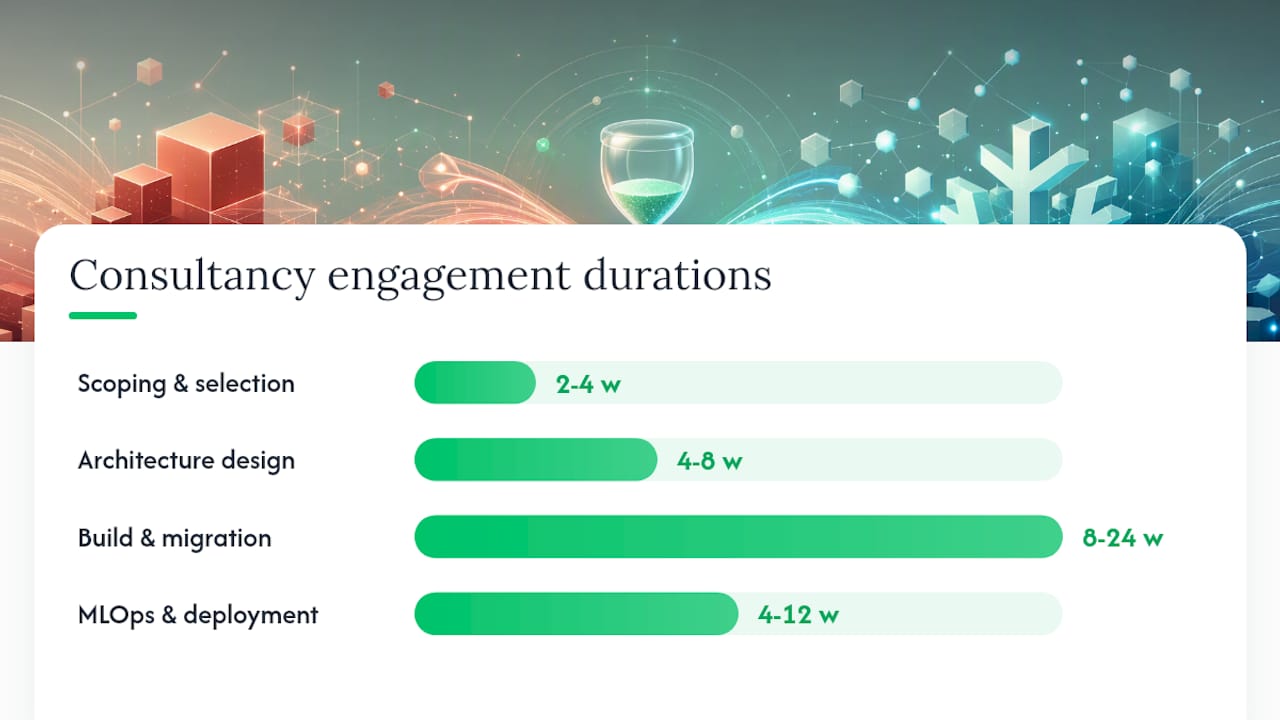
Scoping and platform selection (2–4 weeks): current-state assessment, workload profiling, total cost of ownership modelling, and a written recommendation with rationale.
Architecture and migration design (4–8 weeks): reference architecture, data model mapping, governance framework, and a phased migration plan.
Build and migration (8–24 weeks, depending on complexity): pipeline development, query translation, testing, and runbook creation.
MLOps and model deployment (4–12 weeks): experiment tracking setup, feature store configuration, CI/CD for model deployment, and monitoring.
Sentient Concepts’ data platform engineering and readiness and data diligence services cover each of these phases, with a single accountable team across strategy, build, and operations. For organisations that need to move from platform selection to production within a defined procurement window, that continuity removes the handoff risk that typically inflates timelines.
Pro Tip: Commission a two-week scoping engagement before committing to a platform. The output, a workload profile and total cost of ownership model, is the most valuable document you can bring to a board or procurement committee, and it costs a fraction of a mis-specified contract.
The case for pragmatism over platform purity
The most persistent mistake in enterprise data platform decisions is treating this as a binary choice when the evidence consistently points to coexistence. Organisations that spend six months debating Databricks versus Snowflake in isolation often miss the more useful question: which workloads belong on which platform, and what governance layer will make dual-platform operations sustainable?
The convergence narrative is real but overstated. Yes, Snowflake has added Iceberg and Cortex; yes, Databricks SQL has improved. But the underlying mental models remain distinct. Snowflake is built for people who think in tables and queries. Databricks is built for people who think in pipelines and models. Forcing a SQL-dominant analyst team onto Databricks to achieve “platform consolidation” typically produces higher operational costs, slower onboarding, and a governance debt that compounds over time. The reverse is equally true: asking ML engineers to build production feature pipelines in Snowpark when they know Spark is a productivity tax with no architectural benefit.
The practical recommendation for a mixed-workload UK enterprise in 2026 is a 12–18 month roadmap that starts with a clear workload inventory, assigns each workload to the platform where the team already has skills, and uses open table formats as the interoperability layer. Governance comes first, not last. Unity Catalog or Snowflake RBAC configured before the first analyst connects is worth more than any performance tuning done afterwards. And the procurement decision that matters most is not which vendor to choose, but which table format to standardise on, because that choice determines the cost of every future decision about the stack.
How Sentient Concepts helps you move from decision to delivery
Choosing between Databricks and Snowflake is the first decision. Implementing the platform, migrating existing pipelines, configuring governance, and deploying production ML systems is where most UK enterprises encounter the real complexity. Sentient Concepts delivers end-to-end data platform engineering and AI strategy and roadmap services that take organisations from platform selection through to production, with a single accountable team across every phase.
The engagement typically begins with a two-to-four-week readiness and scoping exercise: workload profiling, total cost of ownership modelling, and a written platform recommendation with a phased delivery plan. From there, Sentient Concepts’ engineers handle architecture design, pipeline migration, Unity Catalog or Snowflake governance configuration, and MLOps setup, including deployment and MLOps for teams building production model serving. Ongoing cost optimisation and managed operations are available as a retainer, ensuring the platform performs and the bill stays predictable after go-live. To discuss your platform selection or migration, contact the team for a discovery conversation.
Sources
The following sources are worth bookmarking for procurement evidence, technical validation, and deeper architectural study:
FAQ
Will Databricks overtake Snowflake in market position?
Both platforms are growing, but they serve overlapping rather than identical markets. Databricks leads in engineering and ML workloads; Snowflake leads in SQL analytics and governed data sharing. Convergence is narrowing some gaps, but neither platform is likely to displace the other for its primary use case in the near term.
Is Azure Databricks the same as standard Databricks?
Azure Databricks is a managed deployment of Databricks on Microsoft Azure, deeply integrated with Azure Active Directory, ADLS Gen2, and Azure networking. The core Databricks runtime and features are the same, but the identity, networking, and billing integration are Azure-native, making it the preferred path for UK enterprises already on the Microsoft stack.
Who competes with Snowflake and Databricks?
The competitive set includes cloud-native warehouses, lakehouse platforms, and managed analytics services from the major cloud providers. Open-source and vendor-neutral alternatives such as Apache Iceberg-based platforms and query engines like Trino or DuckDB are also relevant for organisations prioritising portability over managed simplicity.
Is Databricks or Snowflake bigger as a business?
Both are large, privately and publicly held technology companies respectively, with substantial enterprise customer bases. Snowflake completed its IPO several years ago; Databricks remains private. Revenue figures are publicly reported for Snowflake; Databricks discloses selected metrics. Neither has disclosed figures that allow a direct like-for-like comparison of UK-specific revenue.
Can you run Databricks and Snowflake together?
Yes, and many large enterprises do. The standard pattern uses Databricks for data engineering and ML, and Snowflake for SQL analytics and reporting, with open table formats (Iceberg or Delta) as the interoperability layer in shared cloud object storage. Governance configuration across both platforms is the primary operational challenge in this architecture.
Recommended