Enterprise AI strategy: a practical playbook for leaders
Adopt a business-aligned, capability-first enterprise AI strategy that ties every use case to measurable KPIs, a governance structure, and an operating model built for scale. That is the single most important decision you can make this quarter. According to MIT Sloan and Google experts, the primary challenge is no longer proving that AI works; it is capturing value consistently and at scale through organisational capability and responsible deployment.

Start here this week: convene a two-hour prioritisation session with your CXO, Chief Data Officer, and a senior technology lead. Your agenda has three items: a draft AI vision tied to one or two corporate objectives, a shortlist of five candidate use cases scored on business impact and data readiness, and a governance owner assigned to each. Aim for a first pilot in production within 90 days.
A few signals worth noting before you proceed:
Many companies have yet to define an AI strategy, although those already deploying generative AI often report seeing measurable returns.
ISO/IEC 42001:2023 and ICO guidance on automated decision-making set the compliance floor for UK enterprises; both are tractable when controls are built into your architecture from the start.
Sentient Concepts offers an end-to-end assess, build, and operate model that eliminates the handoffs that typically slow enterprise AI from pilot to production.
Pro Tip: Set a 30-day milestone to complete an AI readiness assessment covering data access, skills inventory, and governance gaps. Without that baseline, prioritisation decisions rest on assumption rather than evidence.
Table of Contents
What should your AI vision and strategic objectives look like?
How do you discover and rank the highest-impact AI use cases?
What do UK regulatory expectations require from your AI programme?
What operating model and governance structure does enterprise AI need?
How do you build a realistic roadmap from pilot to enterprise scale?
How do you build the skills and culture that sustain AI adoption?
How Sentient Concepts delivers enterprise AI strategy and measurable outcomes
What should your AI vision and strategic objectives look like?
The AI vision must deliver a precise, board-legible business outcome: reduce operational cost in a named process by a defined amount, increase revenue from a specific product line, or reduce risk exposure in a regulated workflow. Vague aspirations about “becoming AI-first” do not survive budget scrutiny. Gartner’s guidance is clear: an AI strategy must be dynamic, bidirectionally aligned with corporate strategy, and continuously realigned as capabilities and market conditions change.
To convert corporate objectives into AI objectives, map each strategic priority to a domain: product innovation, process efficiency, or customer journey. For each domain, ask which decisions are currently made by people that AI could augment or automate, and what the measurable consequence of improving those decisions would be.
Board-relevant objectives to consider include:
Revenue uplift through personalisation, cross-sell recommendation, or faster product configuration
Cost avoidance through document automation, claims triage, or predictive maintenance
Risk reduction through real-time compliance monitoring or fraud detection
Customer satisfaction improvement through faster resolution and self-service containment
Speed to decision in underwriting, credit assessment, or supply chain planning
Once objectives are set, translate them into a three-tier KPI structure. The table below shows the template.
KPI tier | Example metric | Measurement method |
Model quality | Precision, recall, F1 score | Offline evaluation, A/B test |
System and operational | Latency, uptime, cost per query | Observability tooling |
Adoption | Active users, task completion rate | Product analytics |
Business impact | Cost saved, revenue attributed, error rate reduction | Finance sign-off, holdout test |
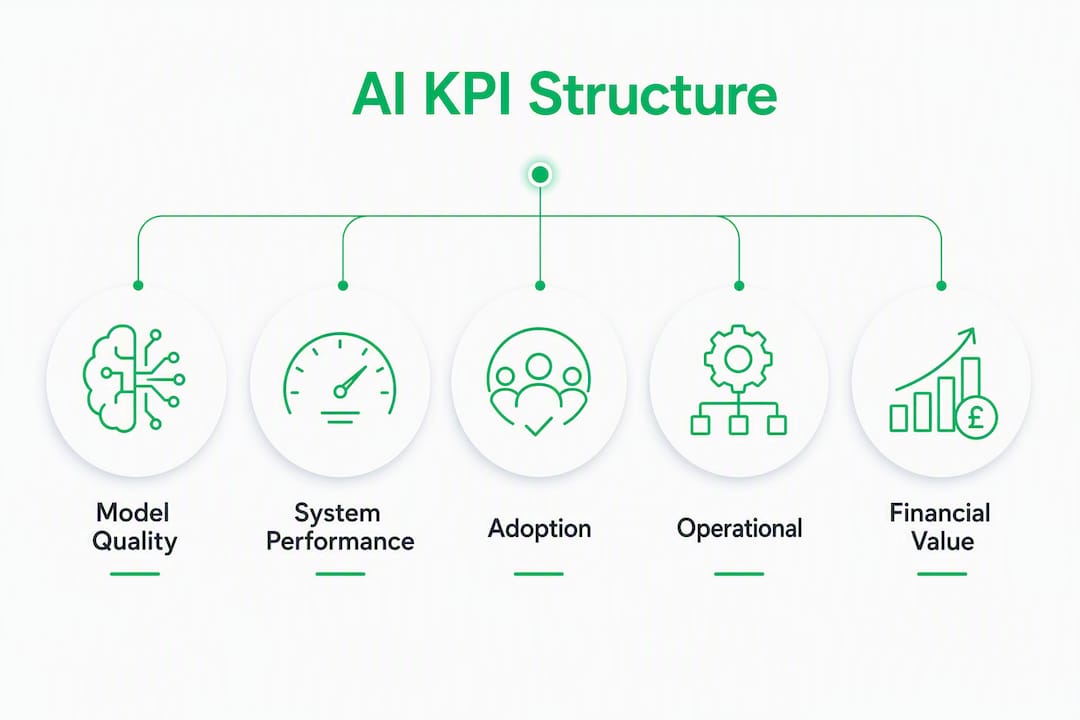
Google Cloud’s measurement framework recommends segmenting KPIs across model quality, system, adoption, operational, and business-impact tiers precisely because technical health and financial value can diverge. A model that scores well on accuracy but sees low adoption delivers no business return.
Pro Tip: Define your baseline measurement before the pilot begins, not after. Record the current cost, time, or error rate for the process you are targeting. Without a pre-intervention baseline, any uplift claim will be challenged in the finance review.
How do you discover and rank the highest-impact AI use cases?
Focus on use cases that combine clear business value with technical actionability and data readiness. That combination is rarer than it appears, which is why a scoring matrix prevents teams from chasing technically interesting problems that have no commercial path.
Score each candidate use case across six dimensions: business impact, time to value, data readiness, implementation complexity, regulatory risk, and strategic fit. A simple 1–5 scale per dimension, weighted by your organisation’s priorities, produces a ranked shortlist in a single workshop.

Dimension | What to assess | High score signal |
Business impact | Revenue, cost, or risk consequence | Quantifiable £ or % outcome |
Time to value | Weeks to first measurable result | Under 90 days to pilot output |
Data readiness | Labelled data available, accessible, clean | Existing structured data source |
Implementation complexity | Integration points, model type, team skill | Low dependency on legacy systems |
Regulatory risk | Automated decision-making, personal data | No high-risk AI Act classification |
Strategic fit | Alignment with 3-year corporate plan | Endorsed by C-level sponsor |
Two patterns illustrate how scoring leads to prioritisation. In a financial services firm, an accounts-payable document automation use case scored high on business impact (manual processing cost was material), high on data readiness (invoices were already digitised), and low on regulatory risk. It moved to pilot in six weeks. A customer credit-scoring model scored high on business impact but low on data readiness and high on regulatory risk; it was placed in a later phase with a data remediation workstream running in parallel.
To gather inputs for scoring, follow this discovery sequence:
Interview process owners in finance, operations, customer service, and product to identify decisions or tasks consuming disproportionate time or cost.
Review existing data assets with your data engineering team to assess what is accessible and labelled.
Map each candidate use case to a regulatory category using ICO guidance on automated decision-making.
Score and rank in a facilitated workshop with business, technology, and compliance representation.
Select three to five use cases for the initial portfolio: one quick win (under 90 days), one strategic bet (six to twelve months), and one foundational capability (data or platform).
Limiting the initial portfolio to five use cases is deliberate. Spreading effort across ten initiatives in the first year typically produces ten incomplete pilots rather than three production systems generating measurable returns.
Is your data ready to support reliable AI outcomes?
Poor data quality does not just slow AI projects; it destroys repeatability and erodes trust in model outputs. Data readiness is a prerequisite, not a parallel workstream. Before committing to a build phase, assess your data estate against six criteria: accessibility, quality, lineage, metadata completeness, observability, and licensing and retention compliance.
A practical readiness checklist covers:
Accessibility: Can the relevant data be queried by the AI system without manual extraction? Are APIs or data pipelines in place?
Quality: What is the known error rate, duplication rate, and completeness score for the target dataset?
Lineage: Can you trace each data field from source system to model input? Is that lineage documented?
Metadata: Are datasets catalogued with ownership, sensitivity classification, and update frequency?
Observability: Will you know when data distributions shift in production, triggering model drift?
Licensing and retention: Does your data licence permit use in AI training or inference? Does retention policy align with GDPR Article 5 storage limitation?
On UK data protection: if your AI system makes or materially influences decisions about individuals, a Data Protection Impact Assessment (DPIA) is required under UK GDPR Article 35. The ICO’s guidance on AI and data protection sets out documentation expectations including purpose limitation, lawful basis, and transparency obligations. Record-keeping for automated decision-making must satisfy Article 22 requirements, and where profiling is involved, individuals retain the right to human review. Engage your Data Protection Officer at the use-case scoring stage, not after build begins.
For integrating enterprise data sources into a knowledge plane, Retrieval-Augmented Generation (RAG) patterns are the most practical approach for most UK enterprises. The key hazards to avoid are chunking documents too coarsely (which degrades retrieval precision), failing to version the knowledge base (which makes audit trails unreliable), and mixing data of different sensitivity classifications in a single vector store.
Pro Tip: Start with a single, well-governed data source for your first RAG implementation. A clean, versioned document corpus with known provenance reduces hallucination risk and gets you to a production-quality knowledge plane faster than attempting to ingest every enterprise data source at once.
How should you choose your AI platform architecture?
Choose an architecture that matches your use-case portfolio and governance appetite. There is no universally correct answer between managed SaaS, cloud platform services, and self-hosted stacks; the right choice depends on your time-to-value constraint, data sovereignty requirements, and the skills your team already holds.
Approach | Best for | Time to value | Key trade-off |
Managed SaaS (e.g. Microsoft Copilot, Azure OpenAI Service) | Quick wins, productivity use cases, low customisation | Weeks | Limited control over model behaviour and data routing |
Cloud platform (Microsoft Azure, AWS, Google Cloud) | Custom models, enterprise integration, regulated industries | 2–4 months | Requires platform engineering capability; ongoing compute cost |
Self-hosted / on-premises | Strict data sovereignty, classified environments | 4–12 months | Highest cost and operational burden; full control |
Microsoft Azure is the most widely adopted cloud platform for enterprise AI in the UK, offering Azure OpenAI Service, Azure Machine Learning, and Azure AI Foundry as a managed orchestration layer. AWS provides Amazon Bedrock and SageMaker for similar workloads. Google Cloud’s Vertex AI platform offers strong tooling for organisations already invested in Google Workspace or BigQuery. Each platform supports the core architectural concerns: model routing, vector storage, observability, and identity management.
A well-structured enterprise AI architecture separates responsibilities across five planes: client (user-facing applications), orchestration (prompt routing, agent coordination), model (LLM and ML model hosting), knowledge (vector stores, RAG pipelines, structured data), and observability (logging, drift detection, cost tracking). This separation reduces coupling between components, meaning a change to the model layer does not require rebuilding the client application, and it makes regulatory documentation tractable by locating controls to specific components.
Your architecture decision checklist should cover:
Model routing: which model handles which query type, and how is that governed?
Orchestrator: are you using a managed service or a framework such as LangChain or Semantic Kernel?
Vector store: which service hosts your embeddings, and does it meet your data residency requirements?
Observability: how will you capture latency, cost per query, and output quality in production?
Authentication and rate-limiting: are API keys rotated, and is usage governed per team or product?
Data sovereignty: does your chosen platform keep data within UK or EEA boundaries?
Build-versus-buy is a central architectural question, and the answer usually varies by layer. Most enterprises buy the model layer (via Azure OpenAI or similar), build the orchestration and knowledge layers to match their specific data and workflows, and use managed observability tooling rather than building it from scratch.
What do UK regulatory expectations require from your AI programme?
Embed responsible AI controls from design to production. Ethics and compliance are not a final gate before launch; they are design constraints that shape architecture, data selection, and operating procedures from the first sprint.
The UK regulatory picture for enterprise AI currently rests on three pillars. First, UK GDPR and the Data Protection Act 2018 govern personal data processing, automated decision-making, and the rights of data subjects. Second, the ICO has published specific guidance on AI and data protection, covering fairness, transparency, and accountability obligations for AI systems. Third, while the UK has not adopted the EU AI Act directly, many UK enterprises operating in or supplying to EU markets must comply with its technical documentation and conformity assessment requirements; the Act’s risk-tier classification is also a useful internal governance tool regardless of direct legal obligation.
Practical artefacts to produce for each AI system include:
A model card recording the model’s intended use, training data provenance, known limitations, performance across demographic subgroups, and version history.
A DPIA for any system processing personal data or making automated decisions with significant effects.
An audit trail of model versions, training runs, evaluation results, and deployment approvals.
A bias and fairness assessment conducted before production deployment and repeated after significant model updates.
When evaluating vendors and cloud providers, ask: Where is training and inference data processed and stored? What is the model provenance, and has it been tested for bias? What security controls govern API access? How are model updates communicated, and what is the rollback procedure?
Apply risk tiers to use cases using the following sequence:
Classify the use case by its potential impact on individuals (high, medium, low) using ICO and EU AI Act criteria.
For high-risk use cases, require a DPIA, human-in-the-loop review, and documented escalation path.
For medium-risk use cases, require a model card, bias assessment, and quarterly review cadence.
For low-risk use cases, apply standard software governance with lightweight model documentation.
Review classifications annually or when the use case scope changes materially.
This article provides general information on UK regulatory obligations for AI. It is not legal advice. Confirm current requirements with the ICO, a qualified data protection professional, or legal counsel.
What operating model and governance structure does enterprise AI need?
Adopt an operating model that balances central governance with domain autonomy. A purely centralised AI team becomes a bottleneck; a purely federated model produces inconsistent standards and duplicated effort. The pattern that works at scale is a Centre of Excellence (CoE) providing shared standards, tooling, and governance, with embedded AI capability in each business domain.
The CoE owns the AI policy framework, the reference architecture, the approved model and vendor catalogue, and the portfolio governance board. Domain teams own use-case delivery, product integration, and adoption within their area, drawing on CoE standards and shared infrastructure. This structure mirrors how mature data organisations operate, and Gartner’s AI strategy guidance explicitly recommends an AI portfolio and operating model tied to business objectives rather than a single monolithic AI programme.
Key roles and their primary accountabilities:
Executive sponsor (C-level): — Owns the AI vision, secures funding, and removes organisational blockers.
For funding, the most practical model for most UK enterprises combines a central investment fund for platform and CoE costs with a chargeback or co-investment model for domain-specific use cases. This keeps platform costs visible and shared while giving domain teams accountability for the value their use cases generate. Budget separately for ongoing MLOps, observability tooling, and model re-training; these operational costs are frequently underestimated in initial business cases and compound over time as the portfolio grows.
Governance cadence should include a monthly portfolio board reviewing use-case progress against KPIs, a quarterly strategy review assessing alignment with corporate objectives, and an annual responsible AI audit covering the full model card and DPIA register.
Pro Tip: Assign a named policy owner to each AI use case at the point of approval, not retrospectively. When a model behaves unexpectedly in production, knowing immediately who is accountable for that system reduces triage time from days to hours.
For practical guidance on building an AI operating model and structuring a CoE, the operating model design decisions are worth addressing early in your programme.
How do you build a realistic roadmap from pilot to enterprise scale?
Structure the roadmap into four phases with explicit gating criteria between each: discovery, pilot (MVP), production, and scale. Moving between phases without evidence-based gates is the single most common cause of AI programmes that consume budget without delivering returns.
Discovery (weeks 1–4): Complete the AI readiness assessment, score and select the initial use-case portfolio, assign executive sponsor and product owner to each use case, and secure data access approvals.
Pilot / MVP (weeks 5–16): Build the minimum viable system for the highest-priority use case, instrument observability from day one, and run a controlled evaluation against the pre-defined baseline metric.
Production (weeks 17–26): Pass security sign-off, complete the DPIA and model card, integrate with production data sources, and deploy to a defined user group with adoption tracking in place.
Scale (months 7–12+): Expand to additional user groups or use cases, migrate to the shared platform infrastructure, and establish the CoE governance cadence.
Gating criteria for promotion between stages:
Discovery to pilot: executive sponsor confirmed, data access granted, baseline metric recorded, use-case charter signed off.
Pilot to production: evaluation results meet pre-defined performance threshold, security review passed, DPIA completed, rollback procedure documented.
Production to scale: adoption metrics above agreed threshold, cost per query within budget, no unresolved compliance findings, CoE standards applied.
Typical cost components to budget for include data ingestion and storage, compute for inference and training, orchestrator and vector store licensing, observability tooling, personnel (ML engineers, data engineers, product owners), and external advisory or implementation support. Inference costs in particular can scale non-linearly with usage; model routing strategies that direct simpler queries to smaller, cheaper models can reduce production compute costs materially.
Unexpected operational overheads that frequently appear after go-live include model re-training triggered by data drift, prompt engineering iterations as user behaviour evolves, and integration maintenance as upstream source systems change. Budget a contingency of 20–30% of the initial build cost for the first year of operations.
How do you measure AI value and prove ROI to the board?
Measure across five tiers so technical health maps to financial value: model quality, system performance, adoption, operational efficiency, and business impact. Google Cloud’s measurement guidance recommends exactly this segmentation because a model that is technically sound but poorly adopted produces no business return, and a widely adopted model with degrading quality erodes trust over time.
Measurement method | Best for | Limitation |
A/B test (randomised) | Proving causal uplift for customer-facing features | Requires sufficient traffic volume |
Holdout uplift test | Measuring impact on a withheld control group | Needs clean group separation |
Before/after observational | Quick baseline comparison in low-traffic contexts | Confounded by external factors |
Example KPIs by use case:
Customer service automation: Containment rate (queries resolved without human escalation), average handling time, customer satisfaction score.
Finance and accounts payable: Automation rate (invoices processed without human touch), exception rate, processing cost per document.
Sales and revenue: Conversion uplift in the treated group versus control, average deal size, time from lead to qualified opportunity.
Underwriting and risk: Decision turnaround time, referral rate to human underwriter, loss ratio on AI-assisted decisions versus manual baseline.
Statistical rigour matters for uplift claims. Define the minimum detectable effect, the required sample size, and the confidence threshold before the experiment begins. A claim of “15% cost reduction” that cannot survive a finance team’s scrutiny because the experiment lacked a control group will set back the programme’s credibility more than a modest but well-evidenced result.
Pro Tip: Instrument your observability layer to capture cost per query from the first day of production. This single metric lets you model the financial impact of scaling, identify inefficient prompt patterns, and make the case for model routing optimisation before costs become a board-level concern.
How do you build the skills and culture that sustain AI adoption?
Long-term AI success depends on people and organisational change, not technology alone. The most capable AI system will stall if the people expected to use it do not trust it, do not understand it, or have no incentive to change their workflow.
Skills gaps to assess and address:
Data engineering: Pipeline development, data quality management, and integration with source systems.
ML engineering: Model training, evaluation, MLOps tooling, and production monitoring.
Product management: Translating business requirements into AI product specifications and adoption metrics.
Security and compliance: AI-specific threat modelling, DPIA authorship, and audit trail management.
Ethics and governance: Bias assessment, fairness testing, and responsible AI policy.
Domain expertise: Subject-matter knowledge to validate model outputs and define edge cases.
Resourcing options are hire, reskill, and partner, and most enterprises need all three. Hiring ML engineers and data engineers into a CoE provides a permanent capability core. Reskilling business analysts and software engineers into AI product roles is faster than it appears when structured bootcamps and role-based curricula are in place. Partnering with a specialist firm covers capability gaps during the build phase and transfers knowledge to internal teams over time.
A change management programme that produces sustained adoption typically follows this sequence:
Secure a visible early win with a use case that directly benefits the frontline team using the system, not just the finance team measuring cost savings.
Make adoption metrics visible to the teams involved, not just to leadership.
Assign internal champions in each business domain who can answer peer questions and escalate issues.
Tie performance conversations and team incentives to AI adoption KPIs, not just to output metrics that the AI is designed to improve.
Run quarterly retrospectives to surface friction points and feed them back into the product backlog.
For practical guidance on AI change management and the organisational steps that drive adoption, the decisions made in the first six months set the cultural tone for the entire programme.
What risk and security controls does enterprise AI require?
Treat AI risk as systemic technology risk with model-specific additions: factuality testing, adversarial robustness checks, and continuous drift detection. Standard IT security controls are necessary but not sufficient for AI systems because the failure modes are different. A compromised database returns wrong data; a compromised or degraded model returns plausible-sounding wrong data, which is harder to detect and potentially more damaging.
Key risk controls to implement:
Data poisoning: Validate training data provenance and maintain an immutable audit log of training runs.
Prompt injection: Apply input sanitisation and output filtering at the orchestration layer; test adversarially before production deployment.
Model theft and extraction: Rate-limit API access, monitor for systematic querying patterns, and apply watermarking where feasible.
Hallucination-related business risk: Implement human-in-the-loop review for high-stakes outputs; set confidence thresholds below which the system escalates to a human.
Model drift: Monitor input data distributions and output quality metrics continuously; define re-training triggers.
For production AI incidents, follow this response sequence:
Detect: observability tooling raises an alert on output quality degradation, anomalous usage, or security event.
Triage: the on-call ML engineer and product owner assess severity within a defined SLA (e.g. one hour for production-affecting incidents).
Contain: route traffic to a fallback model or disable the AI feature if the incident cannot be resolved within the triage window.
Communicate: notify affected users and, where personal data is involved, assess whether ICO notification obligations are triggered under UK GDPR Article 33.
Remediate and review: fix the root cause, update the model card and incident log, and conduct a post-incident review within five business days.
Third-party due-diligence questions to include in procurement assessments:
What data does the vendor process during inference, and where is it stored?
How are model updates communicated, and what is the rollback procedure?
What penetration testing and red-teaming has been conducted on the system?
Does the vendor’s data processing agreement satisfy UK GDPR Article 28 requirements?
Align AI security monitoring with your enterprise Security Operations Centre (SOC). AI API endpoints, model registries, and vector stores should be included in your threat detection scope, not treated as separate from the broader IT security estate.
What should you prioritise in the first 90–180 days?
Prioritise discovery, baseline measurement, governance set-up, and one rapid pilot. The first 90 days are about reducing uncertainty and building credibility; the next 90 are about demonstrating measurable value in production.
Week 1–2: Convene the executive sponsor and AI lead; agree the AI vision and three to five candidate use cases.
Week 3–4: Complete an AI readiness assessment covering data access, skills inventory, governance gaps, and technology estate.
Week 5–6: Score and rank use cases using the prioritisation matrix; select the pilot use case and assign a product owner.
Week 7–8: Secure data access approvals, complete the initial DPIA, and define the baseline metric for the pilot.
Week 9–16: Build and evaluate the pilot MVP; instrument observability from day one.
Week 17–26: Move the pilot to production with a defined user group; track adoption and business-impact KPIs weekly.
Questions to ask potential partners and internal stakeholders during this period:
Can you demonstrate a production AI system in a comparable industry context?
How do you handle model versioning, rollback, and incident response?
What does your data access and governance process look like end-to-end?
How will you transfer knowledge to our internal team during the engagement?
Red flags to watch for in the first months:
No measurable KPIs defined before the pilot begins.
Data access approvals still pending after week six.
No named executive sponsor with budget authority.
A vendor proposing a six-month discovery phase before any working system is demonstrated.
Governance and compliance treated as a post-build activity.
How Sentient Concepts delivers enterprise AI strategy and measurable outcomes
Sentient Concepts offers end-to-end strategy, build, and run services that eliminate the handoffs between advisory, engineering, and operations teams that typically slow enterprise AI from concept to production value. The engagement model follows four stages: assess, prioritise, build, and operate, with a single accountable team across all four.
In a recent engagement with a UK financial services firm, Sentient Concepts automated a high-volume supplier document processing workflow that had previously required significant manual effort from the operations team. The solution combined a document intelligence pipeline with a structured extraction layer and a human-in-the-loop review step for exception cases. The outcome was a material reduction in processing cost per document and a measurable improvement in processing turnaround time, with full audit trail compliance meeting the firm’s internal controls requirements.
Sentient Concepts’ capabilities relevant to an enterprise AI programme include:
AI strategy development, readiness assessment, and use-case prioritisation.
Custom AI and GenAI solutions engineering, including document automation, conversational agents, and predictive analytics.
Data and platform engineering, including knowledge plane design and RAG pipeline implementation.
Deployment, MLOps, and managed AI operations covering monitoring, evaluation, and ongoing optimisation.
Operating model design and CoE enablement for enterprises building internal AI capability.
The firm’s specialisation spans finance, manufacturing, logistics, and insurance, with published case examples in supplier document automation for manufacturing and banking and finance contexts.
Pro Tip: Ask any prospective AI partner to show you a production system in a comparable industry, not a prototype. The gap between a convincing demo and a system that operates reliably at enterprise scale under real data conditions is where most AI projects fail.
Key takeaways
An effective enterprise AI strategy requires a business-aligned vision, a scored use-case portfolio, governance embedded from the start, and measurement planned before the pilot begins.
Point | Details |
Start with a scored use-case shortlist | Score candidates on business impact, data readiness, and regulatory risk before committing to build. |
Embed governance from day one | Assign a named policy owner and complete the DPIA at the use-case approval stage, not after build. |
Measure before you build | Record the baseline metric for every pilot so uplift claims survive finance scrutiny. |
Structure the roadmap in four phases | Discovery, pilot, production, and scale with explicit gating criteria between each phase. |
Sentient Concepts as a delivery partner | Sentient Concepts provides end-to-end assess, build, and operate services that eliminate handoffs and accelerate time to production value. |
The traps that derail enterprise AI programmes
The most persistent mistake in enterprise AI is treating the technology as the hard part. Organisations spend months evaluating large language models, debating cloud providers, and building proof-of-concept demos, then discover that the real blockers are a data access approval that takes twelve weeks, a governance process that nobody owns, and a business team that was never consulted on what the system should actually do.
The second trap is delegating governance. When the Chief Risk Officer or General Counsel is handed a model card three days before a planned launch, the result is either a delayed launch or a system that goes live without adequate controls. Neither outcome builds confidence in the programme. Governance is not a compliance tax; it is the mechanism by which the organisation learns to trust its own AI systems, and that trust is what enables scale.
The third trap is under-investing in operations. A pilot that works in a controlled evaluation environment will behave differently in production, where data distributions shift, user behaviour evolves, and upstream systems change without notice. The organisations that sustain AI value over time are those that budget for MLOps, observability, and model maintenance as recurring operational costs, not as one-time project line items. The cost of neglecting this compounds quickly once a portfolio of systems is in production.
The practical corrective for all three is the same: start with a readiness assessment that surfaces data, governance, and skills gaps before committing to a build. It is a small investment that prevents the much larger cost of a stalled programme. If you are at that stage and want to pressure-test your current thinking, Sentient Concepts is worth a conversation.
Sentient Concepts: from AI strategy to production value
Sentient Concepts is the partner for enterprise leaders who need more than a strategy document. The firm’s end-to-end model covers the full lifecycle from AI strategy and roadmap development through to engineering, deployment, and managed operations, with a single team accountable across every stage. That continuity removes the costly rework that occurs when a strategy consultancy hands off to a systems integrator who hands off to an operations team that was not involved in the original design.
For leaders at the start of their AI programme, the practical entry point is a structured readiness assessment: a focused engagement that maps your data estate, skills inventory, governance gaps, and use-case shortlist, and returns a prioritised roadmap with cost and timeline estimates. Initial findings are typically available within four to six weeks. To discuss your programme and request an assessment, visit Sentient Concepts’ AI strategy and roadmap service or explore the firm’s AI and GenAI solutions for organisations ready to move directly to build.
Useful sources
The sources below support the claims made in this article and provide authoritative further reading for UK enterprise leaders.
ICO guidance on AI and data protection — the primary UK reference for GDPR obligations, DPIA requirements, and fairness in automated decision-making. Start here for legal and compliance follow-up.
ISO/IEC 42001:2023 — the international standard for AI management systems; sets the governance and documentation framework that UK enterprises should align with.
Developing an Effective AI Strategy, MIT Sloan Executive Education — covers the shift from proving AI works to capturing value at scale through governance and organisational capability.
How to Build an AI Strategy and Keep It Current, Gartner — practical guidance on dynamic AI strategy, portfolio management, and operating model alignment.
The Enterprise AI Reference Architecture, COMPEL Framework — the five-plane architecture model that supports regulatory documentation and reduces system coupling.
The Enterprise AI Architecture Handbook, AppScale Blog — practical guidance on build-versus-buy decisions, model routing, and data sovereignty for enterprise platforms.
Microsoft Azure AI adoption framework — Microsoft’s structured guidance on AI strategy, security, and platform adoption for enterprise teams.
FAQ
What is an example of enterprise AI in practice?
A UK financial services firm automating supplier invoice processing with a document intelligence pipeline is a representative example: the system extracts structured data, flags exceptions for human review, and produces a full audit trail, reducing manual processing cost and turnaround time while meeting internal controls requirements.
What does enterprise AI actually do for a business?
Enterprise AI automates high-volume decisions and tasks, augments human judgement in complex workflows such as underwriting or credit assessment, and surfaces patterns in operational data that inform faster, more accurate business decisions. MIT Sloan research frames the primary value as consistent, scalable capture of outcomes rather than one-off proof-of-concept results.
How is AI used across enterprise functions?
AI is applied across customer service (automated query resolution and triage), finance (document automation, fraud detection), sales (lead scoring, conversion prediction), operations (predictive maintenance, supply chain optimisation), and risk and compliance (real-time monitoring, regulatory reporting). The use cases that deliver the fastest returns tend to combine clear business value with high data readiness and low regulatory complexity.
What is the right first step for building an enterprise AI strategy?
Conduct an AI readiness assessment covering your data estate, skills inventory, governance gaps, and candidate use-case shortlist. This baseline, completed within the first 30 days, prevents prioritisation decisions from resting on assumption and gives the executive sponsor the evidence needed to secure funding for a first pilot.
How do you measure ROI from an enterprise AI programme?
Measure across five tiers: model quality, system performance, adoption, operational efficiency, and business impact. Google Cloud’s framework recommends this segmentation because technical performance and financial value can diverge. Define the baseline metric before the pilot begins and use a holdout or A/B test design so uplift claims are credible to the finance team.
Recommended