Event-driven AI: the architecture behind scalable agent systems
- 1 day ago
- 9 min read
For scalable, resilient AI agents, adopt an event-driven architecture: agents react to events rather than poll state. This pattern is now the recommended approach for enterprise agentic AI, and the reasoning behind it is straightforward once you see it in practice.
Two examples make the case immediately. A fraud detection agent should wake the instant a transaction pattern breaks its baseline, not check every thirty seconds whether something changed. A customer service agent should trigger the moment a new account signs up, not sit polling a database for new rows. In both cases, event-driven architecture turns state changes into asynchronous triggers rather than forcing agents to ask “has anything happened yet?” on a loop.
The operational benefits compound quickly:
Decoupling — agents and data producers never need direct knowledge of each other, only a shared event contract.
Independent scaling — a spike in one event type scales only the consumers subscribed to it, not the entire fleet.
Lower latency for reactive tasks — agents respond within milliseconds of a state change rather than waiting for the next poll cycle.
TL;DR:
The main operational challenge is infrastructure, specifically in delivering enriched, context-rich events to agents with minimal latency.
Choosing the right transport layer depends on throughput and latency needs, with options like Pub/Sub for simplicity, Kafka for high throughput, and custom solutions for low-latency demands.
Maintaining feature freshness and ensuring training-serving parity are critical to prevent stale data from impacting agent decisions at scale.
Cost discipline involves reserving persistent connections for truly low-latency triggers and using cheaper asynchronous transports for less time-sensitive events.
Designing lightweight event payloads and proper schema versioning are essential to avoid breaking downstream consumers during system evolution.
Table of Contents
Why event-driven architecture fits agentic AI
Treat events as the control primitive, not the data payload. In a request-response model, an agent has to ask a system for its current state. In an event-driven model, the system tells the agent the moment something worth acting on has happened. That inversion is what makes agentic AI operationally viable at scale, because agents stop wasting compute cycles checking nothing has changed.
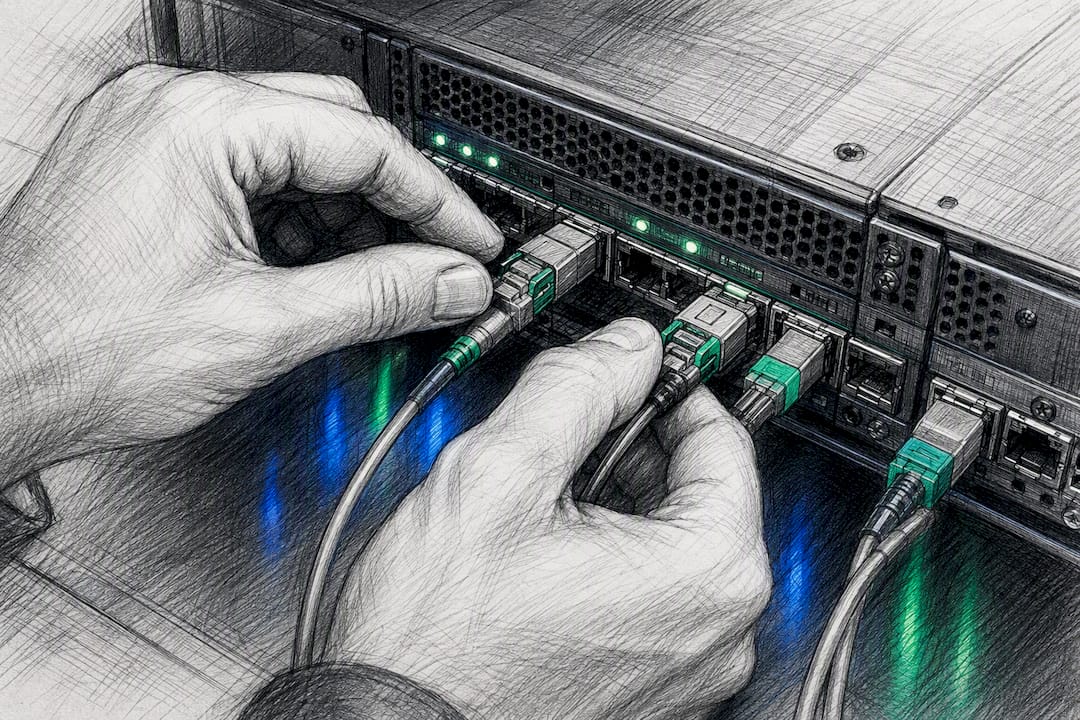
This works through choreography rather than orchestration. Instead of a central controller telling every agent what to do next, agents behave as decoupled microservices, each subscribing to the event streams relevant to its job. One agent watches for anomaly signals, another watches for document uploads, a third watches for customer sign-ups. None of them needs to know the others exist.
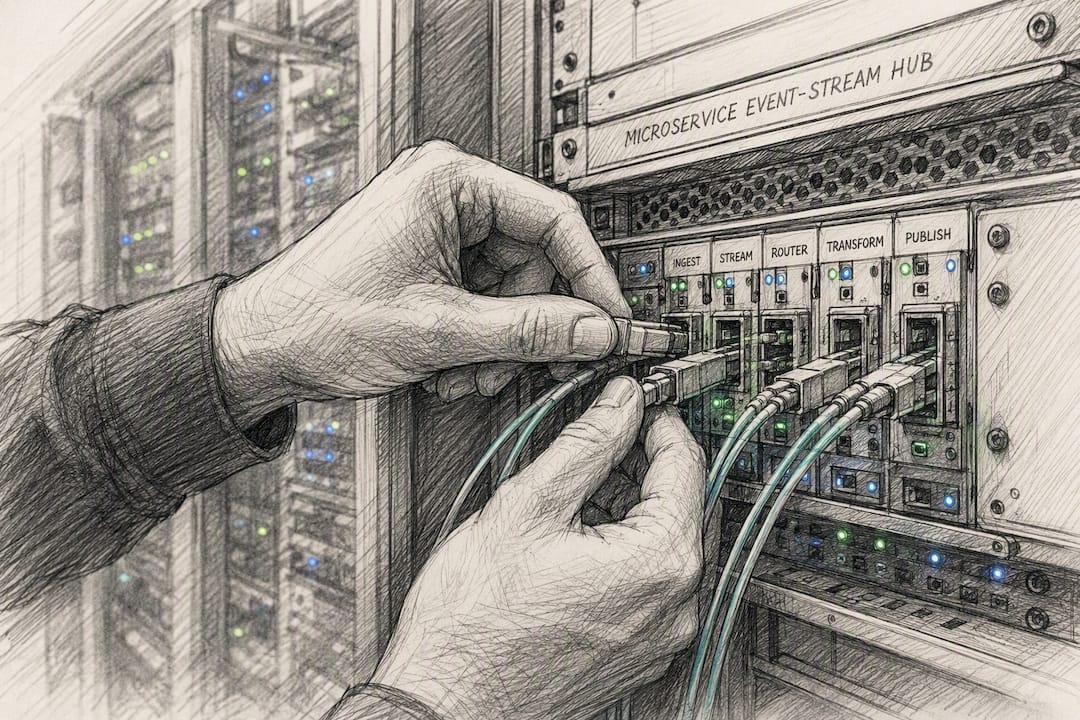
Choreography changes failure behaviour too. In a monolithic orchestration model, one failing component can cascade through the whole workflow. In a choreographed, event-driven system, a failing consumer just stops consuming, its queue backs up, and the rest of the system carries on. Practitioners building agentic systems increasingly treat events as the primary control mechanism precisely because it avoids centralised, brittle workflows.
Here’s the insight most teams miss when they start an agentic AI programme:
The model is rarely the bottleneck. Most large language models are now good enough for the reasoning task at hand.
The bottleneck is infrastructure. Getting the right event, enriched with the right context, to the right agent, at the right latency, is the harder engineering problem.
Solving that problem is what separates a working pilot from a resilient production system.
Pro Tip: Before you evaluate a single model, map your event sources. If you can’t name the ten events that matter most to your agents, you’re not ready to design the routing layer yet.
Core patterns and components for event-driven AI agents
A production-ready event-driven agent system needs a defined set of components, not an ad hoc collection of webhooks and cron jobs. The canonical building blocks are:
Producers — the systems (databases, applications, sensors, user actions) that emit events.
Event bus — the transport layer (Apache Kafka, Google Cloud Pub/Sub) that carries events reliably between producers and consumers.
Event router — logic that inspects an event and decides which agent or service should receive it.
Enrichment layer — adds context to a lightweight event before it reaches an agent, so the agent doesn’t have to fetch it itself.
Agents as consumers — subscribing to specific topics or event types, reacting only to what’s relevant to them.
Event store — a durable, queryable log of events for replay, audit, and state reconstruction.
Dead-letter queue (DLQ) — captures events that fail processing after retries, so nothing silently disappears.
On top of these components sit a small number of recurring patterns. Publish/subscribe (pub/sub) is the default: producers publish without knowing who’s listening. Event sourcing, where every state change is stored as an immutable event, suits systems that need full audit trails or the ability to replay history, such as regulated financial workflows. Ephemeral streaming, by contrast, suits high-volume, low-value signals where replay isn’t worth the storage cost. CQRS (command query responsibility segregation) becomes worthwhile once your read and write patterns diverge enough that a single data model can’t serve both efficiently.
None of this is resilient without three operational disciplines: idempotency (an event processed twice must not corrupt state), retries with exponential backoff, and schema evolution rules that let event formats change without breaking existing consumers. Working event router and DLQ implementations show how retry logic and dead-letter handling get wired together in practice — skipping this step is the single most common reason pilots fail to reach production.
Concrete implementation approaches and tool choices
The right transport layer depends on your throughput, latency, and operational tolerance, not on what’s fashionable. Three implementation paths cover most enterprise cases.
Serverless streams (Pub/Sub, push subscriptions, webhooks). Google Cloud Pub/Sub with push delivery gives you operational simplicity: no cluster to manage, automatic scaling, pay-per-message pricing. Watch connection costs and message volume as you scale — push subscriptions that fan out to hundreds of agent instances can get expensive fast.
Managed streaming with Kafka. Apache Kafka suits stateful processing, high-throughput event pipelines, and exactly-once semantics where financial or compliance workloads demand it. Combined with Apache Kafka Streams or Apache Flink, you can chain stateful stream operators directly into model inference calls, producing low-latency predictions without a separate offline promotion stage.
The Google Cloud recipe: BigQuery continuous queries → Pub/Sub → Vertex AI Agent Engine. BigQuery continuous queries run persistent SQL over streaming data, detecting anomalies as they occur. Pub/Sub, using single message transforms, reshapes and routes that detection event. A Vertex AI Agent Engine (ADK) agent receives it at a secure endpoint and runs a tool-equipped investigation, closing the detect, route, investigate loop without custom glue code.
Model serving decisions sit downstream of transport. Batching inference calls reduces cost and suits most enrichment and classification tasks. Per-event inference costs more but is unavoidable when a decision genuinely can’t wait, such as fraud scoring at the point of transaction. For sub-100ms requirements, edge inference keeps the model near the event source rather than routing every call back to a central cluster. Time-series foundation model workflows generally do better starting with micro-batched near-real-time inference and only moving to true per-event streaming once the latency and windowing trade-offs are well understood.
Operational concerns: freshness, parity, and cost at scale
Running an event-driven agent fleet reliably comes down to four disciplines architects have to own directly, not delegate to a data team after the fact.
Feature freshness. Agents make bad decisions when the features they read are stale relative to the event that triggered them. Define a freshness SLA per feature (seconds, not “roughly real-time”) and monitor it as rigorously as latency.
Training-serving parity. A model trained on batch-computed features and served on streaming features will drift apart quietly. A decision-coherent serving layer that serves features and flags from the same snapshot the inference call reads removes this failure mode and cuts the need for expensive backfills.
Observability. Trace logs, tool-usage metrics, and agent-level dashboards are not optional extras. Without them, you can’t tell whether an agent is failing silently or simply hasn’t been triggered.
Cost controls. Persistent connection models (SSE, gRPC) carry real infrastructure cost at fleet scale, on top of LLM token spend and stream processing charges. Reserve persistent subscriptions for state changes that genuinely warrant them.
Sentient Concepts’s guidance to clients building LLM observability practices starts with the same principle: instrument before you scale, because retrofitting observability into a live fleet of agents is far more expensive than building it in from the start.
How do you wire agents into event streams without losing context?
Getting the wiring right is mostly about discipline in payload design and transport choice, not clever code.
Keep event payloads lightweight. Send an identifier and a minimal state change, then enrich at the router or agent ingress rather than bloating every event with data most consumers won’t need.
Reconstruct context selectively. Use an event store or periodic snapshots to rebuild an agent’s working state, replaying only the events since the last known-good snapshot rather than the entire history.
Choose transport by latency need, not by default. SSE and gRPC suit low-latency persistent streams but get expensive at fleet scale; webhooks and push subscriptions suit lower-cost asynchronous triggers where a few hundred milliseconds of delay is acceptable. This mirrors the wider guidance to avoid streaming every agent interaction and reserve persistent connections for moments that actually matter.
Version your schemas. Use single message transforms and a contract-testing layer so producers can evolve event formats without silently breaking every downstream consumer.
How Sentient Concepts approaches event-driven AI
Sentient Concepts runs event-driven agent programmes as one continuous engagement rather than a sequence of handoffs. Strategy, data and platform engineering, and ongoing operations sit with the same accountable team throughout.
That continuity matters operationally. A team that designed the event schema is the same team troubleshooting a dead-letter queue six months later, which shortens the diagnosis loop considerably. Readiness questions worth asking any delivery partner: Can they name your critical event sources today? Do they have a plan for schema evolution before you sign? Who owns observability once the system is live?
Document automation pipelines triggered by inbound file events
Underwriting workflows that route flagged applications to investigation agents
Conversational agents triggered by customer state changes rather than manual escalation
Key Takeaways
Event-driven architecture is the recommended pattern for scalable agentic AI because it decouples agents from producers, enables independent scaling, and cuts latency for reactive tasks.
Point | Details |
Events, not polling | Agents should trigger on state changes, not check state on a loop, to cut latency and compute waste. |
Choreography over orchestration | Decoupled agents subscribing to streams reduce cascading failure risk versus centralised control. |
Reserve persistent connections | Use SSE/gRPC only for high-value, low-latency triggers; use webhooks or push subscriptions elsewhere to control cost. |
Freshness and parity are operational, not optional | A decision-coherent serving layer prevents stale features from causing bad agent decisions. |
Sentient Concepts delivers end-to-end | Sentient Concepts pairs event-driven architecture design with managed operations under one accountable team. |
What the industry gets wrong about event-driven AI
Most vendor content on this topic sells event-driven architecture as a plumbing upgrade: swap polling for pub/sub, ship faster, done. That undersells the actual shift. The harder and more valuable change is choreography, letting agents behave as genuinely independent consumers rather than obedient nodes in someone’s orchestration diagram.
The conventional advice also underweights cost discipline. Plenty of teams reach for persistent gRPC or SSE connections by default because they feel more “real-time,” then discover the connection overhead at fleet scale. The better default is asking which events genuinely need sub-second reaction and routing everything else through cheaper, asynchronous transport.
If there’s one thing architects should prioritise first, it’s the event schema and enrichment contract, not the model. Get that wrong and every agent downstream inherits the mess. Get it right, and swapping Kafka for Pub/Sub, or one model for another, becomes a much smaller decision than it first appears.
— Thomas Samuel
Ready to build your event-driven agent architecture?
Designing this correctly the first time saves months of retrofitting observability, schema contracts, and cost controls into a live system later. Sentient Concepts runs the full path from architecture design through managed operations under one accountable team, so the people who design your event schema are the same people troubleshooting it in production a year on.
That continuity is the practical advantage over piecing together a build with separate vendors for strategy, engineering, and support: no handoff gaps, no re-explaining your data model to a new team every quarter. Sentient Concepts’s AI strategy and roadmap service is the natural starting point if you’re still mapping your critical event sources, while the managed AI operations service covers the observability and cost-control work once your agents are live. Get in touch to scope a readiness review for your event-driven agent programme.
Sources
FAQ
What does event-driven mean?
Event-driven means a system reacts to state changes (events) as they happen, rather than repeatedly checking for changes through polling. Producers emit events, and consumers, including AI agents, subscribe and react asynchronously.
Is Kafka an event-driven system?
Yes. Apache Kafka is a distributed event streaming platform built specifically for publishing, storing, and consuming events at high throughput, and it underpins many production event-driven ML pipelines.
Can you give an example of event-driven programming?
A fraud detection pipeline is a clear example: a transaction event triggers a BigQuery continuous query, which flags an anomaly, publishes it via Pub/Sub, and invokes a Vertex AI Agent Engine agent to investigate, all without any component polling for changes.
When should you avoid event-driven streaming for AI agents?
Batch tasks, low-value or infrequent interactions, and workloads where a few minutes of delay is harmless are usually better served by scheduled jobs or polling, since persistent streaming subscriptions carry real cost at fleet scale.
How does Sentient Concepts support event-driven AI implementation?
Sentient Concepts designs and operates event-driven agent architectures end to end, from strategy and platform engineering through to managed operations, keeping one accountable team across the full lifecycle.
Recommended