Generative AI for documents: what it delivers in 2026
Generative AI for documents automates extraction, summarisation and draft generation, so operations teams process high-volume unstructured files faster and with fewer manual checks. In practical terms, this means a system that reads a contract, a claim file, or a supplier invoice, and produces a summary, structured data, a drafted response, or a redacted copy, without a person retyping any of it.
The deliverables fall into a few consistent categories:
Concise summaries of long contracts, filings, or reports
Structured data extracted from unstructured PDFs and scans
Generated drafts (clauses, briefings, correspondence)
Redacted or compliance-ready versions of sensitive files
Annotations and confidence flags for human reviewers
Financial services, insurance, manufacturing, and logistics firms are seeing the fastest returns, largely because their document volumes are high and their error tolerance is low. Gartner forecasts that more than 80% of enterprises will have used generative AI APIs or deployed generative AI enabled applications by 2026, which tells you this is no longer an experimental category. Sentient Concepts has built and operated document automation systems across these sectors, and Thomas Samuel draws on that operational view throughout this piece.
Key Takeaways
Generative AI for documents succeeds when grounding, human review, and staged governance are built in from the pilot stage, not added after a production error forces the issue.
Point | Details |
Match technique to task | Use extractive summarisation for auditability and abstractive for readability, choosing based on your review requirements. |
Layout parsing precedes generation | Preserve tables, coordinates, and provenance before any generative step runs on the extracted content. |
Validate before scaling | Introduce human-in-the-loop review and reconciliation checks in Phase 2, before expanding pilot volume. |
Confidence thresholds drive escalation | Route low-certainty extractions and drafts to a person automatically rather than relying on spot checks. |
End-to-end accountability reduces failure | Sentient Concepts runs strategy, build, and managed operations under one team, avoiding the handoff points where document AI pilots typically stall. |
Table of Contents
Core capabilities and techniques behind document processing AI
Sentient Concepts’ practical approach and illustrative outcomes
Future trends and advancements in generative AI for documents
Comparing categories of generative AI tools for document tasks
How Sentient Concepts helps you move from pilot to production
Core capabilities and techniques behind document processing AI
Before you evaluate any vendor claim, you need to understand what is actually happening under the hood. Generative AI for documents is not one technique. It is a stack of methods, each solving a different part of the problem, and conflating them is how procurement decisions go wrong.
Extractive summarisation pulls existing sentences straight from the source text. It is faster, cheaper, and easier to audit because every word can be traced back to the original document.
Abstractive summarisation generates new sentences that condense meaning, producing more readable output at the cost of a harder audit trail. Microsoft’s Azure summarisation service supports both modes, and its extractive API offers a sentenceCount parameter typically ranging from 1 to 20 sentences, which is a useful lever when you are prototyping output length against reviewer capacity.
OCR and layout-aware parsing convert scanned or image-based documents into structured output, preserving tables, coordinates, and form fields rather than flattening everything into plain text. Enterprise document processing vendors increasingly treat this as vision-first work, since preserving table structure and page coordinates is what makes downstream extraction trustworthy rather than approximate.
Retrieval-augmented generation (RAG) breaks long documents into chunks, indexes them semantically, and retrieves only the relevant passages before generation. This keeps context windows manageable, but chunking strategy directly affects retrieval latency and answer quality, poor chunking is one of the most common causes of a RAG system quietly degrading in production.
Grounding and confidence scoring tie generated text back to source passages and flag low-certainty outputs for review, which is the main practical defence against hallucination.
Statistic to note: segmentation and retrieval strategy matter more than most teams assume. Azure’s own guidance notes that summarisation quality and hallucination risk depend heavily on how input is chunked and retrieved, which means a well-tuned RAG layer reduces error rates on long documents more reliably than swapping the underlying model.
IBM frames this correctly: generative AI augments extraction and interpretation rather than replacing OCR and rules-based systems outright, stepping in precisely where ambiguous language or unusual formatting breaks classical pattern matching.
Enterprise use cases and example document workflows
The value of document processing AI shows up fastest in workflows with high volume, repetitive structure, and a real cost to human error. Four use cases account for most of the enterprise deployments Sentient Concepts sees:
Contract summarisation and clause extraction: pulling obligations, renewal dates, and liability terms from lengthy agreements into a reviewable brief.
Insurance claims triage: classifying incoming claims, extracting policy and incident details, and routing complex cases to specialists while simple ones move straight to settlement.
Supplier document onboarding: reading invoices, certificates, and compliance forms from new vendors and populating procurement systems without manual re-keying.
Regulatory reporting and executive briefings: condensing filings, audit logs, or market data into summaries that executives can actually read before a meeting.
A typical contract processing pipeline runs in five stages: ingest the document, parse its layout, extract key fields and clauses, validate those fields against business rules, then generate a summary or draft response. Each stage can fail differently, so each needs its own error handling rather than one blanket retry mechanism.
Full automation tends to work well for classification, initial extraction, and first-draft generation. Human review should stay mandatory wherever a decision affects payment, legal exposure, or a customer’s claim outcome, low-confidence extractions and any clause outside a pre-approved template are the clearest triggers for escalation.
Pro Tip: Start human review at the field level, not the document level. Flagging one uncertain clause in an otherwise clean contract is far more efficient than sending the whole document back for manual reading.
Organisations running these workflows commonly report meaningful reductions in manual processing time and fewer downstream data entry errors, though the scale of the gain depends heavily on document consistency and how well the pilot was scoped. Sentient Concepts’s work with finance sector clients on intelligent document processing and hyper-automation illustrates how claims and invoicing workflows specifically benefit from this staged approach.
How do platform and API options for IDP compare?
Three categories of tooling dominate this market, and mistaking one for another is a common cause of failed pilots. Managed cloud Document AI suites (console plus API) give you pre-built models, scalable infrastructure, and vendor-managed updates, at the cost of less control over model behaviour. Specialist IDP platforms focus on layout-aware extraction and offer deeper customisation for complex document classes, such as multi-page technical schematics or handwritten forms. Lightweight generator apps and browser-native summariser APIs, such as Chrome’s Summarizer API, offer fast client-side summarisation for internal tools, but trade away enterprise governance and data residency controls in exchange for speed.
When evaluating any of these for your own document classes, four criteria matter more than the marketing copy:
Accuracy on your specific document types, not a vendor’s benchmark set. A model tuned on invoices will underperform on insurance claim forms.
Latency, particularly for RAG-based systems where retrieval adds a variable delay on top of generation time.
Security and data residency, especially for regulated industries handling personal or financial data.
Integration effort and total cost, including the engineering time needed to connect outputs to downstream systems.
Before committing to any platform, run a proper prototype:
Assemble a small, representative sample of your actual documents, not clean demo files.
Label ground truth for the fields or summaries that matter most to your workflow.
Measure field-level accuracy, not just overall document accuracy.
Run blind tests where reviewers do not know which outputs came from the model.
Log failure modes specifically, so you can tell whether errors cluster around one document type or one field.
Browser-native summariser APIs suit lightweight internal tools well, since they offer rapid UX iteration without heavy backend integration, but they are not built for enterprise SLAs, audit trails, or the data residency guarantees a regulated deployment usually requires.
Implementation roadmap: from pilot to production
Moving from a proof of concept to a production system that a bank or insurer trusts takes structured phases, not a single big-bang deployment.
Phase 0, readiness and data diligence. Gather a representative set of documents across all the variants you actually receive, not just the clean ones. Label a minimal ground truth set and define service-level expectations for accuracy and turnaround before writing a line of integration code.
Phase 1, prototype (typically four to eight weeks). Keep scope narrow, one document type, one workflow, and define measurable success criteria upfront. Decide early whether an API-first approach or a fuller platform suits your volume and customisation needs.
Phase 2, validation. Introduce human-in-the-loop review, build reconciliation checks that compare extracted data against source documents, and establish clear error-handling routines and governance sign-off before scaling volume.
Phase 3, production and run. This phase needs MLOps discipline: ongoing monitoring, a retraining cadence tied to observed drift, formal change control, and dedicated staffing rather than a project team that disbands after go-live.
Pro Tip: Budget for Phase 3 before you start Phase 1. Teams that treat production monitoring as an afterthought end up rebuilding governance controls under pressure, usually right after the first serious extraction error reaches a client.
Sentient Concepts’s approach to production-grade generative AI architecture treats this staged path as the default, not an optional extra, because skipping Phase 2 validation is the single most common cause of enterprise pilots that never make it past a demo.
Accuracy, safety, governance and limitations to plan for
Generative models hallucinate because they are built to produce plausible text, not verified fact. When a model lacks grounding in the source document, it fills gaps with statistically likely, but sometimes wrong, content. Practical mitigation includes grounding every generated statement to a specific passage, verification passes that check generated claims against source text, and deny-by-default prompts that refuse to answer when confidence is too low rather than guessing.
Handling sensitive documents adds a further layer of responsibility. PII redaction patterns need to run before any content reaches a model that is not fully isolated within your own environment, and compliance requirements (data residency, retention limits, access logging) vary by jurisdiction and document type.
Ongoing governance requires:
Monitoring for drift, since document formats and language patterns change as suppliers, regulators, or customers update their templates.
Setting acceptance thresholds tied to confidence scores, so low-certainty outputs are routed to a person automatically.
Maintaining audit trails that record what was extracted, generated, or redacted, and by which model version.
Applying data minimisation, so only the fields a workflow actually needs are retained downstream.
Industry practitioners increasingly treat confidence thresholds and multi-pass review as a baseline requirement, not an enhancement, for any document agent handling regulated content. A single unverified hallucination in a compliance report can cost far more than the manual review it was meant to replace.
Sentient Concepts’ practical approach and illustrative outcomes
Sentient Concepts runs the full document automation lifecycle rather than handing clients a model and walking away. That means strategy and readiness work up front, engineering the extraction and generation pipeline itself, and then operating it in production, with the same team accountable across every stage.
This matters because the handoff points between strategy consultants, system integrators, and operations teams are exactly where document AI projects tend to stall. A pipeline built by one team and monitored by another rarely survives its first serious edge case.
Clients in finance and manufacturing have used this approach to automate contract review, claims triage, and supplier document onboarding, cutting manual processing time while keeping human reviewers in the loop for anything flagged as low confidence. The specific gains vary by document volume and complexity, but the pattern holds: automation handles the routine cases, and people handle the exceptions.
Sentient Concepts’s enterprise intelligent document processing work and its guidance on agentic AI governance before deployment both reflect the same operating principle: build with production and governance in mind from day one, not as a retrofit.
Ethical concerns and bias in document processing AI
Bias in document AI rarely looks like an obvious failure. It shows up as consistently lower extraction accuracy on documents from a particular region, language, or formatting convention, because the model was trained mostly on cleaner, more standard document types. A claims triage system trained largely on typed forms may underperform badly on handwritten submissions, quietly disadvantaging whichever customer segment submits more of those.
Summarisation carries its own risk. An abstractive summary can subtly shift emphasis, dropping a caveat or softening a liability clause without technically inventing anything false. That is harder to catch than an outright hallucination, because the output still reads as plausible and well-written.
Transparency about model limitations matters more than most vendor materials admit. Teams deploying document AI in regulated sectors should document known failure modes (which document types, languages, or formats produce lower accuracy), rather than presenting a single blended accuracy figure that hides where the system actually struggles. Fair treatment of customers depends on knowing which groups are more likely to hit the model’s weak points, and building a review process that catches this before it affects an outcome such as a claim decision or a loan approval.
The practical fix is procedural rather than purely technical: bias audits on a representative sample across document types, ongoing monitoring segmented by document source, and a clear escalation path when a pattern of lower accuracy emerges for one group of documents. Treating this as a one-time model evaluation, rather than a continuous check, is the most common mistake enterprises make here.
Future trends and advancements in generative AI for documents
Multimodal models that read text, tables, images, and handwriting within a single pass are steadily replacing pipelines that stitched together separate OCR, classification, and generation steps. This reduces the number of handoff points where errors could previously creep in, since one model now handles what used to require three or four specialised tools working in sequence.
Agentic document workflows are the next practical step beyond single-pass summarisation. Instead of extracting and stopping, an agent can extract, cross-reference against a policy database, flag inconsistencies, and draft a recommended action, all before a human ever opens the file. Sentient Concepts’s view on agentic AI governance is that these systems need tighter operational controls precisely because they take more autonomous steps before a person reviews the output.
Grounding techniques are also maturing quickly. Expect tighter integration between retrieval systems and generation models, reducing the latency penalty that currently makes RAG-based document processing slower than simpler extractive approaches. As layout-aware vision models improve, expect the industry gap between handling clean typed documents and messy scanned or handwritten ones to shrink, which matters enormously for sectors like insurance and logistics that still receive a high proportion of non-standard paperwork.
The direction is clear even if the exact timeline is not: enterprises adopting now, ahead of the 80% adoption threshold Gartner forecasts for 2026, are building institutional experience with governance and monitoring that latecomers will have to compress into a much shorter window.
Comparing categories of generative AI tools for document tasks
Rather than naming individual products, it helps to think in terms of what category of tool actually fits your problem. Managed cloud Document AI suites, the kind offered through a console and API by major cloud providers, suit teams that want pre-trained models for common document types (invoices, forms, receipts) without building custom extraction logic from scratch.
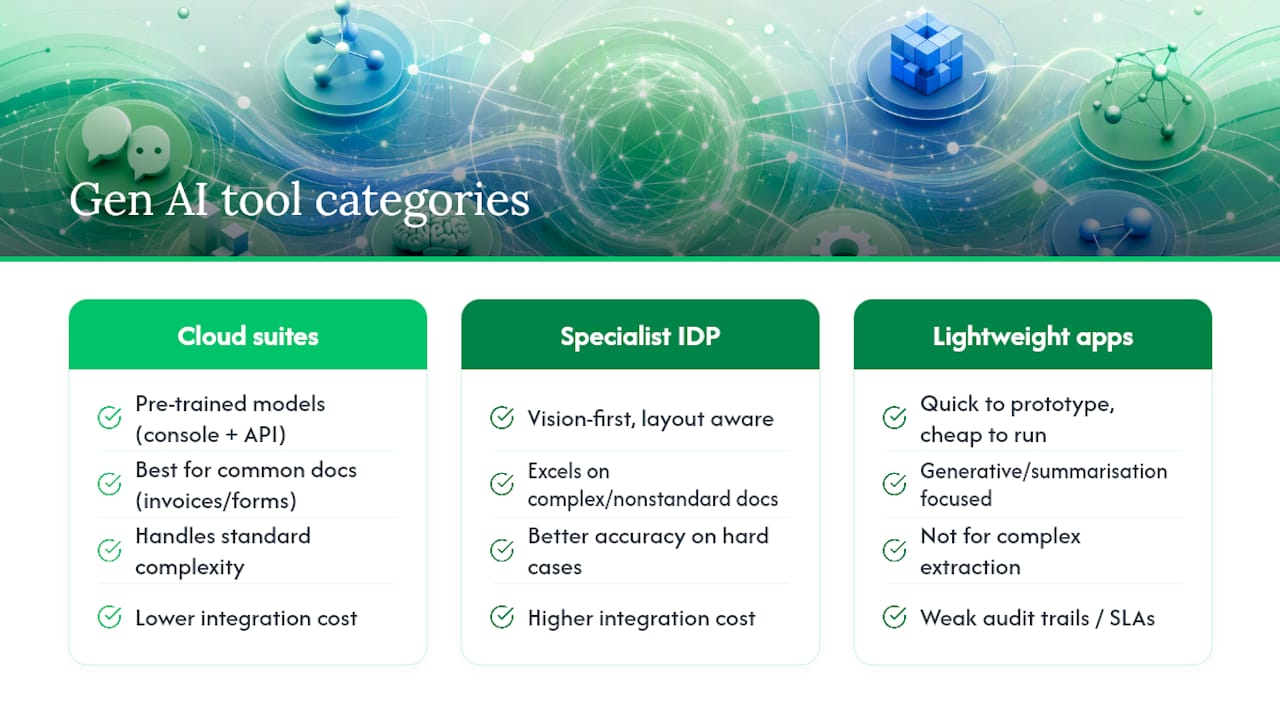
Specialist intelligent document processing platforms lean toward vision-first, layout-aware extraction, and tend to perform better on complex, non-standard documents, technical schematics, multi-column legal filings, or handwritten claim forms, where generic models often struggle. They typically cost more to integrate but pay that back on accuracy for difficult document classes.
Lightweight generator apps and browser-native summariser APIs sit at the opposite end. They are quick to prototype, cheap to run, and well suited to internal tools where governance requirements are lower, but they are not built for the audit trails, data residency guarantees, or SLA commitments that regulated industries need.
The right choice depends on document complexity, volume, and regulatory exposure, not on which category has the most marketing budget behind it. A finance team processing thousands of structured invoices monthly has very different needs from a legal team handling a smaller volume of highly variable contracts. Matching the tool category to the document class, rather than picking a single platform for every workflow, is usually the difference between a pilot that scales and one that quietly gets abandoned after six months.
Privacy and security considerations for document AI
Document AI systems routinely handle personally identifiable information, financial records, and confidential commercial terms, which makes data handling the first governance question, not an afterthought bolted on later. Where processing happens matters: models hosted within your own cloud tenancy or on infrastructure with contractual data residency guarantees carry a fundamentally different risk profile from a general-purpose public API that may retain inputs for model improvement.

Redaction needs to happen at the right point in the pipeline. Stripping PII before content reaches a model that is not fully isolated within your environment is safer than redacting after the fact, since a poorly configured system can leak sensitive fields into logs, prompts, or downstream outputs before redaction ever runs.
Access controls and audit logging matter just as much as the model choice itself. Every extraction, summary, or generated draft should carry a record of which model version produced it, who reviewed it, and what source document it came from, both for internal quality control and for regulatory audits that increasingly expect this level of traceability in financial services and insurance.
Compliance requirements vary by jurisdiction and by document type, so a single privacy approach rarely covers every use case a large enterprise runs. A supplier onboarding workflow processing tax documents faces different retention rules from a claims workflow handling medical records, and treating them identically is a common, avoidable mistake.
The enterprise-ready playbook: what actually matters
The conventional advice on document AI treats it as a model selection problem: pick the right large language model, feed it your documents, and the accuracy gains follow. That framing is backwards. The model choice matters far less than the surrounding architecture, chunking strategy, grounding, validation logic, and the human review points built around it.
Most vendor pitches oversell the “drop in and go” story, and most product roundups compare models on benchmarks that have nothing to do with your actual document mix. What the research and deployment experience actually supports is a duller conclusion: governance discipline predicts success better than model quality does. A mediocre model with strong grounding and tight human-in-the-loop review will outperform a state-of-the-art model deployed without either.
If you take one thing from this, prioritise Phase 2 validation before you scale volume. Teams that rush from prototype straight to production, skipping reconciliation checks and confidence thresholds, are the ones that end up firefighting after a client-facing error. Build the review process first, then let automation take on more of the routine cases as accuracy proves itself over time. That order rarely gets reversed successfully.
— Thomas Samuel
How Sentient Concepts helps you move from pilot to production
Sentient Concepts is the alternative to a fragmented vendor stack for enterprise document automation, one accountable team runs your project from strategy through to daily operations, instead of a consultancy handing you off to a systems integrator who then hands you off again to whoever manages the servers.
If you are still assessing whether your document volumes and formats justify a pilot, the AI Strategy & Roadmap service starts with a readiness review, mapping your document types, current bottlenecks, and realistic success criteria before any engineering begins. Where the groundwork is already clear, Data & Platform Engineering builds the extraction, grounding, and validation pipeline itself, and Managed AI Operations keeps it monitored, retrained, and governed once it is live, so the accountability that started the project does not disappear at go-live.
A first conversation typically covers your document volume, current manual process, and a realistic pilot scope, usually a single workflow you can measure within four to eight weeks. Book a readiness review with Sentient Concepts’s AI Strategy & Roadmap team to find out what that pilot would look like for your document workflows.
Sources
FAQ
Is there an AI that can generate documents?
Yes. Generative AI models can draft contracts, reports, and summaries directly from source data or prompts, and platforms like the ones Sentient Concepts implements combine this with extraction and validation for enterprise use.
How can I use AI to process a document?
Upload or feed the document into a document AI system that parses its layout, extracts relevant fields or text, and applies summarisation or generation depending on the workflow, most enterprise platforms support PDF, Word, and plain text input.
Can ChatGPT generate a document?
ChatGPT can draft text-based documents such as letters, summaries, or reports from a prompt, but it lacks the built-in layout-aware parsing, audit trails, and confidence scoring that enterprise document workflows typically require for regulated use.
Is there an AI I can upload documents to for analysis?
Several platforms, including Microsoft’s Azure summarisation service and specialist intelligent document processing tools, accept uploaded documents and return extracted data, summaries, or generated drafts, with enterprise platforms adding governance controls that general chat tools do not include.
What is the difference between extractive and abstractive summarisation?
Extractive summarisation selects existing sentences from the source text, making it easier to audit, while abstractive summarisation generates new sentences that condense meaning, which reads more naturally but is harder to trace back to the original wording.
Recommended