Insurance predictive analytics: the UK enterprise guide

What insurance predictive analytics means for UK insurers
Insurance predictive analytics applies statistical modelling, machine learning, and real-time data integration to forecast risks, anticipate claims behaviour, and price policies with far greater precision than traditional actuarial methods allow. For UK insurers operating under the Prudential Regulation Authority and Financial Conduct Authority frameworks, that precision carries direct regulatory and commercial weight.
The operational case is well established. A 2023 industry study found that adopting predictive analytics in insurance improves operational efficiency by 60% and customer experience by 95%. Those figures reflect a genuine structural shift: carriers that once responded to loss events are now identifying risk concentrations before a claim is ever filed.
The shift is enabled by several converging forces:
Real-time data integration from IoT sensors and telematics feeds continuous signals into live pricing and risk models, moving insurers from annual renewal cycles to dynamic, policy-level monitoring.
Agentic AI architectures allow models to act autonomously on predictions, triggering underwriting decisions or claims escalations without manual intervention.
ICE-Ai (Intelligent Claims and Evidence AI) processes unstructured documents, claim notes, and correspondence alongside structured policy data, giving models a richer evidence base.
Regulatory alignment with UK GDPR and the FCA’s Consumer Duty requires that predictive models be explainable and auditable, making governance a design requirement rather than an afterthought.
Expert guidance from practitioners such as Christine O’Brien and technology partners including Guidewire reinforces that predictive analytics is most effective when embedded as a pillar of digital transformation, not deployed as a standalone tool.
The result is a discipline that touches every stage of the insurance value chain, from initial risk selection through to reserve setting and customer retention.
Table of Contents
How predictive analytics reshapes claims and underwriting
Claims severity prediction and FNOL triage
General insurance carriers spend approximately 40% of claim processing time manually assigning claims to handlers. Predictive complexity scoring at First Notice of Loss eliminates most of that overhead by routing claims automatically based on predicted severity, legal exposure, and fraud indicators. High-complexity claims reach specialist handlers within minutes; straightforward cases proceed through automated settlement tracks.

Accuracy improves further when unstructured claim notes are incorporated. Multimodal frameworks that combine deep learning on unstructured text with ensemble methods on structured data consistently outperform pure tabular approaches on severity prediction. BERT-based NLP models, for instance, extract diagnostic and repair narratives from claim records to refine loss estimates beyond what numerical variables alone can achieve.
Explainability is not optional in a regulated environment. SHAP values provide handler-level explanations for each severity score, satisfying both internal audit requirements and the FCA’s expectation that automated decisions affecting customers can be interrogated and justified.
Predictive underwriting and dynamic pricing
Granular risk modelling allows underwriters to price at the policy level rather than the segment level, using hundreds of variables simultaneously. Fraud signals, credit indicators, geospatial data, and behavioural telematics can all feed a single underwriting model, reducing adverse selection and improving loss ratios.
Pro Tip: Align your modelling horizon to your product type before selecting algorithms. As Christine O’Brien notes, short-tail motor products require short-horizon models tuned to recent claims patterns, while long-tail liability products demand multi-year projections with different feature sets entirely.
Guidewire’s experts advise treating predictive analytics as foundational infrastructure rather than a departmental add-on. Dynamic pricing, risk selection, and customer engagement all depend on the same underlying model layer; siloing them creates duplication and governance gaps.
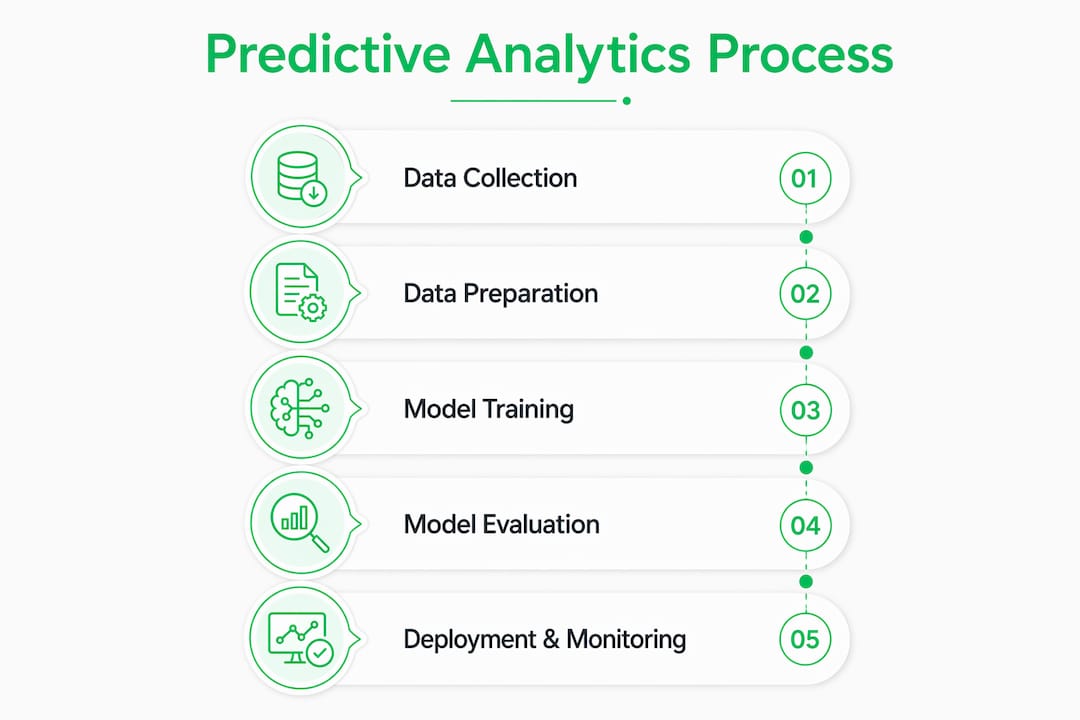
Key implementation steps for claims and underwriting analytics:
Audit existing structured and unstructured data sources for completeness and quality before model development begins.
Define modelling horizons by product line, separating short-tail from long-tail requirements.
Build multimodal pipelines that ingest claim notes, images, and correspondence alongside policy data.
Deploy SHAP or equivalent explainability frameworks at inference time, not retrospectively.
Integrate model outputs directly into claims management and underwriting workbenches via API.
Establish continuous monitoring for data drift and feature degradation, triggering retraining when performance thresholds are breached.
Granularity mismatch and data sparsity are the most common reasons models underperform in production. Hybrid strategies that use high-level models for reserve planning and granular segment-specific models where data density supports them balance accuracy against sustainability.
Why Sentientconcepts is the right partner for this work
Sentientconcepts delivers end-to-end AI services for insurance from initial data diligence through to managed operations, with a single accountable team across the entire lifecycle. There are no handoffs between strategy consultants and implementation engineers; the same team that designs the model architecture deploys and monitors it in production.
Key differentiators for insurance clients include:
Agentic AI for underwriting: Sentientconcepts’ Agentic AI capability enables autonomous underwriting decisions triggered by predictive model outputs, reducing manual touchpoints without sacrificing governance.
ICE-Ai for document intelligence: ICE-Ai processes unstructured claims evidence at scale, feeding richer inputs into severity and fraud models.
Explainability by design: Every model Sentientconcepts deploys incorporates SHAP-based transparency, meeting UK regulatory expectations from day one.
Proven ROI discipline: ROI measurement across data costs, talent, infrastructure, and long-term benefit is built into every engagement, not treated as a post-implementation exercise.
Continuous optimisation: Managed AI operations include ongoing model monitoring, drift detection, and retraining, so predictive accuracy does not degrade as market conditions evolve.
What to look for when selecting an AI consulting partner
The right partner for insurance predictive analytics is not simply the one with the most impressive model library. Enterprise leaders should assess on five dimensions.
Regulatory fluency matters as much as technical capability. A partner unfamiliar with the FCA’s Consumer Duty or the PRA’s model risk management expectations will create compliance debt that costs more to resolve than the original engagement. Ask for specific examples of explainability frameworks deployed in regulated UK environments.
End-to-end accountability separates genuine partners from project vendors. Many firms hand off from strategy to implementation to a third-party managed services provider. Each handoff introduces risk: context is lost, accountability diffuses, and model performance degrades without anyone owning the outcome.
Data readiness support is frequently underestimated. Predictive models are only as good as the data feeding them. A credible partner conducts structured data diligence before committing to model performance targets, identifying gaps in claims history, policy data completeness, and third-party data availability.
Domain depth in insurance accelerates delivery. General AI consultancies can build models; partners with insurance-specific experience understand the actuarial constraints, regulatory reporting requirements, and operational workflows that determine whether a model gets adopted or abandoned.
Scalability planning should be part of the initial scope, not a later conversation. Partners who design for production scale from the outset avoid the costly rearchitecting that plagues proof-of-concept projects promoted to enterprise deployment.
Platforms such as Intelligent Assessments demonstrate how regulated-sector assessment infrastructure can complement predictive analytics deployments, particularly where compliance workflows intersect with model governance requirements.
Scalability and infrastructure for enterprise deployment
Predictive analytics at enterprise scale demands infrastructure decisions made early. Cloud-native architectures on platforms such as Microsoft Azure or AWS give UK insurers the elastic compute needed for nested stochastic modelling and real-time inference without the capital expenditure of on-premise hardware. However, data residency requirements under UK GDPR constrain where training data and model artefacts can be stored, making UK-region cloud deployments the default for most carriers.
MLOps pipelines are the operational backbone. Without automated model versioning, feature store management, and inference monitoring, production models drift silently. The practical standard for enterprise insurance deployments includes CI/CD pipelines for model updates, A/B testing frameworks for challenger models, and alerting on feature distribution shifts that precede accuracy degradation.
Integration architecture deserves equal attention. Predictive outputs are only valuable when they reach the systems where underwriters and claims handlers work. API-first design, with model endpoints callable from policy administration and claims management platforms, is the pattern that delivers adoption rather than shelf-ware.
Measuring ROI and performance after deployment
ROI measurement for predictive analytics projects must account for costs that are easy to undercount: data acquisition and cleansing, specialist talent, infrastructure, and the ongoing expense of model maintenance. Against those costs, the measurable benefits include reduced claim handling time, improved loss ratios, lower fraud leakage, and higher straight-through processing rates.
The most reliable performance metrics for insurance predictive analytics deployments are:
Loss ratio improvement measured against a pre-deployment baseline, segmented by line of business.
Claim cycle time reduction from FNOL to settlement, tracked at the handler and model-routing level.
Fraud detection rate expressed as the proportion of flagged claims confirmed as fraudulent, with false positive rates monitored to protect customer experience.
Model accuracy metrics including Gini coefficient, lift curves, and calibration plots, reviewed on a defined cadence.
Operational cost per claim as a composite measure of automation benefit.
Governance of these metrics requires a model performance dashboard accessible to both technical and business stakeholders. When a metric degrades, the root cause, whether data drift, a market shift, or a process change, must be diagnosable without a full model rebuild.
Sentientconcepts delivers measurable results for insurance leaders
Sentientconcepts offers insurance enterprises a concrete alternative to the fragmented consulting model, where strategy, build, and operations are split across separate firms with no single point of accountability.
From AI strategy and data readiness through to managed AI operations that keep models performing in production, Sentientconcepts covers the full lifecycle under one engagement. For UK insurers building or scaling predictive analytics capabilities, that continuity reduces delivery risk, accelerates time to value, and ensures that regulatory obligations around explainability and audit trails are met from the outset. Contact Sentientconcepts to discuss your predictive analytics roadmap and what a structured deployment engagement looks like for your organisation.
Key takeaways
Insurance predictive analytics delivers its greatest value when deployed as enterprise infrastructure, not as isolated models, with explainability, data governance, and continuous monitoring built in from the start.
Point | Details |
Operational impact is substantial | A 2023 study found predictive analytics improves operational efficiency by 60% and customer experience by 95%. |
Claims triage is the fastest win | Automating FNOL complexity scoring removes approximately 40% of manual claim assignment time. |
Modelling horizon alignment matters | Christine O’Brien advises scaling time horizons to product type to avoid short- versus long-term forecasting errors. |
Explainability is a regulatory requirement | SHAP-based frameworks satisfy FCA and PRA expectations for auditable, transparent model decisions. |
Sentientconcepts covers the full lifecycle | End-to-end accountability from data diligence through managed operations reduces delivery risk for UK insurers. |
Recommended