Invoice processing automation for UK finance teams: 2026 guide

Automated invoice processing is the use of AI-powered software to extract invoice data, validate it against purchase orders and contracts, and route it through approval workflows without manual intervention. For UK finance and accounts payable teams, the case for adoption has never been clearer. Regulatory pressure from HMRC’s Making Tax Digital initiative, persistent cost pressures on operational budgets, and the growing volume of supplier invoices arriving in unstructured formats all compound the risk of staying anchored to manual processes. The core technologies involved are optical character recognition (OCR), large language models for classification, three-way matching engines, and ERP integration layers. Together, they replace a process that historically consumed days per invoice cycle with one that can complete in minutes.
Key drivers for UK businesses adopting automated invoice management include:
HMRC compliance requirements for VAT records and audit trails
Reduction of manual keying errors that distort cash-flow forecasting
Faster supplier payment cycles that protect supplier relationships
Support for remote and hybrid finance teams who cannot rely on paper-based workflows
Scalability to handle invoice volume growth without adding headcount
What features should you prioritise in invoice automation software?
The difference between a capable platform and a costly disappointment usually comes down to a handful of specific capabilities, not the breadth of the feature list.
AI-powered invoice data extraction is the foundation. Platforms built on AI-native document intelligence, rather than legacy rule-based OCR, handle varied invoice formats, poor scan quality, and multi-language documents far more reliably. Microsoft’s Document Intelligence invoice model, for instance, extracts header fields, line items, and vendor details across multiple languages, returning structured JSON ready for ERP ingestion. Choosing between a pure OCR tool and an AI-native platform depends on whether your priority is preserving document appearance or extracting structured data for downstream systems.
Three-way matching and approval workflows are equally critical. Automated matching of invoice data against purchase orders and goods receipts eliminates the most labour-intensive step in accounts payable. Approval workflows must be configurable by value threshold, cost centre, and supplier type, with clear escalation paths for exceptions.
Additional capabilities worth evaluating:
Semantic mapping of invoice fields to General Ledger codes, which is a common failure point when treated as an afterthought rather than a data integration task
End-to-end ingestion from email inboxes, supplier portals, and scanned PDFs
Human-in-the-loop exception routing so ambiguous invoices reach the right reviewer without rework
VAT and HMRC compliance controls built into the validation layer
Real-time dashboards showing invoice status, approval bottlenecks, and payment forecasts
Pro Tip: Before evaluating vendors, map your current invoice ingestion channels. Platforms that cannot ingest directly from your primary channel, whether that is email, an EDI portal, or a supplier self-service portal, will create a manual handoff that undermines the entire automation.
How does invoice automation benefit UK accounts payable teams?
The operational gains from automated invoice management are well documented, but the compliance benefits are often underestimated by UK finance teams.
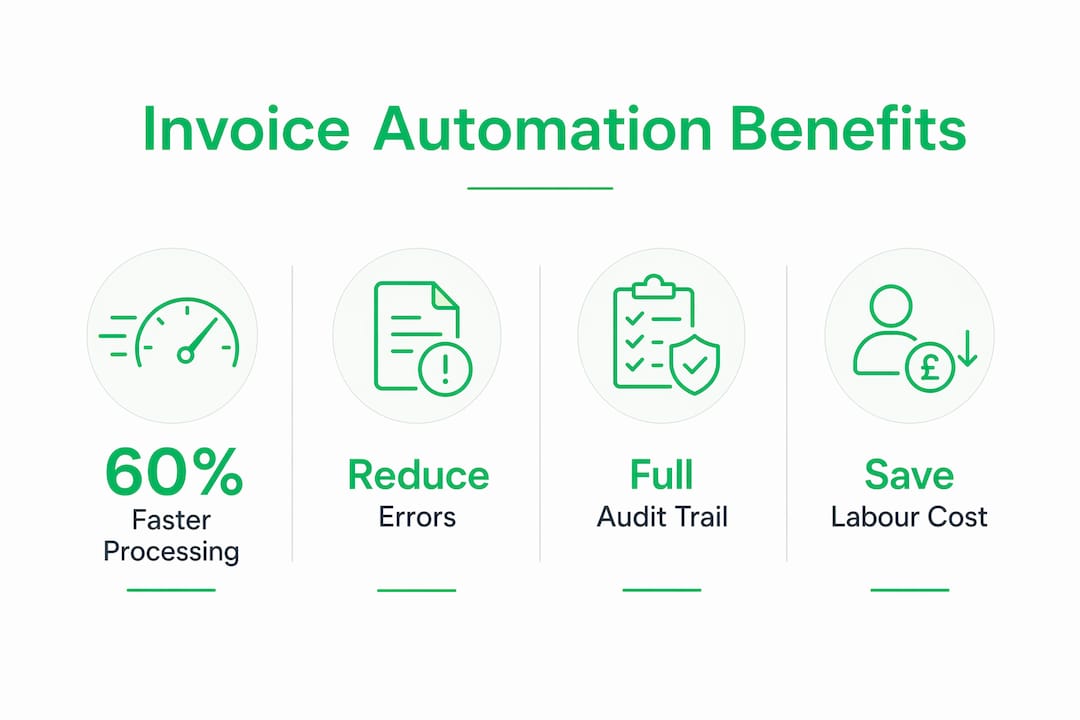
Processing speed improves substantially when manual keying is removed from the critical path. Errors that distort supplier account balances and delay payment runs become far less frequent. Faster processing also means earlier visibility into outstanding liabilities, which directly improves cash-flow forecasting accuracy. Tipalti’s AP automation platform, for example, is built around the premise that faster supplier payments and compliance controls are inseparable goals, not competing ones.

From a compliance standpoint, automated audit trails are a material advantage. Every invoice action, receipt, match, approval, and payment, is timestamped and logged without manual record-keeping. For UK businesses subject to HMRC VAT inspections, that audit trail is not a convenience; it is a requirement. Sage’s HMRC-recognised payroll and finance automation suite demonstrates how compliance can be embedded directly into automated workflows rather than bolted on afterwards.
The cost reduction from eliminating paper-based processes and reducing manual labour is real, though the magnitude varies by organisation size and current process maturity. The less-discussed gain is fraud reduction: automated three-way matching catches duplicate invoices and mismatched amounts that manual review frequently misses.
Which providers offer invoice processing automation for UK businesses?
The market for invoice workflow solutions serving UK organisations spans dedicated AP automation platforms, ERP-integrated suites, document management specialists, and consulting-led implementations. Each category suits a different organisational profile.
Provider | Best for | Core AI features | Key integrations | Specialisation | Rating |
Small to mid-sized UK businesses | AI data extraction, AP automation, Sage Copilot | Sage Intacct, HMRC MTD, payroll | HMRC-recognised compliance, full finance suite | 4.3★ (157) | |
Small UK businesses | Invoicing automation | UK SME accounting tools | Simple SME invoicing | 5★ (31) | |
Mid-sized businesses needing document management | AP automation, document workflow | DocuWare, ABBYY, ERP, CRM | 30+ year DocuWare partner, ABBYY partner | 5★ (16) | |
Businesses prioritising invoice matching | Three-way matching automation | ERP systems | Advanced matching accuracy | 4.8★ (10) | |
Enterprises with global payment needs | AI-powered AP, mass payments, compliance | ERP, procurement, treasury | Global compliance and payment automation | 3.6★ (10) | |
Businesses needing accurate AI data capture | AI data extraction, three-way matching, PO coding | ERP systems | AI-driven capture for PO and non-PO invoices | 4.2★ (9) | |
Service organisations with frequent purchases | AI invoice processing, approval workflows | Cloud accounting platforms | AP automation with audit trail controls | 5★ (5) | |
SAP and Coupa users | Automation implementation, ongoing optimisation | SAP, Coupa | Consulting-led AP automation for SAP/Coupa | 4.4★ (5) | |
Small businesses and freelancers | Cloud invoicing automation | UK accounting tools | Simplified cloud invoicing | 4★ (4) | |
Small to mid-sized UK companies | Web-based invoicing automation | Online accounting | Web-based invoicing | — | |
Businesses seeking end-to-end AP automation | Invoice capture, approval workflows, payment | ERP systems | Complete AP workflow automation | — | |
Sentient Concepts | Enterprises needing custom AI implementation | AI document processing, GenAI, predictive analytics | Finance, ERP, operational systems | End-to-end AI strategy through managed operations | — |
Sage is the natural starting point for most UK SMEs. Its HMRC-recognised status and Sage Copilot AI agent for AP automation mean compliance and efficiency are addressed within a single platform, without requiring separate integration work.

DocTech stands apart through its 30-year DocuWare partnership and additional ABBYY and Kodak Alaris credentials. For mid-sized organisations with complex document workflows across multiple departments, that depth of integration expertise is difficult to replicate with a pure-SaaS alternative.
Tipalti addresses a specific gap: enterprises managing supplier payments across multiple currencies and jurisdictions. Its compliance controls for mass payments are built for organisations where a single AP platform must serve finance teams in several countries simultaneously.
Iron Mountain brings its AI-powered invoice data extraction capability to organisations that process high volumes of both PO-backed and non-PO invoices. The distinction matters because non-PO invoices require more sophisticated coding logic, and Iron Mountain’s AI handles both within the same workflow.
Zahara Software offers a 30-day free trial, which is a practical advantage for service organisations that want to validate approval workflow configuration before committing. Its audit trail controls are particularly relevant for organisations subject to external audit.
Cogent Consulting is not a software vendor; it is a specialist consultancy that implements and optimises invoice automation for organisations already running SAP or Coupa. For those platforms, the gap between a default installation and a well-configured one is considerable, and Cogent’s continuous improvement focus addresses exactly that gap.
Sentientconcepts operates at a different level of the stack. Rather than providing a pre-built AP platform, it designs and deploys custom AI systems for finance and document processing, covering everything from AI strategy and data diligence through to managed operations. For enterprises whose invoice processing requirements do not fit a standard SaaS template, or who need AI integrated across multiple finance functions simultaneously, that end-to-end accountability is the differentiating factor.
InvoiceBerry.com and invoice24 serve freelancers and small businesses that need straightforward cloud invoicing with basic automation, without the configuration overhead of enterprise platforms.
InvoiceHQ and Quadient AP Automation by Beanworks round out the market for businesses seeking web-based or end-to-end AP workflow solutions respectively.
How should UK businesses implement invoice automation effectively?
Deployment failures in invoice automation almost always trace back to the same root cause: automating a broken process rather than redesigning it first. Conducting a readiness and data diligence assessment before selecting a platform is not optional; it determines whether the project delivers its projected ROI or creates a more expensive version of the original problem.
Practical steps that consistently improve outcomes:
Map every invoice ingestion channel before platform selection, as prioritising ingestion channels optimises end-to-end automation efficacy
Treat General Ledger mapping as a data integration project, not a configuration task, to avoid the most common accuracy failure
Design human-in-the-loop exception handling from the outset, because routing ambiguous invoices to the right reviewer is what keeps straight-through processing rates high
Involve finance, IT, and key suppliers in the design phase to align on invoice formats, approval hierarchies, and compliance standards
Train AP teams on exception management rather than data entry, which is where their expertise adds most value post-automation
Evaluate ROI across compliance savings, fraud reduction, and staff redeployment, not only processing cost per invoice
Pro Tip: Do not automate your current approval hierarchy without reviewing it first. Organisations that carry over legacy approval chains into automated workflows often find that bottlenecks simply move from the inbox to the approval queue.
Sentientconcepts: custom AI for finance teams that need more than a SaaS platform
Where pre-built AP platforms reach their limits, Sentientconcepts delivers. For UK finance and operations teams whose invoice processing spans multiple systems, unstructured formats, or complex compliance requirements, a standard SaaS tool often addresses only part of the problem. Sentientconcepts designs and deploys end-to-end AI systems, from initial AI strategy and roadmap through to managed AI operations, with a single team accountable across the entire lifecycle.
The practical difference is continuity. There are no handoffs between a strategy consultant, an implementation partner, and a managed services provider. Sentientconcepts covers all three, which means the AI system that goes live is the one that was designed, not a compromised version that survived a series of vendor transitions. For finance leaders who have seen automation projects stall at integration or fail at scale, that accountability model is worth examining closely. Speak to the Sentientconcepts team about what a tailored AI approach could deliver for your AP function.
Key takeaways
Automated invoice processing delivers measurable gains in speed, accuracy, and compliance for UK finance teams, but only when the underlying process is sound and the platform fits the organisation’s actual requirements.
Point | Details |
AI-native extraction outperforms legacy OCR | Platforms using AI document intelligence handle varied formats and languages more reliably than rule-based OCR tools. |
GL mapping is the most common failure point | Treating General Ledger code mapping as a data integration task, not a configuration step, prevents the most frequent accuracy failures. |
Compliance is built in, not bolted on | HMRC-recognised platforms like Sage embed VAT and audit trail controls directly into automated workflows. |
Ingestion channels determine end-to-end success | Mapping email, portal, and scan channels before platform selection is what separates full automation from a partial solution. |
Sentientconcepts | Designs and deploys custom end-to-end AI for finance teams whose requirements exceed standard AP platform capabilities. |
Recommended