ROI in 2–3 Quarters: Malaysian Manufacturing AI Pilots That Scale

AI is worth pursuing for Malaysian manufacturers, but only when scoped tightly. Predictive maintenance, visual quality inspection and targeted process optimisation deliver the clearest returns, and government programmes plus shared R&D facilities cut the upfront cost and risk of getting started. The right first move is not a company-wide rollout. It is a short data audit followed by a single pilot with defined KPIs.
TL;DR:
Most successful AI pilots focus on a single high-risk asset or defect category, with clear KPIs and a three to six month timeline.
A data audit is essential before modeling, requiring four to twelve weeks to map sensors, records, and legacy machine capabilities.
Upgrading frontline staff skills in interpreting AI outputs and system alerts is more critical than hiring data scientists initially.
Government grants like SmartMFG+ and MDAG-AI can cover up to 70% of solution development costs, reducing initial financial risk.
Partnering with an end-to-end AI provider ensures continuity in implementation, maintenance, and scaling beyond the pilot stage.
Table of Contents
Manufacturing AI in Malaysia: where adoption actually stands
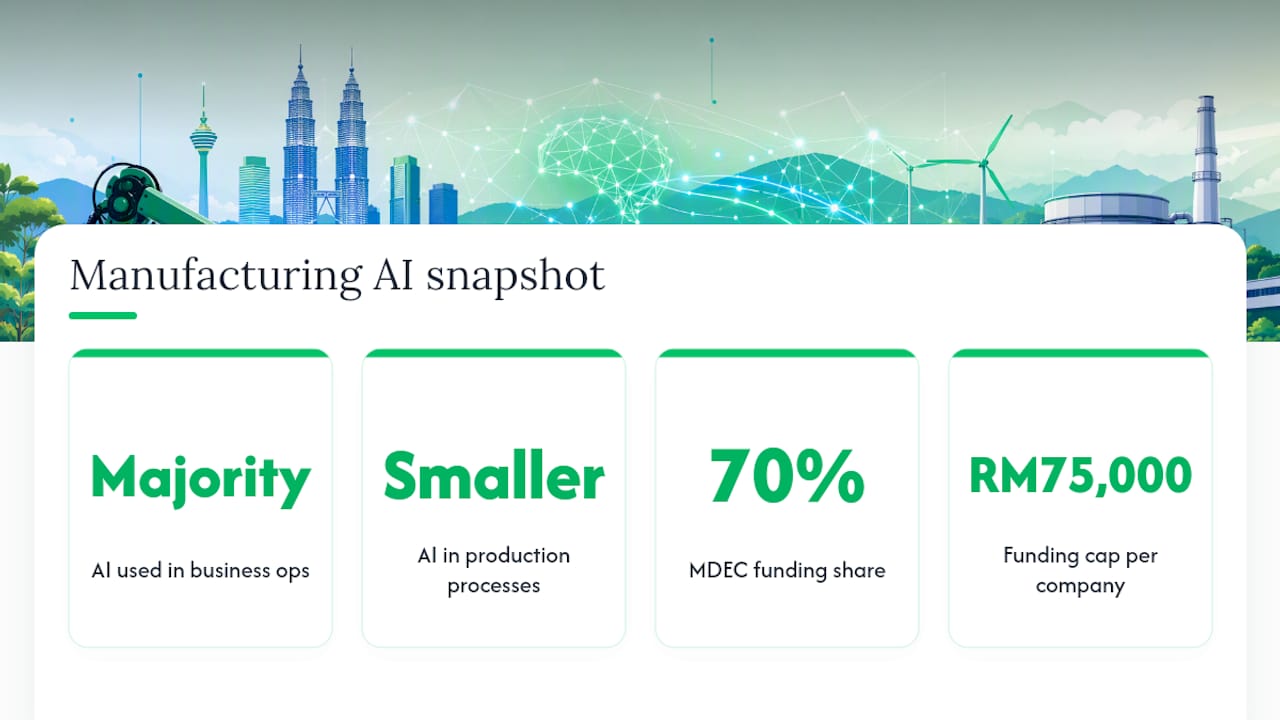
Malaysian manufacturers are further along than the shop floor suggests. Industry 4.0 adoption is at a notable level across manufacturing respondents, according to a recent FMM survey. Among those adopters, a majority use AI software for general business operations, while a smaller portion have implemented AI within production processes.
That gap tells you something practical: business-side AI (drafting reports, automating document workflows, running conversational agents) is easier to switch on than factory-floor AI, which needs sensors, historical data and integration work. Most manufacturers are picking up the easy wins first and leaving deeper transformation for later. That is not a failure of ambition. It is a sensible sequencing if you use the early wins to fund the harder projects.
Government support has scaled up to match. MDEC’s SmartMFG+ Incentive Programme funds selected Malaysia Digital (MD)-status companies for up to 70% of solution development costs, capped at RM75,000 per company, alongside the newer MDAG-AI programme aimed at accelerating industrial AI commercialisation.
Set expectations accordingly. A production-ready predictive maintenance system rarely arrives in weeks. Most manufacturers see meaningful ROI within two to three quarters of a well-scoped pilot, not from a single quarter of experimentation.
Where does AI actually help on a Malaysian factory floor?
The use cases with the strongest evidence base cluster around three areas: keeping machines running, catching defects earlier, and squeezing more consistent output from existing lines.
Predictive maintenance relies on vibration, temperature and current sensors feeding anomaly-detection models that flag a failing bearing or motor before it stops the line. Local implementation case notes report unplanned breakdown reductions of up to 50% when the sensor programme is focused on a plant’s highest-risk assets rather than spread thin across every machine. A dedicated guide to predictive maintenance walks through sensor selection and model choices in more depth.
Computer vision for defect detection replaces or supplements manual visual inspection on packaging lines, PCB assembly and metal fabrication, catching micro-defects a tired inspector might miss on the two thousandth unit of a shift.
Other high-value applications include:
Process parameter tuning that lifts first-pass yield without new capital equipment
Demand and inventory forecasting that reduces both stockouts and excess raw material holding
Document automation for purchase orders, delivery notes and supplier invoices
Conversational agents that handle routine internal queries, freeing operations staff for exception handling
Pro Tip: Pilot computer vision on your single highest-defect-rate line first. A narrow scope with visible results builds the internal case for expanding into predictive maintenance, which typically needs more sensor investment and a longer payback horizon.
How do you start an AI pilot without wasting a year on it?
The single biggest failure pattern among Malaysian SMEs is not a bad algorithm. It is starting the model before the data is ready. Interview-based research on SME adoption found that connecting legacy machines and cleaning historical records consistently takes longer than training the model itself. Sequence the work accordingly.
Run a data audit first. Map which machines have sensors, which run on legacy PLCs with no digital output, and what historical quality or downtime records already exist. Budget four to twelve weeks for this stage.
Pick one asset group, not the whole plant. A single high-risk production line or a single defect category gives you a controllable pilot with a realistic three to six month timeline.
Set measurable KPIs before you build anything. Overall Equipment Effectiveness (OEE), defect rate per thousand units, and mean time to repair (MTTR) are the three metrics most pilots should track from day one.
Check grant eligibility early. SmartMFG+ and MDAG-AI both target specific project types and MD-status holders; confirming eligibility before scoping avoids redesigning your pilot around funding rules midway through.
Evaluate vendor proposals on continuity, not just price. Ask who owns the model after deployment, who monitors drift, and what happens when the original implementation team moves on.
Most pilots that stall do so at step one or two, not at the algorithm.
Which teams need training before the technology arrives?
Hiring a data scientist is rarely the priority. Upskilling the people who already run the line is. Plant engineers, ops managers and frontline technicians need to read model outputs and act on them, and that is a training problem more than a recruitment one, a point reinforced by Malaysian Smart Factory 4.0’s own competency framework.
Malaysian Smart Factory 4.0 (MSF 4.0), run by SHRDC, offers hands-on, device-level courses covering industrial data logging, machine learning data analytics, OEE fundamentals and generative AI prompt engineering. These are practical sessions on physical equipment, not slide decks.
Priority roles to train first:
Plant engineers, so they can interpret anomaly alerts rather than dismissing them as noise
Data engineers, who handle the unglamorous work of connecting legacy machines and cleaning sensor feeds
Operations managers, who translate model outputs into scheduling and maintenance decisions
Frontline technicians, who need to trust and act on system alerts in real time
Vendor-led knowledge transfer during a pilot works best paired with structured in-house training. Otherwise capability walks out the door with the consultants.
What shared facilities help Malaysian SMEs test AI without heavy upfront capital?
Building custom infrastructure is rarely necessary before you have proven a use case. MIMOS’s SMISP (Smart Manufacturing Intelligent Service Platform) gives SMEs cloud-based tools, device connectors and pre-built applied solutions, shortening the path from idea to working prototype.
SIRIM runs smart manufacturing centres for testing, digital integration and validation, useful when a solution needs independent verification before wider rollout. Meanwhile, SMART2030 initiatives, including the ONIT shared innovation ecosystem and the TechCAT fund, support solution providers developing and validating industrial AI tools, reinforcing what the Ministry of Science, Technology and Innovation frames as a long-term national priority rather than a short-lived incentive scheme.
How does an end-to-end partner change the outcome of an AI project?
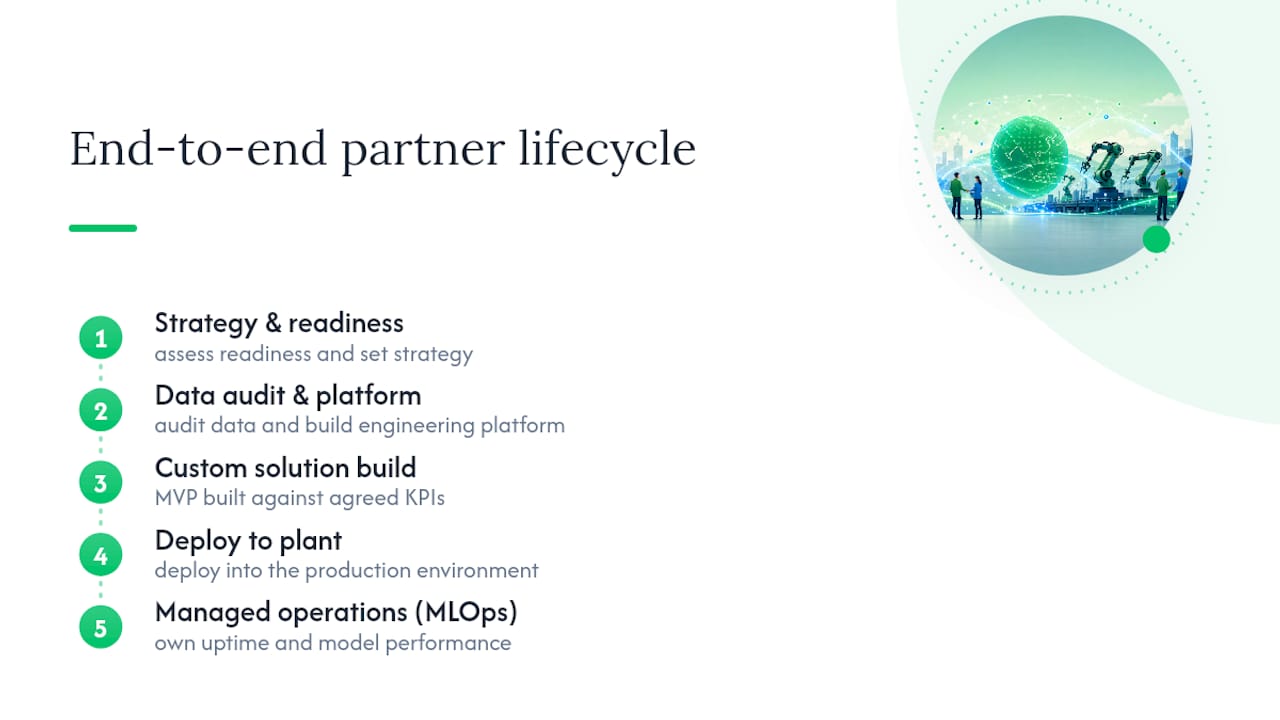
Most stalled pilots share one root cause: the team that scoped the strategy is not the team that operates the system a year later. Sentient Concepts works across that entire lifecycle: strategy and readiness assessment, custom AI and GenAI solution build, data and platform engineering, and managed operations once the system is live.
For a manufacturing pilot, that typically means running the data audit, building an MVP against agreed KPIs, deploying it into the plant environment, then holding accountability for uptime and model performance through MLOps rather than handing off to an internal team unprepared for the maintenance burden. Continuity across those phases, with clear service-level commitments, is usually what separates a pilot that scales from one that quietly dies after the grant funding runs out.
What Malaysian manufacturers get wrong about AI readiness
Most leaders treat AI adoption as a technology purchase decision. It is closer to a workforce and data-readiness project with technology attached at the end. The manufacturers seeing real returns audited their data first, trained their engineers second, and only then scoped the pilot, not the reverse order most vendors pitch.
Grants and shared labs exist precisely to remove the excuse of upfront cost. Use SmartMFG+, MDAG-AI or SMISP to de-risk the first pilot rather than waiting for a bigger budget cycle. What actually determines success afterwards is whether someone owns the system operationally, tracking drift, retraining models, and answering for the KPIs, long after the initial build is finished.
— Thomas Samuel
Start your AI pilot with a partner who stays past deployment
Most manufacturers choosing between a fragmented vendor stack and an internal build end up with neither continuity nor accountability once the initial project wraps. Sentient Concepts is structured differently: one team carries the work from AI strategy and roadmap through to data and platform engineering and managed AI operations, so there is no handoff gap where an under resourced internal team inherits a system nobody trained them to run.
For manufacturers scoping a first pilot, that means one accountable partner from the data audit through to production monitoring, whether the project involves predictive maintenance sensors, defect detection, or automating supplier document processing that currently ties up operations staff. Readers weighing broader automation partnerships may also find value in 121 Groups automation services as a comparison point.
If you are planning a pilot and want to understand which grant programme fits your project, get in touch with the manufacturing team at Sentient Concepts to scope a focused pilot with measurable KPIs before you commit budget to a wider rollout.
Where to check the current programme details
MDEC’s grant announcement for SmartMFG+ and MDAG-AI eligibility
MIMOS SMISP for shared platform access
MSF 4.0 (SHRDC) for training schedules and course content
A broader view of Malaysia’s AI grant landscape for eligibility across programmes
Sources
FAQ
Which is the leading AI company in Malaysia?
There is no single official ranking, but MIMOS holds a distinct position as the national R&D institution behind SMISP, while firms like Sentient Concepts specialise in end-to-end AI delivery for manufacturers. A broader view of the market appears in this overview of AI industry leaders in Malaysia.
Which companies use AI in manufacturing?
FMM survey data shows 36% of Malaysian manufacturers have adopted Industry 4.0 technologies, with 49% of those adopters using AI within production processes and 62% using it for business operations such as document handling and reporting.
What are the top manufacturing companies in Malaysia?
Malaysia’s manufacturing sector spans electronics, semiconductors, automotive parts and petrochemicals, with major clusters in Penang, Selangor and Johor; specific rankings vary by output and are not tracked by a single authoritative source referenced here.
What is the best AI approach for manufacturing?
The strongest results come from narrow, KPI-driven pilots, predictive maintenance on high-risk assets or computer vision on a single defect-prone line, rather than plant-wide automation attempts. Partnering with a team that manages both build and ongoing operations, such as Sentient Concepts, reduces the risk of a pilot stalling after the initial deployment phase.
Recommended