Process mining vs task mining: a practical guide
Process mining reconstructs end-to-end business flows from system event logs; task mining captures the desktop-level actions a person takes within a single step. The recommended sequence is straightforward: use process mining first to identify where problems exist across your systems, then apply task mining selectively to understand precisely how work is being executed inside those problem areas.
Three quick signals to help you orient:
Data source: process mining reads event logs from ERP, CRM, and workflow engines; task mining records clicks, keystrokes, and application switching on individual desktops.
Best-for use case: process mining suits enterprise-scale bottleneck and compliance analysis; task mining suits micro-inefficiency and UI friction discovery.
Common output: process mining produces discovered process maps, conformance checks, and throughput metrics; task mining produces task timelines, automation candidate scores, and screen-level friction reports.
Table of Contents
What is process mining and what does it produce?
Process mining is a data-driven technique that extracts event logs from transactional systems — SAP, Salesforce, Oracle, ServiceNow — and reconstructs the actual sequence of activities that occurred across every case. The output is not a consultant’s whiteboard diagram; it is an objective, evidence-based map of how your processes truly run, including every variant, rework loop, and bottleneck.
Academic and vendor resources commonly divide process mining into three activities: discovery (building the as-is process map from raw logs), conformance checking (comparing actual behaviour against a defined model), and enhancement (enriching the model with performance data such as cycle times and resource costs). Each type answers a different question, which is why process mining is often critical before ERP migrations or compliance programmes — it creates an objective baseline that workshops and interviews simply cannot match.

Process mining is the right starting point when the problem is systemic: high cycle-time variance across thousands of cases, unexplained compliance deviations, or unclear root causes that span multiple systems. Process mining creates an objective as-is baseline and supports continuous monitoring for transformation programmes in finance, manufacturing, and insurance.
Pro Tip: When configuring your first process-mining analysis, apply case filters early. Running discovery across every case variant in a large ERP can surface hundreds of paths, most of which are statistical noise. Narrow to the top 80% of case volume first, then expand to outliers once the dominant flow is understood.
What is task mining and what does it capture?
Task mining operates at the desktop level. It deploys lightweight agents on employee workstations to record screen events: which applications are open, where the cursor moves, what is typed, when windows switch, and how long each interaction takes. The result is a granular timeline of how a person actually executes a step that process mining can only see as a single event in a log.
Typical outputs include task execution timelines, UI friction maps, copy-paste pattern reports, and scored lists of automation candidates. Crucially, task mining reveals redundant applications, inefficient screen layouts, and copy-paste patterns — findings that can remove the need for automation entirely in some cases, rather than simply wrapping a broken workflow in RPA.
Desktop capture is inherently personal data under UK GDPR. Before any task mining pilot, organisations must establish a lawful basis — typically legitimate interest with a documented balancing test, or explicit consent — and implement pseudonymisation at the point of capture. The ICO’s guidance on employee monitoring is the primary reference for UK organisations, and a Data Protection Impact Assessment (DPIA) is strongly advisable before deployment.
Privacy governance is not optional, and it shapes adoption. Practitioners emphasise anonymisation and careful change management to avoid employee resistance and protect privacy. Employees who understand what is and is not recorded, and who see the results used to improve their working environment rather than to monitor performance, are far more likely to engage constructively.
Pro Tip: Before instrumentation begins, run a short briefing session with affected teams. Share a sample anonymised output so employees can see exactly what the data looks like. Resistance drops significantly when people understand that individual keystrokes are aggregated, not reviewed.

How do process mining and task mining compare?
The two technologies are complementary, not competing. Process mining shows structural bottlenecks at scale; task mining reveals micro-inefficiencies and UI friction that logs cannot capture. The table below organises the key differences across the dimensions that matter most for procurement and programme planning.
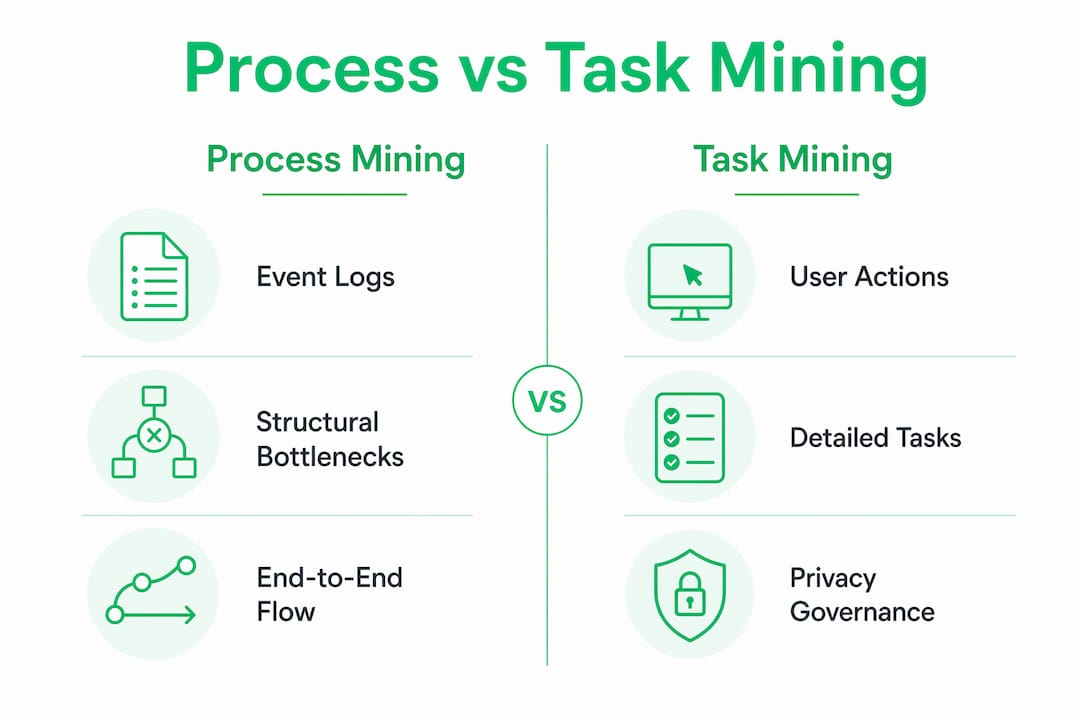
Dimension | Process mining | Task mining |
Scope / analytical layer | End-to-end process flows across systems | Task-level user interactions on a single desktop |
Primary data sources | System event logs (ERP, CRM, workflow engines) | Desktop agents (clicks, keystrokes, screen events) |
Typical outputs | Process maps, conformance checks, cycle times, bottleneck reports | Task timelines, UI friction maps, automation candidate scores |
Best-for use cases | Order-to-cash, procure-to-pay, claims, onboarding at scale | Data entry, desktop reconciliation, agent desktop workarounds |
Deployment complexity | Moderate: requires log extraction, data mapping, case ID alignment | Low to moderate: agent install, anonymisation configuration |
Privacy and governance risks | Lower: system logs rarely contain personal data directly | Higher: desktop capture is personal data under UK GDPR |
Typical timeline / ROI | Pilot in a few weeks; measurable ROI within several months | Pilot in a few weeks; ROI depends on automation or redesign scope |
Process mining strengths and limitations
Analyses thousands of cases objectively, without observer bias.
Surfaces compliance deviations and rework loops invisible to interviews.
Requires clean, well-structured event logs; poor data quality degrades output.
Cannot explain what happens inside a step that appears as one log entry.
Task mining strengths and limitations
Captures the lived reality of desktop work, including workarounds.
Identifies automation candidates with measurable effort and frequency data.
High variability or complex processes are a poor fit for task-mining-only approaches because recordings often reflect a specific user’s happy path rather than the full population of behaviour.
Carries significant privacy obligations under UK GDPR.
Two short examples illustrate the difference in practice. An accounts payable team processing 50,000 invoices per month is a process mining problem first: the log reveals which invoices are rerouted, how many approval steps occur, and where cycle time inflates. Once process mining identifies that manual matching is the bottleneck, task mining on the matching step reveals whether the friction is a UI layout issue, a missing system integration, or a genuine data quality problem. In an order-to-cash flow, process mining maps the end-to-end sequence from order receipt to cash application; task mining then examines the cash application step where analysts manually reconcile remittance advice against bank statements.
When should you use process mining, task mining, or both?
The choice depends on the nature of the problem and the scale of the evidence needed.
Process mining is the right tool when you need to understand a process that spans multiple systems and involves hundreds or thousands of cases. Typical scenarios include:
Preparing for an ERP migration and needing an objective as-is baseline.
Investigating why order-to-cash cycle times vary by a factor of three across customer segments.
Running a compliance audit against a defined process model in financial services or insurance.
Identifying which of twenty candidate processes should be prioritised for automation investment.
Task mining is the right tool when the process-level problem is already located and the question is how work is executed at the desktop. Typical scenarios include:
Understanding why a claims handler takes 40 minutes on a step that should take 10.
Identifying copy-paste patterns between a legacy system and a spreadsheet that could be eliminated.
Scoring RPA candidates by actual effort and frequency rather than stakeholder estimates.
Diagnosing UI friction in a customer service agent desktop that is driving average handling time up.
Combined use cases are where the most significant transformation outcomes occur. An insurance claims operation might use process mining to identify that 30% of claims follow an exception path, then use task mining to understand the desktop behaviour driving those exceptions. A hyper-automation programme that skips the process mining layer risks automating steps that are themselves unnecessary, embedding inefficiency permanently. Manufacturing supply chain teams can use process mining to map supplier onboarding end-to-end, then task mining to identify where document handling friction slows the process at the operator level.
Expected timelines are realistic rather than aspirational. A focused process mining discovery on a single process typically produces initial findings within four to eight weeks. A task mining pilot on a targeted step can yield automation candidate scores within two to four weeks. Full redesign and automation deployment following both analyses typically runs several months for a single process.
How do process mining and task mining work together?
Process mining gives the ‘where’ and task mining gives the ‘how’ — integrating both prevents automating steps that should be removed entirely. The practical sequence runs as follows:
Run process mining discovery on the target process using event logs from your core systems. Identify the top variants by volume, the steps with the highest cycle-time variance, and any conformance deviations.
Prioritise target steps for deeper investigation. Select the two or three steps where process mining shows the greatest bottleneck or rework signal.
Instrument with task mining on those specific steps. Deploy desktop agents on a representative sample of users performing those steps, with anonymisation configured before capture begins.
Analyse and validate task mining outputs against process mining case volumes. A pattern observed in task mining is only worth acting on if it appears in a significant proportion of cases, not just in one user’s recording.
Design the intervention — whether that is a UI change, a system integration, an RPA bot, or a process redesign — based on the combined evidence.
Deploy and measure against agreed KPIs, then feed results back into continuous process monitoring.
KPIs to measure at each layer:
Process mining layer: case cycle time, variant frequency, rework rate, conformance score.
Task mining layer: time on screen per task, error rate, application switch frequency, copy-paste occurrence.
Combined: FTE hours saved, reduction in exception rate, automation bot accuracy post-deployment.
Integrating outputs requires discipline around data alignment. Case IDs from the process mining log must be linkable to the task mining recordings so that a specific desktop session can be traced to its position in the end-to-end flow. Timestamps must be synchronised, and contextual metadata — user role, team, system version — should be captured consistently across both datasets.
Implementation and governance for UK organisations
Governance is non-negotiable, and it should be designed before instrumentation begins, not retrofitted after the first data quality issue surfaces.
UK GDPR requires that any processing of personal data has a documented lawful basis. For task mining, where desktop capture records individual behaviour, organisations should complete a Data Protection Impact Assessment before deployment, implement pseudonymisation at the point of capture, define a clear data retention period, and maintain records of processing activities as required under Article 30. The ICO’s guidance on monitoring at work is the authoritative reference for UK employers.
A structured implementation checklist reduces the risk of programme failure:
Appoint a steering group that includes the process owner, data protection officer, IT security lead, legal counsel, and HR representative. Governance decisions made without this group tend to be reversed later at cost.
Define the lawful basis for desktop capture and document the balancing test if relying on legitimate interest.
Select instrumentation approach: for process mining, agree log export formats and case ID standards with IT; for task mining, select an agent that supports anonymisation at capture.
Run anonymisation configuration before any live capture. Verify that names, free-text fields, and sensitive screen content are masked in the output.
Pilot on a small, consenting cohort — typically 10–20 users on a single process step — before scaling.
Define security controls: data storage location, access controls, encryption at rest and in transit.
Communicate with employees before and during the pilot, sharing sample anonymised outputs.
Scale to full roll-out once the pilot validates data quality, governance compliance, and stakeholder acceptance.
Timeline guidance: a governed pilot typically runs four to eight weeks; full roll-out for a single process, including redesign and automation deployment, typically takes several months.
How do you choose between process mining and task mining?
The single decisive question is: is the problem systemic or executional? If you cannot yet locate where in the end-to-end flow the problem sits, process mining comes first. If the location is known and the question is how work is done inside a specific step, task mining is the appropriate instrument.
Vendor questions worth asking during procurement:
Which event log formats and source systems do you support natively?
How does your platform integrate with our existing data platform or data warehouse?
What anonymisation controls are built into the desktop agent, and at what point in the capture pipeline are they applied?
How does the platform scale from a single-process pilot to enterprise-wide monitoring?
What is the licensing model — per process, per user, or consumption-based?
Does the platform support continuous monitoring, or is it a point-in-time discovery tool?
Red flags to watch for:
A vendor that leads with automation recommendations before process validation has been completed.
Desktop capture tools that do not anonymise at the point of capture, requiring manual redaction later.
Platforms with no data lineage or audit trail for the event logs they process.
Proposals that skip process mining entirely and go straight to task mining across a broad population.
Success metrics to define in the business case before procurement:
Target reduction in case cycle time (expressed as a percentage or absolute days).
Target reduction in exception or rework rate.
FTE hours to be freed through automation or redesign.
Compliance incidents avoided per quarter.
How Sentient Concepts delivers integrated process and task mining
Sentient Concepts provides end-to-end AI consulting and implementation across strategy, engineering, and managed operations — covering the full arc from process discovery through to deployed automation and continuous monitoring.
The delivery methodology follows the sequence described above, with governance embedded at each stage:
Discovery and data readiness: audit event log quality, identify case ID structures, and assess desktop capture feasibility and GDPR obligations.
Process mining baseline: run discovery and conformance analysis on the target process, producing a prioritised list of bottlenecks and automation candidates.
Targeted task mining pilots: instrument the highest-priority steps with anonymised desktop capture, validate findings against process-level case volumes.
Design and automation: translate combined insights into redesign specifications, RPA configurations, or UI changes, with a clear business case for each.
Deployment and measurement: deploy changes, instrument KPIs, and establish continuous monitoring so the programme does not end at go-live.
Illustrative outcomes from this approach include material reductions in invoice processing cycle time in accounts payable, measurable decreases in claims handling exceptions in insurance, and FTE capacity released through targeted automation in finance operations. These outcomes are representative of the type of transformation Sentient Concepts supports; specific results depend on process complexity, data quality, and organisational readiness.
For organisations in finance, manufacturing, logistics, or insurance considering a first engagement, a scoped discovery pilot is a practical starting point. Sentient Concepts’ AI strategy and roadmap service provides the prioritisation framework before any instrumentation begins.
Key takeaways
Process mining and task mining deliver the most value when used in sequence: process mining identifies where to look, and task mining explains what is happening inside the problem area.
Point | Details |
Start with process mining | Use event logs to locate bottlenecks and prioritise before any desktop instrumentation. |
Apply task mining selectively | Instrument only the steps process mining has already flagged as high-priority. |
Governance before instrumentation | Complete a DPIA and configure anonymisation before any desktop capture begins under UK GDPR. |
Validate task findings at scale | Cross-reference task mining patterns against process mining case volumes to avoid optimising a rare happy path. |
Sentient Concepts as delivery partner | Sentient Concepts integrates both techniques across strategy, build, and managed operations for finance, manufacturing, logistics, and insurance clients. |
Why most teams get this backwards
The most common mistake is not choosing the wrong tool — it is applying task mining too early and too broadly. Teams under pressure to demonstrate automation ROI reach for desktop capture because it produces vivid, granular outputs quickly. A recording of someone copying data between two screens is immediately compelling to a sponsor. The problem is that without process mining context, there is no way to know whether that copy-paste step occurs in 5% of cases or 80%, whether it is on the critical path, or whether the underlying process should be redesigned rather than automated.
Automating a task identified by task mining without first validating its role in the end-to-end process can embed unnecessary work permanently. An RPA bot that faithfully replicates a workaround is not a transformation; it is a workaround with a maintenance contract.
The culture dimension is equally underestimated. Employees are not unreasonable to feel uncomfortable when desktop agents are deployed without explanation. The organisations that navigate this well treat anonymisation as a design principle, not a compliance checkbox, and they involve employees in interpreting the findings. When a team sees that task mining data led to a better screen layout or the removal of a redundant approval step, the technology becomes an ally rather than a surveillance instrument.
Finally, process and task mining programmes that are designed as one-off projects tend to decay. The process changes, systems are updated, and the baseline becomes stale within months. Instruments and dashboards should be designed for continuous improvement from the outset, with monitoring thresholds that trigger re-analysis when KPIs drift.
Sentient Concepts’ process and task mining pilot offer
Knowing which process to target and how to govern the data are the two decisions that determine whether a process or task mining programme delivers measurable returns or stalls in a pilot. Sentient Concepts works with enterprise clients in finance, manufacturing, logistics, and insurance to move from those first decisions to deployed, monitored outcomes without the handoff gaps that typically slow transformation programmes.
A fast-track discovery engagement covers event log assessment, process mining baseline analysis, and a scoped task mining pilot on one high-priority step — typically producing a prioritised automation and redesign roadmap within six to eight weeks. For organisations that need the governance and data architecture in place before instrumentation, Sentient Concepts’ data and platform engineering capability covers log extraction, anonymisation pipelines, and integration architecture. To discuss a pilot engagement or request a process readiness assessment, contact Sentient Concepts directly through the enquiry page.
Useful sources
The following authoritative sources underpin the technical claims in this article and are recommended for further reading.
What Process Mining Is, and Why Companies Should Do It — Harvard Business Review: the foundational case for process mining as a management discipline; consult this for strategic framing and executive buy-in arguments.
What is Process Mining? | IBM — IBM Think: clear technical primer covering discovery, conformance, and enhancement; useful for explaining the three types to a technical audience.
Process Mining vs. Task Mining | Appian — vendor-neutral comparison of analytical layers, data sources, and outputs; consult for the comparative analysis and happy-path validation warning.
Process Mining vs Task Mining | SAP Signavio — covers use-case differentiation and sequencing guidance; useful for procurement briefs.
How process mining and task mining work together | Pega — practical integration guidance including the ‘where vs how’ framing and the risk of automating without process context.
ICO guidance on monitoring at work — the primary UK reference for lawful basis, DPIA requirements, and employee rights when deploying desktop capture tools.
What is Process Mining? | Celonis — detailed explanation of object-centric process mining and the relationship between process mining and AI; consult for advanced architecture questions.
FAQ
What is the difference between task mining and process mining?
Process mining analyses system event logs to reconstruct end-to-end business flows across thousands of cases, while task mining captures desktop-level interactions to explain how a person executes a specific step. The two technologies operate at different analytical layers and are most effective when used in sequence.
What are the three types of process mining?
The three types are discovery, conformance checking, and enhancement. Discovery builds the as-is process map from event logs; conformance checking compares actual behaviour against a defined model; enhancement enriches the model with performance data such as cycle times and resource costs.
What is the difference between a task and a process?
A process is an end-to-end sequence of activities that spans multiple systems and roles to deliver a business outcome, such as order-to-cash. A task is a discrete unit of work performed by one person at one point in that sequence, such as manually matching a remittance advice to an invoice.
Does Palantir support process mining?
Palantir Foundry surfaces process mining workflows as a dedicated mode within its analytics platform once a data connection is configured, enabling discovery and conformance analysis within the broader Foundry environment.
When should a UK organisation prioritise governance before deploying task mining?
Always — UK GDPR classifies desktop capture as personal data processing, requiring a documented lawful basis, a Data Protection Impact Assessment, and pseudonymisation at the point of capture before any live recording begins. The ICO’s guidance on monitoring at work is the authoritative reference.
Recommended