Regulatory reporting automation for UK enterprises
Adopt a data-first regulatory reporting automation programme that maps external standards such as eCTD 4.0 and IDMP to a single governed source of truth, then runs submissions through an auditable, validated pipeline. That is the verdict for enterprise leaders in finance, manufacturing, logistics, and insurance operating under UK regulatory oversight from the FCA, PRA, and MHRA. The single most valuable next step is a short discovery and data-diligence sprint: establish your golden set mappings, surface data gaps, and define a realistic pilot scope before committing capital to full-scale build. Sentient Concepts structures exactly this kind of engagement, with single-point accountability from strategy through to managed operations.
Table of Contents
Why automating regulatory reporting is now a strategic opportunity
What does a regulatory reporting automation platform actually need?
How should you govern the programme and align it to UK regulators?
Build, buy, or use a managed service: which model fits your enterprise?
How Sentient Concepts delivers end-to-end regulatory reporting automation
The case for treating compliance as a capability, not a project
Why automating regulatory reporting is now a strategic opportunity
The regulatory environment is not getting simpler. UK regulators are accelerating the shift from document-driven submissions to structured, data-driven formats. Regulatory data specialists confirm this market shift, noting that firms must reconcile internal vocabularies with externally defined controlled vocabularies to meet structured-data submission requirements such as IDMP and eCTD 4.0.
The commercial case is equally clear. Automation can reduce multi-day report assembly to minutes by pulling live governance data and applying framework-aware templates. That reclaimed time converts directly into faster time to market, lower audit-preparation costs, and reduced rework.
The 2024 World Class RIM study found that most companies are planning or piloting automation and AI projects, yet only a small percentage had fully operational advanced automation at scale — confirming that early movers hold a genuine competitive advantage.
The strategic shift is from defensive compliance to what practitioners call offensive efficiency: mapping regulatory requirements directly to risk and business strategy to create measurable regulatory KPIs. Firms that make this move gain real-time visibility into submission status, data quality, and inspection readiness rather than discovering gaps during an audit.
What does a regulatory reporting automation platform actually need?
Five technical layers must work together for automated compliance reporting to hold up under regulatory scrutiny.

Layer | Function | Key standards / tools |
Authoritative data model | Master data management (MDM) mapping internal vocabularies to golden sets | IDMP, eCTD 4.0, controlled vocabularies |
Ingestion | Intelligent document processing (IDP), API feeds, autoclassification | NLP, OCR, structured data parsers |
Validation and reconciliation | Business rules, ALCOA+ checks, data lineage tracking | GxP validation protocols |
Submission engine | Framework-aware renderer producing XML/JSON payloads with audit trail | eCTD 4.0, XBRL, electronic signatures |
Integration layer | Connectors to ERPs, data warehouses, RIM, QMS, eTMF systems | REST APIs, data lake/warehouse |
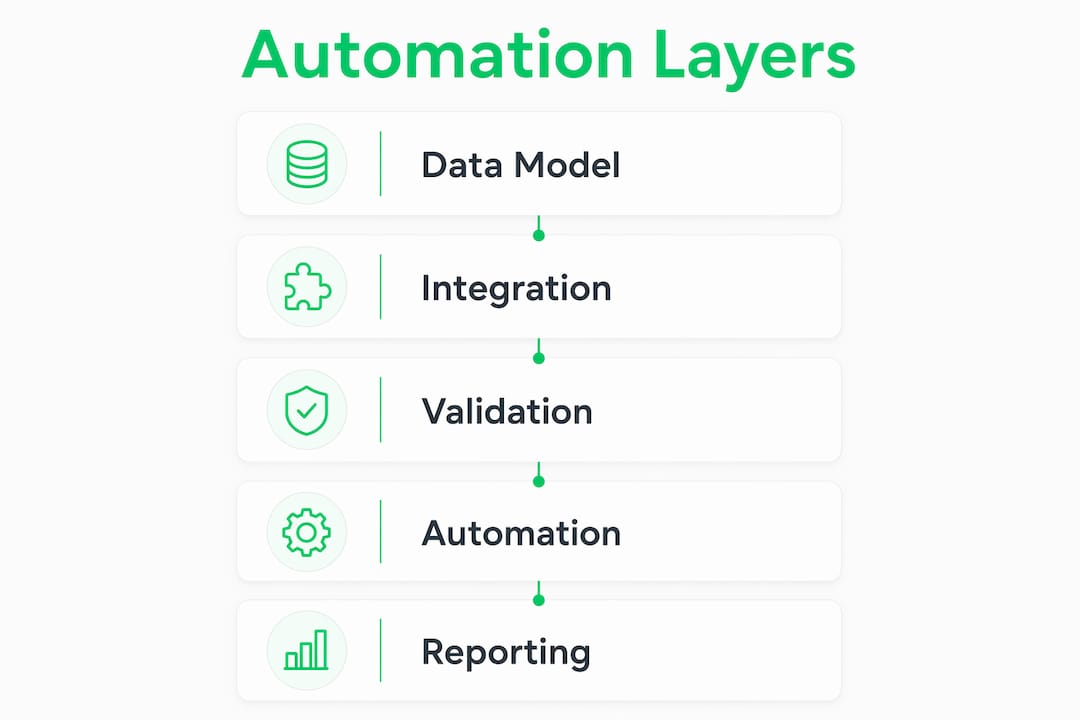
The 2024 World Class RIM study found that MDM, GenAI, and data aggregation platforms rank as the top near-term investments organisations are prioritising to support regulatory automation. A unified platform eliminates duplication and version conflicts across RIM, QMS, and eTMF, enabling constant inspection-readiness rather than periodic scrambles. Sentient Concepts’ intelligent document processing capability feeds directly into this ingestion layer.
Pro Tip: Treat ALCOA+ validation and formal system validation for GxP systems as project-critical activities. Surface them in the discovery timeline and budget — teams that defer validation planning routinely face six-to-twelve-week delays at the point of go-live.
What does a realistic delivery roadmap look like?
Proof-of-concept efforts frequently stall because organisations underestimate the data-quality work required to scale. The World Class RIM study identified technical and data-quality limitations as the most common blockers, which argues strongly for structured discovery upfront.
A phased approach manages this risk:
Discovery and data diligence (weeks 1–4): Audit source systems, map golden set vocabularies, identify data-quality gaps, and define pilot scope and success metrics.
Pilot: minimum viable submission pipeline (weeks 5–14): Build and validate the core ingestion, validation, and submission engine for one submission type or regulatory domain.
Scale and integration (months 4–9): Extend connectors to additional source systems (ERPs, QMS, eTMF), broaden submission coverage, and complete formal system validation.
Validate and operate (month 9 onwards): Transition to managed operations with MLOps monitoring, continuous data-quality checks, and a governance cadence for regulatory schema updates.
Major cost drivers are data-quality remediation, integration complexity (number of source systems), GxP validation effort, and submission framework engineering such as eCTD packaging. Large enterprises with heavily customised legacy systems should budget for integration and validation to represent the majority of programme cost, not the AI or automation tooling itself.
How should you govern the programme and align it to UK regulators?
Governance determines whether the programme holds up when the FCA, PRA, or MHRA comes knocking. Assign four named roles before the pilot begins: a data owner (accountable for source data quality), a data steward (day-to-day quality monitoring), a validation owner (GxP and system validation sign-off), and a regulatory submissions owner (accountable for submission accuracy and timeliness). A senior programme sponsor provides single accountability across all four.
“Data quality isn’t a one-and-done initiative. Teams should plan to iterate and refine data quality initiatives to better master data governance and ensure the right people are in the right roles.” — Veeva
UK GDPR and data residency controls must be embedded at the architecture stage, not retrofitted. For firms submitting to the MHRA, this means confirming that any cloud infrastructure processing personal or patient data is hosted within the UK or an adequacy-recognised jurisdiction. The FCA’s operational resilience requirements add a further obligation to demonstrate that automated submission pipelines have tested recovery procedures.
Pro Tip: Run a RACI workshop in week two of discovery. Undefined ownership of data quality is the single most common cause of stalled programmes — not technology.
A short controls checklist for every programme: ALCOA+ principles applied to all data inputs; full audit trail on every submission event; electronic signature controls meeting 21 CFR Part 11 or equivalent UK standards; and a scheduled revalidation cycle triggered by any material regulatory schema change.
Build, buy, or use a managed service: which model fits your enterprise?
The right operating model depends on your internal skills, validation appetite, and tolerance for long-term vendor dependency.
Model | Best fit | Key trade-off |
In-house build | Firms with mature data engineering teams and long-term control requirements | Highest upfront cost; full validation burden sits internally |
Buy and configure | Firms needing fast time-to-value with existing RIM/QMS infrastructure | Vendor lock-in risk; schema updates depend on vendor release cycles |
Managed service | Firms lacking specialist regulatory data or MLOps capability | Lower internal burden; requires strong SLAs and governance oversight |
Hybrid (build + managed) | Most large UK enterprises during initial scale phase | Balances control with speed; pragmatic for complex integration estates |
Vendor selection should prioritise demonstrable eCTD/IDMP expertise, GxP validation experience, documented integration APIs, and clear SLAs for regulatory schema updates. A useful starting point for comparing compliance management software options is available for teams conducting initial market scans.
For most UK enterprises in finance, manufacturing, and logistics, a hybrid model is the pragmatic choice during the scale phase: build the core data model and submission engine with a trusted partner, then transition to managed operations once the pipeline is validated and stable.
How do you measure whether the programme is working?
Veeva recommends data-quality dashboards with automated checks across five dimensions: timeliness, uniqueness, completeness, validity, and consistency. These form the foundation for operational KPIs that prove the programme is delivering value.
Core KPIs to track from day one of production:
Time to compile a submission (target: reduction from days to hours or minutes)
Submission error rate (target: below a defined threshold agreed with the regulatory submissions owner)
Inspection readiness score (percentage of required artefacts current and accessible)
Number of manual interventions per report cycle
Mean time to remediate a validation failure
ROI calculation should model labour hours reclaimed from manual assembly, reduction in rework costs, and audit-preparation savings. Continuous monitoring with framework-aware reporting keeps evidence current at generation time, which directly reduces the cost of responding to regulatory enquiries. Monthly governance reviews convert these metrics into board-level reporting, shifting compliance from a cost line to a measurable operational capability.
What risks derail regulatory automation programmes?
Risk | Likelihood | Impact | Mitigation |
Poor source data quality | High | High | Data-quality sprint in discovery; MDM before pilot |
Siloed systems and version conflicts | High | High | Data aggregation layer; unified platform approach |
Underestimating GxP validation time | Medium | High | Validation owner appointed in week one; budget ring-fenced |
Regulatory schema drift | Medium | Medium | Managed operations with schema-monitoring alerts |
Insufficient change management | Medium | High | Training programme; staged rollout; named change lead |
The most underestimated risk is change management. Technical delivery teams frequently complete the build on schedule, only to find that submission owners revert to manual processes because they distrust the new pipeline. A staged rollout with parallel running, combined with structured training and visible senior sponsorship, is the most reliable mitigation.
How Sentient Concepts delivers end-to-end regulatory reporting automation
Sentient Concepts operates on a single-accountability model: one team advises, builds, integrates, validates, and runs the solution. There are no handoffs between strategy and engineering, and no gap between the team that designs the operating model and the team that operates it.
Service modules map directly to programme phases:
AI strategy and roadmap: discovery sprint, golden set mapping, pilot scoping, and business-case development
Data and platform engineering: MDM design, data lake/warehouse build, and data-quality framework
Integration and architecture: connectors to ERPs, RIM, QMS, eTMF, and submission authorities
Deployment and MLOps: validated pipeline deployment, monitoring, and schema-update management
Ongoing optimisation: continuous improvement cycles, KPI reporting, and regulatory change absorption
Clients working with Sentient Concepts on financial services automation have reported material reductions in manual processing time and measurable improvements in audit readiness within the first ninety days of production operation.
In the first ninety days, clients receive a validated pilot submission pipeline, a data-quality baseline report, a governance RACI, and a prioritised integration backlog for the scale phase. The managed AI operations service then absorbs ongoing regulatory change without requiring repeated large-scale projects.
Key takeaways
Regulatory reporting automation succeeds when data governance, validated pipelines, and a managed operating model are built together from the outset, not assembled in sequence.
Point | Details |
Start with discovery | A two-to-four-week data-diligence sprint surfaces golden set gaps and sets a realistic pilot scope. |
Prioritise data governance | Appoint a data owner and data steward before the pilot begins; undefined ownership stalls programmes. |
Validate early | Budget GxP validation as a primary cost driver, not an afterthought, to avoid go-live delays. |
Pick the right operating model | Most UK enterprises benefit from a hybrid build-plus-managed-service model during the scale phase. |
Sentient Concepts | Delivers end-to-end regulatory automation with single accountability from strategy through to managed operations. |
The case for treating compliance as a capability, not a project
The conventional framing of regulatory reporting as a compliance obligation to be discharged as cheaply as possible is the wrong lens entirely. Firms that automate well do not simply reduce the cost of submissions. They build a data infrastructure that makes every future regulatory change cheaper to absorb, every audit faster to respond to, and every product launch better evidenced.
The trap most enterprises fall into is treating the first automation project as a one-off technology deployment. The organisations that extract lasting value treat it as the foundation of an ongoing operational capability, with dedicated data-quality roles, iterative improvement cycles, and a managed operations model that absorbs regulatory change as a matter of routine rather than crisis.
The discovery sprint is not a precaution. It is the highest-return investment in the programme, because it is the only stage where you can still change the scope without changing the budget.
Sentient Concepts’ regulatory automation assessment
The gap between a proof of concept and a production-grade, validated submission pipeline is where most programmes lose momentum. Sentient Concepts offers a structured discovery and data-diligence engagement that delivers a golden set mapping, a data-quality baseline, a validated pilot scope, and a phased delivery plan with defined success metrics, typically within four weeks.
For enterprise leaders in finance, manufacturing, logistics, and insurance, this engagement provides the evidence needed to secure board sponsorship and proceed with confidence. The AI strategy and roadmap service is the entry point, with a clear path to custom AI and GenAI solutions engineering and managed AI operations once the pilot is validated. Contact Sentient Concepts to scope your assessment and define the pilot that proves the value before you commit to full-scale delivery.
Useful sources
For technical teams and executive sponsors conducting due diligence, the following authoritative sources are recommended:
Regulatory standards and authorities:
MHRA guidance on eCTD submissions — primary reference for UK pharmaceutical and medical device submission formats
FCA regulatory reporting requirements — applicable to financial services firms under FCA supervision
PRA regulatory reporting — prudential reporting obligations for banks and insurers
UK GDPR guidance — ICO — data protection obligations relevant to automated processing of personal data
Industry studies and technical guidance:
2024 World Class RIM study — Gens & Associates — benchmarks automation maturity and investment priorities; suitable for executive sponsors building the business case
Quality-first approach to regulatory data — Veeva — practical guidance on data-quality KPIs and dashboards; suitable for data and regulatory operations teams
Regulatory data management in life sciences — Kivo — covers unified platform benefits and ALCOA+ validation; useful for technical architects
The 2024 World Class RIM study found that most companies are planning or piloting automation projects, yet only a small percentage had reached full-scale production — a gap that represents both the risk of delay and the opportunity for early movers.
FAQ
What is regulatory reporting automation?
Regulatory reporting automation replaces manual data assembly and submission processes with validated, auditable pipelines that pull from governed data sources and generate framework-compliant outputs for regulators such as the FCA, PRA, or MHRA.
How long does a regulatory reporting automation programme take?
Discovery and pilot phases typically run four to fourteen weeks; full-scale integration and validation for a mid-sized UK enterprise commonly takes four to nine months, depending on integration complexity and GxP validation scope.
What are the biggest risks in automating regulatory reports?
Poor source data quality and underestimated GxP validation timelines are the two most common programme blockers, as confirmed by the 2024 World Class RIM study. Both are best addressed in a structured discovery sprint before the pilot begins.
Which UK regulators does automated compliance reporting need to satisfy?
UK enterprises must align automated reporting to the FCA and PRA for financial services, the MHRA for pharmaceutical and medical device submissions, and the ICO’s UK GDPR requirements for any automated processing of personal data.
How does Sentient Concepts support regulatory reporting automation?
Sentient Concepts delivers end-to-end programmes covering AI strategy, data and platform engineering, integration, validated pipeline deployment, and managed operations, with single accountability across every phase from discovery to production.
Recommended