Route optimisation AI for UK fleet managers
- 16 hours ago
- 13 min read
Yes, AI can deliver measurable routing gains for commercial fleets, provided the constraints and data are correctly modelled. The practical next step is not a full deployment; it is a rapid data-readiness check followed by a small, scoped pilot on a subset of routes.
Three approaches are worth shortlisting before any procurement conversation:
SaaS/API integration (for example, the Google Maps Route Optimization API) — fastest to deploy, lowest engineering overhead, best for fleets with standard constraint sets.
Open-source solver plus engineering (OR-Tools combined with a mapping API) — more control over objective weighting, suited to teams with in-house data engineering capacity.
Commercial optimisation engine plus managed integration (such as NVIDIA cuOpt) — highest performance at scale, appropriate when constraint complexity or fleet size exceeds what SaaS tiers handle well.
The sections below explain how each works, what to measure, and how to run a pilot that produces a defensible business case.
Key takeaways
AI route optimisation delivers the most consistent results when constraints are correctly modelled and data quality is validated before the solver runs.
Point | Details |
Start with a data audit | Validate stop addresses, vehicle profiles, and service times before configuring any solver. |
Measure the right KPIs | Track mileage, fuel cost per route, on-time delivery rate, and vehicle utilisation from day one. |
Match the tool to fleet scale | SaaS/API suits smaller fleets; OR-Tools or NVIDIA cuOpt suits complex or large-scale operations. |
Model EV constraints explicitly | State of Charge and charging station limits must be hard constraints, not afterthoughts, for electric fleets. |
Sentient Concepts for end-to-end pilots | Sentient Concepts delivers data audit, solver integration, and measured KPI comparison in an 8–12 week pilot. |
Table of Contents
What is AI route optimisation, and how does it differ from standard routing?
What features and integrations should you require from a routing platform?
Last-mile, field service, and EV fleets: where AI routing makes the biggest difference
How Sentient Concepts approaches route optimisation implementation
What is AI route optimisation, and how does it differ from standard routing?
Standard map routing solves a single-vehicle, point-to-point problem. It finds the fastest or shortest path between two locations, accounting for live traffic. That is useful for a driver who needs directions, but it does not address the problem a fleet operator actually faces: assigning hundreds of stops across dozens of vehicles, respecting time windows, vehicle capacities, driver shift limits, and depot constraints, while minimising total cost across the whole fleet simultaneously.
AI route optimisation, more precisely called vehicle routing problem (VRP) solving with machine learning augmentation, treats the entire fleet as a system. A multi-objective solver trades off distance, drive time, fuel or energy cost, service-time windows, and vehicle-specific constraints in a single computation. Machine learning contributes travel-time predictions, demand forecasting, and driver behaviour modelling, but the core assignment and sequencing logic is deterministic optimisation, not a neural network guessing routes.
The practical difference shows up quickly. A map API will give each driver the best path for their pre-assigned stops. An AI routing system decides which stops each driver takes, in what order, and whether a stop should be deferred or reassigned in real time when a delay occurs upstream.
Three architectural options exist for UK fleets:
SaaS/API — configure objectives and constraints via an API; the vendor manages the solver infrastructure.
Open-source solver plus engineering — OR-Tools or similar, integrated with a mapping API for distance matrices; requires in-house or partner engineering.
Commercial solver plus managed integration — purpose-built engines such as NVIDIA cuOpt, typically deployed via a cloud or on-premises pipeline with a systems integrator.
Pro Tip: Define your operational KPIs and hard constraints before evaluating any vendor. A solver that cannot model your driver working-time directive limits or your EV State of Charge thresholds will produce plans that dispatchers override, which destroys adoption and makes the business case impossible to measure.
How does AI route optimisation actually work?
The pipeline has five recognisable stages, regardless of which technology sits underneath.
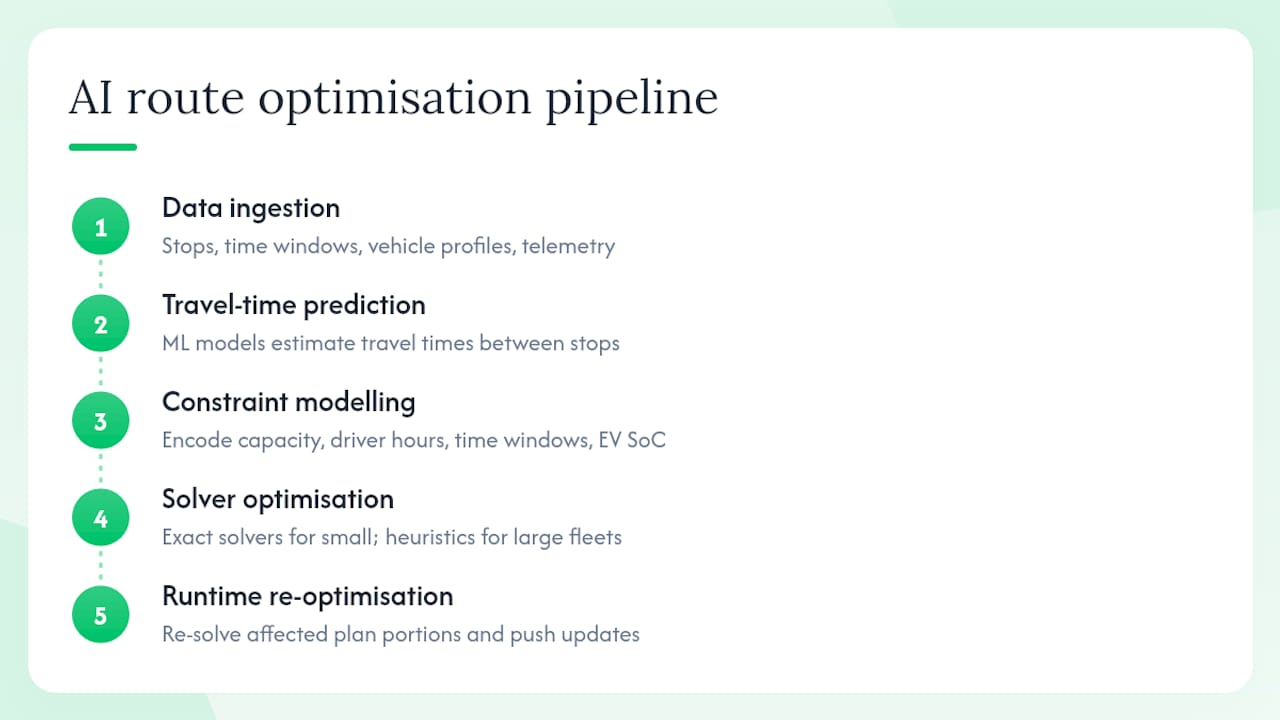
Stage 1 — Data ingestion. Stop locations, time windows, vehicle profiles (capacity, fuel type, shift start/end), and live telemetry feed into the system. Data quality at this stage is the single largest predictor of output quality.
Stage 2 — Travel-time prediction. ML models, trained on historical GPS traces and traffic data, produce estimated travel times between every stop pair. Google Maps Platform’s predictive traffic layer is one widely used source for this step. The Routific MCP integration illustrates how ML-predicted ETAs can be surfaced directly to an agent or dispatcher interface, returning ordered stops with distances and arrival estimates.

Stage 3 — Constraint modelling. Vehicle capacity, driver hours, time windows, depot return requirements, and EV State of Charge limits are encoded as hard or soft constraints. This is where most deployments go wrong: constraints that exist in the real operation but are absent from the model produce plans that cannot be executed.
Stage 4 — Solver. The optimisation engine searches for the best assignment and sequence. Exact solvers (branch-and-bound, integer programming) find provably optimal solutions for small problems. For large fleets, heuristics and metaheuristics (genetic algorithms, simulated annealing, large neighbourhood search) find high-quality solutions within a time budget. NVIDIA’s published workflow emphasises encoding operational KPIs directly into this solver pipeline so that outputs are executable from day one, not theoretical optima that dispatchers must manually adjust.
Stage 5 — Runtime re-optimisation. When a driver falls behind schedule, a stop is cancelled, or traffic conditions change, the system re-solves the affected portion of the plan and pushes updated instructions to the driver app. This is where AI routing separates itself most clearly from static planning tools.
A newer architectural pattern, demonstrated by the LLMAP research, pairs a large language model as a natural-language parser with a graph-search solver. The LLM extracts preferences from unstructured input (for example, a dispatcher’s note about avoiding a particular road or prioritising a customer), and the solver handles the optimisation with full constraint guarantees. This hybrid approach outperforms LLM-as-agent approaches where the language model attempts to solve the routing problem directly, which it cannot do reliably at scale.
What measurable benefits should your logistics team expect?
The primary gains reported across industry deployments cluster around five KPIs: total mileage, fuel cost per route, on-time delivery rate, vehicle utilisation, and CO2 per delivery. DHL’s analysis of AI in route planning confirms that well-implemented systems improve efficiency, reduce costs, and lower environmental impact simultaneously.
Field benchmarks from Musely’s route planner show up to a 24% average mileage reduction versus manually ordered routes, with sequencing of 120 stops completing in approximately 3 seconds. That speed matters operationally: a solver that takes 20 minutes to re-optimise after a delay is not useful for live dispatch.
KPIs worth tracking in a pilot:
Mileage per route — the most direct measure of solver quality.
Fuel cost per delivery — captures both mileage and driving behaviour changes.
On-time delivery rate — requires accurate POD timestamps to measure reliably.
Vehicle utilisation — load factor and active hours versus shift hours.
Average route duration — useful for driver planning and shift compliance.
CO2 per delivery — increasingly required for Scope 3 reporting under UK sustainability frameworks.
Good instrumentation is not optional. Telemetry (CAN bus or telematics platform), proof-of-delivery timestamps, and accurate vehicle profiles are the minimum data set for a credible before/after comparison. Without them, the business case rests on anecdote rather than evidence, which makes internal approval harder and vendor accountability impossible.
KPI | Measurement source | Pilot target |
Total mileage | Telematics / GPS trace | Baseline vs. optimised routes |
Fuel cost per route | Fleet card data | Reduction versus pre-pilot average |
On-time delivery rate | POD timestamps | Improvement versus SLA threshold |
Vehicle utilisation | Telematics active hours | Load factor and shift utilisation |
CO2 per delivery | Telematics + fuel data | Reduction for Scope 3 reporting |
What features and integrations should you require from a routing platform?
A procurement checklist for UK fleet operators should cover two dimensions: solver capabilities and integration points.
On the solver side, require support for time windows (hard and soft), vehicle capacity (weight, volume, and item count), driver working-time rules (compliant with the UK Working Time Regulations and EU drivers’ hours where applicable), live traffic and re-optimisation, EV State of Charge modelling with charging station constraints, depot and shift constraints, and multimodal support where relevant.
The Google Maps Route Optimization API demonstrates what a mature API-level offering looks like: configurable objectives (travel efficiency, on-time arrival, vehicle use cost), hard constraints (driver work hours, vehicle capacity, time windows), and both synchronous (optimizeTours) and asynchronous (batchOptimizeTours) endpoints for single and multi-vehicle fleets. Google Maps Platform also supports predictive traffic and eco-friendlier routing, with matrix operations handling up to 625 route elements in some configurations.
For open-source stacks, OR-Tools (Google’s open-source operations research library) is the most widely adopted solver for VRP problems in engineering teams. It is commonly paired with a mapping API for geocoding and distance matrix generation, as illustrated by open-source route-planner projects on GitHub that combine Google Maps Platform with OR-Tools for the TSP/VRP step.
NVIDIA cuOpt is the commercial solver to reference in RFPs for high-scale or GPU-accelerated requirements. It is designed for large constraint sets and rapid re-optimisation cycles.
On the integration side, the routing engine must connect to:
TMS — for shipment data, order management, and dispatch workflows.
Telematics / CAN bus — for live vehicle location, speed, and EV battery data.
Proof-of-delivery systems — for timestamp capture and exception management.
Driver apps — for turn-by-turn instructions and real-time updates.
ERP — for order volumes, customer SLAs, and billing data.
Ask vendors specifically about telemetry hooks, export formats (JSON, GTFS, proprietary), and re-optimisation latency under realistic fleet sizes.
How to implement AI route optimisation successfully
The most common reason deployments fail is not the algorithm. It is data hygiene: mismatches between the constraints modelled in the system and the constraints that actually govern operations. A vehicle profiled at 1,000 kg capacity that routinely carries 1,200 kg produces plans dispatchers cannot follow. The solver is not wrong; the model is.
A practical implementation checklist:
Define objectives and KPIs first. Agree on what success looks like before touching any technology. Mileage reduction? On-time rate? Fuel cost? Each objective shapes constraint design differently.
Run a data-readiness audit. Validate stop addresses, vehicle profiles, service times, and time windows against actual operations. This step typically takes two to four weeks and surfaces the majority of modelling problems before they reach the solver.
Design a small pilot. Select a representative subset of routes (not your easiest or hardest), limit the fleet to 10–20 vehicles, and run the optimised plan alongside the existing plan for four to six weeks.
Measure and iterate. Use the KPI framework above. Identify constraint mismatches from dispatcher overrides and fix the model before scaling.
Scale with MLOps and managed operations. Once the pilot demonstrates a positive result, operationalise the system with monitoring, model retraining schedules, and a clear escalation path for edge cases.
A practical pilot timeline runs 8–12 weeks: weeks 1–3 for data audit and constraint modelling, weeks 4–5 for integration and test runs, weeks 6–9 for live pilot operation, weeks 10–11 for measurement and model refinement, and week 12 for a go/no-go decision on broader rollout.
Common pitfalls beyond data hygiene: ignoring driver shift rules (which produces legally non-compliant plans), treating the solver as a black box with no human review step, and failing to build a roll-back plan so dispatchers can revert to manual planning if a system issue occurs during a live operation.
Pro Tip: Run A/B routing during the pilot: assign half the fleet to AI-optimised routes and half to standard planning, then compare KPIs directly. Backtesting on historical GPS traces before going live also helps validate that the solver’s outputs match what drivers actually achieved on those roads.
How do you pick the right approach for your UK fleet?
The decision between SaaS/API, open-source solver plus engineering, and a commercial engine with managed integration depends on four variables: fleet scale, constraint complexity, in-house engineering capability, and regulatory requirements.
For fleets under 50 vehicles with standard constraint sets, a SaaS/API approach is usually the fastest path to a working pilot. The engineering overhead is low, pricing is typically per-request or per-seat, and the vendor manages solver infrastructure. The trade-off is less control over objective weighting and solver behaviour.
Fleets with significant in-house data engineering capability and non-standard constraints (complex multi-depot operations, bespoke driver agreements, or unusual vehicle types) often get better results from an OR-Tools-based custom build. The open-source licence removes per-request costs at scale, but the engineering and maintenance burden is real.
Large fleets, EV-heavy operations, or use cases requiring sub-second re-optimisation at scale are the natural territory for commercial engines such as NVIDIA cuOpt, typically deployed via a systems integrator who manages the pipeline end to end.
UK-specific considerations worth raising in any RFP:
GDPR and data residency. Driver location data and customer delivery addresses are personal data under UK GDPR. Confirm where data is processed and stored, and whether the vendor’s data processing agreement covers UK-specific obligations post-Brexit.
EV State of Charge modelling. As UK fleets electrify under government targets, the routing engine must model battery consumption, charging station locations, and range buffers. General-purpose APIs often lack this depth; ask vendors for specific EV constraint documentation.
Urban congestion. London’s ULEZ and Congestion Charge zones, and similar schemes in other UK cities, create cost constraints that must be encoded in the model.
Driver hours compliance. UK Working Time Regulations and, for international routes, EU drivers’ hours rules must be hard constraints, not soft suggestions.
An AI strategy and readiness assessment before procurement helps clarify which path fits your operation’s maturity and data readiness, and produces the vendor questions and KPI framework you need for a credible RFP.
Last-mile, field service, and EV fleets: where AI routing makes the biggest difference
Last-mile delivery is the highest-density use case. Live traffic integration and rapid re-optimisation are the critical capabilities here; a plan that cannot adapt to a road closure or a failed delivery attempt loses its value within the first hour of a shift.
Field service operations add a constraint layer that pure delivery routing does not face: appointment windows tied to customer availability, technician skills compatibility with job type, and the need to return to a depot or home location within shift hours. Route balancing for work allocation across a field team is as important as stop sequencing, and solvers must handle both simultaneously.
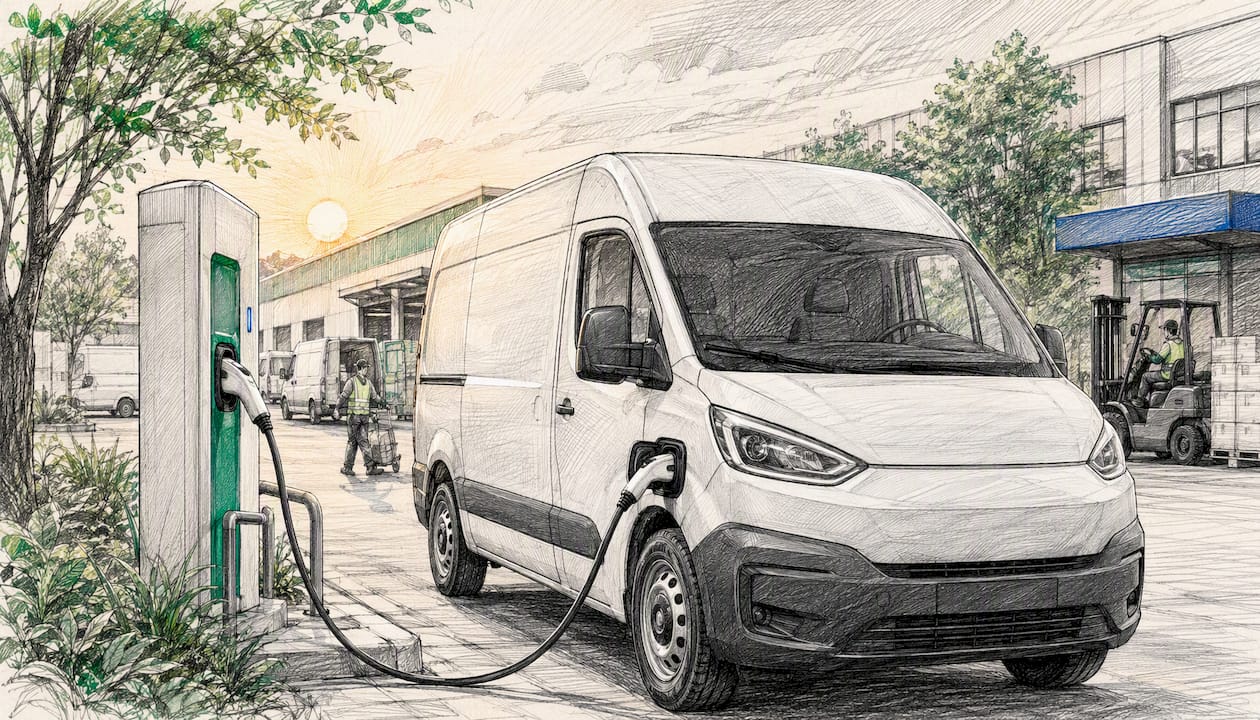
EV fleets require the tightest modelling of any use case. State of Charge at departure, energy consumption per kilometre (which varies with load, speed, and ambient temperature), charging station locations and availability, and range buffers to avoid stranding all need to be encoded as hard constraints. Domain-specific EV telemetry integration produces materially better results than applying a general-purpose routing API to an electric fleet. Nissan’s intelligent route planning research demonstrates this principle by integrating real-time battery data with predictive traffic, yielding meaningfully more reliable range estimates than static vehicle profiles.
Key outcomes reported across these use cases:
Last-mile: mileage reductions and improved on-time rates when live re-optimisation is active.
Field service: better work allocation balance and reduced overtime from tighter route modelling.
EV fleets: fewer range anxiety incidents and lower charging costs from SOC-aware sequencing.
How Sentient Concepts approaches route optimisation implementation
Sentient Concepts delivers AI solutions for supply chain and logistics through an end-to-end engagement model that covers strategy, data diligence, engineering, deployment, and ongoing managed operations, with a single team accountable across the full lifecycle.
For route optimisation specifically, the methodology follows a structured flow:
Strategy and readiness — define objectives, KPIs, and constraint inventory; assess data quality across stop addresses, vehicle profiles, and telemetry.
Data and platform engineering — clean and normalise input data; establish telemetry pipelines and integration architecture with TMS and driver apps.
Pilot design and build — configure the solver (API, OR-Tools, or commercial engine depending on scale and constraints); run a controlled pilot on a representative route subset.
Measurement and iteration — compare optimised versus baseline KPIs; refine constraint models based on dispatcher feedback and override patterns.
Deployment and MLOps — operationalise the system with monitoring, retraining schedules, and escalation protocols via managed AI operations.
A typical pilot engagement runs 8–12 weeks and delivers a data-readiness report, a working optimisation pipeline, and a measured KPI comparison the client can use for internal approval of a broader rollout.
What we consistently see working in UK fleets
The pattern that repeats across UK fleet deployments is straightforward: the operations that get the most from AI routing are not the ones with the most sophisticated technology. They are the ones that fixed their data before they touched the solver.
Standardising service times — the time a driver spends at each stop — is one of the highest-leverage data improvements available. Most fleets have wildly variable service time estimates, often because they were set years ago and never updated. Correcting them tightens ETA predictions and makes time-window constraints credible.
Instrumenting POD timestamps properly is the second quick win. Without accurate arrival and departure times at each stop, there is no way to validate whether the solver’s plan matched reality, and no way to identify which constraints are wrong. A telematics platform that captures geofence entry and exit events automatically is more reliable than manual driver input.
For EV fleets specifically, prioritising State of Charge modelling early in the pilot pays dividends. Fleets that treat EVs as equivalent to diesel vehicles in the routing model consistently find that drivers deviate from plans to avoid range anxiety, which destroys the optimisation benefit. Modelling SOC as a hard constraint from day one prevents this.
One caution worth stating plainly: avoid over-fitting the model to rare or exceptional routes. Trying to encode every edge case into the primary model adds complexity that degrades performance on the common case.
The AI agents for operations playbook covers the broader pilot-to-scale pattern for teams moving from a single use case to a more integrated AI operations model.
Sentient Concepts can run your route optimisation pilot
Fleets that have evaluated SaaS tools, open-source solvers, and commercial engines often find the real bottleneck is not the technology choice. It is the data readiness, constraint modelling, and integration work that determines whether the solver produces plans dispatchers will actually follow.
Sentient Concepts delivers a structured pilot engagement: a data-readiness audit in the first three weeks, a working optimisation pipeline integrated with your TMS and telematics by week five, and a measured KPI comparison at week twelve that gives you a defensible business case for broader rollout. The same team that designs the pilot builds the system and operates it post-deployment, which means no handoffs and no gap between what was promised and what runs in production.
To get started, contact Sentient Concepts with your fleet size, current routing process, and the KPIs you want to move. The team will scope a pilot and confirm what data preparation is needed before any engineering begins. Visit the AI and GenAI solutions page to outline your requirements and arrange an initial scoping conversation.
Sources
FAQ
Can AI do route optimisation reliably for commercial fleets?
Yes.
Can ChatGPT or a general large language model plan routes?
Not reliably on its own.
What is a practical example of AI route optimisation in use?
A last-mile delivery fleet uses an AI routing engine to assign stops across dozens of vehicles each morning, respecting time windows and vehicle capacities, then re-optimises in real time when a driver falls behind schedule, pushing updated instructions directly to the driver app.
Does Google Maps have a route optimiser for fleets?
Google Maps Platform offers the Route Optimization API, which supports configurable objectives, vehicle capacity and time-window constraints, and both synchronous and asynchronous optimisation endpoints for single and multi-vehicle fleets. It is distinct from the consumer Google Maps directions product.
What data do you need before running a route optimisation pilot?
At minimum: validated stop addresses with time windows, accurate vehicle profiles (capacity, fuel type, shift hours), service time estimates per stop type, and a telematics feed for live location and, for EV fleets, State of Charge data.
Recommended