Sales order automation: top UK providers in 2026

Which UK providers lead on sales order automation?
Three providers stand out for UK businesses evaluating automated sales processing in 2026. Each occupies a distinct position, and the right choice depends on your industry, technical environment, and how much of the AI lifecycle you want managed for you.
Provider | Core Services | Industry Specialisations | Key Features | Location | Customer Ratings |
Automation and control systems, cybersecurity AI via Darktrace, SCADA, system integration | Manufacturing, aviation, water, food and beverage, renewables | Process control automation, legacy system migration, cybersecurity integration | United Kingdom | 5★ (3 reviews) | |
End-to-end AI consulting, document processing automation, managed AI operations, MLOps | Manufacturing, finance, logistics, insurance | AI lifecycle management from strategy to deployment, conversational agents, predictive analytics | United Kingdom | 5★ (2 reviews) | |
Automated testing, deployment, and documentation on ServiceNow | ServiceNow platform, DevOps, software quality assurance | Release process automation, monitoring, quality assurance | United Kingdom | 5★ (1 review) |
AAC is the strongest fit for industrial operations teams that need engineering-grade automation paired with cybersecurity controls. Its Darktrace partnership addresses the growing threat surface in connected manufacturing environments, which sets it apart from pure software vendors.

Sentient Concepts covers the full AI project lifecycle, from initial readiness assessment through to managed AI operations and ongoing optimisation. For businesses that want AI-driven sales order automation without assembling an internal team, that continuity across strategy, engineering, and operations is a genuine differentiator.
AutomatePro is purpose-built for organisations running ServiceNow. If your order management workflows live on that platform, it accelerates the DevOps cycle and reduces manual quality assurance effort.
The verdict: match the provider to your environment. Industrial control systems point to AAC; AI-native document and order processing points to Sentient Concepts; ServiceNow-centric operations point to AutomatePro.

What is sales order automation and how does it work?
Sales order automation is the use of AI-driven technology to capture, validate, and process sales orders without manual data entry. Rather than a customer service representative opening each purchase order, reading it, and re-keying every line into an ERP, the system does that work automatically and posts a clean, validated sales order directly into your business systems.
The architecture typically involves three layers. An order management system orchestrates the full order lifecycle, from placement through to fulfilment. An ERP handles the broader enterprise functions: inventory, finance, and fulfilment. Automation sits between the two, ingesting inbound orders and bridging them into both platforms without human intervention.
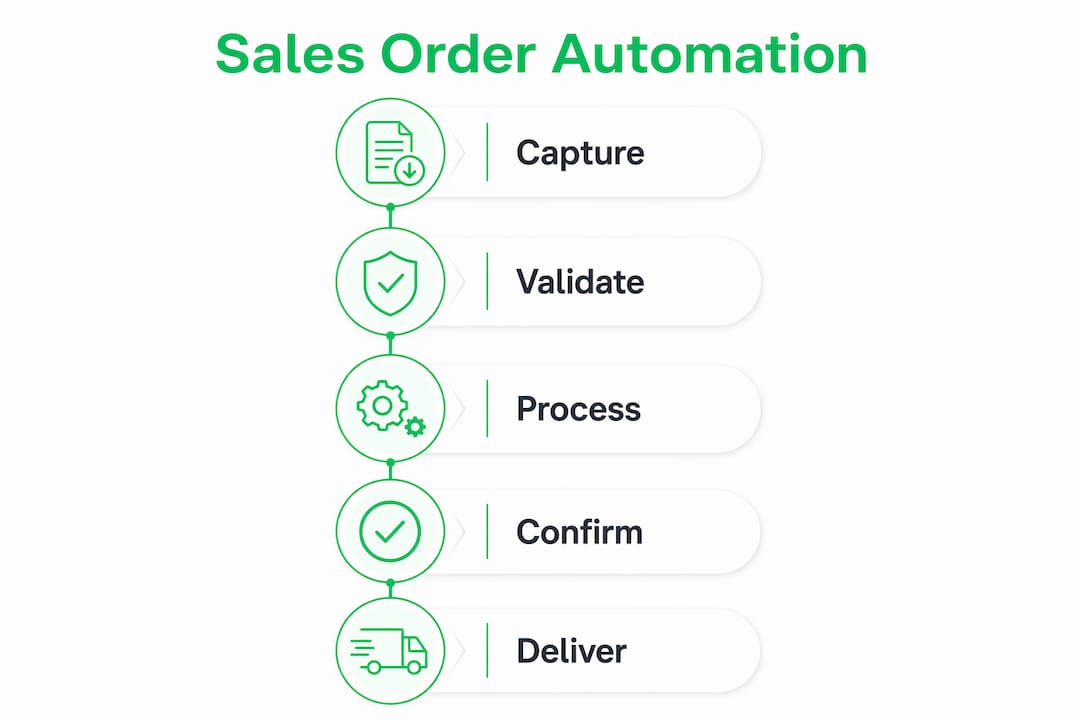
Modern AI-based systems handle diverse formats including PDFs, scanned documents, email bodies, and images, with no template setup required per customer. That is a meaningful departure from traditional electronic data interchange, which demands partner onboarding before a single order can be processed. AI automation works immediately on non-standard documents from any customer, regardless of their format or buying system.
The practical outcomes are faster order turnaround, fewer entry errors, and the ability to process orders around the clock without adding headcount.
What features and benefits should you expect from sales order automation?
The core capability of any credible automated sales processing solution is touchless order handling: the system reads an inbound purchase order, extracts every field, validates it against your master data, and creates the sales order automatically. What separates mature platforms from basic tools is what happens when something does not match.
Exception-led processing uses AI confidence scoring to route orders intelligently. When the system is confident in every field, the order posts without any human involvement. When a field falls below the confidence threshold, it surfaces that specific exception for a quick human review rather than blocking the entire order. Over time, as the system learns from corrections, the volume of exceptions decreases.
Beyond capture, the features that drive real operational value include:
Real-time stock validation checks available inventory before confirming the order, preventing commitments you cannot fulfil. Price verification catches discrepancies between what the customer ordered and your current price list before the order is booked. Customer SKU mapping learns the relationship between a customer’s part numbers and your internal catalogue, eliminating the manual lookup that consumes significant time in high-volume operations. Automated confirmations send acknowledgements, discrepancy follow-ups, and revised confirmations in the same email thread, with no manual drafting.
The headline benefit is speed. Manual processing typically takes 2 to 5 days; AI-powered automation reduces straightforward orders to under 30 minutes. Agentic AI systems go further, proactively monitoring orders and recommending next-best actions for exceptions, which means operations scale without a proportional increase in headcount.
Pro Tip: Ask any vendor to demonstrate exception handling on a real, messy purchase order from your own customer base. A system that only performs well on clean, structured documents will struggle in production.
How do you choose the right sales order automation provider in the UK?
The most common mistake is evaluating providers on their AI marketing rather than on their integration depth. The question that matters most is not “does it use AI?” but “how does it connect to our ERP, and what happens when the data does not match?”
Start with integration. A solution that cannot post directly to your ERP via API forces your team to re-enter data that has already been extracted, which defeats the purpose entirely. Confirm native connectivity to your specific ERP, whether that is Microsoft Dynamics 365 Business Central, SAP, or another platform, before any other evaluation criterion.
Assess industry expertise next. A provider with direct experience in your sector will understand the document types, validation rules, and compliance requirements that are specific to your environment. AAC’s depth in industrial control systems, for instance, is relevant to manufacturers with complex process automation needs that extend beyond order entry.
Data hygiene is the factor most organisations underestimate. Inaccurate master data in your ERP, whether customer records, item codes, or pricing, will cause automation failures regardless of how capable the AI is. Before go-live, audit your customer master, item master, and pricing tables. Clean data is a prerequisite, not a post-implementation task.
On implementation timelines, a
consistently delivers better outcomes than attempting full automation from day one. Start with purchase order ingestion and sales order creation in your ERP. Once that is stable and your team trusts the output, expand to fulfilment tracking, discrepancy resolution, and advanced exception handling. Trying to automate everything simultaneously increases risk and slows adoption.
Questions to ask every provider before signing:
What is the total cost of ownership across year one and year two, including integration, training, and ongoing support? How are exceptions handled, and what does the human review workflow look like? Can the system be customised to our specific validation rules and customer SKU mappings? Who owns the system post-deployment, and what does ongoing optimisation look like?
How Sentient Concepts delivers AI-driven sales order automation
Sentient Concepts approaches sales order automation as an AI engineering problem, not a software configuration task. The firm’s implementations cover the full lifecycle: readiness and data diligence, use-case prioritisation, custom AI solution engineering, ERP integration, deployment, and ongoing managed operations with continuous monitoring and optimisation.
In practice, a Sentient Concepts implementation for a manufacturing or logistics client typically begins with automated purchase order ingestion, where the AI reads inbound POs in any format and extracts every line item without template setup. Those fields are then validated against ERP master data, covering customer records, item codes, pricing, and stock availability. Clean orders post directly to the ERP. Exceptions are handled by AI agents that communicate with customers automatically to resolve discrepancies, without pulling the operations team into routine correspondence.
The processing time reduction is material. Where manual order entry takes 2 to 5 days, straightforward orders processed through an AI-native system complete in under 30 minutes. For high-volume operations, that compression changes the economics of the order desk entirely.
Key differentiators in Sentient Concepts’ approach include:
No handoffs between strategy, engineering, and operations teams, which eliminates the continuity failures that plague multi-vendor implementations. Industry-specific AI models trained on the document types and validation logic relevant to manufacturing, finance, and supply chain environments. MLOps infrastructure that monitors model performance post-deployment and triggers retraining when accuracy drifts, rather than leaving a static model to degrade over time.
That last point is where many implementations quietly fail. A model that performs well at go-live will drift as customer document formats evolve and master data changes. Sentient Concepts’ managed operations layer addresses that directly.
Sentientconcepts offers a different path to AI-powered order processing
If the providers compared above represent specialist tools for specific environments, Sentient Concepts represents something broader: an end-to-end AI partner that takes accountability for the entire project, from the first readiness assessment through to live system performance.
For businesses that have struggled with fragmented implementations, where a software vendor delivered a tool but left the integration, training, and optimisation to internal teams, Sentient Concepts’ model removes that burden entirely. The firm’s AI strategy and roadmap service ensures that sales order automation is scoped correctly from the outset, connected to the right systems, and built to perform at production scale rather than in a controlled pilot.
If you are evaluating AI-driven order processing for manufacturing, logistics, finance, or insurance operations in the UK, Sentient Concepts is worth a direct conversation.
Key takeaways
Sales order automation reduces processing time from days to minutes by replacing manual data entry with AI-driven capture, validation, and ERP posting across any order format.
Point | Details |
Processing time reduction | AI automation cuts order processing from 2-5 days to under 30 minutes for straightforward orders. |
Data hygiene is a prerequisite | Inaccurate ERP master records will cause automation failures regardless of AI quality; audit before go-live. |
Phased implementation wins | Start with PO ingestion and ERP posting; expand to fulfilment tracking and exception handling once stable. |
Provider fit matters | AAC suits industrial control environments; AutomatePro suits ServiceNow operations; Sentient Concepts suits AI-native end-to-end implementations. |
Sentientconcepts differentiator | Sentient Concepts manages the full AI lifecycle from strategy through MLOps, removing the handoff failures common in multi-vendor deployments. |
Recommended