Visual inspection AI for quality teams: a practical guide
- 1 minute ago
- 11 min read
Visual inspection AI uses trained deep learning models to detect, localise, and classify defects from camera images, replacing or augmenting rule‑based machine vision that relies on fixed thresholds. The single most useful next step for a quality team is not a factory‑wide rollout. It’s a narrow pilot on one line, one defect type, with a fixed set of KPIs to measure before scaling.
The evidence for moving now is concrete:
A hardware and software co‑design approach delivered a 23 times speed‑up over pure software solutions, enabling in‑line inspection without slowing the line.
Organisations investing in AI have largely held or increased that investment since 2020, according to Gartner’s survey data.
Keeping operators in the loop, with explainable outputs, improves both trust and detection accuracy.
Pro Tip: Pick a line with a well‑understood defect type and enough historical images to train a first model. Measure false‑reject rate and throughput before you touch a second line.
Key Takeaways
Visual inspection AI succeeds when a narrow pilot with clear KPIs, human‑in‑the‑loop review, and solid PLC/MES integration precedes any line‑wide rollout.
Point | Details |
Start narrow | Pilot one defect type on one line before considering a wider rollout. |
Hardware matters as much as the model | Edge inference and proper lighting can avoid the latency problems software alone can’t solve. |
Keep operators in the loop | Explainable outputs like heatmaps and confidence scores build trust and improve accuracy. |
Measure before you scale | Track detection accuracy, false‑reject rate, and throughput against a pre‑AI baseline. |
Plan for the full lifecycle | Sentient Concepts supports pilots through to managed AI operations, covering retraining and monitoring without a vendor handoff. |
Table of Contents
Why manual and rule‑based inspection fall short
Human inspectors tire. Studies on manual visual inspection consistently show detection rates fall across a shift as fatigue sets in, and inter‑inspector consistency is notoriously poor when defects are subtle or intermittent. Rule‑based machine vision solves consistency but trades it for brittleness: a fixed threshold tuned for one lighting condition or one SKU often fails the moment a supplier changes a component colour or a batch runs slightly warmer than usual.
Three pressures compound the problem:
Throughput — high‑speed lines leave milliseconds for a decision, not seconds.
Latency — a system that can’t classify within the cycle time forces a bottleneck or a blind spot.
SKU variation — rule sets that work for one product variant frequently need re‑tuning for the next.
The cost of getting this wrong compounds. Every escaped defect that reaches a customer costs more than one caught on the line, and every rule‑based system reset after a product change eats engineering hours that never show up on a production report.
Common failure scenarios repeat across sectors: missed solder bridges on PCBs, inconsistent paint defect calls on automotive panels, and contamination in pharmaceutical vials that a fixed‑threshold camera reads as “pass” because the lighting shifted overnight.
What visual inspection AI actually is
Visual inspection AI is learning‑based detection: instead of hand‑coded rules, a model learns what “good” and “defective” look like from labelled images, then generalises to new products and lighting conditions. It differs from rule‑based machine vision in one fundamental way. Rule‑based systems compare pixels against fixed thresholds; AI models learn statistical patterns that tolerate natural variation.
A typical pipeline runs through five stages:
Image acquisition — camera captures the part under controlled or semi‑controlled lighting.
Pre‑processing — cropping, normalisation, noise reduction.
Inference — the model performs detection, classification, or segmentation.
Decision logic — pass/fail thresholds, confidence scoring, routing to reject or review.
Feedback loop — corrected labels flow back into retraining data.
Model choice depends on the defect type. Convolutional neural networks handle classification well; segmentation models pinpoint the exact defective region; object‑detection models locate multiple defects per image; anomaly detection models work best when defective examples are rare and hard to enumerate in advance.
Pro Tip: If labelled defect images are scarce, look at semi‑supervised or self‑learning approaches and synthetic data generation rather than waiting months to collect enough real examples.
System components and architecture: cameras, lighting, and integration
Hardware choices determine what a model can actually see, and no algorithm compensates for a badly lit part. Camera resolution, lens selection, and lighting geometry (backlight, ring light, structured light) all need to match the defect type: a scratch on a reflective surface needs different lighting from a colour variance check on packaging.
Compute sits on a spectrum:
Edge inference (FPGAs, specialised AI cameras, industrial PCs) keeps latency low and avoids sending every frame over the network. Edge inference and dedicated hardware can avoid production‑line stoppages, which matters most on high‑speed lines.
Cloud inference suits lower‑speed lines or batch analysis where bandwidth and centralised model management outweigh latency concerns.
Integration is where most projects succeed or fail quietly. A model that scores well in a lab but has no reliable route into PLC‑driven reject actuators, MES traceability logs, or ERP synchronisation never delivers value on the floor. Practical deployments increasingly push trained models directly onto PLCs and industrial controllers, giving operators a factory‑native interface rather than a separate laptop screen.
Pro Tip: Before a pilot starts, validate IO wiring, timestamp synchronisation between camera and PLC, and gather a genuine sample of test images from the actual line, not a lab bench. Sentient Concepts’ work in AI and GenAI solution engineering treats this hardware and integration layer as inseparable from the model itself.
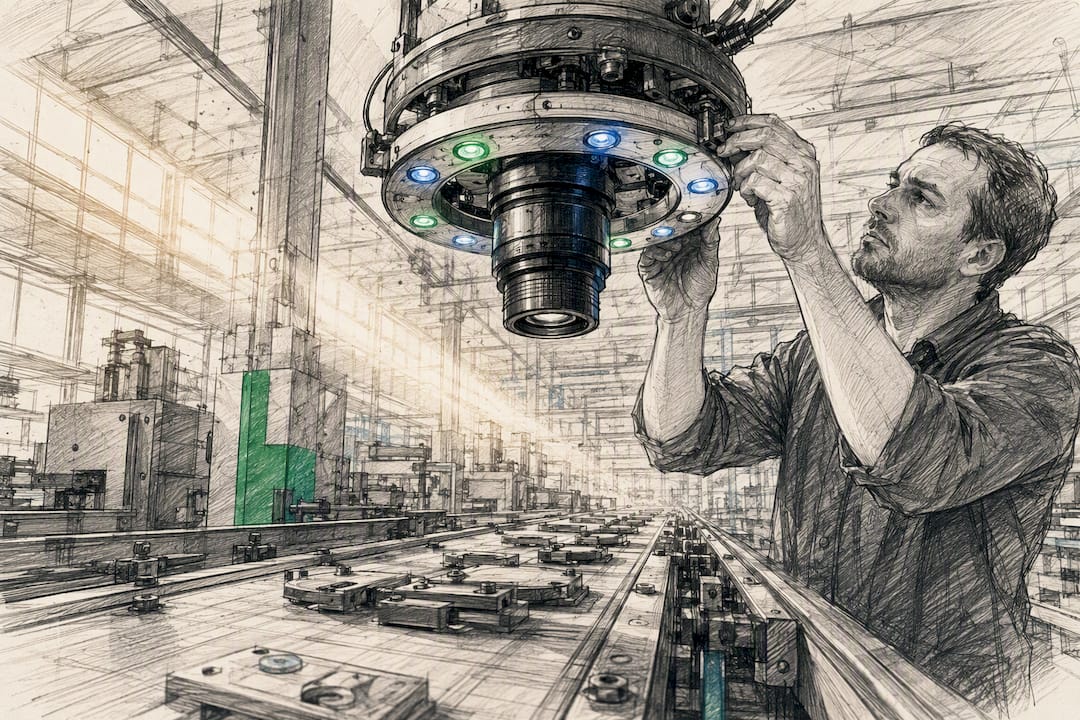
How do you run a pilot-to-scale roadmap?
A visual inspection AI project moves through six stages, each with its own timeline and owner:
Pilot scoping (1–2 weeks) — QC lead and automation engineer agree on one defect type, one line, and success criteria.
Data capture (2–4 weeks) — collect representative images across normal variance and known rare defects, not just clean lab samples.
Model selection and training (3–6 weeks) — data engineer and vendor/integrator train and validate against a held‑out test set.
Edge or cloud deployment (2–3 weeks) — integration engineer connects inference output to PLC/MES and reject mechanisms.
Operator feedback loop (ongoing from go‑live) — frontline staff flag misclassifications, feeding corrected labels back.
MLOps and scale (ongoing) — monitoring, retraining cadence, and rollout to additional lines.
Graduation from pilot to production should hinge on stable KPIs over a defined window, not enthusiasm. A model that holds detection accuracy and false‑reject rate steady across at least two to four weeks of live production, without manual intervention beyond planned reviews, is ready to scale.
Roles matter as much as timeline. A QC lead owns defect definitions and acceptance criteria; an automation engineer owns the PLC and reject‑mechanism integration; a data engineer owns the labelling pipeline and retraining schedule; an external integrator or vendor typically owns model architecture choices and initial training.
Procurement teams should ask for proof‑of‑value metrics from day one: baseline scrap rate, current inspection labour hours, and current escape rate to customers. Sentient Concepts’ approach to building a robust AI operating model treats this governance structure as a prerequisite for scaling past one line, not an afterthought bolted on after go‑live.
Explainable AI and human-in-the-loop practices
Operators reject systems they don’t understand, whatever the accuracy score claims. Explainable AI increases operator trust and can improve defect detection accuracy when humans stay in the loop, because trust grows when an inspector can see why a part was flagged, not just that it was.
Practical features that build this trust:
Heatmaps and bounding boxes showing exactly which region triggered a flag.
Confidence thresholds that route uncertain calls to a review queue instead of an automatic reject.
Rapid relabelling tools so operators correct mistakes in seconds, not minutes.
Human‑in‑the‑loop design typically samples a percentage of “pass” results for spot‑checking, escalates low‑confidence calls to a senior inspector, and feeds every correction back into the retraining pipeline. The most successful projects keep this loop tight, turning operators into active contributors rather than passive overseers of a black box.
KPIs and ROI: what actually proves the business case
Five metrics matter most: detection accuracy, false‑accept rate, false‑reject rate, throughput in units per minute, and mean time to detect a drifting defect pattern. Track these against a baseline captured before the model goes live.
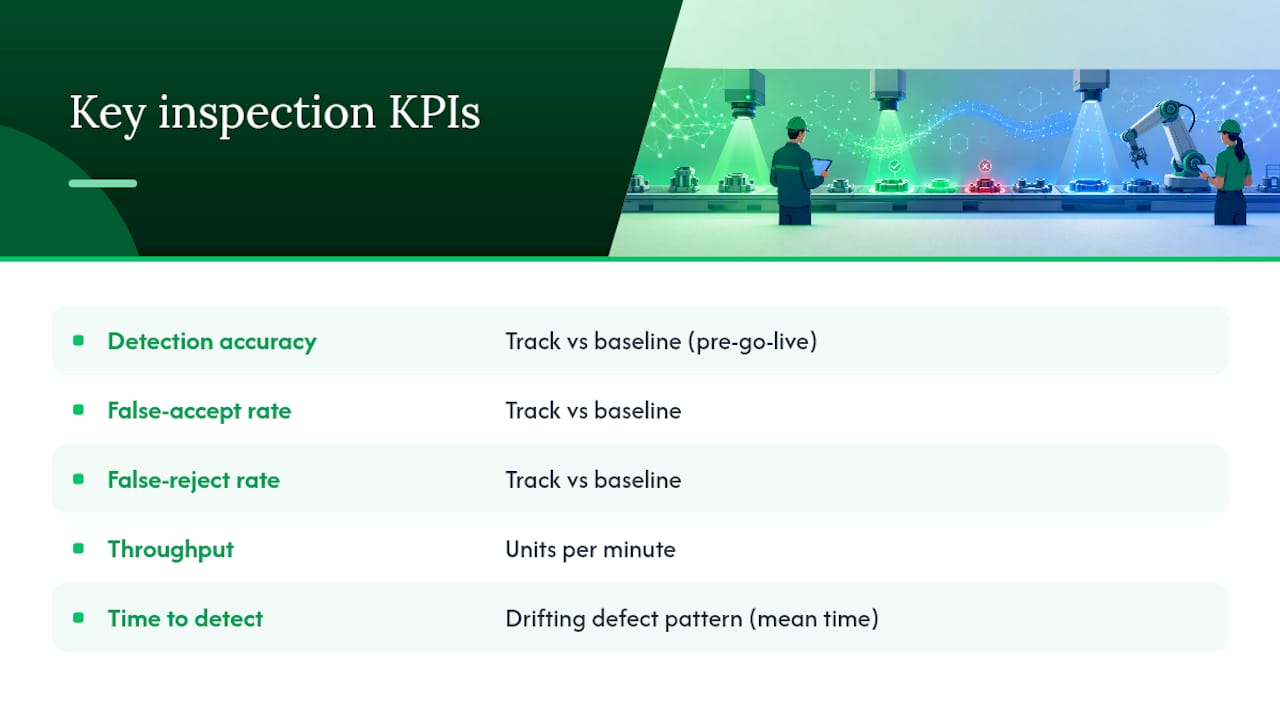
Business‑side KPIs translate technical performance into money: scrap reduction, rework hours saved, labour hours redeployed to higher‑value tasks, and cost per defect avoided. The cost of quality framework is worth borrowing here, since it separates prevention and appraisal costs from the far larger internal and external failure costs a good model prevents.
Run a phased or A/B rollout, comparing one AI‑inspected line against a matched manual line, to isolate the incremental benefit rather than guessing at it.
Pro Tip: Include labelling costs, hardware amortisation, and ongoing MLOps support in the ROI model, not just the licence fee. A cheap model with expensive retraining cycles rarely beats a slightly pricier one with a managed operations plan built in.
Operational checklist and governance for real deployments
Governance decisions made in week one determine whether a system survives its first product change. Data ownership needs to be explicit: who owns the labelled dataset, and who can retrain the model without vendor lock‑in. Retraining cadence should be scheduled, not reactive, ideally tied to a rolling accuracy‑drift check.
Common pitfalls repeat across industries:
Unrepresentative training data — models trained only on clean lab images fail against real shop‑floor lighting and dirt.
Latency blind spots — a model validated offline but never tested against the actual cycle time.
Poor change management — a new model version pushed without operator briefing or rollback plan.
An audit‑ready system logs every decision, every model version, and every operator override, which matters as much for compliance as for debugging. A knowledge‑driven, generic inspection framework that accumulates and reuses inspection knowledge across product variants avoids retraining from scratch every time a line changes.
Pro Tip: Build a 24/7 runbook before go‑live: who gets paged when the model’s confidence drops, and what the fallback inspection process is while the issue gets resolved. Sentient Concepts’ manufacturing practice builds this handover documentation into every deployment, not as a final step but as a design requirement from day one.
Data security and privacy considerations during deployment
Inspection images rarely contain personal data, but they routinely contain commercially sensitive information: proprietary component designs, supplier part numbers, and process parameters visible in the background of a frame. Treat that image data with the same access controls as any other confidential manufacturing record.
Three areas need attention before go‑live. First, decide where images are stored and for how long. Edge inference that discards frames after scoring reduces exposure considerably compared with a cloud pipeline that retains every image for retraining. Second, control who can access the labelling interface, since a correction tool that exposes raw production images to an external contractor without an access agreement creates unnecessary risk. Third, if any vendor’s model runs in a shared cloud environment, confirm contractually that your training data and model weights aren’t used to improve a competitor’s model.
Traceability logs, which quality teams need for audit purposes, also need their own access controls. A log that records every reject decision alongside a timestamp and image reference is invaluable for root‑cause analysis, but it becomes a liability if it’s readable by anyone on the network. Segment that data the same way you’d segment financial records: role‑based access, encrypted storage, and a defined retention policy that matches your industry’s regulatory requirements. Pharmaceutical and other regulated sectors typically carry stricter retention and audit requirements than general manufacturing, so confirm the applicable standard for your sector before finalising a data policy.
Training and change management for frontline teams
The model is the easy part. Getting inspectors, line supervisors, and quality managers to trust a new decision‑making tool is where most projects actually stall. Operators who’ve spent years developing an eye for defects understandably resist a system that appears to override their judgement without explanation.
Start training before go‑live, not after. Walk operators through why the model flagged specific historical examples, using the same heatmap and confidence‑score interface they’ll use in production. This turns an abstract “trust the algorithm” ask into a concrete “here’s what it saw and why” conversation.

Give supervisors a genuine override path, logged and reviewed weekly rather than buried. Early in a deployment, overrides should be frequent and welcomed, since they’re the fastest source of retraining data. A sharp drop in override rate over the first few weeks is one of the better early signals that the model is converging on real production conditions.
Change management extends beyond the shift floor. Quality managers need new reporting formats that reflect model confidence scores alongside pass/fail counts, and plant managers need a realistic picture of what the system does and doesn’t catch. Sentient Concepts’ guidance on AI change management treats this communication work as inseparable from the technical rollout, because a technically sound model with an untrained workforce behind it rarely survives its first difficult week.
Vendor evaluation criteria and questions to ask
Ask any vendor how their system handles a product change, not just how it performs on the demo dataset. A model that requires weeks of retraining every time a SKU changes will cost more in engineering hours than it saves in inspection labour.
Questions worth putting to every shortlisted provider:
Data ownership: Who owns the labelled dataset and trained model weights after the engagement ends?
Integration depth: Does the vendor handle PLC and MES integration directly, or hand that off to a separate team?
Retraining process: Can your own quality team retrain the model, or does every update require a vendor visit?
Latency guarantees: What’s the measured inference time on your actual hardware, not a benchmark server?
Support model: Is ongoing monitoring and retraining included, or a separate contract negotiated later?
The last question separates vendors who deliver a model from those who deliver a working system. A review of industrial AI and computer vision applications highlights this as a recurring gap: plenty of published accuracy figures, far fewer accounts of what happens operationally six months after go‑live. Ask for a reference client who’s been live for at least a year, not just a pilot success story.
A practitioner’s reality check
Projects that succeed usually share one trait: someone owns the whole chain, from data capture through to the PLC integration and the retraining schedule, rather than handing pieces to separate teams who never quite talk to each other.
If you’re starting your first pilot, pick a defect type you already understand cold, and measure everything before you touch the model.
How an end-to-end partner shortens the path from pilot to production
Sentient Concepts is the alternative to piecing together a vendor, an integrator, and an internal MLOps team separately for visual inspection AI. One team carries accountability from the first pilot through to years of live production, so there’s no handoff where responsibility for a drifting model quietly disappears between three different contracts.
That end‑to‑end structure matters most after go‑live, which is where most inspection projects actually run into trouble:
Edge and cloud deployment engineering that matches your latency budget and existing PLC/MES infrastructure, rather than a generic template.
Managed AI operations covering monitoring, retraining cadence, and incident response, so a model that starts drifting gets caught before it costs a batch of product.
If you’re weighing up a pilot for your own line, start with a conversation about your current defect rates and line speed. Visit Sentient Concepts’ manufacturing industry page to see how pilot‑to‑scale engagements are structured, or get in touch directly to scope a first pilot against your own KPIs.
Sources
FAQ
What is visual inspection?
Visual inspection is the process of examining products for defects, contamination, or dimensional errors using sight, whether performed by a human inspector or a camera‑based system. In manufacturing, it’s typically the last checkpoint before a product ships.
What is an AI inspection?
An AI inspection uses trained deep learning models to detect and classify defects from images, learning what “good” and “defective” look like from labelled examples rather than relying on fixed rule thresholds. Sentient Concepts builds these systems with PLC and MES integration built in from the start, not added later.
What are the main points of visual inspection?
The core elements are image acquisition under consistent lighting, a decision process (human judgement or model inference) against defined acceptance criteria, and a feedback mechanism that captures errors for future improvement.
What is 100% visual inspection?
100% visual inspection means every single unit produced is examined for defects, rather than a sampled subset. Manual 100% inspection is expensive and prone to fatigue‑driven misses, which is a primary reason manufacturers move toward automated inspection for high‑volume lines.
Recommended