Warehouse slotting optimisation: faster picks for managers

Start by slotting for velocity, layer in affinity where order data confirms it reduces travel, and lock every structural constraint before you move a single pallet. Malaysian warehouses that follow this sequence and apply velocity-based slotting correctly can expect pick-efficiency gains in the 15–35% range. Safety and ergonomics are not a later consideration, they constrain placement from day one. they constrain placement from day one.
Immediate next steps you can act on within 24–72 hours:
Pull 90 days of pick history from your WMS and rank every SKU by pick frequency.
Identify your golden zone (waist-to-shoulder height, closest to the pack station) and audit which SKUs currently occupy it.
Flag any heavy or hazardous items currently slotted above shoulder height and move them to a compliant position per OSHA storage guidance.
Confirm your building’s column bay spacing and clear height before modelling any new layout.
Set a baseline for your three primary KPIs: pick time per order, picks per hour, and travel distance per pick.
Key takeaways
Warehouse slotting optimisation delivers its strongest returns when velocity-based placement, structural constraint alignment, and clean WMS data are addressed together before any AI or automation layer is added.
Point | Details |
Start with velocity and structure | Run ABC segmentation on 90 days of pick data and confirm building constraints before moving any inventory. |
Validate affinity with order data | Co-occurrence must be confirmed from actual order lines, not assumed from product categories, to avoid displacing A-class items. |
Set performance-based re-slot triggers | A 10–15% rollback in pick-time performance is a practical threshold for initiating a targeted re-slot. |
Benchmark against 15–35% uplift | Industry data shows pick-efficiency improvements in the 15–35% range when velocity and affinity slotting is applied correctly. |
Sentient Concepts for managed AI slotting | Sentient Concepts delivers pilot design, AI model deployment, and managed ongoing optimisation for Malaysian DC operations. |
Table of Contents
What is warehouse slotting optimisation and why does it matter in Malaysia?
Static, periodic, and AI-enabled slotting: which model fits your operation?
How to run a slotting optimisation project from data to rollout
How do you measure whether slotting optimisation has worked?
Which technology tools support slotting in Malaysian warehouses?
Change management and staff training during slotting implementation
What is warehouse slotting optimisation and why does it matter in Malaysia?
Warehouse slotting optimisation is the discipline of assigning every SKU to the physical location that minimises picker travel, reduces handling effort, and maximises throughput given the building’s structural and equipment constraints. It is sometimes called inventory placement strategy or slot assignment, though slotting is the term most practitioners use in distribution centre (DC) operations.
The primary benefits are well-established. Placing fast-moving SKUs close to pack stations cuts the distance a picker walks per order. Grouping SKUs that appear together on the same order lines reduces the number of aisle traversals per pick run. Both effects compound: fewer steps per pick means more picks per hour, which means lower labour cost per order line and shorter order cycle times. Error rates also tend to fall when pickers spend less time searching for locations.
For Malaysian operations specifically, several factors amplify the value of good slotting. Labour availability in logistics hubs such as Shah Alam, Klang, and Johor Bahru is tighter than it was five years ago, and wage pressure makes every pick-per-hour improvement directly visible on the operational budget. Many Malaysian DCs handle a wide mix of SKUs serving both domestic retail and export channels, which creates high SKU churn and volatile velocity profiles. Seasonal demand patterns tied to Hari Raya, Chinese New Year, and year-end sales campaigns can shift the top-velocity tier dramatically within weeks. A slotting model that does not account for this will degrade faster than one built with seasonality explicitly in scope.
Core metrics to track from the outset:
Pick time per order (minutes from pick release to completion)
Picks per hour per operative
Travel distance per pick (metres, measured or modelled)
Order fill rate and error rate per shift
Replenishment frequency per slot (a proxy for slot-size misconfiguration)
Five core principles every slotting decision must follow
Principle 1: velocity (ABC) segmentation
ABC analysis divides your SKU catalogue into velocity tiers based on pick frequency. B-class items occupy mid-range locations. C-class and slower SKUs go to the periphery, upper shelves, or bulk storage. The segmentation must be recalculated from actual pick data, not from sales revenue or unit volume alone, because a high-revenue SKU picked infrequently in large quantities behaves differently from a low-value item picked dozens of times per shift.
Principle 2: affinity and co-occurrence
Affinity slotting clusters SKUs that appear together on the same order lines so a picker can complete a multi-line order in a single short loop. The gain is real, but it must be validated with order-line co-occurrence data before committing prime slot real estate. A common mistake is assuming two SKUs are frequently co-picked because they are in the same product category; the order data often tells a different story. Affinity that is not data-validated can displace A-class items from the golden zone and increase overall travel.
Principle 3: cube, weight, and handling constraints
Heavy items belong at floor level or on lower shelves to protect pickers from musculoskeletal injury and to comply with safe stacking requirements. Bulky or awkwardly shaped SKUs need wider pick faces and clear aisle access. Fragile items should not be slotted below heavier ones. These rules are not optional ergonomic preferences; they are operational constraints that override velocity-based placement when the two conflict.

Principle 4: zone and equipment alignment
Slotting decisions must match the racking system, handling equipment, and pick methodology in each zone. A narrow-aisle zone served by a reach truck has different slot-width and height constraints than a wide-aisle zone served by counterbalance forklifts. If your operation uses voice-directed picking or pick-to-light, the slotting model must account for the physical layout of those systems. Misalignment between slot assignments and equipment capability is one of the most common sources of pick errors and near-misses.
Principle 5: flexibility and re-slot triggers
Static slot assignments degrade as demand patterns shift. Build in a re-slot trigger tied to measured performance rather than the calendar alone.
Pro Tip: Never place a slow-moving SKU in the golden zone purely because it is frequently co-picked with an A-class item. Run the numbers: if the affinity gain is smaller than the velocity loss from displacing the A-class item, keep the A-class item in prime position and accept the slightly longer affinity travel.
Static, periodic, and AI-enabled slotting: which model fits your operation?
Three models, three levels of complexity
Static slotting assigns locations once and revisits them on a fixed schedule, typically quarterly or annually. It works well for operations with stable SKU catalogues, low seasonal volatility, and fewer than 2,000 active SKUs. The main risk is that velocity profiles drift between reviews, eroding the gains.
Periodic re-slotting uses WMS pick data to recalculate velocity tiers and affinity clusters on a defined cadence, usually monthly or after a major seasonal event. This is the most common model in mid-size Malaysian DCs. It requires a WMS with location control and a rules engine, plus an analyst who can run the segmentation and manage the physical moves.
Dynamic (AI-enabled) slotting continuously monitors pick patterns, predicts velocity shifts, and generates slot recommendations in near real-time. Vendor literature describes systems that learn a DC’s spatial characteristics and adapt as conditions change, reporting productivity gains beyond existing periodic models. Treat those vendor figures as directional rather than guaranteed; actual gains depend heavily on baseline quality and data hygiene.
Slotting model | Best fit | Data requirement | Typical uplift |
Static | Stable catalogue, low SKU churn | Basic pick history | Baseline gains from initial sort |
Periodic re-slotting | Mid-size DC, seasonal volatility | WMS pick data, monthly refresh | 15–35% pick-efficiency improvement |
Dynamic / AI-enabled | High SKU churn, multi-site, real-time demand | Clean WMS data, integration layer | Incremental 5–20% on top of periodic |
At that point, the cost of manual re-slotting labour and the pick-time degradation between cycles typically justifies an automated or AI-driven approach.
Pro Tip: Before investing in an AI slotting tool, audit your WMS data quality first. An AI model trained on inaccurate pick history or inconsistent unit-of-measure data will produce worse recommendations than a well-maintained spreadsheet model.
How to use heatmaps and plan for seasonal peaks
A pick heatmap visualises which locations generate the most pick activity over a defined period, typically 30–90 days of WMS transaction data. Zones with high pick density that are physically far from the pack station are the primary targets for re-slotting. Congestion hotspots, where multiple pickers converge on adjacent locations simultaneously, are a secondary signal that zone design or slot assignment needs adjustment.
Steps to generate a usable heatmap:
Export location-level pick transaction data from your WMS for the chosen period, including timestamp, location ID, SKU, and picker ID.
Map location IDs to physical coordinates (aisle, bay, level) and calculate distance from the pack station for each.
Aggregate pick counts by location and plot them on a floor-plan grid, using colour intensity to show pick density.
Overlay travel-path data if available to identify congestion corridors.
Identify the top 10% of locations by pick count and confirm they sit in the golden zone; flag any that do not.
For seasonal planning in a Malaysian context, the workflow has three phases. In the preparation phase, four to six weeks before a peak (Hari Raya, Chinese New Year, or a major e-commerce campaign), recalculate velocity tiers using the equivalent period from the prior year and model the expected slot changes. In the execution phase, move SKUs to seasonal positions and update WMS location records before the peak begins. In the rollback phase, after the peak subsides, revert to the standard velocity profile and free up the temporary positions for the next cycle.
Academic work on safety-stock placement under non-stationary demand confirms that static placement policies underperform dynamic ones when demand patterns shift materially, which is exactly what happens during Malaysian peak seasons.
Pro Tip: Reserve a dedicated block of flexible locations near the pack station specifically for seasonal surges. Keeping 15–20% of your total location count unassigned, as warehouse layout guides recommend, means you can absorb a peak without displacing your standard A-class slots.
How to run a slotting optimisation project from data to rollout
Step 1: collect the right data
The minimum data set for a credible slotting model covers:
SKU master: dimensions (L × W × H), weight, handling constraints (fragile, hazardous, temperature-sensitive), and unit-of-measure hierarchy.
Pick history: at least 90 days of order lines with SKU, quantity, location, and timestamp.
Order profiles: number of lines per order, order type (single-line vs multi-line), and channel (retail, e-commerce, export).
Replenishment rules: minimum/maximum quantities, lead times, and supplier constraints.
Location master: physical coordinates, dimensions, weight capacity, and equipment zone.
Field | Why it matters |
SKU velocity bucket (A/B/C) | Drives golden-zone allocation |
Cube (L × W × H) | Determines slot size and face width |
Weight | Constrains shelf level and ergonomic placement |
Handling constraints | Overrides velocity-based placement |
Co-occurrence score | Identifies affinity clusters |
Replenishment frequency | Flags slot-size mismatches |
Step 2: choose a modelling approach
Three approaches are available. A heuristic model (spreadsheet-based ABC sort with manual affinity adjustments) is adequate for operations with fewer than 3,000 active SKUs and stable demand. An optimisation model (linear or mixed-integer programming) handles larger catalogues and multiple constraints simultaneously but requires an analyst with operations research skills. An AI-driven model uses machine learning to predict velocity shifts and generate continuous recommendations; sorting-based slotting algorithms from the academic literature offer an alternative algorithmic framework to classic heuristics. For most Malaysian mid-size DCs, a heuristic model is the right starting point; move to optimisation or AI when the heuristic model’s maintenance cost exceeds its value.
DDMRP buffer-positioning methods documented in Microsoft Dynamics 365 are worth reviewing for operations that need to set strategic inventory positions based on lead time and customer tolerance, particularly where replenishment decoupling points are relevant.
Step 3: design and run the pilot
Baseline your three primary KPIs for the control zone before any moves.
Select a single zone or product family for the pilot, not the whole DC.
Run the pilot for at least four weeks to allow stabilisation; eight weeks is better.
Maintain a control group (an equivalent zone with no changes) for comparison.
Conduct a safety walkthrough before and after moves to confirm ergonomic compliance.
Step 4: roll out and measure
After a successful pilot, roll out zone by zone rather than all at once. Update WMS location records before each physical move, not after. Measure pick time, picks per hour, and travel distance in each zone for four weeks post-move before declaring success. A before-and-after comparison is the minimum; a controlled A/B design is preferable when the operation can support it.
What your WMS must be able to do
A WMS that cannot support slotting optimisation will constrain every other improvement. The critical capabilities are:
Location control: every pick location has a unique ID, physical coordinates, and dimension/weight attributes stored in the system.
Dimension and weight capture: SKU master records include cube and weight data at the each/inner/case level, with consistent unit-of-measure coding.
Rules engine: the WMS can enforce placement rules (e.g., no items above X kg above shoulder height, no hazardous items adjacent to food) automatically at putaway.
Replenishment triggers: the system generates replenishment tasks based on location minimum quantities, not just on stock-out events.
Cycle count support: the WMS supports directed cycle counting by location, velocity tier, or exception flag so that slot accuracy can be verified without a full physical count.
Data hygiene is as important as system capability. SKU master inaccuracies (wrong dimensions, missing weights, inconsistent UOM codes) will corrupt any slotting model built on top of them. Before modelling, run a data audit: compare physical measurements for your top 100 SKUs against the master record and correct discrepancies. For supply chain and logistics AI applications, clean master data is the prerequisite that determines whether an AI model produces useful recommendations or amplifies existing errors.
How do you measure whether slotting optimisation has worked?
The primary KPIs and their measurement approach:
Pick time per order: measure from pick release to completion in the WMS; compare the four-week post-implementation average against the four-week pre-implementation baseline.
Picks per hour: total picks divided by total operative hours per shift; track daily and compare weekly averages.
Travel distance per pick: either modelled from location coordinates or measured with wearable devices; a 10–15% reduction is a reasonable near-term target.
Order cycle time: time from order receipt to despatch; slotting improvements typically show up here within two to four weeks of stabilisation.
Error rate: mis-picks per 1,000 lines; a well-slotted operation typically sees this fall as pickers spend less time searching.
Industry benchmarks indicate that warehouses running formal slotting programmes commonly achieve pick-efficiency improvements in the 15–35% range when velocity and affinity principles are applied correctly.
Report KPIs weekly during the stabilisation period (the first four to eight weeks post-implementation) and monthly thereafter. Tie picks-per-hour data to your labour planning model so that throughput gains translate directly into shift-staffing decisions.
Common mistakes, pitfalls, and facility alignment
Structural constraints are not a slotting problem — they are a building problem that slotting cannot solve. Misaligned column bay spacing can waste 5–15% of usable storage area, and no amount of re-slotting recovers that space. Align the building before you optimise the slots.
PEB Steel’s warehouse design guidance recommends 12-metre bay spacing as optimal for pallet racking and shows that smaller bay spacing permanently reduces usable storage area. If your building’s structural bays do not align with your racking module, the most analytically perfect slotting model will still produce suboptimal results because the physical space is the binding constraint.
Beyond structural issues, the most damaging operational mistakes are:
Over-slotting for short-term velocity. Placing a SKU in the golden zone because it spiked during a promotional campaign, then failing to move it when the campaign ends, wastes prime real estate on a slow mover. Performance-based re-slot triggers, rather than calendar-only reviews, prevent this.
Unvalidated affinity assumptions. Grouping SKUs by product category rather than by actual order-line co-occurrence data displaces A-class items without delivering the expected travel savings.
Ignoring replenishment constraints. A slot that is too small for the replenishment unit (e.g., a full pallet replenishment into a single-carton slot) creates constant replenishment interruptions that offset pick-time gains.
Skipping the structural walkthrough. Sprinkler runs, column positions, and traffic routes can make a theoretically optimal slot physically inaccessible or unsafe. Walk the floor before finalising any model output.
Set re-slot triggers based on measured performance degradation rather than the calendar alone.
How does warehouse layout design interact with slotting?
Slotting and layout design are not sequential activities. The most effective operations treat them as a single integrated problem: the building structure sets the outer boundary, the layout design (aisle configuration, racking type, zone boundaries) sets the middle layer, and slotting fills in the detail. Attempting to optimise slotting inside a poorly configured layout is like optimising a route on a map with the wrong roads drawn on it.
The key integration points are aisle width and flow direction, dock-to-pack-station travel paths, and zone boundaries. A cross-dock or flow-through layout places receiving and despatch on opposite walls, which means the optimal golden zone sits on the despatch side, not the geometric centre of the building. A U-flow layout, common in Malaysian DCs with a single dock face, places the golden zone closest to the dock, with pick paths looping through the middle of the building. Each layout type produces a different optimal slotting pattern, and the two must be designed together.
Modern inventory placement strategies now combine multi-echelon inventory optimisation (MEIO), probabilistic forecasting, and simulation to decide whether to centralise or distribute inventory across a network, and to compute safety stocks at each node. For a single-site DC, the equivalent decision is which SKUs to hold in forward-pick locations versus bulk reserve, and how much buffer stock to maintain in each zone.
Which technology tools support slotting in Malaysian warehouses?
The Malaysian warehousing sector has access to a range of WMS platforms, from global enterprise systems such as SAP Extended Warehouse Management and Oracle WMS Cloud to regional and mid-market platforms that are more commonly deployed in Malaysian DCs. The critical selection criterion for slotting purposes is not brand but capability: location control, dimension capture, rules engine, and a data export layer that can feed an external slotting model or AI agent.
For operations ready to move beyond periodic re-slotting, the integration architecture matters as much as the WMS itself. A slotting engine, whether a commercial product or a custom model, needs a reliable data feed of pick transactions, location attributes, and SKU master data. Most Malaysian DCs export this data via flat-file or API; the quality and frequency of that export determines how responsive the slotting model can be.
AI agents for operations are increasingly viable for slotting tasks: they can ingest pick history, run velocity segmentation, flag affinity clusters, and generate slot-change recommendations without requiring a full enterprise slotting software licence. The prerequisite is clean, structured WMS data and an integration layer that can push recommendations back into the WMS location master.
Barcode scanning, RFID, and voice-directed picking systems all generate location-level transaction data that can feed a slotting model. Malaysian DCs that have invested in these technologies are better positioned to move to dynamic slotting because the data infrastructure is already in place.
Change management and staff training during slotting implementation
Physical slot changes affect every picker, every replenishment operative, and every supervisor on the floor. A technically correct slotting model that is poorly communicated will produce worse short-term results than the status quo, because pickers will revert to memorised locations rather than follow the new assignments.
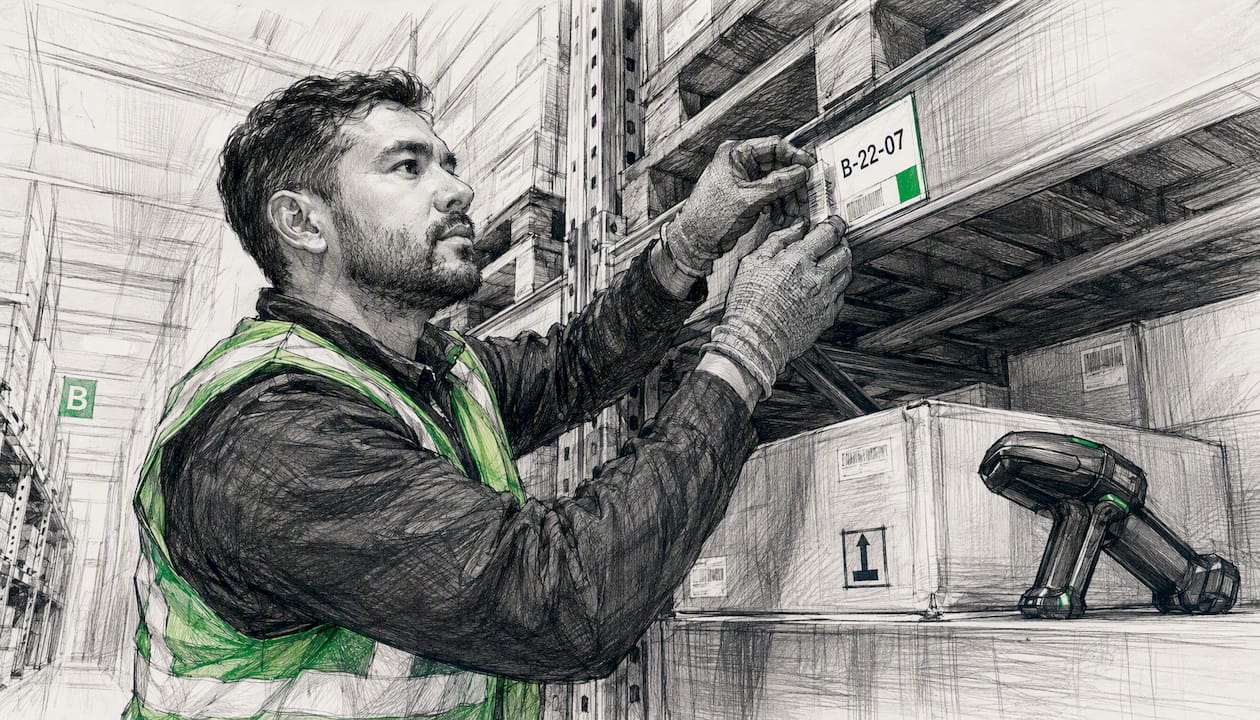
The change management approach should start before the first pallet moves. Brief team leaders on the rationale: faster picks, less walking, fewer errors. Show them the heatmap and the before-and-after model output so the logic is visible. During the pilot, assign a floor champion in each zone who can answer questions and flag exceptions in real time.
Training for a slotting change is narrower than it sounds. Pickers do not need to understand the optimisation model; they need to know that locations have changed, that the WMS is the authoritative source for every location, and that they should not rely on memory for the first two to four weeks. A short briefing, updated WMS location labels, and a floor champion cover most of the training requirement.
Supervisors need more: they need to understand the new zone logic, the re-slot trigger thresholds, and how to escalate a location conflict (a SKU that physically does not fit its assigned slot). Build a simple escalation path and a log for location exceptions so that the model can be refined after the pilot.
An AI strategy workshop approach, adapted for operations teams, is useful here: structured facilitation that surfaces floor-level knowledge about location constraints, equipment quirks, and informal workarounds that never appear in the WMS data but materially affect slotting decisions.
Environmental factors that affect slot assignment
Temperature control is the most significant environmental constraint in Malaysian warehousing. Ambient temperatures in non-climate-controlled DCs regularly exceed 35°C, which affects both product integrity and picker productivity. SKUs with temperature-sensitive specifications (pharmaceuticals, certain food categories, cosmetics, and some electronics) must be slotted within designated cold-chain or controlled-temperature zones regardless of their velocity profile. A high-velocity pharmaceutical SKU cannot be placed in the golden zone of an ambient warehouse simply because its pick frequency warrants it.
Humidity is a secondary constraint. Malaysia’s consistently high relative humidity affects packaging integrity for certain SKUs, particularly those with moisture-sensitive components or paper-based packaging. Slotting these items near dock doors, where humidity fluctuates with door openings, increases damage rates and returns.
Hazardous materials require segregated storage zones with appropriate ventilation, containment, and signage, as outlined in OSHA storage and handling guidance. These zones are fixed by regulatory requirement and cannot be repositioned for velocity reasons. Any slotting model must treat hazmat zone boundaries as hard constraints, not soft preferences.
For operations handling food and pharmaceutical products alongside general merchandise, zone segregation is a compliance requirement, not an optimisation choice. Map all fixed environmental zones before building the slotting model; they reduce the addressable location pool and must be excluded from the velocity-based allocation.
When does a slotting project need outside expertise?
The signals that indicate external help is genuinely warranted are specific. If your operation spans more than one DC site and inventory is shared or transferred between them, the slotting problem becomes a network-level placement problem that requires MEIO methods and analytics capability that most internal teams do not have. If your WMS data quality is poor and you lack the engineering resource to clean and structure it, a slotting model built on that data will produce unreliable recommendations.
When hiring external consultants or software vendors, the contract structure matters as much as the technical capability. Insist on a pilot-first engagement: a defined scope, a fixed timeline (eight to twelve weeks), and clear success criteria before any broader rollout commitment. Require a data access clause that gives you full ownership of all model outputs, slot assignments, and configuration parameters. Knowledge transfer should be a contractual deliverable, not an afterthought; if the consultant leaves and the model is a black box, you have created a dependency rather than a capability.
Questions to ask any potential consultancy or software vendor:
What does your pilot scope include, and what are the success criteria?
Who owns the model outputs and configuration after the engagement ends?
How do you handle WMS integration, and what data formats do you require?
What is your approach to change management and floor-level training?
Can you provide a reference from a comparable Malaysian or South-East Asian DC?
For managed ongoing operations, the question is whether the vendor will run the model for you or train your team to run it. Both are legitimate models, but they have different cost structures and different dependency profiles. A managed AI operations engagement that includes monitoring, evaluation, and continuous optimisation is appropriate when internal analytics capability is limited and the operational stakes are high.
Sentient Concepts brings end-to-end AI to slotting projects
Warehouse managers who have read this far know what good slotting looks like. The harder question is whether the internal data, engineering, and analytics capability exists to build and sustain it. Sentient Concepts delivers end-to-end AI implementation for logistics and supply chain operations in Malaysia, covering the full project lifecycle from data diligence and use-case prioritisation through to model deployment and managed operations, with no handoffs between strategy and delivery teams.
For slotting specifically, Sentient Concepts can run the data audit, build the velocity and affinity model, design the pilot, and then operate the AI-driven optimisation layer on an ongoing basis so that slot recommendations stay current as demand patterns shift. The managed operations model means the gains do not erode between internal review cycles.
To assess whether your operation is ready for AI-enabled slotting, or to scope a pilot, request a readiness assessment with the Sentient Concepts team.
Sources
FAQ
What is warehouse slotting optimisation?
Warehouse slotting optimisation is the process of assigning SKUs to physical storage locations to minimise picker travel, reduce handling effort, and maximise throughput. It uses velocity (ABC) analysis, affinity clustering, and physical constraints to determine the best position for every item.
What is the 5S rule in warehousing?
The 5S methodology (Sort, Set in order, Shine, Standardise, Sustain) is a workplace organisation framework originating in lean manufacturing. In warehousing, it provides the organisational foundation that makes slotting changes sustainable by ensuring locations are clearly labelled, consistently maintained, and regularly audited.
What are the five core warehouse processes?
The five core warehouse processes are receiving, put-away, storage, picking, and despatch. Slotting optimisation primarily affects put-away and picking, but improvements in pick efficiency also reduce order cycle time and improve despatch throughput.
How often should a Malaysian warehouse re-slot?
Most Malaysian DCs also conduct a targeted re-slot before major peak seasons such as Hari Raya and Chinese New Year.
What pick-efficiency improvement can I realistically expect?
The actual gain depends on the quality of your baseline data, the severity of current misalignment, and how rigorously the new slot assignments are maintained.
Recommended