What It Costs to Run an AI Agent in Production (Malaysia, 2026)
A production AI agent costs far more to run than its model calls suggest. The visible API bill is one line. Around it sit hosting, integrations, monitoring, evaluation, human review, retries and maintenance, and these recur every month. For Malaysian enterprises, published 2026 estimates run from a few hundred ringgit a month for a small pilot to six figures a month for heavy agentic use across a large workforce. The number that matters most is the cost per correctly completed task, and it is only controllable when one team owns the build and the operation together. That is how we run agents at Sentient Concepts: strategy, engineering and operations under the same senior team, so the running cost is designed in rather than discovered after launch.
This guide is for leaders in finance, manufacturing, logistics and insurance who need to budget an agent for document processing, underwriting support or customer conversations. It explains what the bill is made of, what drives it, how to estimate it before deployment and how to keep it in check.
Key Takeaways
Running cost is recurring and has several layers: model usage, infrastructure, tooling, human review, maintenance and retries. Build cost is a separate, one-time line.
Agentic work consumes many times more tokens than a chat question, so a budget built on chat assumptions will be too low.
Hidden layers such as storage, egress, observability and evaluation runs can add roughly 1.4 to 1.6 times the visible model bill.
Judge an agent by cost per correctly completed outcome, not cost per run.
Caching, model tiering, volume limits and capacity planning cut the bill without hurting reliability when they are designed in from the start.
Table of Contents
What actually goes into a production agent’s monthly bill
The first mistake in most budgets is to treat the agent as a model subscription. A production agent is a system. It receives a document or a request, plans several steps, calls tools and internal systems, writes a result and often waits for a person to approve it. Each of those stages has a cost.
The recurring layers are these:
Model usage. Input and output tokens (the small chunks of text a model reads and writes) billed by the provider, or the rental cost of GPUs if you host the model yourself.
Infrastructure. Application hosting, queues, databases, vector stores for retrieval and the network between them.
Integrations. Calls to core banking, policy administration, ERP or document systems. Setting up an integration is a project cost, but keeping it working as those systems change is not.
Monitoring and evaluation. Logging, tracing, test sets that are re-run when a model or prompt changes, and the audit trail regulated firms need.
Human review. Approvals, exception handling and corrections. This is operating effort, and in document-heavy workflows it is often the largest cost that never appears on a cloud invoice.
Maintenance. Prompt changes, model upgrades, incident response and fixes when a source system changes its format.
Separate the one-time build from this list. Mixing them hides the real run rate and makes the first-year return look better or worse than it is. Our own AI project cost benchmarks and estimator follow the same separation.
What published Malaysian figures say
Public numbers for Malaysia are still thin and vary by method, so read them as ranges for a stated period rather than as quotes. Two reference points help.
For enterprise usage billed per token, a Malaysian hosting provider’s October 2026 analysis models a 100-seat deployment in three tiers. Average usage of RM5 to RM30 per user per day comes to RM11,000 to RM66,000 a month for the company. High usage at RM30 to RM50 per user per day gives RM66,000 to RM110,000. Extremely high usage at RM50 to RM300 per user per day gives RM110,000 to RM660,000. The same analysis puts self-hosted H200 GPUs at RM14,910 to RM52,185 a month depending on the model. The gap between the lowest and highest tiers is about 60 to 1, which tells you that usage design, not the headline price per token, decides the bill.
For self-hosting at a smaller scale, one Malaysian GPU cloud lists RM1,435.02 a month for a single RTX 3090 and RM1,934.98 for an RTX 4090, with local data residency as part of the offer. A single consumer-class GPU is a development or low-volume option, not a capacity plan for a bank’s document queue, but it shows where the floor sits.
These are published figures for October 2026 and earlier. Token prices change often as providers release new models, and the ringgit conversion moves with the exchange rate, so treat every number here as a starting scenario and check the provider’s live price list before you commit.
Why agents cost more than chat
An agent does not answer once. It plans, calls a tool, reads the result, and calls again. Each step re-sends the conversation history and the tool definitions. The same October 2026 analysis estimates that an agentic task uses 5 to 30 times more tokens than the same question asked as a chat message. It also notes that agentic traffic skews towards input tokens, with a blended rate of RM1.71 per million tokens for the model it examines, against RM0.38 for chat. Getting that input-to-output ratio wrong distorts every later estimate by a factor of four or five.
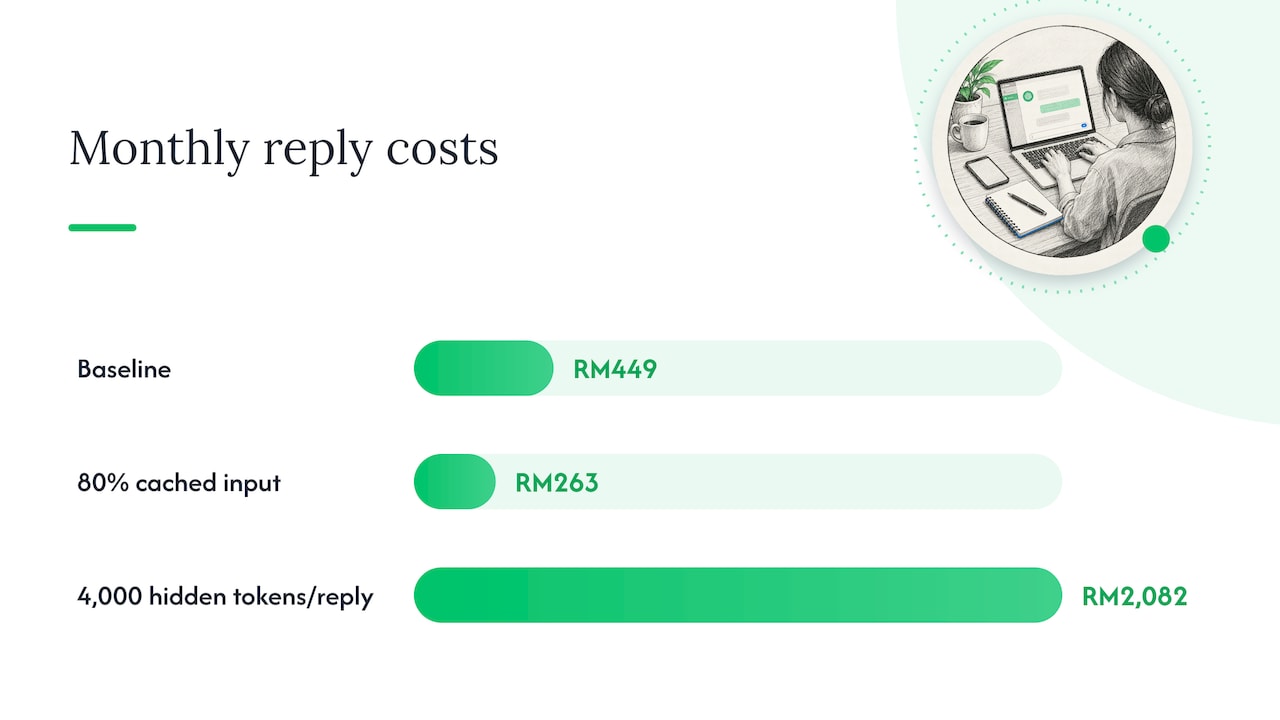
Output tokens cost more than input tokens, and “reasoning” models can generate thousands of hidden tokens before they answer. A worked example from a Malaysian token-cost guide shows the effect: 10,000 customer-service replies a month, each with 3,000 input and 500 output tokens, cost RM449 on one model. With 80% of input cached the same workload falls to RM263. Add 4,000 hidden reasoning tokens per reply and it rises to RM2,082. That calculation excludes retries, embeddings, search fees and staff time.
The lesson for a document-processing agent is practical. A 40-page insurance submission or a trade finance file is mostly input. Caching the instructions and reference material that repeat on every call, and keeping reasoning effort proportionate to the task, moves the bill more than switching vendors does.
The costs most budgets miss
Three categories regularly surprise finance teams after go-live.
Utilisation. Reserved capacity that sits idle is still paid for. Big Domain’s Dr Henry Tye makes the point that a resource used at 20% costs five times its sticker price per useful unit. This matters for self-hosted GPUs and any committed-capacity contract, and it is why capacity planning belongs before procurement, not after.
Surrounding tooling. The same source notes that egress, storage, observability, evaluation runs and vector databases typically add 1.4 to 1.6 times the visible model API bill. If your forecast has only the model line, add at least that margin before you take it to the CFO.
Regulatory and tax effects. Model prices quoted in Malaysia can exclude the 8% SST (sales and service tax), so confirm whether a quoted rate is tax-inclusive. Cloud customers may also face future cost pressure from telecom-sector levies: Analysys Mason estimated that mandatory contributions to the Universal Service Provision Fund would have added about MYR250 million in fees for Malaysian cloud customers in 2024. The report applies 6% to infrastructure and platform revenue and estimates a 1.5% increase for software services. Whether such a levy applies to your provider is a question for your cloud contract and your tax adviser.
Data location is a further cost driver in regulated sectors. Models marketed with Malaysian data residency are typically priced above global equivalents. One local price list shows YTL’s ILMU v3.1 at RM4.00 per million input tokens and RM16.00 per million output before SST, against well under RM3 for output on some global models. Where a bank or insurer must keep data onshore, that premium is a design input, not an afterthought. Our data protection page sets out how we approach it.
How to estimate your own monthly cost before deployment
A credible estimate fits on one page and uses your own volumes. Work through it in this order.
1. Count the work. Monthly runs: how many invoices, claims files, KYC packs or customer conversations the agent will handle, including seasonal peaks.
2. Measure the tokens. For each run, the number of model calls and the average input and output tokens per call. Take a sample of 50 to 100 real documents, not a clean demo set. Scanned pages, long attachments and mixed languages (Bahasa Malaysia, English, Chinese) all lengthen inputs.
3. Apply the rates. Multiply by the provider’s current price for input and output separately, then add SST if the quote excludes it. If you are comparing buying tokens with reserved inference capacity, model both at your expected utilisation, not at the maximum.
4. Add the surrounding layers. Tool and search calls, hosting, storage, monitoring and evaluation. Use the 1.4 to 1.6 range above as a sanity check on your total.
5. Price the people. Estimate what share of outputs needs review and the minutes each takes. Do not double-count support staff already funded elsewhere.
6. Run three scenarios. Low, expected and high volume, with a retry rate in each. Retries are the quiet multiplier: an agent that retries a third of its tasks costs a third more before anyone notices.
7. Divide by correct outcomes. Take the total and divide by tasks completed correctly, not tasks attempted. A cheap run that needs manual cleanup is an expensive outcome. This is the figure to put beside the cost of the manual process it replaces, and the approach behind our unit economics test for AI ROI.
For a Malaysian SME pilot, one local guide puts running costs at a few hundred ringgit up to about RM1,000 a month for usage, hosting and monitoring, with maintenance at 15 to 20% of build cost a year. Enterprise document programmes in banking or insurance sit well above that, because volumes, audit requirements and integrations are larger.
Controlling the bill without losing reliability
Cost control fails when it is a late squeeze on a running system. It works when it is part of the design. Five levers do most of the work.
Cache what repeats. System prompts, policy wording and reference tables are identical across calls. As the example above shows, caching 80% of input took a workload from RM449 to RM263.
Tier the models. Route classification, extraction and routing to a small, inexpensive model, and reserve the larger model for the cases that need judgement. Published Malaysian price lists show the spread: a small model can cost a fraction of a flagship per million tokens. Our work on cutting GenAI inference costs covers how this is done in practice.
Cap the loops. Set a maximum number of steps and a token budget per task, with an alert when a task exceeds it. Runaway loops are the commonest cause of a bill that doubles overnight.
Evaluate continuously. A fixed test set, re-run whenever a prompt or model changes, shows whether a cheaper configuration still meets the accuracy you need. Without it, savings are guesses and regressions reach customers.
Write the runbook. Who is paged when accuracy drops, how rollbacks work, how exceptions are reviewed. A documented AI runbook for production agents turns incidents into routine work, and routine work is cheaper than heroics.
None of these is a one-off task. Prices, models and volumes keep moving, which is why the running cost of an agent is a managed quantity, reviewed monthly.
Where one accountable team lowers the run rate
Most cost overruns trace to a gap between the people who built the agent and the people who operate it. The builders chose a model for accuracy in a demo. The operators inherit a token bill, a review queue and no authority to change the design.
Our approach is to have one senior team own strategy, build and operation, with no handoff between them. In practice that means the engineering choices that determine cost, such as retrieval design, model tiering, caching and integration patterns, are made by people who will carry the monthly bill and the audit trail. We engineer for production from day one, with governance and measured business results in scope, and our services run from readiness and data diligence through integration and architecture to deployment, MLOps, managed AI operations and ongoing optimisation.
For finance leaders, the five-year view matters as much as the monthly one. Our analysis of total cost of ownership for AI platforms puts the full five-year cost at 4.2 times the token spend, which is why a budget that stops at the API invoice understates the commitment.
Perspective
Every agent we are asked to cost has the same hidden question inside it: who is accountable for the number after go-live? When strategy, engineering and operations sit with different parties, nobody owns cost per correct outcome, and the bill compounds quietly through retries, manual correction and idle capacity. We prefer to design the run rate before we write the first line of code. That means agreeing the unit economics with the business owner, choosing the model tier for each step, building evaluation and audit trails into the system and planning capacity against real volumes. The operating model is part of the product, not an appendix to it. For regulated industries the same discipline serves two purposes. It keeps the bill predictable, and it produces the evidence a risk committee or auditor will ask for: what the agent did, why, at what cost and with what result. Cost control and governance are the same work seen from two sides. Thomas Samuel
Plan your agent’s run rate with us
If you are budgeting an agent for document processing, underwriting support or customer conversations, we can help you model the running cost against your own volumes before you commit to a build. Our team covers the full path from use-case prioritisation and data diligence to managed AI operations and ongoing optimisation, so the number you approve is the number you operate to. See how we approach AI workflow automation with agents or get in touch through Sentient Concepts.
FAQ
Does it cost money to run an AI agent after it is built?
Yes. Model usage, hosting, monitoring, human review and maintenance all recur every month. One local guide puts maintenance alone at 15 to 20% of build cost per year for an SME. Budget the build and the run as separate lines.
Is it expensive to run an AI agent in Malaysia?
It depends on volume and design. A small pilot can run at a few hundred ringgit a month, while a 100-seat enterprise deployment is modelled at RM11,000 to RM660,000 a month across usage tiers, according to a published October 2026 analysis. Caching, model tiering and step limits are what separate the low end from the high end.
How do I compare self-hosting with paying per token?
Model both at your expected utilisation. Self-hosted GPUs have a fixed monthly cost whether they are busy or idle, so a low-utilisation system costs far more per task than its list price suggests. Pay-per-token scales with use but rewards careful prompt and caching design.
What is the best single measure of an agent’s cost?
Cost per correctly completed outcome. Divide total monthly cost, including retries, tooling and review time, by the number of tasks finished correctly. It exposes cheap-looking agents that rely on manual cleanup and lets you compare directly with the manual process.
Sources
Recommended