AI Project Handoff Risks for AI Leads: Survive with 30 Day Validation
The highest risk moment in any AI project is the handoff, and the single best defence is a named owner backed by a versioned eval set a migration test can run. Most failures trace back to five recurring problems: lost ownership, missing evaluation baselines, unmanaged model deprecation, unnoticed schema drift, and tribal knowledge that walked out the door. Fix the ownership and testing gap first, and the rest becomes manageable with the checklists below.
TL;DR:
Ensuring a named owner with managerial approval and verified system access is the first step to a survivable AI handoff.
A versioned eval set and migration test script enable the incoming team to quickly verify system stability after migration.
Documentation should focus on failure symptoms, escalation paths, and known limitations rather than architecture diagrams.
Formal credential transfer, SLAs, and scheduled 30-day check-ins with clear success criteria reduce post-handoff risks.
Ongoing monitoring of eval performance, data drift, latency, and business KPIs during the first three months is crucial to catch silent failures early.
Table of Contents
Common AI project handoff risks: a quick reference checklist
AI handoffs fail in predictable ways. Each risk below has a fast diagnostic you can run in an afternoon, not a week.
Ownership vacuum. No named successor exists. First check: ask “who signs off on model changes now?” If nobody answers within a day, you have no owner.
Missing eval baseline. Nobody can prove the new team’s version still works. First check: does a versioned eval set with pass/fail thresholds exist anywhere?
Model deprecation blind spot. The underlying model gets retired with no warning. First check: which provider API version is pinned, and when does it sunset?
Schema or data drift. Upstream data changes silently break assumptions. First check: compare today’s input schema against the one documented at build time.
Credential gaps. Access to dashboards, model registries, or vendor consoles was never transferred. First check: can the incoming team actually log in?
Monitoring gaps. Alerts exist but nobody watches them post-handoff. First check: who receives the alert emails now?
No SLAs. Response times for incidents were never agreed. First check: is there a written response time for a model outage?
Tribal knowledge loss. Design reasoning lived only in one person’s head. First check: is there a decision log, or just Slack messages nobody can find?
Root causes and failure modes: why AI handoffs fail
Handoff failures rarely stem from a single dramatic mistake. They accumulate from small organisational and technical gaps that compound quietly until something breaks in production.
Organisationally, three roots recur. First, no one is formally named as the accountable owner, so accountability defaults to whoever last touched the code, often the departing engineer. Second, access provisioning lags behind the calendar: incoming staff wait weeks for credentials while the clock on the outgoing team’s availability runs out. Third, handoffs get squeezed into leftover time rather than scheduled properly, so documentation becomes a rushed afterthought.
Technically, the roots are different but equally damaging. Large language models behave non-deterministically, so a system that “worked” in testing can drift without any code change. Design decisions and undocumented judgement calls rarely survive in written form, because they were never written down. Underlying models get deprecated by vendors on their own schedule, not the client’s. And when work passes between AI agents rather than humans, incomplete context gets passed forward silently.
Four failure modes show up again and again:
A departing lead takes the only working knowledge of prompt tuning with them, and nobody notices until outputs degrade weeks later.
A vendor deprecates a model version, and the migration only surfaces when the API starts returning errors in production.
An upstream data source changes its schema, and the model keeps running but produces subtly wrong outputs.
A new team inherits code with no test to confirm it still matches expected behaviour, so every change becomes a gamble.
How to build a handoff that actually survives
A survivable handoff is not measured by how polished the final presentation looks. It is measured by whether the incoming team can diagnose a failure at 2am without calling the person who left.
Start with ownership. A handoff needs one named person, confirmed in writing by their manager, with verified working access to every system the AI touches, not just a login that “should work”. Verify access before the outgoing team leaves, not after.
Next comes the runbook, and it must be written as failure modes, not architecture diagrams. Runbooks structured around symptoms, first checks, and escalation paths outperform pure documentation because they answer the question someone actually asks during an incident: “what do I check first?”
Then the eval harness. A versioned eval set with labelled examples, paired with a migration test script, gives the incoming team a way to prove nothing broke, as explained by Zero TestaAI. This single artefact does more work than pages of narrative documentation.
Add a single-file model and configuration map listing every model ID, API version, and endpoint in one place, so migration steps become “change this file, run the test” rather than a hunt through scattered notebooks.
Finally, agree SLAs, transfer credentials formally with a checklist, and schedule a 30-day check-in with specific, measurable success criteria before the outgoing team’s contract or involvement ends.
Named owner with manager sign-off and tested access
Symptom-first runbook, not an architecture document
Versioned eval set plus a migration test script
Single-file model and config map
Agreed SLAs and a documented credential transfer
30-day check-in booked with clear success criteria
Pro Tip: Negotiate the 30-day check-in before the handoff ends, not after. Issues that only surface under real production load rarely appear in the final week, and by then the outgoing team has moved on.
Model and agent handoffs: technical patterns that hold up
Static documentation ages badly. What holds up over time is anything the incoming team can run and verify for themselves, rather than anything they simply have to trust.
An automated eval harness beats narrative documentation because it encodes the outgoing team’s judgement in a form a machine can check. A script that runs 20 to 50 labelled examples against both the old and new model version, and prints the pass rate difference, tells the incoming team in minutes whether a change is safe. No document can do that.
Multi-agent systems introduce a sharper version of the same problem. When work passes between AI agents rather than people, naive conversation dumps cause context explosion and information loss, and poorly designed handoffs can cut task completion rates by 40 to 60%. The fix is a structured context object rather than a raw transcript, built around four fields:
Source: where this piece of context originated
Section: which part of the task or document it refers to
Version: which iteration of the model or prompt produced it
Completeness flag: whether the context is partial or fully validated
Schema-enforced context objects with provenance let the receiving system, or the receiving human, trace exactly where a decision came from and whether it can be trusted.
Keep migration tasks deliberately small: change one configuration file, run the eval, compare the pass rate. Confirming a receiving model reproduces expected behaviour is not a one-off event. It is the test you run every time something upstream changes, for as long as the system is in production.
Organisational rules that reduce handoff risk
Governance does not need to be heavy to be effective. It needs to be enforced consistently, and it needs to exist before the handoff starts, not after something breaks.
A responsible handover framework reduces adoption risk precisely by making ownership, rationale, and evaluation explicit rather than assumed. That means a small set of non-negotiable rules:
No handoff proceeds without a named owner confirmed in writing by their manager.
Access provisioning is verified, not just requested, before the outgoing team’s last day.
Every model or schema update goes through a lightweight change-control step, even a one-line log entry, so nobody discovers a change by accident.
Documentation preserves why a decision was made, not just what was built, including a plain statement of the system’s known limitations.
Vendor handoffs come with contract clauses specifying SLAs, deprecation notice periods, and a named vendor contact, not just a support email address.
Transparent documentation of what a system does and does not cover is what prevents the incoming team from unintentionally misusing a model outside its tested scope. Pair these rules with a clear operating model for the AI lifecycle and change-control becomes routine rather than exceptional.
What to monitor in the first 30 to 90 days after handoff
The first three months after a handoff are where silent failures surface. Watch four metrics closely: eval pass rate against the versioned baseline, data drift on key input features, latency against the agreed SLA, and the business KPI the AI system was actually built to move.
Build alert thresholds into the dashboard from day one, not after the first incident:
Eval pass rate drop below an agreed threshold triggers an immediate review, not a queued ticket.
Data drift alerts fire when input distributions shift beyond a defined tolerance.
Latency breaches the SLA agreed during the handoff, escalated automatically.
Business KPI movement gets checked weekly against the pre-handoff baseline.
A negotiated 30-day check-in with concrete success criteria, not a vague “how’s it going” call, catches problems that only appear under real production load. If something does break, replay from saved checkpoints and roll back to the last known-good model version rather than debugging live.
Pro Tip: Book the 30-day check-in on the calendar during the handoff itself. Once the outgoing team disperses, scheduling it becomes someone’s forgotten task.
Templates worth copying into every handoff
You don’t need elaborate tooling to make a handoff survivable. Four lightweight artefacts do most of the work.
Runbook skeleton: symptom observed → first diagnostic check → where to look in the codebase or logs → who to escalate to and when.
Migration test outline: load the versioned eval set, run it against old and new model IDs, print the pass rate difference, flag anything below threshold.
Minimal eval-set spec: 20 to 50 labelled examples covering typical and edge cases, enough to catch most regressions without becoming unmanageable.
Ownership-and-access checklist: named owner, manager sign-off, verified credentials, listed systems, and a signature line confirming access was tested, not just granted.
Agent context object fields: source, section, version, and completeness flag, for any workflow where AI agents pass work to one another.
How Sentient Concepts applies these practices in engagements
These checkpoints can be integrated into engagements rather than treated as a final-week formality. Readiness and data diligence work establishes the ownership map and access checklist before a system goes near production. Deployment and MLOps work can build the eval harness and migration test script alongside the model itself, not retrofitted afterwards.
Where clients need ongoing support after go-live, managed AI operations covers the monitoring, alert thresholds, and 30-day validation window described above. The aim across various finance, manufacturing, logistics, and insurance engagements is to establish a system that a different team can inherit and run without needing the original engineers on speed dial.
Knowledge transfer of design decisions and reasoning
The hardest thing to hand over in an AI project is not the code, it is the reasoning behind decisions that never made it into a comment or a ticket: why a threshold was set at 0.85 rather than 0.9, why a particular prompt structure was chosen after three failed attempts, why a fallback rule exists for a specific edge case.
Behaviour depends on models, data, prompts, and a long chain of undocumented judgement calls, not just the code that ships. That is what makes AI knowledge transfer fundamentally different from handing over a traditional software project, where the code itself is close to a complete record of intent.
Capture design reasoning as a running decision log, updated as choices are made, not reconstructed from memory during the final week. Each entry should record the decision, the alternatives considered, and the reason the alternatives were rejected. This is more useful than a comprehensive architecture document, because it tells the incoming team what not to reinvent.
Pair the decision log with a plain statement of known limitations: what the system is not good at, what inputs it was never tested against, and what edge cases were consciously left unhandled. Incoming teams who inherit a system without this context tend to either over-trust it in situations it was never validated for, or under-trust it and rebuild working components unnecessarily. Neither outcome serves the organisation well.
Legal and compliance risks during AI project handoff
Compliance obligations do not pause during a transition, and regulators do not distinguish between “the old team’s model” and “the new team’s model.” The obligation sits with the organisation deploying the system, regardless of who built it or who currently maintains it.
The most common compliance gap during handoff is losing the audit trail. If the outgoing team cannot hand over a record of what data trained the model, what decisions the model influenced, and what human review steps existed, the incoming team inherits a system it cannot defend if a regulator or auditor asks questions. This matters acutely in regulated sectors like finance and insurance, where document automation and decisioning systems face specific scrutiny.
Contractual risk follows the same pattern. If the AI system was built by a vendor or external consultancy, check what the contract says about data ownership, model IP, and liability once the vendor’s involvement ends. A handoff that skips this review can leave an organisation using a model it does not legally own the rights to modify or retrain.
Before any handoff closes, confirm three things in writing: who owns the training data and any fine-tuned model weights, what audit records exist and where they are stored, and what liability terms apply if the system produces a harmful or incorrect decision after the handoff. None of this needs to be exhaustive legal drafting, but it needs to exist somewhere other than a verbal agreement from the original build phase.
Data privacy and security considerations
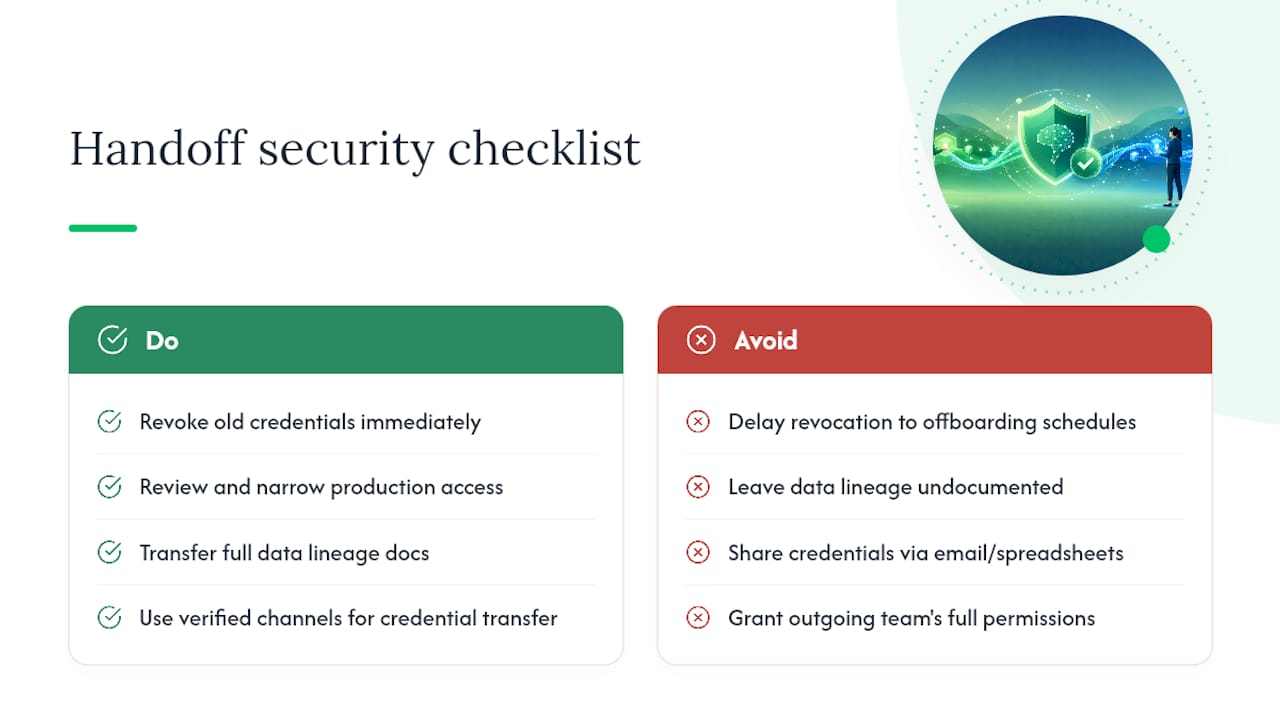
Handoffs move access, and every access change is a potential privacy exposure. The most overlooked risk is not a dramatic breach. It is stale credentials: former team members retaining access to production systems or customer data weeks or months after their involvement ends.
Revoke old credentials the moment a handoff completes, not on a delayed schedule tied to offboarding paperwork. Pair this with a fresh review of who can see what: many AI systems accumulate broad data access during development that was never scoped back down for production use.
Data lineage matters just as much as access control. If personal or sensitive data flows through the system, the incoming team needs to know exactly what data the model was trained on, what data it processes in production, and whether any of that data crosses jurisdictional boundaries, particularly relevant for organisations operating across Southeast Asian and international markets. A handoff that transfers the model but not the data lineage documentation leaves the incoming team unable to answer basic questions if a data subject requests deletion or an auditor asks where their information went.
Security reviews should treat the handoff itself as a risk window. Attackers know that transitions create confusion about who owns what, and that confusion is exactly when phishing attempts targeting “new” points of contact tend to succeed. Confirm that credential transfer happens through verified channels, not email attachments or shared spreadsheets, and that the incoming team’s access is scoped to what they actually need, not inherited wholesale from the outgoing team’s broader permissions.
Communication protocols between teams during handoff
Most handoff communication breakdowns are not caused by teams refusing to talk. They are caused by nobody agreeing in advance on who talks to whom, about what, and how often.
Set a single point of contact on each side before the handoff begins, and put it in writing. Without this, questions bounce between whoever happens to be available, and critical context gets lost in side conversations that never reach a shared record.
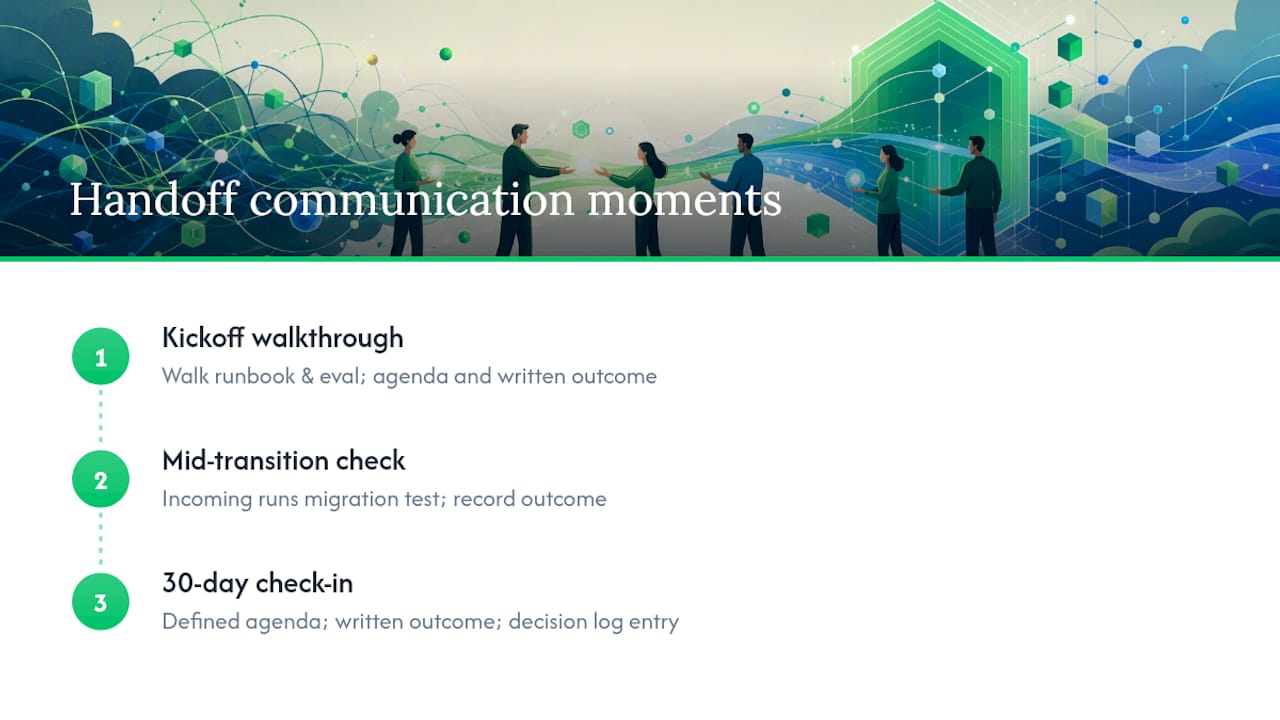
Structure communication around three moments: a kickoff session where the outgoing team walks through the runbook and eval harness live rather than just handing over documents, a mid-transition check where the incoming team demonstrates they can run the migration test independently, and the 30-day check-in described earlier in this article. Each of these should have a defined agenda and a written outcome, not an open-ended call that drifts.
Keep a shared, dated log of every question the incoming team asks and how it was answered. This does two things: it prevents the same question being asked twice to two different people with two different answers, and it becomes a working addition to the decision log once the outgoing team is no longer reachable.
Finally, agree explicitly on what happens if the incoming team cannot reach the outgoing team after the formal handoff period ends. A vague “reach out if you need anything” commitment is not a communication protocol. A named contact, a defined response window, and a hard cutoff date are.
Risk mitigation strategies for AI model bias and ethical issues
Bias risk does not stay fixed at the point a model is deployed. It shifts as the population using the system changes, as upstream data sources drift, and as the model’s outputs feed back into decisions that shape future training data. A handoff is exactly the moment this risk tends to go unmonitored, because the team that understood the original bias testing has left, and the incoming team often does not know that testing happened at all.
Before a handoff, document what bias and fairness testing was actually performed, on what data, and against what benchmark. If no such testing happened, say so explicitly rather than letting the incoming team assume it did. A gap acknowledged is manageable; a gap hidden by silence is not.
Build bias checks into the same eval harness used for technical migration testing, rather than treating them as a separate, occasional audit. Running fairness checks alongside the standard pass rate test means bias drift gets caught at the same cadence as any other regression, not months later when a pattern in outcomes finally gets noticed.
Ethical risk in document automation and conversational agents, the areas where finance and manufacturing clients most often deploy AI, tends to concentrate around edge cases: unusual applicant profiles, ambiguous documents, or conversation inputs the model was never trained on. Flag these cases for human review rather than letting the model guess, and make sure the incoming team knows exactly where that human-review boundary sits.
Impact of infrastructure changes on AI project continuity
Infrastructure rarely stays still for the lifetime of an AI system, and a handoff is often the point where infrastructure assumptions that quietly held everything together get exposed. A cloud provider changes a default configuration, a GPU allocation shifts, or a vendor deprecates the specific model version the whole pipeline was built around, and continuity depends on whether anyone documented those dependencies in the first place.
Model deprecation is the most disruptive version of this risk. Providers retire model versions on their own commercial schedule, often with a fixed notice window, and if the outgoing team did not flag the deprecation date, the incoming team can find out only when the API starts returning errors in production. A single-file model and configuration map, listing every pinned version and its known sunset date, turns this from a crisis into a scheduled task.
Infrastructure changes below the model layer matter just as much. A change to a data pipeline’s compute environment, a shift in container orchestration, or an update to an authentication service can silently break integrations that were never load-tested against the new configuration. Connecting these dependencies to a clear lifecycle view of the whole system, not just the model, makes it far easier to spot which infrastructure change actually threatens continuity and which is cosmetic.
The practical defence is the same migration test used for model handoffs: run it after any infrastructure change, not just after a model update, and treat a failed run as a signal worth investigating before it reaches production.
Why survivable handoffs beat polished demos
A demo that impresses a steering committee tells you almost nothing about whether the system will survive contact with a different team. What tells you that is whether someone who was not in the room can run the migration test and get the same answer.
The 30-day check-in is where the real follow-on work reveals itself, not in the handoff meeting itself. Organisations that skip it tend to discover, three months later, that the “successful” handoff left gaps nobody had the checklist to find in time.
— Thomas Samuel
How Sentient Concepts can help operationalise handoffs
If your organisation is inheriting, or handing over, an AI system without a named owner, a working eval set, or a tested runbook, that gap is fixable before it becomes an incident. Sentient Concepts works across the full lifecycle rather than dropping a system and leaving: readiness and data diligence establishes the ownership map and access checklist up front, while managed AI operations covers the monitoring, alerting, and 30-day validation window that catches problems while they’re still cheap to fix.
For teams already mid-transition, a short audit against the checklist in this article, including ownership, eval harness, migration test, SLAs, can often surface the highest-risk gap within a week. Start with an AI strategy and roadmap conversation to scope what a short managed handover or a 30-day validation engagement would look like for your specific system, before the next model deprecation notice forces the issue.
Sources
FAQ
What are the biggest risks in an AI project handoff?
The biggest risks are losing a named owner, having no versioned eval set to test against, unmanaged model deprecation, silent data or schema drift, and tribal knowledge that leaves with departing staff.
What are the stages of an AI project handoff cycle?
A survivable handoff typically moves through readiness assessment, ownership and access transfer, documentation and eval harness creation, a live migration test, and a 30-day post-handoff check-in with objective success criteria.
How do you mitigate AI model bias risk after a handoff?
Document what bias testing was done before the handoff, fold fairness checks into the same eval harness used for technical migration testing, and flag ambiguous edge cases for human review rather than model judgement.
Can Sentient Concepts help with an AI handoff that’s already underway?
Yes. Sentient Concepts offers readiness and data diligence audits and managed AI operations support for organisations mid-transition, focused on closing ownership, eval, and monitoring gaps quickly.
Recommended