Cut GenAI Inference Costs 40–70% in 90 Days for Tech Leaders
Four levers determine whether enterprise generative AI spend stays controlled or spirals: real-time telemetry, inference-level optimisation (routing, caching, batching), FinOps governance, and infrastructure right-sizing. Routing, caching and batching alone commonly cut inference spend by 40 to 70% on routed requests, with batched, cached workloads pushing savings even higher. This article covers the metrics, technical levers, governance model, and a 90-day plan to capture them.
TL;DR:
Routing, caching, and batching can reduce inference costs by 40 to 70%, but require ongoing monitoring to prevent quality degradation.
Measuring input and output tokens, request latency, and cost per outcome are essential before implementing cost optimization strategies.
Continuous governance with a single control tower, combined with real-time telemetry and quota enforcement, prevents runaway expenses.
Self-hosting becomes cost-effective for high-volume, predictable workloads, with GPU pooling and dynamic scaling reducing infrastructure costs by up to 70%.
Proper architecture, telemetry, and governance are more impactful for controlling AI spend than technical fixes alone, especially in regulated industries.
Table of Contents
What is genai cost optimization and why does it matter now?
GenAI cost optimization is the discipline of reducing what an organisation spends on large language model inference, infrastructure, and data pipelines without degrading the outcomes those systems deliver. It sits inside a broader practice called FinOps, the operating model that treats cloud and AI spend as something engineering, finance, and product teams manage jointly rather than something finance discovers after the invoice lands.
The problem is speed. GenAI spend grows faster and more unpredictably than most other cloud categories, and it does so because usage compounds in ways traditional infrastructure never did. An agent that calls a model three times per user request becomes ten times per request once someone adds a retry loop and a verification step. Nobody notices until the monthly bill triples.
The fix is not a single tool. It is visibility, engineering discipline at the inference layer, and a governance structure that catches problems before finance does. The sections below cover each in turn, starting with the metrics you need before you touch a single model or router.
What metrics do you need before optimising GenAI costs?
You cannot optimise what you cannot measure, and most enterprises attempting cost reduction skip straight to model swaps without a baseline. That is backwards. Workload shape, meaning the ratio of input tokens to output tokens, determines which model is actually cheapest for a given task — and you cannot know your workload shape without instrumentation first.
The metrics that matter, tracked per request and rolled up per feature:
Input tokens and output tokens, tracked separately, since most providers price them differently
Cost per token and cost per request, the atomic units of any GenAI budget
GPU or TPU utilisation, which exposes idle capacity you are paying for but not using
Time to first token and requests per second, the latency metrics that constrain how aggressively you can optimise for cost
Cost per outcome, meaning cost divided by successful task completions, not just raw calls
Adopt a “no telemetry, no deploy” policy. Nothing goes to production without token-level logging, request tagging, and a proxy or SDK layer that attributes every call to a team, feature, and business outcome. Without that tagging, you get a single monthly number from your model provider and no way to explain it to finance or engineering.
Pro Tip: Tag every request with a feature ID and user-tier label at the SDK level before launch, not after. Retrofitting attribution into a production system usually means weeks of log archaeology to reconstruct spend by feature.
The blind spot that catches most teams is agentic workflows. A single user action can trigger a chain of model calls, each invisible individually but compounding into a cost curve nobody modelled. One unmonitored agent looping on a retrieval failure can burn through a monthly budget in days. Dashboards that show cost per feature and cost per outcome, refreshed daily rather than monthly, are the only reliable early warning. Sentient Concepts has seen this pattern repeatedly in agentic AI deployments that launched without spend caps: the surprise invoice arrives roughly four to six weeks after the feature ships, once usage patterns settle into their real shape.
How do you reduce LLM inference costs at the model level?
Inference is where most GenAI budgets bleed, and it is also where the highest-leverage, lowest-risk savings live. Five techniques cover the bulk of what’s achievable, and they stack.
Model routing. Classify incoming requests by complexity and route simple ones to smaller, cheaper models while reserving frontier models for genuinely hard tasks. Routing typically cuts costs by 40 to 70% on the requests it touches, though the classifier itself needs monitoring since a poorly tuned router will misroute complex requests to weak models and quietly degrade output quality.
Prompt caching. Cache the static portions of prompts, system instructions, few-shot examples, and repeated context, so you only pay full price for the variable part of each request. Caching delivers 20 to 40% savings when traffic concentrates on repeated patterns, but hit rates collapse if every request carries unique context. Measure your actual cache hit rate before assuming the discount applies.
Batching. Asynchronous batch APIs process non-time-sensitive workloads, like bulk document summarisation or overnight report generation, at a steep discount. Batch processing can cut costs substantially for jobs that tolerate delayed turnaround
Prompt trimming. Shorter system prompts, compressed few-shot examples, and stripped boilerplate reduce billable input tokens on every single call. This is unglamorous work, but it compounds across millions of requests.
Quantisation and model compression. Running INT8 or lower-precision versions of a model cuts GPU memory and compute cost, often with negligible quality loss on well-suited tasks. Pilot quantised models on non-critical workloads first to measure real quality impact before rolling out to production traffic.
The order matters. Routing and caching are near-zero-risk and should come first. Batching applies only to workloads without a real-time SLA. Quantisation carries the most quality risk and deserves a controlled pilot, not a wholesale swap. Engineering teams building this from scratch often start with prompt caching implementations to establish the hit-rate baseline before layering routing logic on top.
The trap enterprises fall into is treating these as a one-time project. Seven levers, including a single gateway that centralises attribution across all of them, work best as a continuous system rather than a quarterly initiative, because model pricing, traffic patterns, and available model options all shift monthly.
Should you self-host or use a hosted API for GenAI workloads?
The right answer depends on volume, latency requirements, compliance obligations, and how predictable your traffic is, not on which option sounds more sophisticated. Hosted APIs win on speed to deploy and zero infrastructure management; self-hosting wins on unit economics once volume crosses a threshold that varies by workload but often sits in the tens of millions of tokens per month.
Criteria that should drive the decision:
Volume profile. Spiky, unpredictable traffic favours hosted APIs; steady, high-volume traffic favours self-hosting or reserved capacity.
Latency SLA. Sub-200ms time-to-first-token requirements often push towards dedicated, co-located infrastructure rather than shared API endpoints.
Compliance and data residency. Regulated sectors, finance and insurance among them, frequently require on-premises or private-cloud deployment regardless of cost.
Total cost of ownership, not just the sticker price of GPU hours, since self-hosting adds engineering, monitoring, and on-call burden that hosted APIs absorb for you.
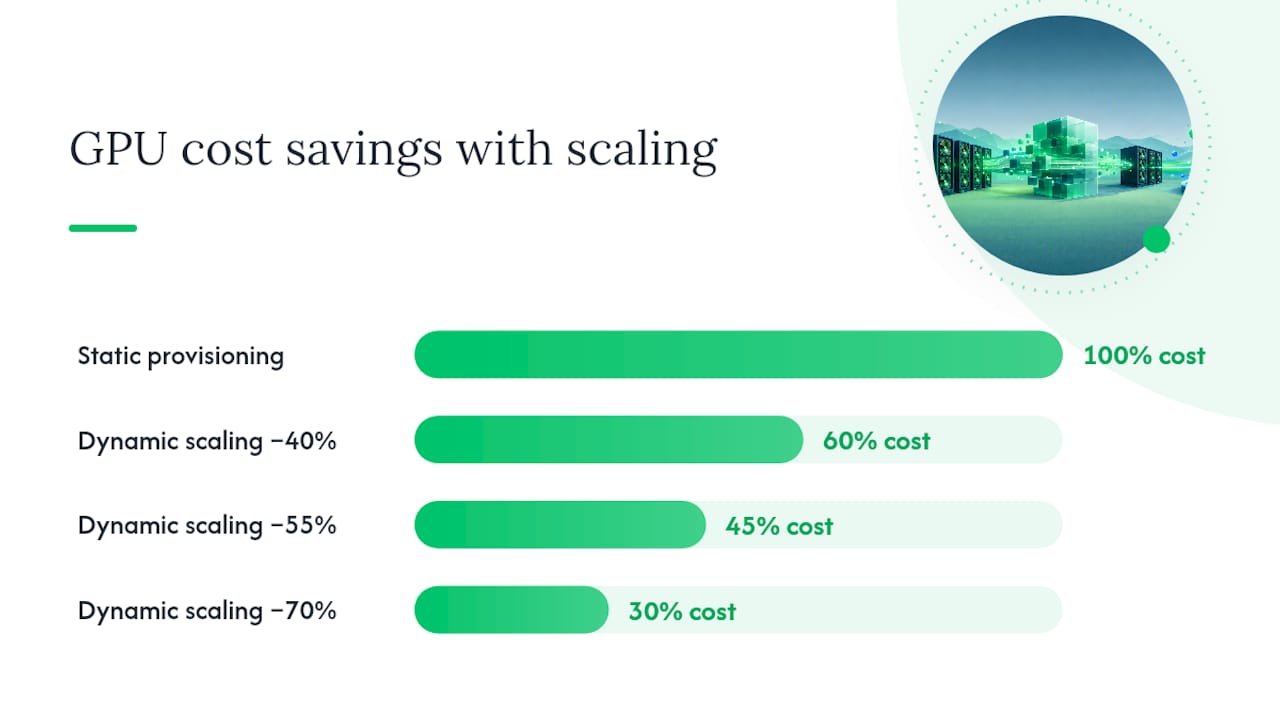
For teams considering self-hosting, GPU pooling and dynamic scaling reduce GPU costs by 40 to 70% compared with static provisioning by matching capacity to real-time demand instead of provisioning for peak load year-round. Set autoscaling triggers on queue depth and GPU utilisation rather than raw request count, since request count alone doesn’t capture how expensive individual requests are.
Benchmarking latency against throughput and mapping the Pareto front across precision formats like FP16 and INT8 tells you exactly where the sweet spot sits for your specific workload. Feed that benchmark data into a simple TCO formula: total infrastructure and licensing cost, divided by requests served, gives cost per 1,000 prompts; divide by total tokens processed for cost per million tokens. Both figures let you compare hosted and self-hosted options on equal footing, something a raw GPU-hour price cannot do alone. Teams weighing this trade-off in depth often benefit from a structured build versus buy assessment before committing infrastructure budget, and a look at on-premises deployment patterns for regulated workloads specifically.
How do you build FinOps governance for GenAI spend?
Engineering fixes decay without governance behind them. A router gets bypassed, a quota gets raised “temporarily,” a new feature ships without telemetry. Treating AI cost management as an ongoing operating discipline, not a one-off clean-up, is what separates organisations that stay in control from those that firefight every quarter.
The structure that works in practice has four components.
An AI cost control tower. One team, usually a FinOps function partnered with platform engineering, owns a single-pane view of every model contract, usage figure, and outcome metric across the organisation. Without this, spend fragments across a dozen team-level budgets that nobody reconciles.
Rolling forecasts built on token run rates. Static annual budgets fail for GenAI because usage compounds unpredictably. Model spike scenarios explicitly, what happens at 3x current traffic, what happens at 10x, and set alert thresholds before either scenario becomes real.
Chargeback and allocation by feature and outcome. Every team building on shared model infrastructure should see its own cost per feature and cost per successful outcome, not a lump-sum bill split evenly regardless of actual usage.
Automated quotas and anomaly alerts. Policy enforcement that fires before a runaway agent burns through a month’s budget in a weekend, not a report that arrives after the fact.
GenAI spend left unmanaged tends to grow faster than any other cloud category an enterprise runs, which is precisely why a control tower needs teeth rather than just dashboards. A documented AI strategy and operating model gives the control tower its mandate; without executive sponsorship, quota enforcement gets overridden the first time a product team complains.
What’s the 90-day checklist for cutting GenAI costs?
Sequencing matters more than intensity. Attempting every lever simultaneously in week one produces chaos and no clean before-and-after comparison.
Instrument everything. Deploy token-level telemetry and request tagging before changing anything else.
Establish your baseline. Two to four weeks of clean data on cost per request, cost per outcome, and GPU utilisation by feature.
Deploy routing policies. Start with the clearest cheap-versus-expensive classification cases.
Enable caching and batching. Target the highest-traffic-concentration workloads first for caching; move anything without a real-time SLA to batch.
Set hard quotas. Per feature and per team, informed by your baseline, not guesswork.
Audit for anomalies weekly. Catch runaway agents and misrouted requests before they compound into a monthly surprise.
Report to finance monthly. Cost per outcome and variance to forecast, not just raw spend.
Quick wins that need almost no engineering time: trim system prompts, identify batchable overnight workloads, and tighten default rate limits on new features before launch. Medium-term projects, a proper routing gateway, GPU pooling, a quantisation pilot, and a live TCO dashboard, take longer but compound month over month.
Pro Tip: Track monthly variance to forecast as your primary governance KPI, alongside cost per outcome. A programme that hits its cost-per-token target but blows the forecast by 40% is still failing at governance.
How does Sentient Concepts approach GenAI cost optimisation?
Sentient Concepts structures GenAI cost work around three connected stages: Build, Run, and Advise. Build covers data and platform engineering to instrument telemetry from day one, plus custom AI and GenAI solutions designed with routing and caching baked into the architecture rather than retrofitted later. Run means managed AI operations, continuous monitoring, scaling decisions, and cost governance after deployment, so savings identified in month one don’t erode by month six. Advise covers AI strategy and readiness work, the operating-model design that gives a cost control tower actual authority inside the organisation.
Clients in finance and manufacturing have used this structure to convert document-processing and conversational-agent workloads into measured, governed systems rather than open-ended API bills. Manufacturing clients automating supplier document processing, for instance, have moved from unmonitored per-call spend to feature-level cost accounting within a single engagement.
A typical 90-day engagement runs discovery first, mapping current spend and workload shape, then instrumentation to establish the telemetry baseline, then a pilot on one or two high-volume workflows to validate routing and caching gains, then scale-out once the numbers hold up under real traffic. Because Sentient Concepts stays accountable through implementation and ongoing operations rather than handing off after a strategy deck, the governance model built in week one is still enforced in month twelve.
Can incremental learning cut GenAI training costs?
Training costs get less attention than inference costs in most cost-optimisation conversations, but for organisations fine-tuning their own models, dataset management is often the single biggest lever available. Curating a smaller, higher-quality dataset frequently outperforms throwing more raw data at a training run, and it costs a fraction as much in compute.
Incremental learning, updating an existing model with new data rather than retraining from scratch, avoids paying the full training cost every time your data changes. This matters enormously for enterprises with data that shifts monthly, like a manufacturing firm updating a defect-classification model as new product lines launch. Retraining from a clean slate every cycle is not just expensive; it discards everything the previous training run already learned.
Practical dataset management starts with deduplication and quality filtering before volume. A dataset with fewer, cleaner examples trains faster, costs less, and often generalises better than a larger, noisier one. Version your training data the same way you version code, since being able to trace a quality regression back to a specific dataset change saves weeks of debugging.
For most enterprise use cases, though, fine-tuning is not the first move. Retrieval-augmented generation lets you ground a general-purpose model in your own data without touching training costs at all, and it’s worth understanding how RAG compares to fine-tuning before committing to a training budget that may not be necessary.
Do spot and reserved instances reduce cloud compute costs?
Spot instances and reserved capacity address different parts of a GenAI compute bill, and conflating them leads to either overpaying or building on unstable ground.
Spot instances offer steep discounts, often well below on-demand pricing, in exchange for the provider’s right to reclaim capacity with little notice. They suit batch inference, training checkpoints, and any workload that can tolerate interruption and resume from a saved state. They are a poor fit for real-time inference serving live user traffic, since a reclaimed instance mid-request means a failed or delayed response.
Reserved instances, or committed-use discounts, trade a usage commitment, typically one to three years, for a lower effective rate on infrastructure you know you’ll need continuously. These fit the steady-state portion of your workload: the baseline GPU capacity that runs regardless of traffic peaks, with autoscaling and spot capacity layered on top for variable demand.
The practical pattern most enterprises land on is a mixed fleet: reserved capacity covering baseline load, autoscaled on-demand or spot capacity absorbing peaks, and batch workloads routed to spot instances wherever the interruption risk is tolerable. Getting this mix wrong in either direction is expensive. Over-committing to reserved capacity leaves you paying for idle GPUs during low-traffic periods, while under-committing means paying full on-demand rates for predictable, steady-state load that could have been locked in cheaper.
Why do storage and data transfer costs matter for GenAI budgets?
Compute dominates most GenAI cost conversations, but storage and data transfer charges accumulate quietly and often go unbudgeted until they represent a meaningful share of the total bill.
Vector databases supporting retrieval-augmented generation store embeddings for potentially millions of documents, and that storage cost scales with corpus size and embedding dimensionality, not with query volume. A vector search cost that looked negligible in a pilot can grow substantially once a full document corpus is indexed. Reindexing frequency matters too: rebuilding embeddings every time source documents change is far more expensive than incremental updates to only the changed segments.
Data transfer, particularly cross-region or cross-cloud, adds a cost line that engineering teams frequently overlook when architecting a system. Serving inference from a different region than where your data lives means paying egress charges on every request that pulls context, and those charges compound at scale in ways a single test request never reveals.
The practical mitigation is architectural: co-locate your vector store, your model endpoints, and your data pipeline in the same region wherever compliance allows, and monitor storage growth against your data retention policy rather than letting embeddings accumulate indefinitely. AWS’s generative AI cost-optimisation guidance specifically calls out resource control parameters and workflow boundaries as a defence against exactly this kind of quiet cost accumulation, treating storage and transfer as first-class budget items rather than an afterthought to compute.
Are open-source or commercial GenAI models cheaper?
Neither wins outright, and the honest answer depends on your volume, your engineering capacity, and how much you value not managing infrastructure yourself.
Commercial, API-hosted models carry a premium per token but eliminate infrastructure management, GPU procurement, and scaling engineering entirely. For low-to-moderate volume workloads, or teams without deep MLOps capacity, that premium is often cheaper in total than hiring the engineers needed to run open-source models reliably at scale.
Open-source models, self-hosted on your own or rented GPU capacity, can undercut commercial API pricing substantially at high volume, but only once you account for the full engineering cost: provisioning, scaling, monitoring, security patching, and the ongoing work of keeping pace with newer open-source releases as they overtake older ones in capability. A team that self-hosts without dedicated MLOps investment frequently ends up paying more in engineering time than they saved on inference.
The workload-shape principle applies here too: model choice should follow measured input and output token ratios for your actual traffic, not a general reputation for being “the cheap option”. A commercial model with an efficient caching discount can beat a self-hosted open-source model on a workload with high context reuse, while the same open-source model might win decisively on a high-volume, low-context-reuse batch job. Run the comparison on your own traffic before committing either way, ideally using a structured comparison of AI tooling options as a starting reference point.
Why most GenAI cost advice misses the point
The conventional advice on GenAI cost optimization treats it as a technical problem: swap models, add a cache, batch what you can. That advice isn’t wrong, it’s incomplete. The engineering levers work exactly as advertised, but they decay within a quarter if nobody owns the governance layer that keeps them enforced.
What the research actually supports is a sequencing argument most vendors skip: measurement before models, governance before growth. Teams that route and cache without a control tower behind them tend to see savings evaporate the moment a new feature ships without the same discipline applied. The teams that hold onto savings treat cost per outcome as a permanent KPI, not a one-time audit finding.
If you take one thing from this, prioritise telemetry over technique. A mediocre routing policy with full visibility beats a perfect routing policy nobody can measure. Fix the blindness first, and the technical levers become obvious.
— Thomas Samuel
Get GenAI spend under control with Sentient Concepts
Most enterprises trying to fix GenAI cost overruns end up choosing between a piecemeal engineering fix, one team caching prompts, another team ignoring theirs, or a slow internal FinOps build that takes a year to reach production. Sentient Concepts closes that gap by staying accountable from telemetry design through to ongoing operations, so the routing policy and quota enforcement you build in month one are still the ones running in month twelve, not something a departed contractor left half-finished.
That continuity matters most for regulated industries. In finance and manufacturing specifically, Sentient Concepts has built document-automation and conversational-agent systems with cost governance engineered in from day one rather than bolted on after the first surprise invoice. If your organisation is past the point of ad hoc prompt tweaks and needs a proper cost control tower, start with a readiness and data diligence assessment to baseline your current spend and workload shape before committing to a build.
Sources
FAQ
Can AI be used for cost optimization?
Yes. AI systems, particularly routing classifiers and anomaly-detection models, are increasingly used within FinOps control towers to automate cost decisions like model selection and quota enforcement in real time.
How can AI be used to reduce costs?
Beyond optimising its own inference spend, GenAI reduces costs elsewhere by automating document processing, conversational support, and predictive analytics tasks that previously required manual labour, a pattern Sentient Concepts applies across finance and manufacturing clients.
What are the four pillars of cost optimization?
For GenAI specifically, the four practical pillars are telemetry and visibility, inference-level engineering (routing, caching, batching, quantisation), FinOps governance and forecasting, and infrastructure right-sizing across hosted and self-hosted deployments.
Is SEO replaced by AI?
No. AI tools assist with research, drafting, and analysis, but they don’t replace the strategic judgement, editorial oversight, and governance that effective SEO, like effective GenAI cost management, still requires from experienced practitioners.
Recommended