Modeling Implicit Relations for Enterprise Contract Clause Extraction
- 1 day ago
- 8 min read
Contract clause extraction (CCE) is the automated identification and structured pulling of specific contractual provisions, such as termination rights, indemnities or payment terms, from unstructured or semi-structured documents. Effective CCE depends on models that capture implicit context between clauses and preserve enough document structure to reconstruct the source accurately. The methods, data pipelines, and evaluation standards below determine whether that promise holds in production, not just in a paper.
TL;DR:
Properly calibrated models are essential for high-quality clause extraction, with QA-based and span retrieval approaches outperforming token classifiers on long and conditional clauses.
Extracted clause accuracy heavily relies on precise document parsing, including layout analysis, clause segmentation, and canonicalization, to prevent fragmentation and data loss.
Zero-shot and long-range context modeling significantly improve performance on complex references and cross-references, enabling more reliable interpretation of contract relationships.
Reporting benchmark results by clause type and reconstruction coverage helps identify specific weaknesses, especially in high-stakes areas like indemnification or termination.
An effective pipeline requires clear ownership, risk-based validation, and traceable audit trails to ensure legal trust and regulatory compliance in deployment.
Table of Contents
What contract clause extraction actually covers
CCE sits between two tasks that get confused constantly: field extraction and full clause extraction. Field extraction pulls a discrete value, such as a renewal date or a contract number. Clause extraction pulls the entire provision, including its qualifying language, cross-references and exceptions, which is why it is harder and why token-level shortcuts often fail on it.
Clause types that come up repeatedly in enterprise pipelines include:
Termination and renewal provisions
Indemnification and limitation of liability clauses
Confidentiality and data protection terms
Payment, penalty and interest clauses
Governing law and dispute resolution clauses
Downstream, extracted clauses feed contract lifecycle management (CLM) systems, populate obligation registers, and support due diligence during mergers or vendor onboarding. Getting scope right matters because a due diligence project needs breadth across thousands of contracts, while a CLM population project needs precision on a narrower set of clause types. Termscout draws a useful distinction here: contract review is deep single-document analysis against a playbook, while contract analysis is portfolio-level pattern detection. Conflating the two at the design stage is one of the most common reasons CCE projects miss their brief.
Core technical approaches to clause extraction
Four families of method dominate current practice, and each suits a different clause profile.
Rule-based and template extraction still works well for highly standardised documents with predictable headings, such as boilerplate NDAs or government procurement templates. It is cheap to build and easy to audit, but it breaks the moment a counterparty edits a heading or restructures a clause across paragraphs.
Token-level sequence labelling, typically using a transformer-based token classifier, tags each word or subword with a clause label. This performs well for short, structurally consistent fields but struggles with clauses that run across several sentences or nest sub-clauses inside a parent provision.
Span extraction and QA-based formulations treat clause extraction as an answer-retrieval problem: given a question like “What is the termination notice period?”, the model retrieves the exact span containing the answer. Reframing the task this way improves handling of variable-length clauses and conditional language, which token classifiers routinely fragment.
Hybrid architectures combine a rule-based first pass for known boilerplate with a learned model for everything else, followed by normalisation logic that standardises clause labels across contract templates.
Rule-based: fast, auditable, brittle to drafting variation
Token classification: reliable for short fields, weak on long clauses
QA/span models: strong on variable-length and conditional text
Hybrid: best coverage, highest engineering overhead
Pro Tip: Match the model family to the clause, not the project. Running a single architecture across both short fields and long conditional clauses usually means one category is quietly underperforming.
Document ingestion and preprocessing: where accuracy is actually won or lost
Extraction quality is bounded by parsing quality, full stop. Scanned contracts need OCR with layout analysis; born-digital PDFs need a parser that respects tables, columns and footnotes rather than flattening them into a single text stream. Skipping this step is the single most common cause of production failures in CCE deployments.

Practitioners increasingly treat reconstruction quality, how faithfully extracted text can rebuild the original document, as a deployment gate rather than a nice-to-have. The pragmatic target used across practitioner literature is ≥95% mean word coverage before clause-level metrics are even evaluated, because poor layout parsing fragments clauses in schedules, annexes and multi-column exhibits.
A workable preprocessing sequence looks like this:
Layout analysis to separate headers, tables, footnotes and body text before any extraction runs
Clause segmentation to identify provision boundaries, including numbered sub-clauses and cross-referenced exceptions
Canonicalisation to map extracted text to a consistent schema across contract templates and counterparties
Versioning to track amendments and side letters against the base agreement
Guidance on parsing complex layouts, including PDF table extraction for schedules and pricing exhibits, applies directly here.
Research spotlight: implicit relations and QA-based extraction
Superficial, context-free extraction misses what actually makes contracts hard to parse. Three implicit relations drive most of the remaining error rate: long-range context (a definition on page 2 governing a clause on page 40), term-definition links (a defined term used inconsistently across sections), and similar-clause relations (near-identical provisions that differ in one material respect, such as a carve-out).
ConReader, presented at EMNLP 2022, models these three relations explicitly rather than treating each clause as an isolated span. The result is state-of-the-art extraction accuracy and, more importantly for practitioners, stronger zero-shot performance on contract types the model never saw during training.
Modelling long-range context, term-definition relations and clause similarity does not just improve raw accuracy. It improves interpretability, because the model’s decisions can be traced back to the specific definition or cross-reference that drove them, rather than sitting as an opaque token-level guess.
Separately, QA-based extraction research shows that reframing extraction as span retrieval outperforms token labelling specifically on conditional clauses, where the answer depends on an “if, then, unless” structure that a flat tagging scheme cannot represent well. Zero-shot gains are real, but a follow-up analysis notes that domain shift between contract types still causes failures when preprocessing is inconsistent.
Evaluation and benchmarks: what a credible number actually looks like
Precision, recall and F1 remain the baseline metrics, but they need reporting at both the span level and the document level, because a model can score well on isolated spans while still failing to reconstruct a coherent clause. Reconstruction coverage sits alongside these as a parsing-quality gate rather than a model metric.
Public contract datasets vary widely in what they capture: some focus on commercial NDAs, others on procurement or lease agreements, and few cover the multi-column schedules and cross-referenced annexes that cause most production failures. Treat any benchmark score as a floor, not a ceiling, for real-world documents outside that dataset’s domain.
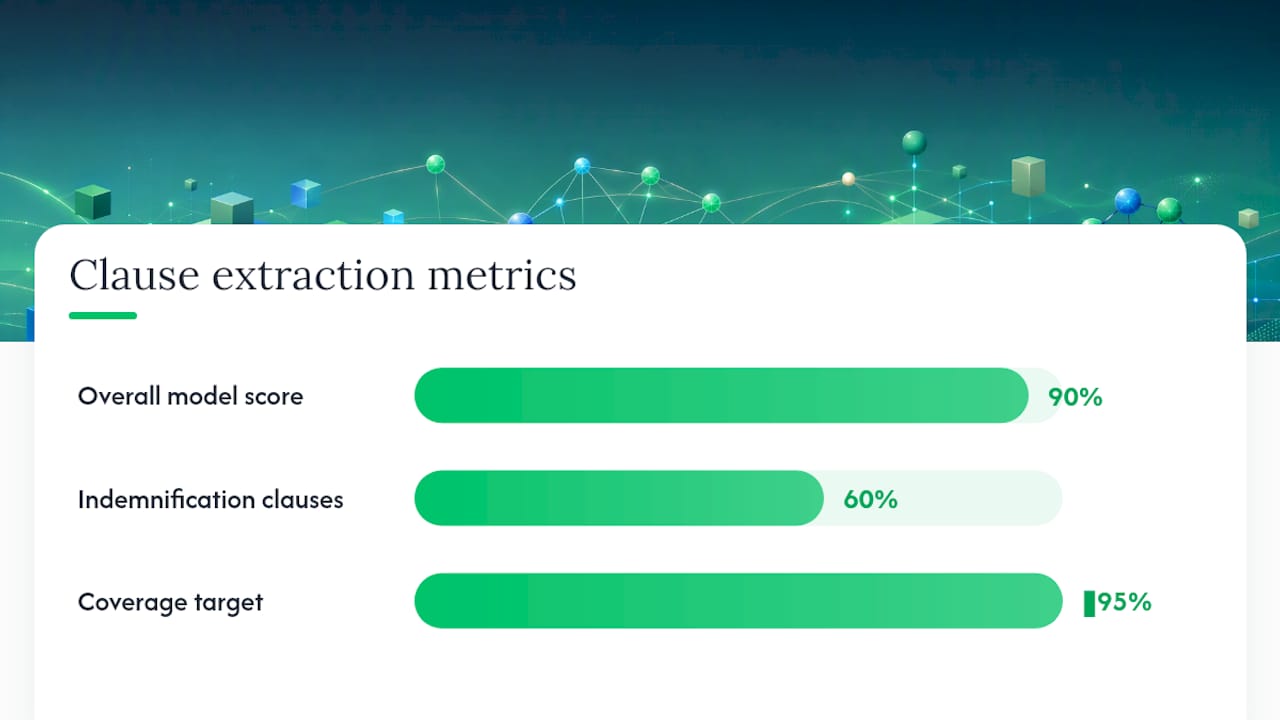
The most useful report format breaks results down per clause type rather than as a single blended score, alongside a human-reviewed failure taxonomy. A model that scores 90% overall but 60% on indemnification clauses is not production-ready for a due diligence project that lives or dies on indemnification. A pragmatic target of ≥95% mean word coverage for reconstruction, reported in practitioner-oriented analysis, remains the clearest early signal that a pipeline is ready for clause-level evaluation at all.
Production considerations: pipeline design and governance
A reliable pipeline follows a clear sequence: ingest, parse, extract, validate, integrate. Each stage needs an owner and a checkpoint, not just a model call. This mirrors the ingestion, comparison, risk identification and clause-suggestion stages used in production-grade automated review agents.
Human-in-the-loop validation should be sampled and escalated by risk, not applied uniformly. Playbook-driven checks, where extracted clauses are compared against pre-agreed thresholds, substantially reduce high-severity misses compared to spot-checking at random.
Sample high-risk clause types (liability caps, termination rights) at a higher rate than boilerplate
Escalate low-confidence extractions to a reviewer before they reach a CLM system
Log every extraction decision against the source span for audit trails
Mask or redact PII during processing where jurisdictional privacy rules apply
Pro Tip: Build the audit trail before you build the dashboard. Explainability that traces a decision back to the exact clause and definition it relied on is what makes legal teams trust automated output enough to act on it.
Build in-house or engage an end-to-end partner?
Bespoke builds make sense when clause types are narrow and stable, but most teams underestimate the timeline once reconstruction quality, edge-case handling and audit trails enter the scope. A managed engagement earns its cost when the pipeline needs to reach production reliability quickly and stay tuned as contract templates change. Scope a pilot around one clause family, set precision and reconstruction coverage as your KPIs, and expand only once both hold.
— Thomas Samuel
How Sentient Concepts builds production-grade clause extraction
Sentient Concepts is the alternative to a fragmented build, where strategy, data engineering and deployment sit with different vendors and nobody owns the failures. One team carries the project from readiness assessment through model engineering, integration and managed operations, so reconstruction quality and clause accuracy stay someone’s job long after launch.
That continuity matters most in finance, manufacturing and logistics, where contract volumes are high and the cost of a missed indemnity clause is measured in real exposure, not just review time. Sentient Concepts scopes pilots around a single clause family with agreed precision and reconstruction targets, then builds out the data and platform engineering and integration and architecture needed to take it into production. Document-processing patterns from ICE-Ai and workflows like those described by DocuPOW illustrate the ingestion and review layer this rests on. If you are weighing a pilot, start with a product and application development readiness review to scope the clause set and KPIs before committing to a build.
Sources
FAQ
What is contract clause extraction?
Contract clause extraction is the automated process of identifying and structurally pulling specific provisions, such as termination or indemnity clauses, from contract documents so they can be tracked, compared or analysed at scale.
What is a clause in a contract, with an example?
A clause is a distinct provision addressing one obligation or right, such as a limitation of liability clause capping damages at a fixed amount or a defined multiple of fees paid.
What is it called when you pull out of a contract?
Ending a contract before its natural term is generally called termination, which may be exercised under a termination clause, for breach, or by mutual agreement depending on what the governing clause permits.
How do I summarise a contract effectively?
An effective summary extracts each material clause type (term, payment, termination, liability, confidentiality) and states its key parameters rather than paraphrasing the full text, which is exactly the structured output CCE pipelines are designed to produce.
How do I pull out of a contract?
Review the termination clause first, since it typically sets required notice periods, permitted grounds and any exit fees; extraction tools that isolate this clause specifically help avoid missing a notice deadline buried in dense legal text.
Recommended