90 Day Playbook: Conversational AI Evaluation for Product & Engineering
A conversational AI evaluation programme works only when it runs on two layers at once: operational KPIs that show business impact and LLM-specific quality metrics that show whether the model is actually right. Get both layers into a repeatable pipeline, built from a golden dataset, an automated CI/CD gate, and live production analytics, and regressions get caught before customers do. Start by selecting three to five outcomes on each layer, assembling a 10 to 20 example golden seed dataset, assigning a metric owner, and scheduling your first pilot A/B test within 90 days.
TL;DR:
Evaluating conversational AI requires monitoring both operational KPIs and LLM-specific quality metrics simultaneously to prevent over-optimization on a single aspect.
Combining human review, automated LLM judging, and simulation testing ensures a comprehensive assessment that captures nuance, safety, and flow issues.
Building a small initial golden dataset with explicit rubrics allows effective offline scoring and iterative expansion for reliable repetition and regression detection.
Automating CI/CD gates to test prompts, models, and safety filters on every change helps catch regressions early and maintains continuous performance monitoring.
Ongoing evaluation, including live A/B testing and rigorous safety controls, is essential for maintaining model quality and safety in production workflows.
Table of Contents
What metrics matter most in conversational AI evaluation?
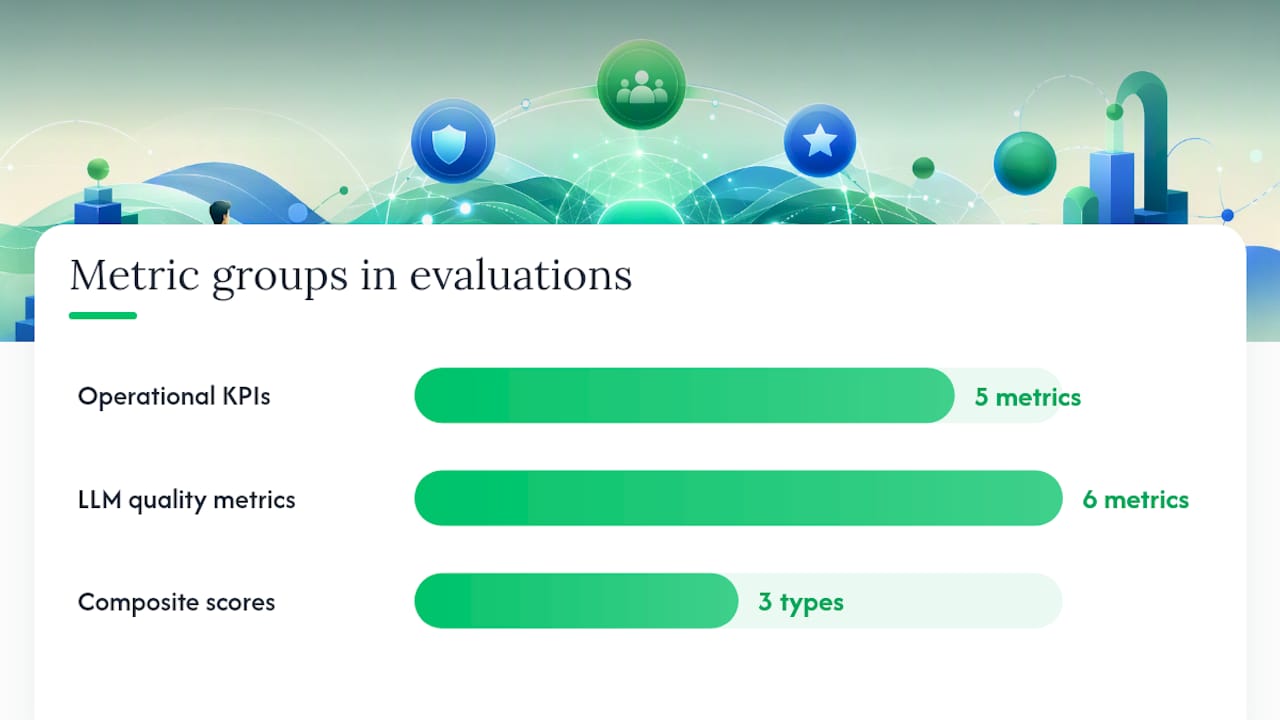
Every mature conversational AI evaluation programme tracks two distinct sets of numbers, and confusing them is the single most common mistake teams make. Operational KPIs tell you whether the bot is doing its job for the business: containment rate, escalation rate, resolution rate, cost per automated conversation, and latency. LLM quality metrics tell you whether the model itself is behaving: relevance, completeness, groundedness (whether answers are actually backed by the source material), instruction following, role adherence, and knowledge retention across a session.
Practitioner guidance on chatbot performance metrics and testing recommends blending both layers rather than treating either as sufficient on its own. A bot with perfect containment but poor groundedness is confidently wrong at scale.
Composite scores, sometimes framed as bot experience, bot automation, and conversation quality, help translate a dozen metrics into something a product leader can act on. The risk is optimising a single number: a bot chasing containment alone will simply stop escalating, which looks good on a dashboard and terrible in a customer complaint.
Useful metric groupings include:
Efficiency: containment, resolution, cost per conversation, latency
Correctness: relevance, completeness, groundedness/factuality
Behaviour: instruction following, role adherence, tone consistency
Safety: refusal correctness, policy compliance, escalation triggers
Pro Tip: Pick a single “north star” pairing, usually one operational metric and one quality metric, and report it every week. Everything else is diagnostic, not decisional.
Human review, LLM-as-a-judge or simulation: which evaluation method should you use?
No single method covers everything a conversational system needs checked. The practical answer is to run all three, each doing the job it’s actually good at.
Human review remains the gold standard for nuance, tone and safety calls that automated scoring still misses. Reviewers need explicit rubrics and calibration examples, or scores drift between people within weeks, a point reinforced by guidance on chatbot evaluation frameworks and echoed in wider discussion of AI peer review challenges.
LLM-as-a-judge scales far beyond what human reviewers can manage, scoring thousands of conversations for a fraction of the cost. It needs the judge model version pinned and periodically recalibrated against your golden dataset, because unpinned judges drift and silently inflate or deflate scores over time.
Simulation and user-simulators exercise multi-turn task completion, catching flow-level regressions that single-turn checks miss entirely, an approach reflected in unified toolkits like UniDial-EvalKit, which standardises multi-turn pipelines for exactly this kind of testing.
The hybrid pattern that works in practice: sample conversations, score them with an LLM judge, then route anything low-scoring or safety-flagged into a human review queue. That’s a three-tier funnel, not a single tool.
Pro Tip: Never let LLM-as-a-judge grade its own homework: use a different model family for judging than the one powering your production bot, or you’ll systematically miss shared blind spots.
How do you build a golden dataset for testing?
Start small and specific. Ten to 20 hand-labelled examples covering your core intents, a handful of edge cases, and at least one known safety failure is enough to begin, a rule of thumb backed by practitioner guidance on chatbot testing. Trying to label everything up front before shipping anything usually stalls the whole programme.
Write explicit rubrics for relevance, completeness, factuality and safety, with calibration examples showing what a pass and a fail look like side by side. Tag each example by intent, channel, difficulty and failure mode so you can filter regressions by category later.
Golden examples do double duty:
They anchor offline comparisons between prompt or model versions.
They validate your LLM judge against real human labels.
Semantic similarity scoring against a golden answer, using sentence embeddings rather than word-overlap metrics like ROUGE, catches paraphrased correct answers that n-gram scoring wrongly penalises, a method detailed in the E2E benchmark research.
Expand the set every time production throws up a genuine failure. That’s how a 15-example seed becomes a 200-example regression suite within a year.
How do you automate regression testing in CI/CD?
Treat every prompt, model, or retrieval change the way you’d treat a code change: nothing ships without passing automated checks. That means running the golden dataset score, a latency and tool-call check, and a rule-based safety filter on every pull request, not just before quarterly releases.
Score against the golden set and calculate the version delta, the change versus the last approved release, not just an absolute score.
Set a pass/fail threshold on that delta, blocking merges that drop groundedness or safety scores beyond an agreed margin.
Sample rather than score everything on every commit; run the full suite nightly and a smaller representative sample per pull request to manage judge API cost.
Pin the judge model version in your CI configuration and schedule periodic recalibration against human labels, since an unpinned judge silently changes what “pass” means.
A lightweight release scorecard weighting accuracy, safety, latency, and cost gives engineering teams one number to gate on, an approach outlined in SmartBot’s evaluation framework. Teams running these gates as software CI, not a manual quarterly review, catch regressions from prompt edits within hours instead of weeks, a principle borne out in the same chatbot evaluation guidance.
Pro Tip: Wire the safety filter to fail closed, not open. If the rule-based check errors out, treat it as a failure, never a pass by default.
How should you monitor and A/B test in production?
Offline scores predict live performance; they don’t guarantee it. Production monitoring should track drop-off points, escalation clusters, non-response rate, repeat usage, and CSAT proxies, watching for distribution shifts that never showed up in your test set.
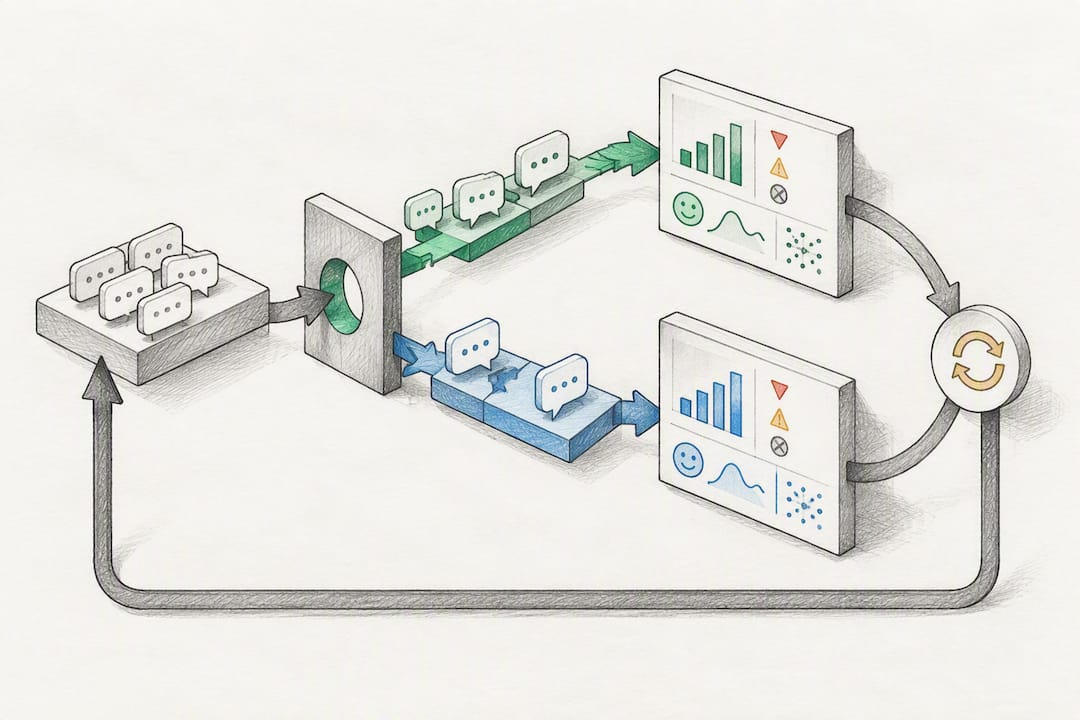
A/B testing an LLM system needs more caution than testing a traditional feature flag. Because responses are non-deterministic, you need larger sample sizes, thousands of conversations rather than hundreds, hash-based assignment so a returning user always lands in the same variant, and a run duration long enough to avoid novelty effects skewing early results, cautions well documented in independent chatbot monitoring and A/B testing analysis. The same source stresses treating the full conversation session, not the individual turn, as your unit of analysis, since turn-level wins can mask session-level losses.
A useful dashboard composition:
A release scorecard covering accuracy, safety, latency, and cost
Alerts for judge score drift versus the pinned baseline
Alerts for input distribution shift (new intents, new phrasing patterns)
Rollback if any gated metric breaches threshold; roll out gradually otherwise, expanding traffic share on a fixed schedule rather than a single cutover.
What governance controls keep a production bot safe?
Safety metrics deserve the same rigour as accuracy metrics: track policy failures, refusal correctness, PII leakage, and any harmful content that slips past filters.
Keep audit logs and change control on every prompt, model, and retrieval update.
Pin prompts and require human-in-the-loop sign-off for high-risk categories before release.
Set inter-rater agreement targets for human reviewers and re-run calibration sessions when agreement drops.
Add domain-specific checks for regulated sectors: finance and healthcare typically require extra disclosure, consent, and audit-trail controls beyond a general-purpose bot.
What does a pilot-to-scale evaluation playbook look like?
A workable pilot follows a fixed sequence: define your three to five outcomes, assemble the golden testset, run offline regressions, launch a small-scale A/B test, then expand coverage with CI/CD gates once the pilot clears its thresholds.
Week 1 to 2: define outcomes and assign metric owners.
Week 3 to 4: build the golden dataset and rubrics.
Week 5 to 8: run offline scoring and fix the worst failure modes.
Week 9 to 12: launch a limited A/B test and expand gating into CI/CD.
Teams following this sequence typically report meaningful reductions in manual handling and measurable efficiency gains, an outcome consistent with the operational playbooks Sentient Concepts has applied on similar agentic AI pilots and operations rollouts.
Why evaluation has to run continuously, not quarterly
Conversational AI evaluation only earns its keep when it’s built as CI/CD, not as a review exercise you schedule around a launch date. Automating the golden dataset checks, the judge scoring, and the safety filters doesn’t just catch regressions faster: it lets teams ship prompt and model changes with genuine confidence instead of crossed fingers.
My honest recommendation for any team starting from zero: don’t wait for the perfect metric taxonomy. Run a 90-day measurement pilot using the sequence above, get one composite scorecard live, and refine the rubrics as failures teach you what they were missing.
— Thomas Samuel
How Sentient Concepts helps you operationalise evaluation
An alternative to hiring and training an internal evaluation team is to engage a single accountable team to design your metric taxonomy, build the golden dataset, wire the CI/CD gates, and keep running the programme afterwards, instead of handing you a report and moving on.
End-to-end continuity is especially important for regulated industries where handoffs between the team that built an evaluation pipeline and the team operating it can result in safety checks lapsing. Sentient Concepts’ AI Strategy & Roadmap work sets the outcome metrics and prioritisation up front, Deployment & MLOps builds the automated regression gates into your release pipeline, and Managed AI Operations keeps monitoring, recalibrating judges, and running A/B tests once the bot is live.
If you’re weighing a pilot evaluation workshop or a full managed programme, review the full services list and get in touch to scope a pilot against your own conversational system.
Sources
FAQ
How can I test conversational AI?
Build a golden dataset of 10 to 20 examples covering core intents and edge cases, score responses against it with a mix of rule-based checks and LLM-as-a-judge, and route low-scoring or safety-flagged cases to human reviewers. Add these checks as automated gates in CI/CD so every prompt or model change gets tested before release.
What is the best AI for evaluation?
There’s no single best judge model; the reliable approach is pinning a specific judge model version, recalibrating it periodically against human labels, and combining it with human review for nuanced or safety-critical cases. Using a different model family for judging than the one powering your production bot also helps catch shared blind spots.
What is an example of a conversational AI?
Conversational AI covers systems from customer support chatbots to internal helpdesk assistants, like the internal IT helpdesk bots many enterprises deploy to automate ticket triage and containment. Each still needs the same two-layer evaluation: operational KPIs and LLM quality metrics.
How do I do AI evaluation?
Select three to five business outcomes and three to five LLM quality metrics, build a golden dataset, and gate every release against it in CI/CD before validating gains with a live A/B test. Sentient Concepts’ LLM evaluation metrics guide breaks the scoring rubrics down in more detail for teams building their first pipeline.
What does Sentient Concepts charge for an evaluation pilot?
Pricing depends on scope, so current rates for services like Monitoring & Evaluation or Deployment & MLOps are available on request through the Sentient Concepts services page. No published flat fee applies across every engagement.
Recommended