PDPA and MY AI: Malaysia's AI Rules for Policymakers and Businesses
Malaysia currently governs artificial intelligence through voluntary ethics guidelines layered on top of a strengthened Personal Data Protection Act, but that floor is about to get a ceiling. The AI Governance Bill, now in public consultation, would create a Central AI Authority, sort AI systems into three risk tiers, and impose incident reporting and sandbox obligations on the businesses that build and deploy them.
TL;DR:
Most organizations in Malaysia should begin documenting risk assessments, incident workflows, and human oversight controls for all AI systems now to meet upcoming Tier 2 obligations.
The AI Governance Bill will introduce mandatory incident reporting, sandbox access, and distinct duties for developers and deployers, with compliance expected to be proportionate to risk tiers.
Existing legal frameworks, such as PDPA amendments, sectoral regulations, and technical standards, will continue to apply alongside the new Bill, requiring integrated compliance efforts.
Public sector AI deployments should incorporate human rights due diligence and independent oversight, as these are likely to be explicitly mandated once the Bill becomes law.
Businesses must avoid delaying action until the Bill’s enactment by mapping current systems, aligning controls with standards, and establishing ongoing monitoring practices in advance.
Table of Contents
The current state of AI regulations in Malaysia
Nothing binding governs AI directly in Malaysia today. What exists instead is a patchwork of voluntary principles sitting on top of laws that were never written with AI in mind, but now apply to it anyway.
The National Guidelines on Artificial Intelligence Governance and Ethics (AIGE), issued by MOSTI, set out seven principles: fairness, reliability and safety, privacy and data security, inclusivity, transparency, accountability, and human benefit. None carry legal force. Enforcement, where it exists, comes from elsewhere:
PDPA amendments (2024 to 2025): mandatory data protection officers, breach notification duties, data portability rights, and sharply higher penalties, most taking effect from June 2025 and forming the current binding floor for AI systems that touch personal data.
Sectoral rules: Bank Negara Malaysia and the Securities Commission already apply model risk and technology governance expectations to AI used in banking data compliance and capital markets.
The Cyber Security Act 2024 and Online Safety Act 2025: security and content obligations that catch AI systems handling critical infrastructure or user-generated content.
Standards infrastructure: MY-AI Standards, developed with SIRIM and CyberSecurity Malaysia under NAIO’s governance remit, begins turning AIGE’s principles into testable technical requirements.
That combination, voluntary ethics plus a hardening PDPA, is the real starting point for any Malaysia AI policy conversation today.
What the AI Governance Bill actually proposes
The public consultation paper (PCP) released by the National AI Office describes a horizontal, risk-based statute, not a sector-by-sector patch. It borrows the tiered logic familiar from the EU AI Act but scopes it deliberately lighter, aiming for proportionate obligations rather than a single blanket regime.
Three risk tiers anchor the whole structure:
Tier 1 (unacceptable risk): systems prohibited outright, likely mirroring practices like social scoring or manipulative AI.
Tier 2 (high risk): systems permitted but subject to documentation, assessment, and reporting duties, most of the Bill’s compliance weight sits here.
Tier 3 (low risk): lighter-touch obligations, largely transparency-based.
The Bill’s core design choice: it regulates two roles, not one. A “Developer” builds or substantially modifies an AI system; a “Deployer” puts it into use. Each carries distinct duties, and the PCP text extends jurisdiction extraterritorially to any Deployer established in Malaysia, regardless of where the underlying system is hosted.
A Central AI Authority sits above both roles, organised around three functions: AI Safety (standards and risk classification), Investigation and Enforcement (compliance and penalties), and AI Enablement (sandbox access and innovation support). The Bill also introduces AI incident reporting duties and formalises regulatory sandboxes as supervised spaces where businesses can trial higher-risk systems before full compliance kicks in.
How the Bill fits alongside existing Malaysian law
The Governance Bill does not replace anything. It sits on top of laws that already apply, which creates real integration questions for compliance teams.
The PDPA remains the binding floor. Any AI system processing personal data must satisfy PDPA obligations regardless of its risk tier under the new Bill, the two regimes run in parallel, not in sequence.
Public-sector exemptions under existing law create friction. SUHAKAM has flagged this directly, recommending the Bill close any gap that would let government AI deployments escape scrutiny that private-sector Deployers face.
Sectoral regulators keep their turf. Bank Negara and the Securities Commission are expected to retain competence over financial-sector AI, with the Central AI Authority likely delegating to these “Sectoral Leads” rather than duplicating oversight.
MY-AI Standards do the technical heavy lifting. Where the Bill sets legal obligations, SIRIM-backed standards are expected to define what “adequate testing” or “sufficient documentation” actually looks like in practice.
Getting this stack right, PDPA, sectoral rules, and the new Bill, is the single hardest task facing in-house counsel over the next year.
What developers and deployers will need to do
Once the Bill moves past consultation, compliance stops being aspirational. Here is the practical sequence most Tier 2 organisations will need to work through:
Build a risk assessment file for each Tier 2 system. Keep records of intended use, training data provenance, testing results, and known limitations, this becomes your evidence base if the Central AI Authority ever asks.
Set up incident reporting workflows, covering not just confirmed failures but near-misses. A single-window filing process, one contact point, one format, will save enormous time compared to ad hoc reporting.
Strengthen human oversight controls. Document who can override an AI decision, how often that happens, and what triggers escalation.
Update DPO and DPIA processes to fold in AI-specific harms, then flow those changes into supplier contracts so vendors carry matching obligations.
Pro Tip: A fast way to start is mapping your existing PDPA controller and processor roles onto the Bill’s Developer and Deployer categories. Most organisations already have compliance templates that need extending, not rebuilding from scratch.
A practical roadmap for policymakers and business leaders
Waiting for the Bill to pass before acting is the costliest mistake available right now. A sensible preparation sequence looks like this:
Inventory every AI system in use, then classify each by likely risk tier and assign clear Developer or Deployer accountability internally.
Harmonise PDPA compliance with AI risk processes rather than running two parallel programmes, and adopt MY-AI Standards where technical benchmarks are available.
Stand up an incident-reporting workflow now, with one named compliance contact, so you are not building this under regulatory pressure later.
Explore sandbox participation. Testing under supervision produces documented mitigation evidence that reduces enforcement risk once the Bill takes effect.
Commission a readiness audit and review supplier contracts, particularly where third-party AI tools feed into regulated processes. Aligning this work with Malaysia’s broader national AI leadership strategy keeps compliance work connected to wider digital economy goals rather than treated as a standalone burden.
The human-rights dimension policymakers cannot ignore
Government use of AI carries different stakes than commercial use, and SUHAKAM’s submission to the consultation says so plainly. Its central recommendation is that the Bill explicitly bind public authorities, closing any exemption gap that would let state agencies deploy high-risk systems without the scrutiny private Deployers face.
Specific asks include:
Mandatory human-rights due diligence for Tier 2 systems used in justice, social protection, or policing contexts.
Independent oversight mechanisms separate from the agency deploying the system.
Audit and contract clauses requiring public-sector suppliers to demonstrate ongoing compliance, not just a one-time certification.
Timeline: what happens next and when it matters
The pace here has been unusually fast by Malaysian legislative standards. The National AI Office released its public consultation paper on 10 July 2026 and was itself institutionalised as a standing body just eighteen days later, on 28 July 2026, a pivot from advisory guidance towards genuine enforcement capacity.
Key dates to track:
Consultation feedback window: closing dates typically follow within weeks of a PCP release, legal and industry submissions (including SUHAKAM’s) are already shaping revisions.
Cabinet and parliamentary steps: these determine the real compliance clock, businesses should not assume a fixed enactment date until the Bill clears Cabinet.
Practical triggers now: update supplier contracts, extend DPIA templates, and set sandbox exit criteria before, not after, the Bill becomes law.
What operationalising AI governance actually looks like in practice
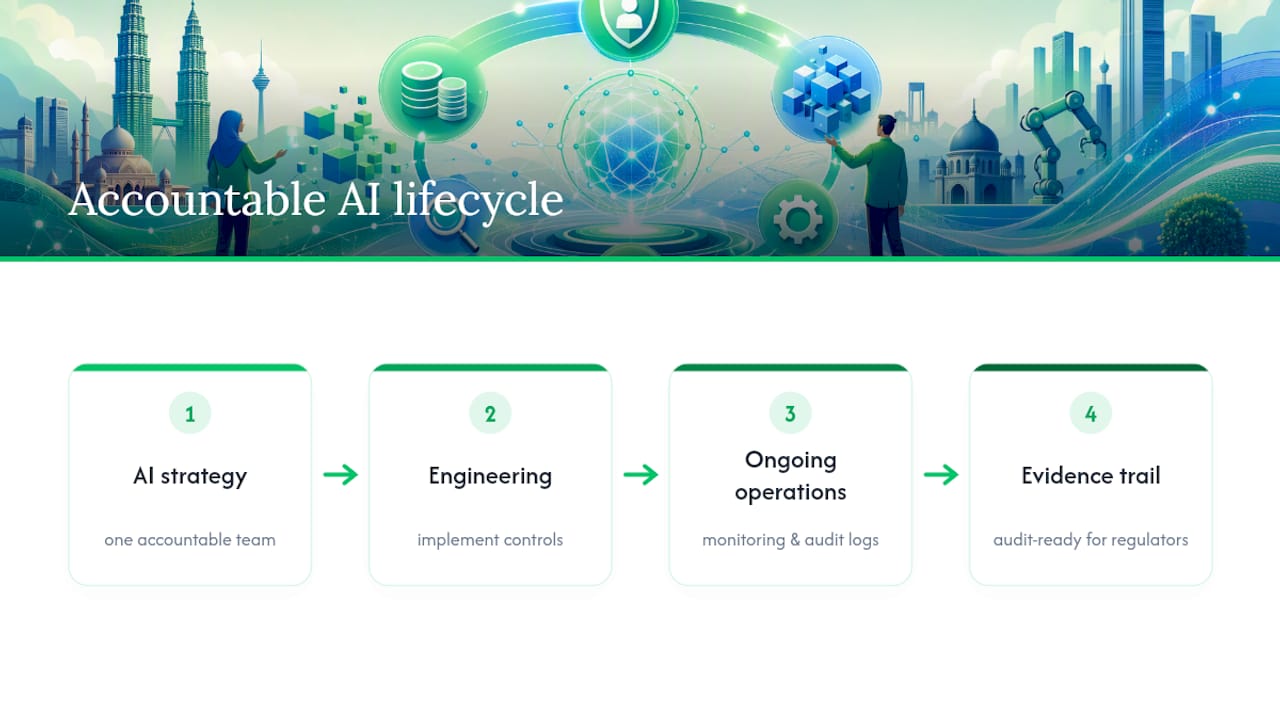
Most compliance failures do not come from bad intentions, they come from governance work getting split across three vendors who never talk to each other. AI strategy, engineering, and ongoing operations are best kept under one accountable team, which matters when regulators expect a single coherent evidence trail rather than fragmented documentation. In document automation and conversational agent deployments in industries like finance and manufacturing, such continuity is what turns monitoring and audit logs into something a Central AI Authority could actually review. Services that map most directly onto Bill readiness include readiness audits, DPIAs, and managed operations, the parts of compliance that dissolve without the sandbox trial.
Why the compliance conversation misses the point
Most commentary on Malaysia’s AI Governance Bill treats it as a future event, something to prepare for once it clears Cabinet. That reading understates how much of the real work is already compulsory. The PDPA amendments effective from June 2025 are not preparation for future AI law, they are current law, and any AI system touching personal data is already exposed to breach notification and DPO requirements today.
The conventional advice, “wait for the Bill, then comply”, gets the sequencing backwards. Organisations that treat MY-AI Standards and sandbox participation as optional extras will find themselves scrambling for documentation evidence the moment the Central AI Authority exists to ask for it. Businesses that come out ahead will be the ones who started building risk-tier documentation and incident workflows before the law demanded it, not after.
If there is one priority worth acting on now, it is this: stop separating “PDPA compliance” from “AI governance” as if they were two different projects. They are the same evidence base, viewed through two lenses. Build it once, properly, and the Bill becomes a formality rather than a scramble.
— Thomas Samuel
Get ready for Malaysia’s AI Governance Bill before it becomes law
Sentient Concepts is the alternative to piecing compliance together across separate vendors: one accountable team carries your AI strategy, risk documentation, and operational monitoring from day one, so nothing gets lost between a consultant’s recommendation and an engineer’s build.
For organisations trying to work out where they actually stand against the Bill’s three risk tiers, a readiness and data diligence review is the sensible starting point, it maps your current AI systems against likely Developer and Deployer obligations before you spend money fixing the wrong things. Where systems need ongoing monitoring and incident reporting built in, deployment and MLOps support keeps that evidence trail running without adding headcount. The full range of services, from strategy through managed operations, sits on the Sentient Concepts services page. Get in touch to scope a compliance readiness review before the consultation window closes.
Primary sources worth bookmarking
The AIGE guidelines, NAIO’s governance page, the Baker McKenzie Bill analysis, and SUHAKAM’s submission cover the guidelines, institutional remit, Bill mechanics, and rights-based critique respectively. For a broader look at building governance frameworks around AI deployment, the partner guide on thought leadership frameworks and risk offers a useful complementary lens.
Sources
FAQ
What are the main AI regulations in Malaysia right now?
There is no standalone AI law yet. The binding rules come from the PDPA amendments covering data protection, alongside sectoral rules from Bank Negara and the Securities Commission, while the AIGE principles remain voluntary.
What are the MY-AI Standards in Malaysia?
MY-AI Standards are technical standards developed under NAIO with SIRIM and CyberSecurity Malaysia, designed to turn AIGE’s voluntary principles into testable requirements for things like fairness testing and data security.
Will there be binding AI regulations in Malaysia?
Yes. The AI Governance Bill is currently in public consultation, having been released as a public consultation paper on 10 July 2026, and would introduce risk tiers, Developer and Deployer duties, and a Central AI Authority once enacted.
Which countries have AI regulation laws similar to Malaysia’s proposal?
The European Union’s AI Act uses a comparable risk-tier structure, and Singapore has developed its own AI governance frameworks, though Malaysia’s proposed model is intentionally lighter-touch to preserve room for innovation.
How can businesses prepare for compliance before the Bill passes?
Start by inventorying AI systems, classifying them by likely risk tier, and aligning existing PDPA controls with AI-specific documentation. Sentient Concepts offers a readiness and data diligence review to map current exposure against the Bill’s proposed obligations.
Recommended