Prioritize Banking Chatbot Use Cases That Prove Production Readiness
A banking chatbot has moved past scripted FAQ answers into conversational banking AI that can check a balance, freeze a card, or route a payment under governed rules. The use cases that pay back fastest are account queries, payments and transfers, onboarding and KYC, fraud alerts, lending support, collections, personal financial management, and internal IT or HR helpdesk automation. Each targets high-volume, repeatable tasks, so deflection from human agents starts almost immediately once the bot is grounded and integrated.
TL;DR:
High-volume, low-risk tasks like account queries and card controls are the easiest and fastest to automate for immediate deflection benefits.
Payments and transfers require defined scopes, confirmation steps, and human-in-the-loop gates to ensure safety while automating transaction mechanics.
Grounded, live data access and comprehensive governance layers are critical for chatbots to safely execute transactions and retain regulatory compliance.
Starting with pilot programs for account queries, fraud alerts, KYC, and internal helpdesk reduces risk while demonstrating value before full-scale deployment.
Continuous monitoring, audit trails, and escalation rules are essential for maintaining safe, compliant, and effective conversational banking systems long term.
Table of Contents
Banking chatbot use cases that deliver the fastest return
Not every conversational project deserves equal priority. Some tasks are high-volume and low-risk, which makes them ideal starting points; others touch money movement or regulated disclosures and need tighter governance before they go anywhere near production. The order below reflects that risk-and-reward curve, moving from the safest deflection wins towards use cases that require real transactional authority.
1. Account queries and card controls. Balance enquiries, transaction history lookups, and card lock/unlock requests are the bread and butter of contact centre volume, and they are also the easiest to automate because they are read-heavy rather than write-heavy. Industry guidance on high-ROI banking chatbot applications consistently lists these alongside transfers and KYC intake as the tasks with the fastest deflection payback. A well-tuned bot can resolve these without ever touching a human queue, provided it has live, tokenised access to the core banking system rather than a cached snapshot.
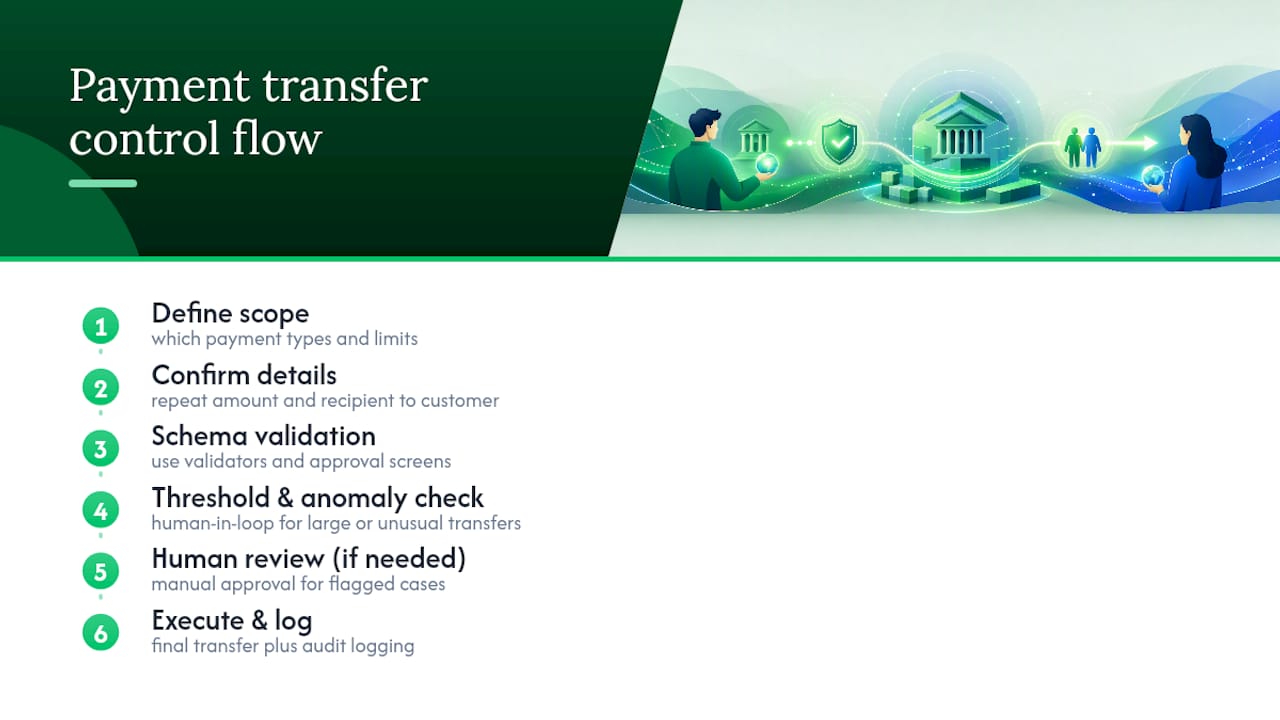
2. Payments and transfers. This is where conversational banking crosses from informational into transactional, and it demands a different design discipline. The bot needs a defined scope (which payment types, which limits), a confirmation step that repeats the amount and recipient back to the customer, and a human-in-the-loop gate for anything above a set threshold or flagged as unusual. Agentic architectures built for this purpose use schema validators and explicit approval screens before a transfer executes, which keeps the customer in control while still automating the mechanics of the payment pipeline.
3. Onboarding and KYC. Guided document capture, data prefill from existing records, and automated validation against sanctions and identity checks can compress account opening from days to minutes for straightforward cases. The ceiling here is “straight-through processing” for low-risk applicants; anything ambiguous, higher-risk, or involving joint ownership should route to a human reviewer rather than force the bot into a judgement call it isn’t built for.
4. Fraud alerts and security. Outbound conversational alerts, where the bank messages the customer about a suspicious transaction and offers one-touch actions (confirm, freeze, dispute), turn a slow phone-tag process into a near-instant resolution. Every action taken through this channel needs to be logged with the same rigour as a call centre transcript, because fraud disputes are exactly the kind of interaction regulators expect to be reconstructable after the fact.
5. Lending support and pre-qualification. Bots can collect income documents, run soft pre-qualification checks, and give applicants live status updates without a loan officer fielding “where’s my application” calls all day. This use case pairs well with onboarding automation because the document collection mechanics are similar, even though the underwriting decision itself stays with a human or a separate credit engine.
6. Collections and payment arrangements. A chatbot presenting pre-approved repayment offers, and capturing explicit consent to a new arrangement, gives customers a lower-friction way to resolve arrears than a collections call. The offers themselves must come from an approved policy engine, never generated freely by the bot, because this is a heavily regulated conversation with real consumer-protection implications.
7. Personal financial management. Spending nudges, subscription alerts, and savings insights build daily engagement, and they double as a cross-sell channel when the bot flags a relevant product (a savings account, a better-rate card) based on observed behaviour rather than a blanket promotion. This is one of the few use cases where the bot creates revenue rather than just cutting cost.
8. Internal automation. An IT or HR helpdesk bot handling password resets, leave requests, and policy questions carries none of the customer-facing regulatory weight of the other seven, which makes it the lowest-risk place to prove the technology works before customers ever see it.
Pro Tip: Start with account queries and internal helpdesk automation in the same quarter. One proves customer-facing deflection, the other proves the operating model, and neither risks a regulatory incident if something goes wrong.
What the numbers look like once a bot is grounded and integrated
The business case for conversational banking rests on four measurable shifts, and none of them require an exotic model, just disciplined integration and a clear scope.
Cost-to-serve falls as tier-1 account queries, card controls, and status checks move off the phone queue and onto a channel that costs a fraction per interaction to run.
Availability stops being a variable. A bot answering balance queries at 2am on a Sunday removes an entire category of “call back during business hours” friction that human-staffed centres can’t avoid.
First-contact resolution improves when the bot has live account access rather than a scripted decision tree, because it can actually answer the question instead of routing the customer to hold music.
Revenue moves through conversational cross-sell when PFM nudges surface a relevant product at the moment a customer is already looking at their spending, rather than through a generic email blast.
Deloitte’s research on banking chatbots found many customers still default to a human agent when their query spans multiple systems, because fragmented data prevents the bot from resolving the request end-to-end; a unified data model closes that gap and lifts both resolution rates and satisfaction. The KPIs worth tracking from week one are deflection rate (queries resolved without escalation), containment rate (customers who don’t re-contact within 24 hours), time to resolve, and conversion uplift on any cross-sell prompt the bot surfaces.
The architecture behind a bot that can actually act
Rule-based chatbots follow decision trees. Natural-language-understanding bots interpret intent but still hand off anything unscripted. Agentic, LLM-native systems sit a rung above both: they can hold a conversation, reason about which internal action to take, and execute it under a governed policy layer, which is the architecture that lets a bank offer real conversational banking rather than a glorified FAQ page. Research on language-centric AI banking systems describes exactly this kind of agentic orchestration, where the model plans an action, a schema validator checks it, and a human approval gate sits in front of anything that moves money.
Getting there requires specific plumbing, and skipping any piece of it is where most pilots stall:
Live data access. The bot needs tokenised API access to core banking, cards, and payments systems, not a batch export refreshed overnight. Success is genuinely determined by whether the bot can see and act on live account data, because an advisory-only bot working from stale data is a different (and much less useful) product than one that can actually execute.
A unified data model across lines of business. Retail, SME, and wealth data living in separate silos is exactly what produces the fragmented, “let me transfer you” experience Deloitte’s research flags.
Grounding through retrieval-augmented generation. The bot’s responses should be constrained to approved policy documents and knowledge bases rather than generated freely, which is the primary defence against a model inventing a plausible-sounding but wrong answer.
Stateless audit logging. Every decision the bot makes needs a reproducible trail a regulator or internal audit team can replay after the fact.
Human approval gates and drift monitoring. Anything above a defined risk threshold routes to a person, and the model’s behaviour gets watched over time for drift away from its trained baseline.
There’s a competitive dimension worth naming here too. When a general-purpose assistant connects to account-aggregation data and builds a read-only dashboard, it raises customer expectations for conversational access without giving the bank any control over the experience. Commentary on this shift argues banks need to build their own governed, action-capable conversational layer rather than cede that interface to a third party that can only read, never execute on the bank’s behalf.
Keeping conversational banking safe, auditable, and compliant
The IMF’s fintech note on generative AI in finance is blunt about this: the technology introduces specific, identifiable risks that need dedicated controls, not a generic “AI governance” checkbox. Five controls matter most for a transaction-capable bot.
Ground every response. A model answering from its general training data, rather than from the bank’s own approved policy documents, is the single biggest hallucination risk in a regulated conversation. Retrieval-augmented generation against a curated knowledge base is the primary defence.
Authenticate before acting, confirm before executing. Every transactional flow needs identity verification appropriate to the action’s risk, explicit consent capture, and a confirmation step that repeats the transaction details before it fires.
Build stateless, reproducible audit trails. Malaysian banks and development finance institutions adopting governing AI practices are converging on the same requirement: a reproducible decision log that lets a regulator reconstruct exactly why the bot did what it did, not just what it did.
Define escalation rules in advance. Confidence thresholds, transaction size limits, and ambiguous-intent detection should all trigger a clean handoff to a human agent, with the conversation context carried over so the customer never has to repeat themselves.
Simulate against historical tickets before going live. Running the bot against a bank’s own past support tickets surfaces the specific hallucination paths and edge cases it would otherwise hit for the first time with a real customer.
Pro Tip: Treat the escalation rulebook as a living document, not a launch-day artefact. Review it every quarter against actual handoff logs, because the edge cases a bot mishandles in month one are rarely the ones it mishandles in month six.
A rollout checklist for moving from pilot to production
A scoped pilot beats a sprawling one every time, but the checklist that gets a pilot to scale safely covers five areas.
Prioritise by value and risk together. Score each candidate use case on deflection potential and regulatory exposure, and start with the highest-value, lowest-risk combination.
Assign clear ownership. Product, compliance, and operations each need a named owner for the bot, plus an agreed escalation path when something goes wrong.
Set the technical minimums before writing a line of conversation flow. Secure APIs, verified identity handling, a RAG pipeline against current policy documents, and full logging need to exist before the bot ever talks to a customer.
Define the pilot’s evaluation window and exit criteria up front. Decide what “ready to scale” looks like in numbers, not vibes, before the pilot starts.
Build the monitoring and incident playbook alongside the bot, not after launch. Continuous drift monitoring and a rehearsed incident response are what separate a bank that catches a problem in hours from one that catches it in a regulatory enquiry.
Checklist area | What good looks like |
Use-case prioritisation | Scored on value and risk, starting with account queries or internal helpdesk |
Operating model | Named owners across product, compliance, and operations |
Technical minimums | Secure APIs, tokenised identity, RAG grounding, full audit logging |
Pilot evaluation | Defined metrics and time window before scaling |
Governance | Continuous monitoring and a rehearsed incident playbook |
Four pilots a bank can realistically start this quarter
Tier-1 deflection pilot. Scope it to balance enquiries and card lock/unlock only, and measure deflection rate against the contact centre’s current volume for those two tasks.
Proactive fraud alert pilot. An outbound SMS or email flow that lets the customer freeze a card or verify a transaction in one touch, measured on time-to-resolution versus the existing callback process.
KYC intake pilot. Guided document upload with automated validation for the simplest applicant segment, measured on straight-through processing rate.
Internal helpdesk pilot. An IT or HR bot handling password resets and leave requests, measured on ticket volume reduction, with no customer-facing risk at all.
Why production operations, not model choice, decides who wins
The model a bank picks matters far less than who runs the system after launch. Continuous monitoring, drift detection, and audit-ready logs are the decisive capability, because a bot that works well on day one and drifts unchecked by month six is a liability, not a product.
— Thomas Samuel
Where Sentient Concepts fits into the rollout
Getting from a use-case list to a working, governed bot usually breaks down at the handoff between the team that designed the strategy and the team that has to run it in production. Sentient Concepts is built around closing exactly that gap: one accountable team carries the work from use-case prioritisation and value mapping through data readiness, engineering, and into deployment, rather than passing the project between separate strategy and delivery vendors.
A sensible starting engagement looks like a short prioritisation phase to score candidate use cases against risk and value, followed by a scoped pilot (account queries or internal helpdesk are the safest starting points), then a move into managed AI operations so the bot’s monitoring, auditing, and drift detection don’t fall to an internal team stretched too thin to own them properly. For the deployment and MLOps groundwork that keeps a transaction-capable bot auditable once it’s live, the deployment and MLOps service covers the operational plumbing directly. Banks weighing up build partners for the customer-facing agent layer itself can also look at 121 Group’s work on customer-facing AI agents for a comparable production-automation perspective. If your team has a shortlist of use cases already and needs help scoring them against risk, get in touch through the Sentient Concepts services page to scope a first engagement.
This article is general information, not a substitute for advice from a qualified financial advisor. Consult a qualified financial professional about your own circumstances before acting on anything here.
Sources
Banking done right: redefining retail banking with language-centric AI (arXiv)
Generative artificial intelligence in finance: risk considerations (IMF fintech note)
AI in practice: how Malaysia banks and DFIs are adopting governing AI (Ecosystm)
AI chatbots in banking: Beyond the bot to the platform beneath (Backbase blog)
FAQ
What is the use of chatbots in banks?
Banking chatbots handle high-volume, repeatable tasks such as balance enquiries, card locks, transfers, and fraud alerts, freeing human agents for complex cases. The more advanced, agentic versions can execute governed transactions directly rather than just answering questions, as described in research on language-centric AI banking systems.
What are some real-life examples of banking chatbot use cases?
Common examples include a bot freezing a card after a suspicious transaction alert, guiding a new customer through document upload during onboarding, or presenting a pre-approved repayment plan to a customer in arrears. Industry guidance groups these under high-ROI use cases like balance checks, transfers, and KYC intake.
What are some real-world examples of AI use cases in banking beyond chat?
Beyond conversational interfaces, banks apply AI to fraud detection scoring, credit underwriting support, and internal helpdesk automation for IT and HR requests. Sentient Concepts’ work on fraud detection architecture shows how these signals feed directly into a conversational fraud alert flow.
What are the 5 most common current use cases for AI in banking?
The five most frequently cited are account and card queries, payments and transfers, onboarding and KYC, fraud alerts, and personal financial management nudges. These appear consistently across industry use-case guides because they combine high transaction volume with relatively contained risk.
How much does it cost to build a banking chatbot with Sentient Concepts?
Pricing depends on scope, since engagements range from a short use-case prioritisation phase through to full deployment and managed operations. Current details are available on the Sentient Concepts services page.
Recommended