5 Pillars of Enterprise Inventory Optimization AI: Agentic Workflows
AI inventory optimisation uses machine learning and, increasingly, agentic AI to forecast demand, calculate safety stock dynamically, and trigger replenishment automatically across locations. Done properly, it reduces stockouts, lowers carrying costs, and sharpens forecast accuracy at the same time, something manual planning rarely achieves together. None of that happens without clean data and real integration into your ERP, WMS, and OMS systems.
TL;DR:
Demand forecasting now incorporates external signals and probabilistic ranges to better anticipate seasonal and promotional demand spikes.
Multi-echelon optimization can release substantial working capital by balancing stock across a network, but it requires complex modeling and data integration.
AI models with graph neural networks capture demand ripple effects between locations, improving forecasts where traditional single-node models fall short.
Data quality, integration cadence, and governance disciplines, including continuous model monitoring, are critical to sustaining real-world accuracy.
Human oversight remains essential for high-value SKUs and system automation thresholds to prevent risky decisions and ensure system trustworthiness.
Table of Contents
What are the key components of inventory optimization AI?
Every credible AI inventory system rests on the same five pillars, whether it runs in a distribution network or a single-site manufacturing plant. Miss one, and the rest underperform.
Demand forecasting has moved well past simple moving averages. Modern systems generate probabilistic forecasts, ranges of likely outcomes rather than a single number, and pull in external signals such as weather, local events, and competitor pricing to adjust predictions in real time. ASCM identifies predictive forecasting as one of the primary applications driving measurable gains across supply chains.
Dynamic safety stock replaces the old static buffer, typically a fixed number of weeks’ cover, with a figure that adjusts to actual lead-time variability and demand volatility for each SKU. A slow-moving spare part with an erratic supplier needs a very different buffer than a fast-moving consumable with a reliable one.
Beyond forecasting and buffers, the components that make optimisation operational include:
Automated replenishment and exception management, where routine reorders execute without human sign-off while anomalies (a sudden demand spike, a supplier delay) get flagged for review.
SKU segmentation and prioritisation, tying attention and inventory investment to margin contribution and sales velocity rather than treating every product line the same.
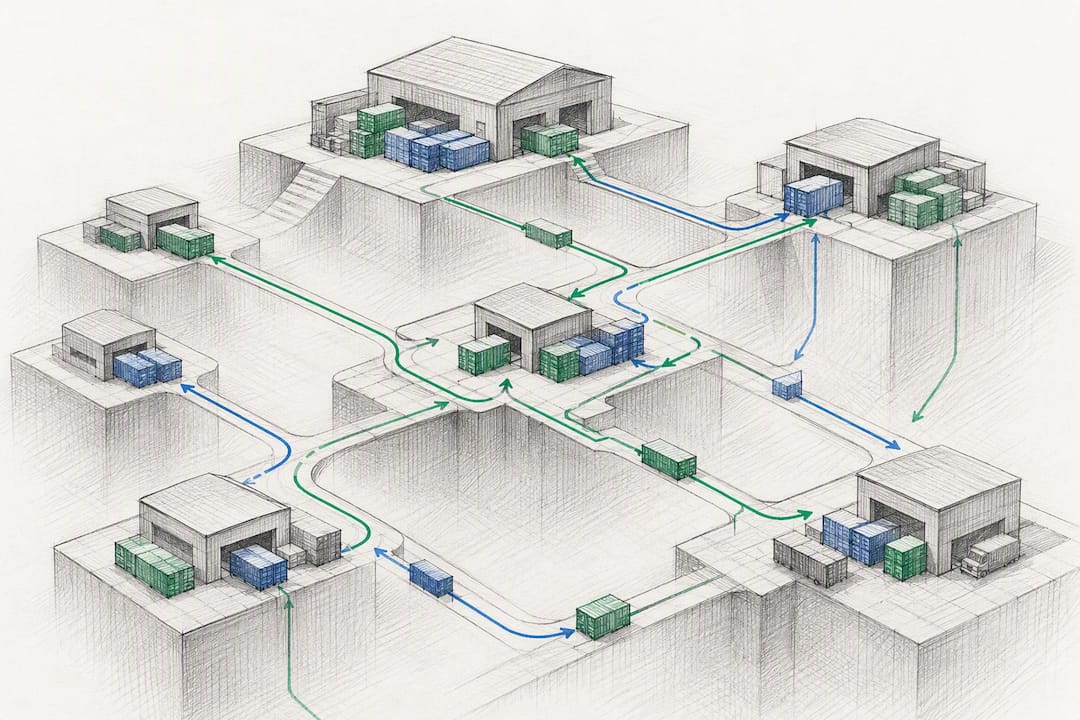
Multi-location and multi-echelon optimisation, which looks at stock positions across an entire network rather than one warehouse in isolation, allowing surplus at one node to cover a shortfall at another.
Continuous recalibration, where the system relearns from actual outcomes rather than running on a forecast set once a quarter.
IBM’s overview of AI in supply chain frames automated replenishment and AI agents coordinating exception handling as core capabilities, not experimental add-ons. That framing matters because it signals where the technology has matured enough for production use, and where it still needs close supervision.
SKU segmentation deserves particular attention because it’s the step most businesses skip. Treating a £2 fastener and a £20,000 industrial motor with the same forecasting logic wastes analytical effort on the former and under-invests in protecting availability of the latter. Segmentation by margin, velocity, and criticality lets the AI system allocate its most sophisticated modelling to the SKUs where getting it wrong actually costs money.
Multi-echelon optimisation is where the financial upside tends to be largest, and also where the modelling gets genuinely difficult. A network with dozens of locations has thousands of possible stock allocation combinations at any given moment; solving for the optimal one across the whole network, rather than location by location, is precisely the kind of problem that traditional spreadsheet-based planning cannot handle at scale.
How do AI models and architectures make optimisation possible?
Two distinct model families do most of the heavy lifting in modern inventory systems, and knowing the difference helps you evaluate a vendor’s claims rather than take them at face value.
Time-series machine learning handles single-node forecasting well: predicting demand for one SKU at one location based on its own history plus external variables. It’s the workhorse for the bulk of SKU-level forecasting. Graph neural networks, by contrast, model the entire network as a set of connected nodes, capturing how a stockout at one warehouse ripples into demand for a neighbouring one, or how substitution between similar products shifts demand patterns. Graph-based multi-echelon models capture demand cascades and substitution effects that single-node formulas simply cannot see, because they treat every location as an island.
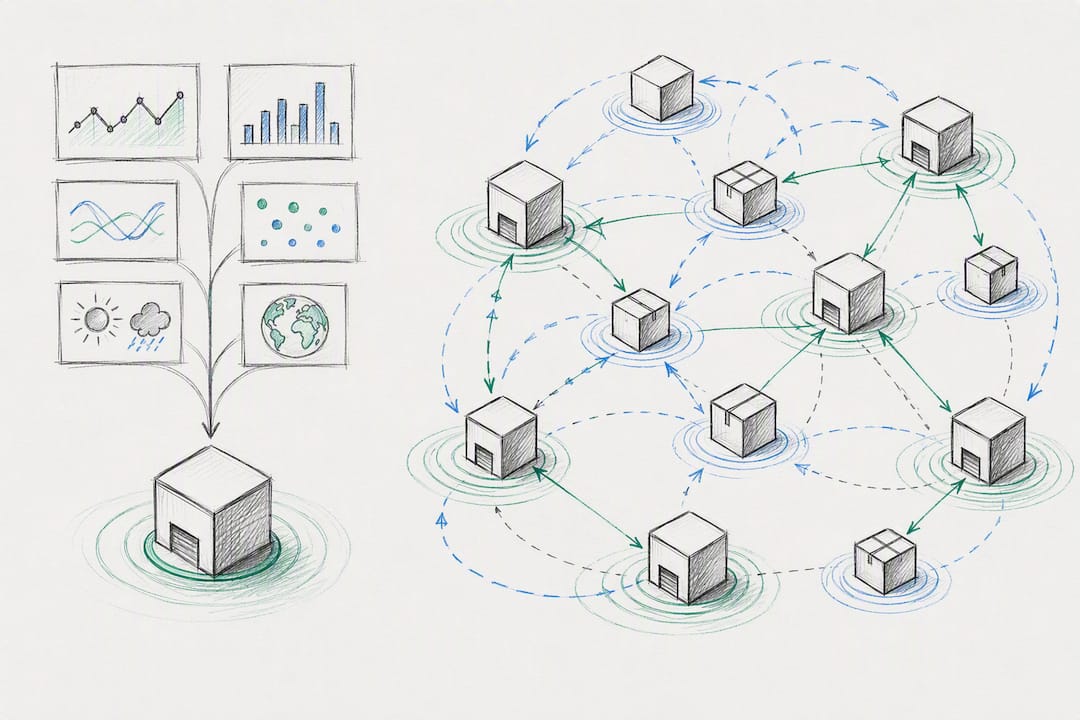
Agentic AI is the newer layer sitting on top of both. Rather than producing a forecast for a human to act on, an agent monitors live signals, executes routine reorder decisions within predefined limits, and escalates anything outside its confidence threshold to a planner. Gartner forecasts that a substantial share of enterprise apps will include task-specific AI agents by 2026, increasing significantly from 2025, and inventory replenishment is one of the clearest use cases for that shift. Our own view on how enterprises should prepare governance before agentic AI enters workflows covers this in more depth.
Feature engineering is where forecasts either hold up under real conditions or fall apart the moment something unusual happens. The features that matter most:
Lead-time volatility, not just the average lead time but its variance, since an unreliable supplier needs a bigger buffer even with the same average.
Promotional calendars, because demand spikes from a promotion look nothing like organic demand and need separate modelling.
Substitution effects, where one SKU’s stockout drives demand to a near-identical alternative, distorting both products’ apparent demand patterns.
Integration is the unglamorous part that determines whether any of this works in production. AI models need live or near-live data from your ERP, WMS, and OMS, and the latency tolerance depends on the decision being made: a reorder trigger can run on daily batch data, but exception escalation for a live stockout risk needs something closer to real time.
Pro Tip: Ask any vendor demonstrating a forecasting model exactly which data refresh cadence it assumes. A model tuned for hourly data will underperform badly if your actual integration only delivers a nightly batch feed, and that mismatch rarely shows up until the pilot is already running.
What use cases show the clearest benefits?
Different sectors get value from AI inventory optimisation in different ways, though the underlying mechanics, better forecasts feeding smarter stock decisions, stay consistent.
Retail peak-demand and promotion planning. Seasonal spikes and promotional events are the hardest patterns for static reorder rules to handle, because they break the assumption that next week looks like last week. AI models trained on historical promotional lift and external calendar data anticipate the surge rather than reacting to it after shelves empty.
Distribution and multi-node working capital release. Freeing cash tied up in excess stock is often the single biggest financial argument for multi-echelon optimisation. One vendor example describes $80 million freed for a distributor running 2,000 SKUs across 50 locations by right-sizing stock allocation across the network rather than location by location. Treat that as an illustrative vendor case rather than a guaranteed outcome, but it shows the order of magnitude available in networks of that scale.
Manufacturing MRO and intermittent demand. Spare parts and maintenance items rarely sell on a predictable schedule; long stretches with no demand followed by an urgent need. Standard time-series methods often misread those zero-demand gaps as obsolescence, leading to under-stocking of parts that then cause costly unplanned downtime when they’re actually needed. Specialised intermittent-demand algorithms handle this pattern far more reliably.
Supplier intelligence and lead-time forecasting. AI models that track supplier delivery performance over time can flag a deteriorating lead time before it causes a stockout, giving planners time to reroute an order or adjust safety stock proactively rather than discovering the delay when a shipment is already late.
What data and systems do you need before starting?
AI inventory optimisation is only as good as the data feeding it, and this is where the systematic literature review of empirical AI supply-chain studies is usefully blunt: organisational and data readiness, not model sophistication, is what separates successful deployments from stalled ones.
At minimum, you need clean transactional history covering demand, inventory positions, and lead times at SKU and location granularity, ideally two to three years deep to capture seasonal cycles. Product metadata matters just as much as transaction volume: substitution relationships, shelf-life constraints, and pack-size variants all shape how a model should interpret demand signals.
Data quality guardrails are non-negotiable rather than a nice-to-have:
Consistent timestamp conventions across every source system, since a mismatch between order date and shipment date quietly corrupts lead-time calculations.
Deduplicated SKU identifiers, particularly where merged systems or acquisitions have left overlapping product codes.
A documented process for handling returns and cancellations so they don’t inflate apparent demand.
Sentient Concepts’ pro tip: treat a data-quality audit as the actual first deliverable of any inventory AI project, not a footnote to it. The systematic literature review found that projects treating AI as a small add-on bolted onto broken processes typically underdeliver, regardless of how good the underlying model is.
Integration architecture needs deciding early: batch feeds from an ERP suit daily replenishment cycles, while streaming data from a WMS matters more for real-time exception handling. Our note on hybrid approaches to data quality covers how to reconcile imperfect legacy data with model requirements without waiting for a full data warehouse rebuild first.
How do you roll out AI inventory optimisation step by step?
A phased rollout keeps risk contained and gives you real evidence before scaling, rather than betting the whole operation on an unproven model.
Pick a narrow pilot scope. Choose a product category or region with clean data and a clear baseline, and define success metrics (fill rate, forecast error, working capital) before the pilot starts, not after you’ve seen the results.
Run iterative model development with human-in-the-loop review. Early forecasts should be checked against planner judgement, not deployed unsupervised, so you catch systematic errors before they scale across the whole network.
Validate against a holdout period. Test the model against a period it never saw during training, rather than the same data used to build it, to get an honest read on real-world accuracy.
Establish MLOps discipline from day one. That means monitoring for model drift, setting a retraining cadence, and logging every prediction against the actual outcome so degradation gets caught early rather than discovered as a stockout three months later.
Define governance before scaling. Set explicit approval thresholds for which decisions an agent can execute automatically and which need a planner’s sign-off, then widen the rollout in phases rather than switching the whole network over at once.
MLOps for inventory models needs confidence scoring and manual review gates built in for high-impact replenishment decisions specifically, because this is where “set-and-forget” deployments tend to fail quietly, running for months on a stale model nobody is watching. Our guide to building a robust AI operating model covers the governance structures that keep this sustainable once you’re past the pilot stage.
Pro Tip: Start the pilot with demand forecasting specifically, before automated replenishment. Forecasting improvements flow directly into both replenishment accuracy and safety-stock reduction, giving you an early, measurable win that builds the internal case for expanding automation further.
Which metrics prove AI inventory optimisation is working?
Four KPIs give you a reliable read on whether the investment is paying off, and each ties directly back to a financial outcome a finance team will recognise.
Fill rate, the percentage of demand met from available stock without a backorder or lost sale.
Stockout rate, tracked by SKU and location to catch problems a network-wide average would hide.
Inventory turnover, how many times stock cycles through in a given period, a direct proxy for capital efficiency.
Days inventory outstanding (DIO), how long cash sits tied up in stock before it converts to revenue.
KPI | What it measures | Typical AI-driven improvement |
Fill rate | Demand met without stockout | 1 to 3 percentage point gains reported |
Stockout rate | Frequency of unmet demand | Material reduction with multi-node optimisation |
Inventory turnover | Capital efficiency of stock | Improves as excess buffers shrink |
DIO | Days cash is tied up in stock | Falls as turnover improves |
Fill rate improvements of one to three percentage points, alongside material reductions in excess stock, are the kind of gains commonly reported once multi-node optimisation is running properly. Estimating working-capital savings starts with a simple calculation: the value of stock you can safely remove without harming fill rate, multiplied by your cost of capital, gives a rough annual saving figure worth presenting to finance before the project even begins.
Measurement design matters as much as the metrics themselves. Run the pilot against a genuine control group, whether that’s a comparable region or category not yet using the AI model, rather than comparing before-and-after on the same population, since seasonal shifts alone can otherwise be mistaken for AI-driven improvement. Most organisations see meaningful signal within one full seasonal cycle, typically three to six months, though multi-echelon gains often take longer to materialise as the model learns network-wide patterns.
What did a real warehouse slotting project teach us?
A recent Sentient Concepts engagement involved optimising warehouse slotting logic for a client managing high SKU turnover across multiple storage zones, work that sits directly alongside the multi-location optimisation techniques covered above. The brief centred on tightening the relationship between forecasted demand velocity and physical stock placement, so fast-moving items sat closer to dispatch points and slow movers didn’t crowd prime warehouse space.
A few operational lessons stood out clearly enough to repeat here:
Integration with the client’s existing WMS took longer than the model-building itself, a pattern that shows up in most inventory AI projects regardless of industry.
Governance around automated slotting changes needed explicit approval gates early on, since warehouse staff needed confidence the system wouldn’t reshuffle stock in ways that disrupted picking routines without warning.
Continuous monitoring mattered more after go-live than before it; the model’s early accuracy degraded once seasonal patterns shifted, which is exactly the drift that MLOps discipline is designed to catch.
That last point is arguably the most transferable one across any AI inventory project. A model that performs well in its first month can quietly lose accuracy within a quarter if nobody is watching for drift, which is precisely why a managed-operations approach, rather than a one-off deployment, tends to sustain the gains rather than let them erode. Continuous improvement here means retraining on fresh data, revisiting thresholds as the business changes, and treating the model as a live system rather than a finished project.
Where should human judgement stay in control?
Agentic AI is genuinely useful for routine, high-volume decisions: standard reorders, straightforward safety-stock adjustments, low-risk exception triage. The mistake I see most often is either extreme. Some businesses hand agents too much autonomy too fast, and others insist on approving everything, which defeats the point entirely.
A practical threshold works better than a blanket policy. Give agents full autonomy on decisions below a defined financial or risk threshold, and require a planner’s sign-off above it, particularly for high-value SKUs or supplier changes. Governance controls, audit trails, confidence scoring, and a clear escalation path, are what make that threshold trustworthy rather than theoretical. Review the threshold itself every quarter, because what counts as low-risk shifts as the model matures and as your business changes.
— Thomas Samuel
How Sentient Concepts helps you get from pilot to production
An alternative approach to hiring separately for strategy, model-building, and ongoing operations is to have one accountable team carry an inventory optimisation project from the first data audit through to the model running reliably in production, avoiding handoff gaps where momentum usually stalls.
That continuity matters more than it sounds. Most inventory AI projects don’t fail because the forecasting model is weak; they fail because nobody owns the system once the consultants who built it move on, and the model quietly drifts out of accuracy within a couple of quarters. Sentient Concepts’ managed AI operations service exists specifically to close that gap, covering monitoring, retraining cadence, and drift detection as an ongoing service rather than a one-time deliverable.
A typical discovery engagement starts with a data readiness assessment against your ERP, WMS, and OMS systems, followed by a scoped pilot proposal with defined success metrics before any model gets built. For businesses running complex, multi-location networks, the supply chain and logistics practice covers the full path from strategy through to sustained operations. If you’re weighing up whether your data and systems are ready for this, get in touch to scope a discovery engagement.
Sources
For readers who want to go deeper, Gartner’s forecast on task-specific AI agents sets useful context on where agentic automation is heading across enterprise software generally, not just inventory. ASCM’s overview of AI in supply chains is a solid practitioner-level primer on the main application areas. The systematic literature review of empirical AI supply-chain studies offers a more sceptical, evidence-grounded counterweight to vendor enthusiasm, and IBM’s explainer on AI in supply chain covers capabilities in plain terms. For a broader look at automation patterns outside inventory specifically, this workflow automation guide for family offices is a useful comparison point.
FAQ
What Is Inventory Optimisation?
Inventory optimisation is the practice of setting stock levels, reorder points, and safety buffers to meet demand reliably while minimising the capital tied up in excess stock. AI adds predictive forecasting and dynamic recalculation to that practice, replacing static rules with models that adjust continuously to real demand and lead-time patterns.
Which AI Is Best for Inventory Management?
There’s no single “best” AI model; the right approach depends on your network’s complexity. Time-series machine learning suits single-location forecasting well, while graph-based models handle multi-location networks with substitution effects more accurately, and an end-to-end provider like Sentient Concepts can match the architecture to your actual data and systems rather than a one-size model.
How Can ChatGPT Be Used for Inventory Management?
General-purpose tools like ChatGPT can help draft reorder policies, summarise demand patterns, or explain forecast outputs to non-technical stakeholders, but they aren’t built to run live probabilistic forecasts against your transactional data. Production inventory optimisation needs purpose-built models integrated with your ERP and WMS, not a chat interface layered on top.
What Is the 80/20 Rule in Inventory?
The 80/20 rule, often called Pareto analysis, holds that roughly 80% of inventory value or demand typically comes from around 20% of SKUs. It underpins SKU segmentation in AI inventory systems, directing the most sophisticated forecasting and tightest safety-stock control toward that smaller, high-impact group of products.
Recommended