Enterprise Prompt Engineering: RTRE, Tests and Audit Ready Ops
Prompt engineering for enterprises means treating instructions to AI systems as governed software artefacts, not one-off phrasing tricks. The single fastest way to move from chaos to control is to standardise every prompt around a Role, Task, Rules and Examples template, then attach it to a basic test suite before it reaches production. Gartner expects 40% of enterprise apps to carry task-specific AI agents by 2026, which makes disciplined prompt design a board-level priority, not an engineer’s side project. This discipline is ideally built into every client deployment from day one.
TL;DR:
Less than 5 percent of enterprise prompts were structured into a Role, Task, Rules, and Examples format in 2025, with Gartner forecasting 40 percent of apps will use task-specific agents by 2026.
Consistent, format-compliant, and auditable responses are critical, requiring structured output—such as JSON schemas—and clear separation between instructions and dynamic data.
Multi-step agent workflows demand explicit memory management, tool boundaries, and stopping conditions, with breaking complex tasks into smaller, testable prompts improving reliability.
Regular testing, version control, and regression checks, treat prompts like software, minimizing risks of drift and failures, especially in regulated environments.
Implementing a centralized prompt library with metadata, tests, and ownership, along with strict lifecycle management practices, is essential for scaling prompt engineering across enterprise operations.
Table of Contents
The anatomy of a production prompt: role, task, rules, examples
Advanced prompt techniques for agentic workflows and complex tasks
Operationalising prompts: libraries, tooling and lifecycle management
How Sentient Concepts applies these practices in client work
Practitioner view: what separates successful programmes from failed ones
What prompt engineering means at enterprise scale
A consumer chatbot user can rephrase a question three times until the answer looks right. An enterprise system processing thousands of invoices, claims, or support tickets a day does not get that luxury. The output has to be correct, formatted consistently, and traceable back to a specific instruction set every single time, whether the model runs at 9am on a Monday or during a compliance audit six months later.
This is the real difference between casual prompting and enterprise prompt engineering: consumer use tolerates variance, production use cannot. When an underwriting workflow or a supplier document pipeline depends on a large language model’s output, that output needs to be predictable enough to slot into downstream systems without a human checking every line. A prompt that works “most of the time” is a liability, not a feature.
Three things separate enterprise-grade prompting from casual use:
Consistency. The same input should produce structurally identical output on the hundredth run as on the first.
Format compliance. Downstream systems, whether an ERP, a claims engine, or a CRM, need machine-parsable output, which is why structured output and JSON schemas matter more in enterprise settings than almost anywhere else.
Auditability. Regulated industries need to show a regulator, or an internal risk committee, exactly what instruction produced a given decision.
The baseline template that satisfies all three is what’s often called the RTRE framework: Role, Task, Rules, Examples. It is not a new invention so much as a discipline that structures system prompts into distinct, testable blocks rather than a wall of prose. Microsoft’s own system prompt engineering guidance recommends exactly this separation, because prompts organised into role, task, rules and example sections are far easier to test, scale and review than free-form instructions. Getting this structure right is the difference between a prompt that survives a model upgrade and one that quietly breaks the first time the vendor changes a default.
The anatomy of a production prompt: role, task, rules, examples
RTRE breaks a system prompt into four blocks that each do a specific job. Skipping any one of them is usually where production prompts start to drift.
Role. One or two sentences defining who the model is acting as and for whom. “You are a claims triage assistant for a commercial insurer, reviewing first notice of loss documents for a claims handler” gives the model a frame it can’t get from a generic instruction. Vague roles produce vague outputs.
Task. A precise statement of what the model must produce, in what format, and for what purpose. Ambiguity here (“summarise the document”) is far weaker than specificity (“extract the claimant name, incident date, and estimated loss value into the fields below”).
Rules. The hard constraints: what the model must never do, how it should handle missing data, what tone it must hold, and what it should say when it doesn’t know. This is where refusal behaviour and edge cases live.
Examples. Two to five worked input/output pairs that show the model exactly what a good answer looks like, including at least one edge case (missing data, ambiguous input, an out-of-scope request).
Output structure deserves its own attention inside the Task block. When a model’s response feeds a downstream system, structured JSON output with a defined schema beats free text every time, because a validator can catch a malformed response before it ever reaches a database. Dynamic data, the actual invoice text, the actual customer message, should never sit loose inside the same prompt as your instructions. Fence it with XML or clearly labelled tags so the model (and any downstream parser) can tell instruction from content at a glance. This separation between a static control layer and a variable data layer is also your first line of defence against prompt injection, a point worth carrying into the governance section later.
On few-shot examples: three to five is usually the sweet spot. Fewer than three and the model has too little signal about format and edge cases; more than five and you’re often just adding token cost without meaningfully improving reliability. What matters more than quantity is coverage.
Pro Tip: Diversity beats volume in your example set. One clean, typical case, one edge case with missing or malformed input, and one case where the correct answer is “I don’t have enough information” will teach a model more than five near-identical happy-path examples ever will.
Teams building this out for the first time often find a genai architecture built for production requires this kind of structural discipline from the start, because retrofitting RTRE onto a sprawling, undocumented prompt later is far more expensive than building it in from the first version.
Advanced prompt techniques for agentic workflows and complex tasks
Single-turn prompts answer one question. Agentic workflows plan, call tools, retrieve information, and often loop back to check their own work, which changes what the prompt needs to specify. Where Gartner’s forecast of task-specific AI agents reaching 40% of enterprise apps by 2026 becomes real, prompt design has to account for goals, constraints, and decision rules rather than a single desired output. Agent prompts, as Adobe’s guidance on prompting AI agents puts it, emphasise workflow orchestration over a single response, which means the prompt is less a script and more a set of operating instructions for an ongoing process.
A few design choices matter most here:
Planning and memory. An agent prompt needs to state what the agent should remember across steps and what it should discard, otherwise context windows fill with irrelevant history.
Tool use boundaries. Specify exactly which tools the agent may call, under what conditions, and what to do if a tool call fails or returns nothing useful.
Retrieval design. If the workflow uses retrieval-augmented generation, the prompt needs to state how retrieved content should be weighted against the model’s own reasoning, and how to handle a retrieval that returns nothing relevant. Choices around retrieval strategy and scope directly shape how the downstream prompt should be written, since a narrow, high-precision retrieval needs different handling instructions than a broad, recall-heavy one.
Freshness. For anything time-sensitive (pricing, regulatory thresholds, stock levels), the prompt should instruct the model to flag when retrieved data may be stale rather than presenting it with false confidence.
On the question of chain-of-thought versus stepwise decomposition: chain-of-thought, asking the model to reason step by step within a single prompt, works well for self-contained analytical tasks where you want visibility into the reasoning. Stepwise decomposition, breaking a task into a chain of separate prompts each with its own output contract, works better for genuinely multi-stage workflows because it makes each step independently testable and auditable. A multi-stage workflow broken into focused prompts with well-defined contracts between steps is dramatically easier to debug than one long prompt trying to do everything at once, and failures don’t cascade silently through five steps before anyone notices.
The most common pitfall in agentic design is treating the agent prompt like a longer version of a single-turn prompt. It isn’t. An agent needs explicit stopping conditions, explicit escalation paths for when it’s uncertain, and explicit limits on how many tool calls or retries it can attempt before handing back to a human. Teams considering agentic AI for the first time benefit from thinking through agentic workflows before they enter production, because the governance questions are easier to answer before an agent is live than after.
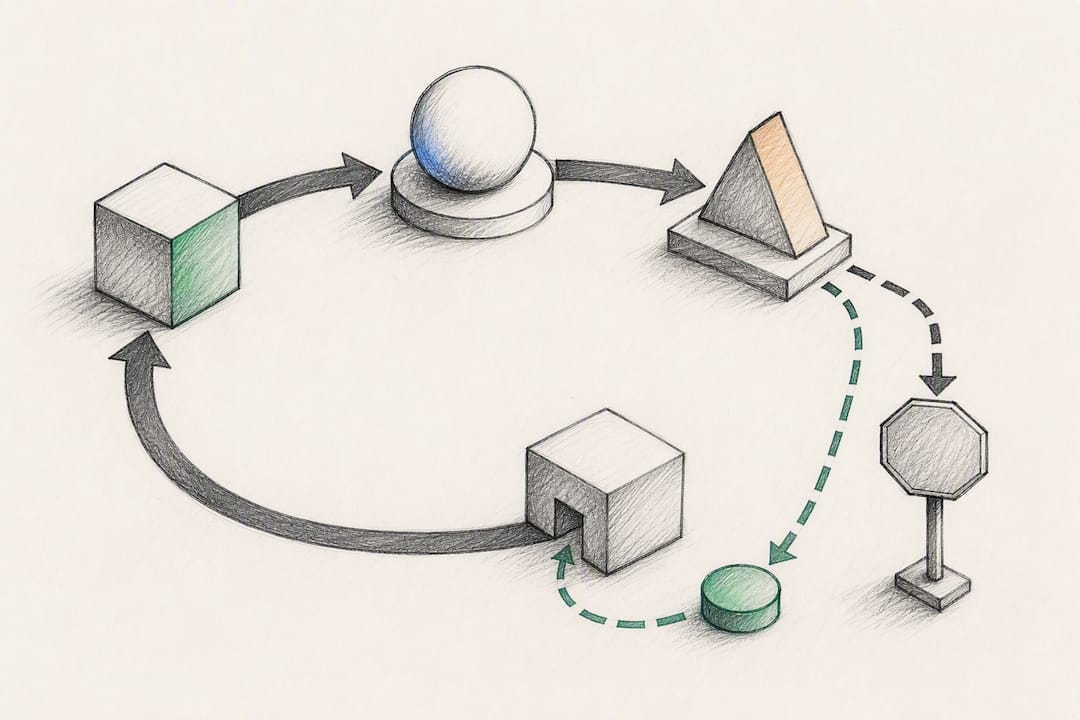
Pro Tip: If your agent prompt is longer than a page and still growing, that’s usually a sign the task should be split into two agents with a handoff contract between them, not one agent with an ever-expanding rulebook.
Testing, evaluation and metrics for prompt performance
A prompt that hasn’t been tested against a representative sample of real inputs is a guess dressed up as a system. The core metrics worth tracking are accuracy against a labelled test set, format compliance (did the output actually match the schema), downstream pass-rate (did the receiving system accept it without manual correction), latency, and token cost per call. None of these matter in isolation; a highly accurate prompt that costs three times as much per call as a nearly-as-accurate alternative is rarely the better business decision.
Building a workable testing plan follows a fairly consistent sequence:
Assemble a representative test set. Pull real examples from production logs or historical data, deliberately including edge cases and known failure modes, not just clean happy-path inputs.
Run A/B comparisons between prompt versions. Change one variable at a time (the instruction, the example set, the temperature setting) and measure the effect on your core metrics rather than eyeballing a handful of outputs.
Version-control every prompt change. Treat a prompt edit exactly like a code change: commit it, tag it, and keep the previous version retrievable for rollback.
Run regression tests before any prompt goes live. A change made to fix one failure mode can easily break a case that was previously working, so the full test set needs to run again, not just the case you were fixing.
Roll back fast when a metric regresses. Having the previous version pinned and ready to redeploy is what makes rollback a five-minute fix instead of a fire drill.
An analysis of prompt editing sessions across 57 enterprise users and 1,523 prompts found that practitioners overwhelmingly edit context and examples rather than rewriting instructions from scratch, which is a strong argument for tooling that exposes prompt histories and diffs rather than treating each edit as a fresh start.
Statistic Callout: Teams that treat prompts as software rather than static text tend to run version-controlled regression tests on every change, mirroring standard CI/CD cadence rather than the informal “check it looks right” approach that dominates ad-hoc prompting. Building this cadence in from the start avoids the far more painful retrofit later.
Tracking accuracy alone misses the point if latency or cost quietly creeps up with each “improvement.” A practitioner’s guide to LLM evaluation metrics is worth working through in detail if your organisation hasn’t yet settled on a standard scorecard, because the metrics that matter differ meaningfully between a customer-facing chatbot and a back-office document extraction pipeline.
Governance, security and auditability
Every system prompt in a regulated environment needs hard constraints stated early and stated plainly: what the model must refuse, what it must escalate to a human, and what it must never claim to know. Placing these near the top of the prompt, rather than burying them under paragraphs of tone guidance, measurably improves compliance, because models weight early instructions more heavily and contradictory instructions accumulated over time are one of the most common causes of erratic behaviour.
Security in prompt design starts with a simple architectural rule: the system prompt is a static control-plane artefact, and any dynamic data, a customer’s message, a document’s contents, a retrieved passage, belongs only in a clearly fenced user channel. Separating control from data this way reduces prompt-injection risk substantially, because an attacker embedding an instruction inside a document has a much harder time getting the model to treat it as a system-level command when the boundary between the two channels is explicit and consistently enforced.
Practical governance controls worth building in from the start:
Input sanitisation at the point data enters the pipeline, not just at the model call.
Explicit fencing of all dynamic content using XML or labelled tags, never blended into the instruction text.
Injection detection that flags inputs attempting to override system instructions, even when the attempt is subtle.
Full logging of every prompt version, every input, and every output, tied to a timestamp and a model version identifier.
Escalation rules written directly into the system prompt, not left to the model’s judgement, for anything touching legal, medical, or financial advice.
For regulated sectors specifically, what agentic AI actually means for compliance extends well beyond the prompt itself into how decisions get documented for audit. A logged, versioned prompt history is what turns “the AI made a mistake” from an unanswerable question into a traceable one.
Pro Tip: Never rely on the model to enforce a constraint the system should enforce structurally. If an output must never contain a specific field, validate and strip it at the application boundary, don’t just ask the model nicely not to include it.

Operationalising prompts: libraries, tooling and lifecycle management
Prompts that live in a single engineer’s notes or scattered across Slack threads are prompts nobody can audit, test, or hand over. The fix is treating every production prompt as a versioned artefact inside a centralised library, exactly the way source code lives in a repository rather than on someone’s laptop.
A workable prompt library needs a few consistent components:
Metadata for every prompt: owner, purpose, last-tested date, and the model version it was validated against.
A test suite attached to each prompt version, not stored separately where it will drift out of sync.
Full version history, so any regression can be traced to the exact change that caused it.
Defined ownership, so a prompt change always has a named accountable person, not a committee.
Maintaining a centralised prompt library with metadata, tests, version history and clear ownership is what separates organisations that can scale prompt engineering across dozens of use cases from those stuck firefighting one brittle prompt at a time. Tooling built for this, prompt managers with built-in diffing, evaluation dashboards that run automatically on every commit, and prompt-ops integrations that tie into existing CI/CD pipelines, turns prompt engineering into an engineering discipline rather than a craft practised by whichever analyst happens to be good at wording things.
The operational model matters as much as the tooling. Defining an SLA for how quickly a broken prompt gets patched, who owns that fix, and how a change gets reviewed before it reaches production removes the handoff gaps where accountability usually gets lost. LLMOps practices built for reliable production systems generally treat prompt changes with the same rigour as a code deployment: a review, a test run, a staged rollout, and a documented rollback plan. Skipping any of those steps is usually where “it worked in testing” turns into an incident report three weeks later.
How Sentient Concepts applies these practices in client work
Prompt engineering can be built into an accountable lifecycle across every AI engagement, from initial strategy through to ongoing operations, rather than treating prompt design as a discrete deliverable that gets handed off once and forgotten. That continuity is the point: the same team that designs a system prompt is still accountable for it six months into production.
In various industries including finance, manufacturing, logistics, and insurance, this shows up in a few consistent use cases:
Document automation, where structured prompts extract and validate data from supplier invoices, claims forms, and compliance filings against a defined schema before anything reaches a downstream system.
Conversational agents, built with RTRE-style system prompts, fenced input channels, and escalation rules for anything outside their defined scope.
Managed operations, where deployed prompts are monitored, tested against regression suites, and version-controlled as model providers update their underlying systems.
When the full lifecycle is owned rather than handing a project off after launch, prompt version control, test coverage and governance documentation stay current as the underlying models change, rather than decaying the moment the original project team moves on. Readers wanting a deeper look at how this plays out in specific domains can review how generative AI is being used for document-heavy workflows or explore the AI and GenAI solutions built around this same accountable model.
Practitioner view: what separates successful programmes from failed ones
Most failed prompt programmes share the same three symptoms. First, prompts written ad-hoc by whoever needed a quick answer that day, with no template, no owner, and no record of why a particular phrasing was chosen. Second, zero test coverage, so nobody notices a regression until a customer or a regulator does. Third, and this is the one people underestimate, a slow accumulation of contradictory instructions as different people patch the same prompt over months, until the model is effectively being asked to satisfy rules that quietly conflict with each other.
The programmes that avoid this tend to do a handful of unglamorous things well. They pick a template (RTRE or similar) and enforce it everywhere, even when it feels like overkill for a “simple” prompt. They build a test suite before the first production deployment, not after the first incident. They version everything and never let a prompt change ship without a rollback plan already in hand.
If your organisation doesn’t yet have anyone accountable for prompt quality the way you have someone accountable for code quality, that’s the gap to close first, before adding another use case. External specialists earn their keep less on writing better prompts and more on building the governance scaffolding, the test harnesses, the version control, the escalation rules, that most internal teams never get around to building under deadline pressure. A solid enterprise AI strategy playbook can help leaders sequence that work sensibly rather than trying to fix everything simultaneously.
— Thomas Samuel
Turning a prompt pilot into a managed operation
There’s a wide gap between a prompt that impresses in a demo and one that survives six months of production traffic, model updates, and edge cases nobody anticipated. This gap can be closed by staying accountable for the whole lifecycle, strategy, engineering, and the ongoing operations that keep a prompt reliable long after launch, rather than handing over a template and leaving version control, testing, and governance to figure themselves out.
For teams ready to move past ad-hoc prompting, the practical path usually starts with one of three entry points: a scoped pilot to validate an RTRE-based system prompt against real data, a test-suite build for an existing prompt that’s never been formally evaluated, or a governance scoping exercise for a regulated use case that needs audit-ready documentation from day one. Once a prompt is live, managed AI operations keep it tested, versioned, and tuned as models and business rules change, and ongoing optimisation ensures performance doesn’t quietly drift as usage scales. If you’re weighing where prompt engineering fits into a broader deployment, get in touch with Sentient Concepts to scope a pilot around your specific workflow.
Primary sources and further reading
The Gartner forecast on task-specific AI agents is worth tracking as agentic adoption accelerates through 2026. The arXiv analysis of enterprise prompt editing behaviour offers rare empirical data on how practitioners actually iterate, rather than how guides assume they do. Microsoft’s Fluent2 system prompt engineering guidance and Adobe’s writing on prompting AI agents both offer detailed, vendor-neutral technical patterns worth reading in full. For a practitioner-written walkthrough of testing and lifecycle management, the enterprise applications guide from Bonjoy covers ground this article only summarises. Readers wanting practical, hands-on prompt-writing tips might also find AmmarAI’s guide to writing better AI prompts a useful companion reference.
Sources
FAQ
What does a prompt engineer do in an enterprise setting?
A prompt engineer designs, tests, and maintains the instructions that direct AI models to perform specific business tasks reliably, covering everything from role and rule definitions to output schemas and regression testing.
What are examples of prompt engineering in practice?
Examples include structuring a system prompt with the RTRE template, writing few-shot examples that cover edge cases, fencing dynamic data in labelled tags to prevent injection, and defining a JSON schema so a model’s output can be validated automatically.
Can I learn prompt engineering from scratch?
Yes. The core skills, clear task definition, structured formatting, and systematic testing, are learnable without a technical background, though building enterprise-grade governance and testing infrastructure around those skills usually benefits from specialist support such as Sentient Concepts’s AI and GenAI solutions.
What is prompt engineering for AI used for in business?
It is used to make AI outputs consistent, auditable, and safe enough for production use in areas like document automation, conversational agents, and decision support across finance, manufacturing, logistics, and insurance workflows.
How is enterprise prompt engineering different from casual prompting?
Casual prompting tolerates trial and error; enterprise prompt engineering requires version control, test suites, format compliance, and audit trails because outputs feed directly into business systems and regulatory processes.
Recommended