Open vs Closed LLMs for Enterprise: POC Routing Rules That Save 70%+
Choose open-weight models when you need control, data residency, or high-volume cost efficiency; choose closed models when you need frontier capability fast and lack the engineering bandwidth to run inference yourself. Most enterprises land somewhere between the two, routing routine work to open weights and escalating only the hardest tasks to proprietary APIs. The checks below help you make that call with evidence, not preference.
TL;DR:
Open-weight models reduce inference costs significantly only at high request volumes, after accounting for engineering and infrastructure expenses.
Closed models remain superior for tasks requiring advanced reasoning, high accuracy, or when error costs are critical, despite the narrowing benchmark gap.
Data residency and regulatory requirements favor open-weight deployment, as it keeps data and inference processes within an organization’s infrastructure.
Hybrid routing, with routine tasks handled by open weights and complex issues escalated to closed APIs, is now a standard enterprise practice.
Proper evaluation involves real workload testing, cost analysis including engineering overhead, and continuous monitoring rather than relying solely on benchmark scores.
Table of Contents
Open vs closed LLM: definitions and the open-weights nuance
The phrase “open source” gets misused constantly in this market, and the confusion costs teams real evaluation time. Most models marketed as open source are actually open-weight: the trained parameters are downloadable and can be self-hosted, but the training data, code, and methodology often stay private. A fully open project publishes all three. Closed or proprietary LLMs, by contrast, are accessed exclusively through a vendor’s API, with the weights, training data, and infrastructure locked behind that vendor’s walls.
Licensing terms matter as much as access. Some open-weight releases carry permissive licences allowing commercial redistribution and fine-tuning; others restrict commercial use above certain revenue thresholds or ban redistribution of fine-tuned derivatives entirely. IBM’s overview of open-source LLMs notes that proprietary vendors compensate for this lack of transparency with support contracts, service-level agreements, and simplicity, which matters for teams without deep in-house ML expertise.
In practice, you will encounter three deployment patterns:
Weights-only: download the model, host it yourself on GPU infrastructure you control, and manage the full serving stack.
API-only: call a hosted endpoint, pay per token, and let the vendor handle scaling, updates, and reliability.
Hybrid releases: some providers now offer both an open-weight variant and a hosted API version of the same model family, letting you prototype against the API before migrating to self-hosted infrastructure.
Getting this taxonomy right before you start comparing vendors avoids a common mistake: treating a restrictively licensed open-weight model as if it carries the same freedoms as a fully open one.
What do benchmarks actually tell you about performance?
The performance gap between the best closed model and the best open-weight model has narrowed sharply and fast. The Stanford HAI AI Index 2025 found that gap shrank from around 8 percentage points in January 2024 to just 1.7 percentage points a year later.
Statistic callout: A benchmark gap of 8 percentage points collapsing to 1.7 points in twelve months means the “closed models are simply smarter” assumption, still repeated in a lot of vendor pitch decks, is losing its factual footing fast.
That narrowing changes the calculus for almost every standard task: summarisation, classification, structured extraction, and customer-facing chat. But leaderboard scores measure narrow, well-defined tasks under controlled conditions. They tell you little about how a model behaves across a 40-step agentic workflow, where errors compound, or how it handles tool invocation under ambiguous instructions. MIT Sloan’s analysis of open-model adoption warns that relying solely on public benchmarks can overstate a model’s real production suitability for exactly these long-horizon tasks.
A practical way to map workloads:
Likely sufficient with open weights: document classification, structured data extraction, retrieval-augmented Q&A, internal knowledge search, routine customer support.
Worth testing carefully, case by case: multi-step agentic workflows, tool-calling pipelines with several dependent steps, code generation for production systems.
Often still favours frontier closed models: novel reasoning under high ambiguity, tasks with severe error cost and no room for a second attempt, work requiring the broadest possible world knowledge.
The gap is closing on paper. Whether it has closed for your specific failure modes is something only your own evaluation harness can answer, not a leaderboard.
Cost and quality-to-price trade-offs
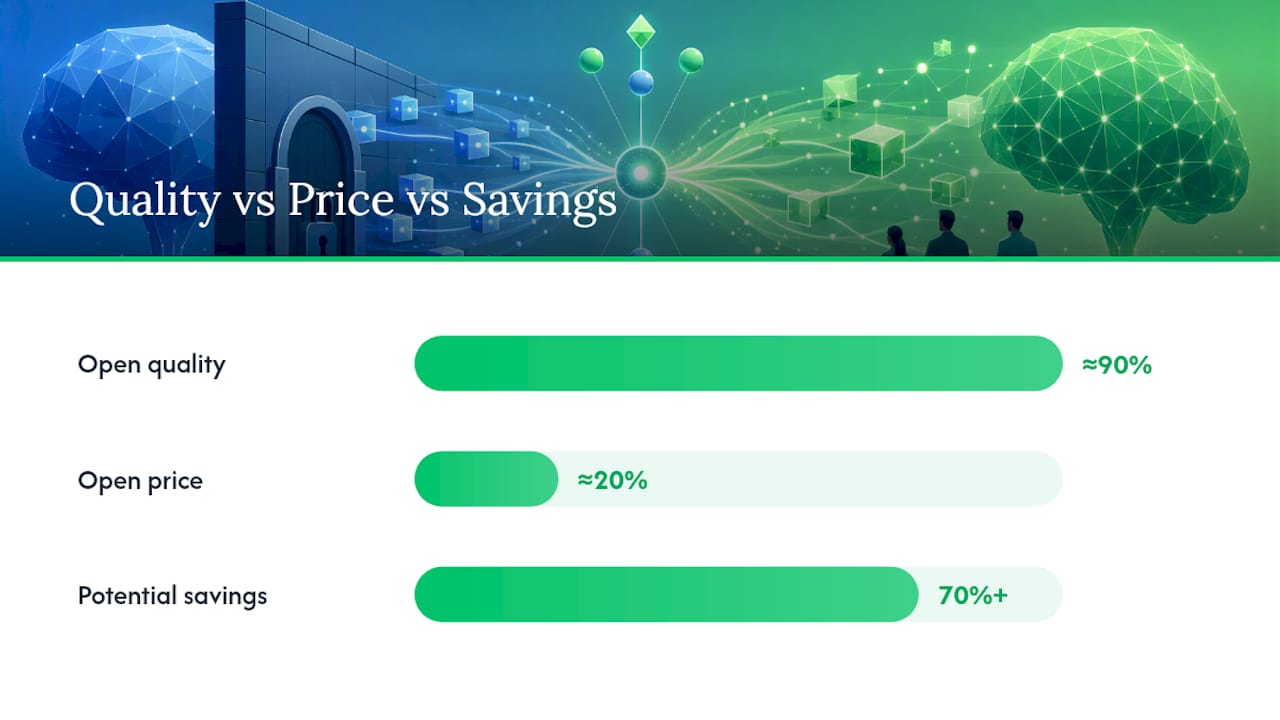
Self-hosting open weights can cut inference costs dramatically, but only past a certain volume threshold, and only once you account for the engineering overhead that vendors quietly absorb on your behalf. MIT Sloan estimates that optimal substitution to open alternatives can reduce inference spending by more than 70% for some users, with industry-wide reallocation potentially saving around $25 billion annually. The OECD’s 2026 analysis frames this as a quality-to-price ratio: open-weight models often enter the market at roughly 90% of closed-model quality while costing about 20% of the price.
That is a genuinely favourable ratio on paper. The break-even point in practice depends on:
Token volume: self-hosting rarely pays off below a certain sustained request rate, since GPU capacity sits idle between bursts.
Staff capability: you need engineers who can tune serving infrastructure, not just call an API.
Infrastructure amortisation: GPU hardware or reserved cloud capacity has to be paid for whether it is fully utilised or not.
A production decision guide from LevelUp makes an important correction here: the real crossover point is driven by architectural stability and hidden operational costs, not token volume in isolation. Quantisation work, observability tooling, and failover engineering all eat into the headline savings, and teams that ignore them tend to discover the real total cost of ownership only after they have already committed budget.
Pro Tip: Before comparing per-token pricing across two models, price out the engineering hours needed to stand up and maintain the self-hosted option for three months. That number changes the comparison more than the token rate does.
Privacy, data residency, and governance: which model type wins?
Self-hosting open weights wins decisively when data cannot leave your infrastructure, whether for regulatory, contractual, or sovereignty reasons. The OECD notes that open-weight deployments reduce dependence on foreign providers and support local auditability where regulators or clients demand it. If your organisation handles regulated financial data, patient records, or classified manufacturing specifications, keeping both the weights and the inference process in-house materially reduces your exposure to third-party breach or subpoena risk.
Closed providers have responded with real contractual mitigations: data processing agreements that prohibit training on customer inputs, regional hosting commitments, and enterprise tiers with dedicated capacity. These are often sufficient for organisations whose compliance obligations centre on contractual assurance rather than physical data location. The distinction that actually matters is whether your regulator or auditor accepts a vendor’s contractual promise or requires demonstrable technical control.
Whichever path you choose, build these governance checks in from day one:
Logging and audit trails covering every inference request, its inputs, and its outputs, retained for the period your compliance regime requires.
Access controls at the model and infrastructure level, not just at the application layer.
Data flow mapping showing exactly where prompts and outputs are stored, cached, or logged, whether by you or your vendor.
Contract review for closed providers, specifically the training-data exclusion and breach notification clauses.
Skipping these checks because “the vendor probably handles it” is how governance gaps surface during an audit rather than during design.
Running the models: MLOps, observability, and reliability
Self-hosting an open-weight model in production is an infrastructure commitment, not a one-off deployment task. You take on:
Serving and batching — configuring an inference server capable of handling concurrent requests efficiently, often with dynamic batching to keep GPU utilisation reasonable.
Autoscaling — provisioning enough GPU capacity for peak load without paying for idle capacity around the clock.
Failover — building redundancy so a single node failure does not take your production system down with it.
Version management — tracking which model checkpoint, quantisation level, and prompt template combination produced which output, for both debugging and compliance.
Observability is the part teams underestimate most. LLM outputs need monitoring that goes beyond standard infrastructure metrics: hallucination rate on domain-specific queries, latency distribution under load, and drift in output quality as you update prompts or fine-tune weights. More detail about LLM observability is available online, which is worth reading before you commit to a self-hosting architecture.
Closed APIs remove almost all of this burden. You send a request, you get a response, and the vendor absorbs the scaling, failover, and much of the reliability engineering. That is precisely why closed models often win on time-to-production: a team with no dedicated MLOps capacity can ship a working prototype against a closed API in days, while the equivalent self-hosted deployment can take weeks even before fine-tuning begins. For teams evaluating this trade-off more broadly, our overview of LLMOps best practices covers the operational patterns that make self-hosting sustainable once you commit to it.
How do you choose between open and closed LLMs?
Most enterprises get this decision wrong by treating it as binary. The workload should decide the model, not a company-wide policy.
Weigh each workload against five criteria: cost sensitivity at scale, task complexity and error tolerance, privacy or residency requirements, expected request volume, and your team’s existing infrastructure skill. A workload with high volume, low error tolerance for latency, and no regulatory constraint often points cleanly to a well-tuned open-weight model. A workload with low volume but severe error cost, or one requiring the broadest possible reasoning capability, points towards a closed frontier model regardless of price.
The routing pattern that has become the practical default across production deployments: default to a cheaper, self-hosted or otherwise controlled model for stable, well-specified requests, and escalate only uncertain or high-risk queries to a frontier closed model. This hybrid architecture is now common enough to be considered standard practice rather than an experimental compromise, and it lets you capture the cost advantages of open weights without gambling your hardest cases on a model that was never designed to handle them alone.
Concrete mapping by workload:
Invoice and document data extraction: open-weight model, fine-tuned on your document types, running on modest GPU infrastructure.
Conversational customer support, routine tier: open-weight model with retrieval augmentation, escalating to a human or a frontier model only on low-confidence responses.
Complex financial risk analysis or legal reasoning: closed frontier model, given the cost of a wrong answer far exceeds the cost of the inference call.
Agentic workflows spanning multiple systems: start with a closed model for the reasoning core while you build and validate your evaluation harness, then test whether an open-weight alternative holds up under the same harness before migrating.
Guidance on agentic AI governance covers the additional oversight multi-step agentic tasks demand, regardless of which model family sits behind them.
Pro Tip: Write your routing rules as explicit, testable conditions (“if confidence score below X, escalate to frontier model”) rather than vague guidance. Vague routing rules degrade quietly over months as traffic patterns shift.
How to design a fair open vs closed LLM evaluation
A proof of concept only earns its name if it tests what production will actually demand, not just what a benchmark measures.
Build a representative test harness using real examples from your own workload, not generic public datasets, and tie each test case to a specific business KPI (accuracy on your document types, resolution rate on your support tickets).
Include adversarial and long-horizon tests that deliberately push multi-step reasoning, ambiguous instructions, and edge cases your production traffic will eventually surface.
Set operational acceptance criteria upfront — latency ceilings, uptime targets, and a maximum acceptable error rate — before you see a single result, so you cannot rationalise a bad number after the fact.
Calculate total cost of ownership honestly, combining per-token or per-hour inference cost with engineering time and infrastructure amortisation.
Statistic callout: MIT Sloan’s modelling suggests optimal substitution to open alternatives can cut inference spending by more than 70% for some workloads. That figure only holds once engineering and infrastructure costs are counted against it, which is exactly what step four above forces you to do.
A practitioner’s guide to LLM evaluation metrics walks through the specific test types worth building into this harness.
From pilot to production: an implementation checklist
Run a minimal-infrastructure pilot. Deploy on the smallest viable GPU footprint or a single API integration, tune on a limited dataset, and A/B test against your current process on real traffic, not synthetic samples.
Measure real-world metrics for at least two to four weeks before drawing conclusions, since early results often reflect novelty rather than genuine performance.
Plan the scale-up separately from the pilot. GPU capacity planning, cost monitoring dashboards, and a documented fallback strategy for outages all need to exist before you commit production traffic.
Secure governance sign-off from compliance and security stakeholders before rollout, not after, particularly if the pilot touches regulated data.
Our guide to cutting GenAI inference costs covers the scale-up cost monitoring step in more practical detail, including where budgets typically drift.
What practitioner experience adds to this comparison
Frameworks are only as good as the judgement behind them, and that judgement comes from having run these evaluations under real production pressure, not from reading someone else’s leaderboard…
A recommended approach to open vs closed LLM decisions is to build a domain-specific evaluation harness before recommending a model family, run proofs of concept against real workloads rather than generic benchmarks, and keep monitoring the deployed system after launch rather than treating go-live as the finish line. That continuity, from strategy through engineering to ongoing operations, is what catches the hidden costs and failure modes that a one-off vendor comparison misses.
For readers evaluating this in finance or manufacturing specifically, our supplier document processing automation work and our broader manufacturing industry page show how this evaluation approach plays out against real document-heavy workloads, where the open-weight cost advantage tends to be strongest.
An external example of how modular AI stacks get adopted in practice, outside enterprise finance, comes from Sun State Digital’s case studies on AI adoption, which illustrate similar change-management friction across a different industry.
Where is this heading next?
Benchmark parity between open and closed models will likely continue narrowing for well-defined tasks, but frontier capability on genuinely novel reasoning problems will probably stay a closed-model advantage for some time yet. That is not a contradiction. It is two different races happening at different speeds.
The bigger shift is architectural: hybrid routing stacks, once a workaround for cost-conscious teams, are becoming the default enterprise pattern rather than the exception. Teams that invest now in evaluation infrastructure, domain-specific test harnesses, and observability tooling will be positioned to move fluidly between model families as the economics and capabilities shift, instead of being locked into whichever choice they made eighteen months ago.
— Thomas Samuel
How Sentient Concepts helps you run this evaluation properly
Running a genuinely fair open vs closed LLM comparison takes an evaluation harness, GPU infrastructure judgement, and engineering time most internal teams cannot spare alongside their day jobs. Sentient Concepts closes that gap by owning the entire lifecycle, from strategy and readiness assessment through proof-of-concept delivery, MLOps engineering, and ongoing optimisation, without the handoffs that usually stall these projects between the “strategy” phase and the “who actually runs this in production” phase.
If you are weighing this decision for a finance, manufacturing, or logistics workload, engaging expert services to design the domain-specific POC harness, run the comparison against your real data, and keep operating the winning system afterwards is advised. Start with an AI strategy and roadmap engagement to define your evaluation criteria, or go straight to a build and deployment scoping conversation if you already know which workload needs testing first.
Sources
FAQ
Is ChatGPT open or closed source?
ChatGPT runs on OpenAI’s proprietary models, which are closed. The weights, training data, and infrastructure are not publicly available, and access is only through OpenAI’s API or products.
Why do some argue LLMs are a dead end?
The criticism usually targets a specific limitation, such as poor performance on long-horizon reasoning or hallucination on unfamiliar topics, rather than the technology as a whole. Evaluation results, including the narrowing benchmark gap Stanford HAI reports, suggest capability is still improving quickly rather than plateauing.
Which open LLM is best for enterprise use?
There is no single best model. The right open-weight model depends on your workload, licensing needs, and infrastructure, which is why Sentient Concepts recommends running a domain-specific proof of concept before committing rather than picking off a leaderboard.
What is an open LLM model, exactly?
An open LLM, more precisely called an open-weight model, is one where the trained parameters are downloadable and can be self-hosted, though the training data and code behind it may still be private.
Is open source or closed source LLM better overall?
Neither is universally better. Open weights suit high-volume, cost-sensitive, or privacy-constrained workloads, while closed models suit lower-volume, high-stakes tasks needing the broadest reasoning capability and fastest time-to-production.
Recommended