Avoid Oversight Theater: 4 Phases to Make Human in the Loop ML Work
Human-in-the-loop machine learning (HITL) puts people at defined points in a model’s lifecycle to label data, correct outputs, or approve decisions before they take effect. It earns its budget in high-stakes, low-data, or alignment-sensitive tasks, where a fully automated system carries too much risk. The three dominant families, active learning, interactive machine learning, and RLHF, differ mainly in how much control the human retains over the loop.
TL;DR:
Active learning is cost-effective at scale but struggles with novel domains where most examples appear uncertain to the model.
Human reviewers should exercise explicit agency with structured rationales and provenance tracking instead of passive rubber-stamping to ensure meaningful oversight.
Reviewers’ inconsistency, fatigue, and reward hacking remain primary risks, requiring calibrated, well-governed review processes to maintain system reliability.
HITL is most valuable in high-stakes or scarce-data scenarios such as healthcare, finance, or content moderation, where mistakes have significant consequences.
Proper integration of HITL into ML pipelines involves versioning, automated escalation, and clear separation between system and human decision-making to prevent latency and loss of context.
Table of Contents
What is human-in-the-loop ML and how does the loop actually work?
How do you design human oversight that isn’t just rubber-stamping?
What does a HITL implementation checklist look like phase by phase?
What should you actually measure to keep a HITL system reliable?
What security and privacy risks does adding humans to the loop create?
What is human-in-the-loop ML and how does the loop actually work?
Interaction with a model can happen at three points: before training (curating and labelling data), during training (correcting predictions, ranking outputs, demonstrating correct behaviour), or after deployment (evaluating live outputs and escalating edge cases). Each timing solves a different problem, and conflating them is a common design mistake.
Before training, a human’s job is mostly annotation: labelling examples, defining taxonomies, and flagging ambiguous cases the model shouldn’t learn from. During training, feedback gets richer. Reinforcement Learning from Human Feedback (RLHF) relies on rankings and preference judgements rather than binary labels, which is why it dominates alignment work on generative models. After deployment, the human role shifts again, from teaching the model to auditing it, catching drift, and handling the cases the system itself flags as uncertain.
Interactive ML literature identifies the specific feedback modalities practitioners work with, and they aren’t interchangeable — a ranking task and a correction task demand different interfaces and different reviewer skills. The ar5iv guide to human-centred interactive machine learning frames this as a design choice: pick the interaction type that matches what the human is actually best placed to judge.
The mechanics that make this workable at scale include:
Active querying: the model requests labels for the examples it’s least confident about, rather than sampling data randomly.
Uncertainty thresholds: a confidence score below a set point automatically routes a case to a human reviewer.
Escalation policies: rules defining who sees an escalated case, how fast, and what happens if no human is available.
Annotation tooling: interfaces built for the specific task (bounding boxes, preference pairs, free-text corrections) rather than generic spreadsheets.
Audit logs: a durable record of who reviewed what, when, and what they decided, which becomes essential during any compliance review.
Get the interaction type wrong and you get expensive noise. Ask a reviewer to justify a ranking when a simple correction would do, and you’ve doubled the cognitive cost for no accuracy gain.
Which HITL method family fits your problem?
Academic surveys typically sort human-in-the-loop systems by one question: who controls the learning process, the system or the human? The Springer state-of-the-art review uses exactly this axis to separate the main approaches.
Active learning — the system selects which examples need a human label, usually the ones nearest its decision boundary. Cheap to run once built, but it scales poorly when the domain is genuinely novel and every example looks uncertain.
Interactive machine learning (IML) — a human steers the model iteratively, correcting or adjusting behaviour in near real time. Higher human effort, but tighter control over what the model actually learns.
Machine teaching — a domain expert designs the curriculum and examples the model sees, effectively teaching rather than labelling. Expert time is the bottleneck here, not data volume.
RLHF / preference optimisation — humans rank or compare outputs rather than labelling them directly, which suits subjective quality judgements language models can’t self-assess.
Human-on-the-loop / human-over-the-loop — the human doesn’t intervene per decision but monitors aggregate behaviour and can pause or override the system, trading responsiveness for lower ongoing cost.
Cost and scalability move in opposite directions as you go down that list: active learning is the cheapest to run at volume, machine teaching demands the most expert time per unit of output, and RLHF sits in between but introduces its own failure mode. Reward models trained on human preferences can be gamed, a system optimises for what looks good to the reward signal rather than what’s actually correct, a risk the PMC review of HITL methods flags directly.
What are the real benefits and risks of HITL systems?
Done properly, HITL buys you four things worth naming specifically. Accuracy improves because humans catch errors a model’s own confidence score can’t detect. Bias mitigation improves because a reviewer can flag systematic patterns a loss function has no way to notice. Explainability improves because a human-reviewed decision comes with a rationale, not just a probability. And trust calibration improves: stakeholders learn where the system is reliable and where it isn’t, which is different from simply trusting it more.
The risks sit on the other side of the same ledger:
Evaluator inconsistency — two reviewers judging the same case differently, which undermines the reliability the loop was supposed to add.
Cognitive load — reviewers fatigue on repetitive tasks, and fatigue produces worse judgements than the model they’re meant to be checking.
Reward hacking — optimisation processes exploiting quirks in human feedback rather than solving the underlying task.
Scalability and cost — human review doesn’t scale the way compute does, and unmanaged growth in review volume becomes a budget line nobody planned for.
A 2026 systematic review lists scalability, cognitive load, and trust calibration among the recurring deployment challenges across HITL implementations, not edge cases but the default failure modes teams run into once a pilot moves to production. The mitigations are unglamorous but effective: selective review triggered by uncertainty rather than blanket checking, structured evaluator training with periodic calibration checks, and governance reviews that audit the review process itself, not just the model’s output.
How do you design human oversight that isn’t just rubber-stamping?
Most HITL failures aren’t technical, they’re structural. A reviewer given thirty seconds and a binary approve/reject button isn’t exercising oversight, they’re rubber-stamping. A 2026 framework in AI and Ethics draws a distinction that changes how you should build the interface: operative agency, where the human actively performs or directs an action, versus evaluative agency, where the human judges an action the system already proposed. Confusing the two is why so many “human-in-the-loop” checkpoints add latency without adding safety.
The handover between system and human needs to be explicit, not implied. If a reviewer is meant to exercise evaluative agency, don’t ask them to redo the model’s work from scratch, that wastes the solve-verify asymmetry the system exists to exploit: the model solves, the human verifies, and verification should be quicker than solving.
Practical mechanisms that make evaluative agency real rather than nominal:
Structured rationales — the model states why it reached a decision, not just the decision, so the reviewer has something concrete to check against.
Confidence-with-abstain — the system flags its own uncertainty and explicitly declines to decide rather than forcing a low-confidence output through.
Provenance capture — every decision carries a record of which data, model version, and reviewer touched it.
Circuit breakers — automatic halts when error rates, disagreement rates, or escalation volume cross a defined threshold.
Appeal bundles — a packaged case (input, rationale, decision, prior similar cases) that a second-level reviewer can assess without reconstructing context from scratch.
Pro Tip: Track inter-rater agreement on a rolling sample, not just once at launch. A drop in agreement is usually the earliest warning that either the task has drifted or your reviewers need recalibrating, and it shows up weeks before accuracy metrics do.
Instrument the loop itself, not just the model. Throughput (cases reviewed per hour), detection yield (the share of true errors the loop actually catches), and escalation logs (what got kicked upstairs and why) tell you whether oversight is working or just adding cost. Teams building agentic systems face this exact problem when deciding how much autonomy to grant AI agents before they enter live workflows.
What does a HITL implementation checklist look like phase by phase?
HITL RL research organises the lifecycle into four phases, each with a distinct human role and its own metrics, and conflating them is a reliable way to under-resource one while over-resourcing another, according to OpenReview’s phase framework.
Development — define the task boundary, build the annotated corpus, and choose interaction types. Deliverable: a labelling guideline document reviewers can actually follow without asking for clarification every hour.
Learning/training — humans provide corrections, rankings, or demonstrations while the model trains. Deliverable: uncertainty triggers calibrated on held-out data, not just training accuracy.
Evaluation — build a held-out evaluation suite distinct from training feedback, ideally with a different reviewer pool to avoid contaminating the test with the same biases that shaped training. Deliverable: a documented evaluation protocol and a baseline detection-yield figure.
Deployment/operations — live monitoring, escalation handling, and a rollback plan for when the system starts failing in ways the evaluation suite didn’t catch. Deliverable: a rollback runbook that’s been tested, not just written.
Piloting responsibly means starting narrow: one task, one reviewer pool, one clearly bounded metric, before expanding scope. Scale the reviewer pool and the task coverage together, expanding either alone tends to produce either idle reviewers or an overwhelmed one. Guidance on avoiding the operational gaps that appear during scale-up is covered in more depth in Sentient Concepts’s playbook for piloting and scaling AI agents in operations.
Where does human-in-the-loop ML add the most value?
HITL earns its cost where mistakes are expensive, data is scarce, or judgement is genuinely subjective, and it’s wasted where none of those apply.
Healthcare triage — a clinician reviews model-flagged cases before any action is taken; the risk mitigated is a false negative reaching a patient untreated.
Document processing in finance and insurance — a human checks extracted fields on ambiguous or high-value documents; the risk mitigated is a compliance breach from a silently wrong extraction.
Content moderation — reviewers handle borderline cases a classifier flags as uncertain; the risk mitigated is either wrongful removal or harmful content slipping through.
Agentic operational assistants — a human approves any action with real-world consequences (a payment, a customer commitment) before the agent executes it; the risk mitigated is an autonomous action nobody can reverse.
Full automation still wins where errors are cheap to reverse, volume is enormous, and the cost of any human step outweighs the marginal accuracy gain, routine spam filtering being the obvious case.
What should you actually measure to keep a HITL system reliable?
Selective review beats blanket review every time it’s been tested properly: route cases by uncertainty or active-learning selection, not by rotating every case through a human regardless of risk.
Reviewer throughput (cases per hour) and detection yield (true errors caught per hundred reviewed).
Inter-rater agreement, tracked continuously rather than at a single audit point.
Calibration drift, whether the model’s confidence scores still match its real accuracy over time.
Pro Tip: If detection yield is falling while throughput stays flat, your uncertainty threshold has probably drifted out of date, not your reviewers. Treat human review as a scarce resource to be allocated deliberately, an approach the IEEE Technology Navigator frames as central to avoiding the “review everything” reflex that quietly bankrupts HITL programmes.
How do you train and onboard human labellers or evaluators?
Onboarding a labeller badly is one of the most common, and most avoidable, sources of downstream model error. A guideline document that’s ambiguous on edge cases produces inconsistent labels long before anyone notices, because early labelling errors get baked into the training set silently.
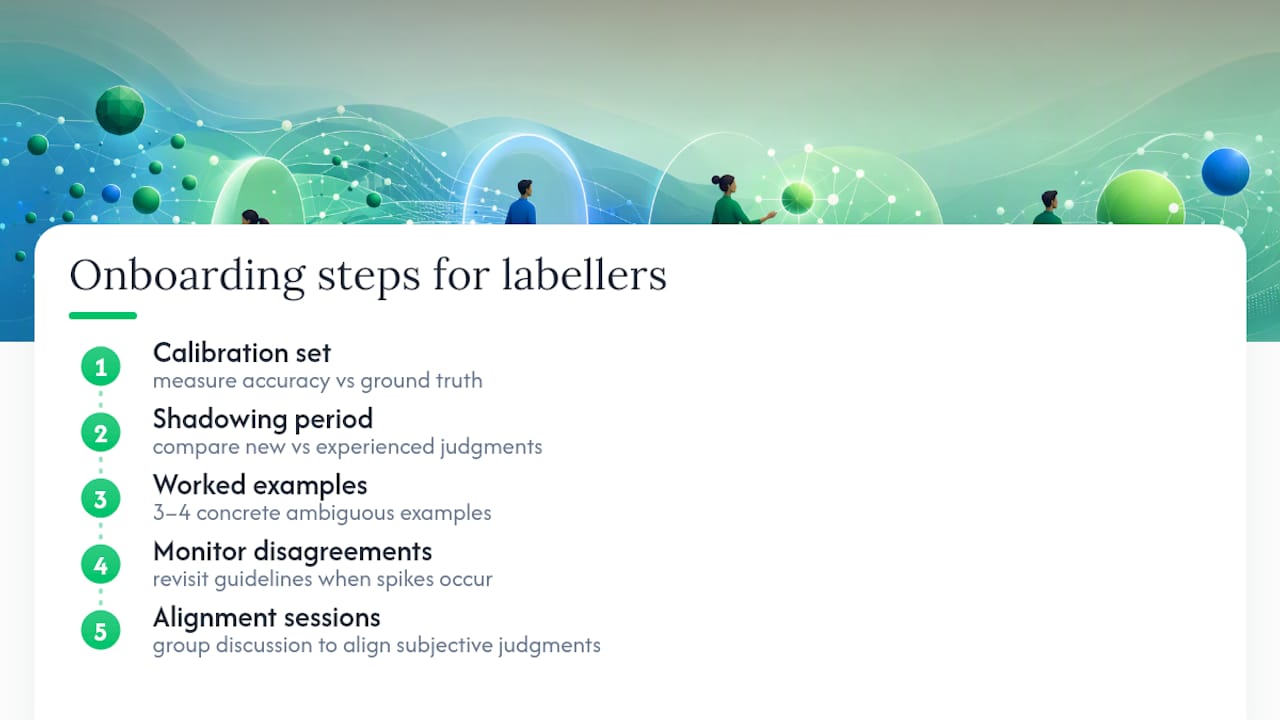
Start new reviewers on a calibration set with known correct answers, not live data, so you can measure their accuracy against ground truth before they touch anything that affects the model. Pair this with a short shadowing period where a new reviewer’s judgements are compared against an experienced reviewer’s on the same cases, disagreements become the training material, not a failure to be hidden.
Guidelines need worked examples, not abstract rules. “Flag ambiguous cases” means nothing without three or four concrete instances of exactly what counts as ambiguous in that specific domain. Revisit the guideline whenever disagreement rates spike, that’s usually a sign the instructions haven’t kept pace with the data the reviewers are actually seeing.
For subjective or preference-based tasks, the kind RLHF depends on, calibration matters even more, because there’s no single ground truth to check against. Regular reviewer alignment sessions, where a group discusses disagreements on a sample of cases, keep individual judgement from drifting away from the group’s shared standard over time. This applies even in adjacent fields: instructional design for AI-assisted human teaching faces a near-identical calibration problem when trainers are asked to judge subjective quality rather than mark objectively right or wrong answers.
What security and privacy risks does adding humans to the loop create?
Every human touchpoint is also a new access point, and that fact tends to get overlooked in the rush to build the labelling interface. Reviewers often need to see raw data, sometimes with personally identifiable information intact, to make an informed judgement, which means annotation platforms carry the same data protection obligations as the production system itself.
Access control should follow the same principle as the model’s own permissions: reviewers see only what they need for the specific task, not the full case history, unless the task genuinely requires that context. Audit logs matter here for a second reason beyond model governance, they’re also the record you need if a data access question ever gets raised by a regulator or an internal compliance review.
Outsourced or crowd-sourced labelling introduces its own exposure. Data leaving your infrastructure to reach a third-party labelling workforce needs contractual and technical safeguards, redaction of sensitive fields, secure transfer, and clear data retention limits, before it ever reaches a reviewer’s screen. Where the data involves regulated categories, financial records, health information, anything covered by sector-specific rules, the labelling workflow needs the same compliance review as any other system touching that data, not a lighter one just because a human is doing the reviewing rather than a model.
How do you integrate HITL into an existing ML pipeline?
The biggest integration mistake is treating human review as a bolt-on step at the end rather than a first-class component of the pipeline architecture. If the escalation logic lives in a separate system from the model-serving infrastructure, you end up with latency, lost context, and cases that vanish between systems.
Build the human review interface to consume the same feature and prediction data the model uses, not a simplified export, so reviewers see exactly what the model saw. Escalation should be triggered by the serving infrastructure itself, an uncertainty score crossing a threshold routes automatically to a queue, rather than depending on a separate monitoring dashboard someone has to check manually.
Version everything a decision touches: model version, data snapshot, and reviewer identity, so a decision made six months ago can be reconstructed exactly if it’s ever challenged. This is where MLOps discipline and HITL design overlap directly, retraining on reviewer-corrected data without careful versioning is a common way models silently regress, a risk covered in more depth in guidance on avoiding silent failures during model retraining.
Platform choice matters less than the discipline around it. Whether you’re using an established MLOps platform or a custom pipeline, the integration points that matter are the same: a queueing mechanism for escalated cases, a feedback loop that feeds corrected labels back into retraining, and monitoring that treats the human review step as a measurable stage, not an invisible one.
Choosing HITL over full automation: a practitioner’s view
The heuristic is simpler than most teams make it: weigh error cost against data scarcity and regulatory exposure, not against how sophisticated the model already is. Pilot on one narrow task, measure detection yield honestly, then expand. Teams that skip the narrow pilot tend to build oversight theatre instead of oversight, and end-to-end accountability across strategy, build, and operations is what prevents that gap from opening in the first place.
— Thomas Samuel
How Sentient Concepts supports human-in-the-loop AI systems
Designing a HITL system that actually holds up under production load takes more than a good taxonomy, it takes someone accountable for the whole lifecycle, not just the model. Choosing a single team to carry the design through strategy, engineering, and ongoing operations can help prevent escalation policies from getting lost during project handoffs.
That continuity matters most in the phases this article covers: defining uncertainty thresholds during Deployment & MLOps, and keeping detection yield and inter-rater agreement stable over time through Managed AI Operations. Both sit within Sentient Concepts’s broader end-to-end AI services, covering everything from initial readiness assessment through to the operating model that keeps human reviewers correctly resourced as volume grows. If your team is scoping a HITL pilot or hitting scaling friction on an existing one, you can explore AI consulting and implementation services to support your efforts.
Sources
FAQ
What is human-in-the-loop machine learning?
Human-in-the-loop machine learning is a design approach where people label data, correct model outputs, or approve decisions at defined points in the training or operational pipeline, rather than letting the system run fully unsupervised.
Does agentic AI have a human-in-the-loop?
Agentic AI systems can include a human-in-the-loop, typically as an approval step before an agent executes a consequential action like a payment or a customer commitment, though many agentic deployments run with reduced or no per-action human checkpoints once trust is established.
What does human-in-the-loop mean when using AI?
It means a person actively reviews, corrects, or approves specific AI decisions rather than accepting every output automatically, with the review point placed where errors are costliest or the model is least certain.
What is the difference between human-on-the-loop and human-in-the-loop?
Human-in-the-loop involves per-decision intervention, while human-on-the-loop (sometimes called human-over-the-loop) means the person monitors aggregate system behaviour and can pause or override it, without reviewing every individual case.
Recommended