POC vs POV: Run a POC for Technical Doubt, a POV for Economic Doubt
A proof of concept answers “can this work?” A proof of value answers “is this worth it?” Run a POC when the doubt is technical, run a POV when the doubt is economic, and when both doubts exist, run the POC first to clear feasibility before spending stakeholder time proving business impact.
TL;DR:
Conduct a POC to resolve technical doubts when integrating legacy systems, dealing with new technologies, or confirming compliance requirements, ensuring feasibility first.
Run a POV to demonstrate measurable business impact and justify investments, especially when multiple stakeholders with different priorities are involved.
Match the evaluation type to stakeholder concern: technical leads need POCs for integration, while executives require POVs for ROI and decision-making.
Enforce clear success criteria and fixed timelines to prevent scope creep and ensure evaluations lead to actionable decisions.
Recognize that technical objections often mask economic doubts, making early diagnosis of the true concern critical to avoiding wasted effort.
Table of Contents
POC vs POV: what each term actually means
A proof of concept is defined by the Cambridge English Dictionary as a test of a new idea or product to see whether it will work, before committing further money to development. In enterprise technology, that translates into a narrow, technical exercise: can this system integrate with our data, handle our volume, or meet a specific performance threshold?
A proof of value goes a step further. Rather than testing whether something functions, it tests whether it delivers measurable return, typically expressed in cost saved, hours reclaimed, or revenue protected. Tenable’s framing of the distinction, POC proves feasibility while POV proves business impact, has become the industry-standard way to separate the two.
A few related terms cause confusion and deserve a quick note:
Pilot: a limited live deployment, often run after a POC or POV, closer to production than either.
MVP (minimum viable product): a stripped-down but shippable product, a build decision rather than an evaluation stage.
PoT (proof of technology): near-synonymous with POC, usually vendor-specific jargon.
POV outside business: Cambridge’s dictionary entry confirms POV commonly means “point of view” in film, gaming, and everyday writing, an entirely different sense from the business use here.
Define both acronyms at the start of any evaluation. A stakeholder walking in assuming POV means “point of view” will misread the entire exercise.
Comparing POC and POV side by side
The two evaluations differ on nearly every practical dimension, not just their headline question. Tenable’s comparison and independent analysis from TechHelp both frame the split around the type of decision each is built to support: technical validation versus an economic, business-case decision.
Dimension | Proof of Concept | Proof of Value |
Core question answered | Can it work technically? | Is it worth the investment? |
Primary focus | Feasibility, integration, performance | Measurable business impact, ROI |
Typical audience | Technical leads, engineers, architects | Buying committee, executive sponsor, business owner |
Typical timeline | 1 to 4 weeks | 2 to 4 weeks |
Typical outputs | Technical validation report | Quantified business case, results document |
The timeline ranges come from practitioner guidance on POV vs POC evaluations for SaaS teams, which recommends timeboxing POCs tightly and giving POVs more room to gather representative data across an enterprise buying cycle.
The practical takeaway: match the evaluation to the seat at the table. If your technical lead has doubts about integration, a POC settles it fast and cheaply. If your economic buyer needs a number to defend the spend to their own board, no amount of technical proof substitutes for a POV’s business case. Running the wrong one wastes the exact stakeholder time you were trying to save.
When should you run a POC versus a POV?
The decision comes down to a single diagnostic question: where does the buyer’s doubt actually sit? Technical doubt calls for a POC. Economic doubt calls for a POV. Most deals that stall have run the wrong one, or skipped straight to a demo with neither.
Run a POC when integration complexity is unknown. Legacy systems, unusual data formats, or a new technology stack all justify a technical proof before anyone discusses budget.
Run a POC when regulatory or compliance requirements are unclear. Financial services and insurance clients often need to confirm data handling and audit trail behaviour works before a business case is even relevant.
Run a POC when the vendor or approach is genuinely new to the market. Uncertain performance claims deserve technical scrutiny first.
Run a POV when you need to justify budget to people who weren’t in the technical room. Modern Presales notes that a POV without pre-agreed KPIs rarely convinces executives, even when the technical results are strong.
Run a POV when multiple stakeholders sit across different functions. A finance director and an operations head need different proof than an engineer does.
Run a POV when the real competitor is inertia, not another vendor. Deals lost to “doing nothing” are lost on economic argument, not technical merit.
Sequence both when the category is new and the spend is large. Run the POC first to clear the technical gate, then the POV to build the case for funding, as Tenable recommends for enterprise decisions.
The one exception worth naming: in mature product categories, where feasibility is well established across the market, a POV alone is often sufficient. Skipping the POC in that case isn’t corner cutting, it’s recognising the doubt was never technical to begin with.
Running a POC or POV that actually leads to a decision
Every evaluation, technical or economic, needs the same skeleton before it starts: an objective, defined success criteria, named stakeholders and their commitments, a fixed timeline, explicit scope boundaries, and an agreed next step if the result is positive, as exemplified in this case study of defining evaluation goals and outcomes.
Map stakeholders before day one:
Executive sponsor: owns the go/no-go decision and, per Modern Presales, their early involvement in setting success criteria is the single strongest predictor of a POV converting into a purchase.
Technical lead: validates feasibility, owns the POC’s pass/fail thresholds.
Business owner: defines what “value” means in their own operational terms, cost per transaction, hours saved, error rate.
Solutions or account team: coordinates the evaluation and keeps it timeboxed.
End users: provide the representative workflows that make results credible rather than theoretical.
On timelines, keep POCs tight, one to four weeks for mid-market deployments, and give POVs more breathing room, typically two to twelve weeks depending on enterprise complexity, as sandboxed evaluations require time to gather representative metrics rather than a single test run. Deliverables should match the stage: a technical validation report closes a POC, while a results document with quantified business impact closes a POV.
Pro Tip: Build your POV inside a sandbox with real, representative data rather than a stripped demo dataset. A POV doesn’t need full production infrastructure to be credible, it needs metrics that map cleanly to the business case you’ll present afterwards.
Sentient Concepts’s approach to use-case prioritisation and value mapping exists specifically for the KPI-selection step, choosing the two or three metrics that will actually move an executive decision, rather than a dozen vanity numbers nobody defends later.
Where evaluations stall, and how to stop it
The most common failure mode is what practitioners call the “museum of prototypes”: a string of technically successful POCs that never convert to production because nobody defined what success actually meant for the business. Scope creep is the usual accomplice, a two-week technical test quietly expanding into a three-month unpaid consulting engagement.
The fix is enforcing kill criteria from the outset. Modern Presales recommends agreeing explicit pass/fail thresholds before the evaluation starts, so the team has a clear yes or no decision waiting at the end rather than an open-ended “let’s keep testing.”
A few non-negotiables:
Define pass/fail criteria and the specific KPIs before work begins, not after results come in.
Involve the economic buyer in setting those criteria, not just reviewing them at the end.
Fix the timeline in writing and treat any extension request as a signal something was scoped wrong.
Pre-agree the next step on success, whether that’s a contract, a pilot, or a budget submission.
Budget and resourcing: what each stage actually costs you
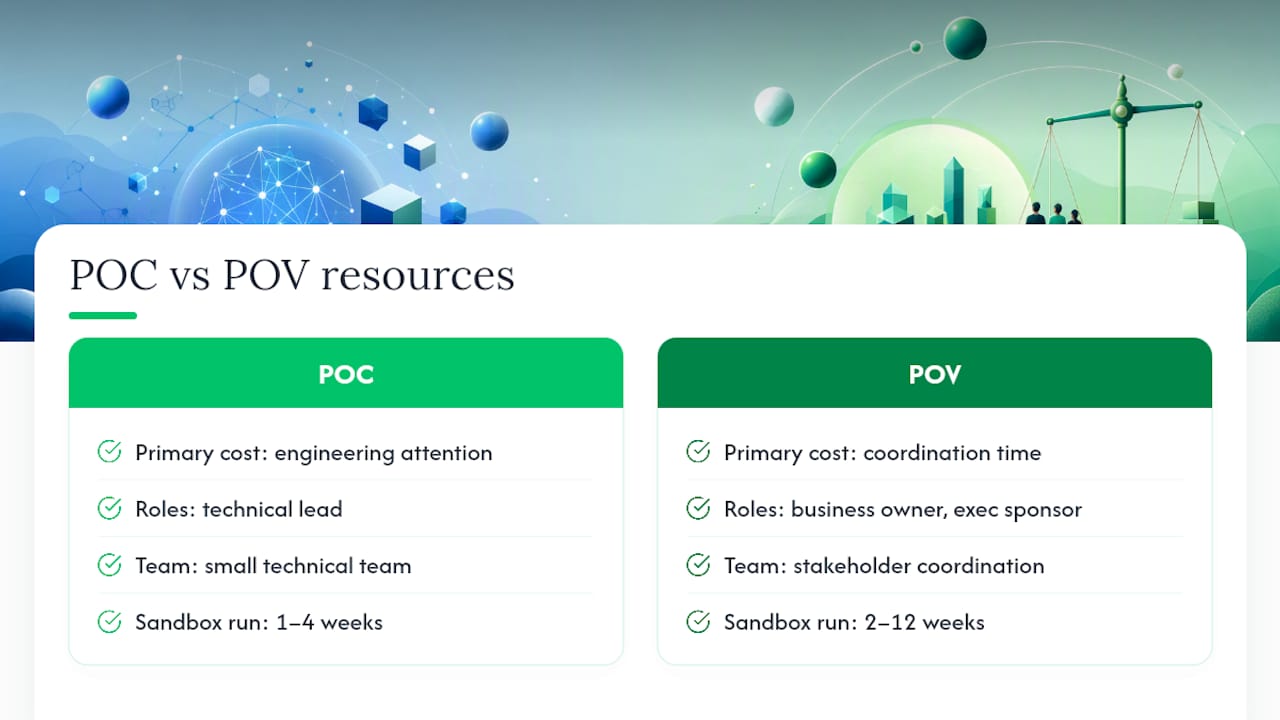
A POC is cheap in cash but expensive in engineering attention. It typically needs a technical lead, a sandbox environment, and a narrow slice of representative data, rarely more than a small team for one to four weeks. The real cost is opportunity: pulling senior engineers off other work to validate someone else’s product.
A POV costs more in coordination than in technology. It needs the business owner’s time to define what value looks like, the executive sponsor’s attention to agree KPIs, and often a longer sandbox run, two to twelve weeks, to gather metrics that hold up under scrutiny. Underfunding this coordination is the single most common way a POV drifts into an expensive, inconclusive pilot.
Budget for both stages as internal cost centres, not just vendor spend. A POC that “costs nothing” because the vendor runs it for free still consumes your technical lead’s hours, and a POV that looks free because it’s “just a trial” still consumes your business owner’s and sponsor’s calendars for weeks. Treat that internal time as a line item when deciding whether to run one stage, both, or neither.
Smaller organisations often try to compress both stages into one exercise to save time. This usually backfires: technical and economic doubt need different evidence, and conflating them tends to produce a result nobody trusts enough to act on. Budget separately for each, even when running them back to back.
Documenting and reporting POC and POV results
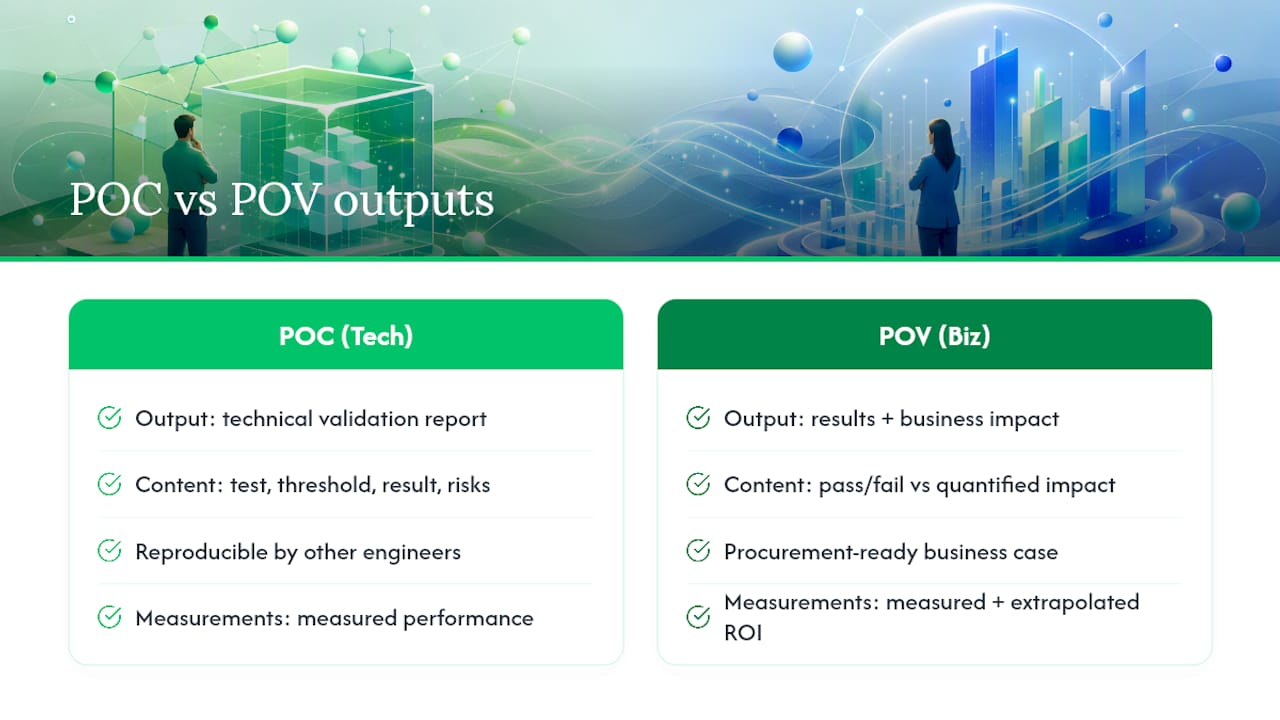
A POC’s output is a technical validation report: what was tested, against what threshold, with what result, and what technical risks remain if the project proceeds. Keep it specific enough that an engineer who wasn’t in the room could reproduce the conclusion.
A POV’s output is heavier: a results document that maps pass/fail criteria against quantified business impact, plus pre-defined next steps if the result is positive. Modern Presales recommends building this document to convert directly into a procurement decision, so the business case and the purchase approval are effectively the same artefact.
Both documents share three habits worth adopting regardless of which stage produced them. First, state the criteria before the results, so nobody can retrofit success after seeing the numbers. Second, separate what was measured from what was estimated, a POC’s performance number is measured, while a POV’s ROI projection is often partly extrapolated, and readers deserve to know which is which. Third, name the decision the document is meant to trigger on its first page, not its last.
Poor documentation is why technically successful evaluations die quietly. A verbal “it went well” from an engineer carries no weight with an economic buyer who wasn’t in the sandbox. Written, criteria led reporting is what actually moves a deal from evaluation to signature. Sentient Concepts’s work on proving AI ROI within a fixed test window follows the same logic, unit economics stated plainly enough that a CFO can act on them without translation.
How company culture shapes the choice between POC and POV
Engineering-led organisations default to POCs even when the real doubt is economic, because technical validation is the kind of proof that culture already knows how to produce. The result is a technically flawless prototype that stalls at budget approval because nobody built the business case alongside it.
Sales and finance led organisations have the opposite tendency: pushing straight to a POV, complete with ROI projections, before confirming the technology actually integrates with existing systems. That produces a business case built on an assumption nobody tested, which collapses the moment implementation starts.
Organisations with a genuine presales discipline, where technical and economic evaluation are treated as separate, sequenced steps rather than one blurred “trial”, tend to close faster because they never ask a single evaluation to answer two different questions at once. That discipline usually shows up structurally: a named executive sponsor engaged from the start, a business owner who signs off on KPIs before testing begins, and a technical lead who reports results without being asked to also defend the ROI case.
If your organisation has run three or four vendor evaluations that stalled after a promising demo, the pattern is worth examining honestly. It is rarely the technology that failed. It is more often that nobody in the room was accountable for the economic question, because the culture only ever asked the technical one.
How Sentient Concepts approaches proof of concept and proof of value work
POC and POV work can be run under one accountable team across strategy, build, and operation, rather than handing a technical validation to one vendor and a business case to another. That continuity matters most at the handoff point, where most evaluations quietly lose momentum.
A concrete example: Sentient Concepts’s routing rules between open and closed large language models are decided during the POC stage specifically because model choice drives the cost assumptions a POV will later depend on. Getting that sequencing right, feasibility first, cost model second, is what turns a technical trial into a defensible business case.
Sentient Concepts’s use-case prioritisation and value mapping service exists to help enterprise teams in finance, manufacturing, logistics, and insurance scope that KPI conversation before the clock starts on either evaluation. Full service details, including readiness and data diligence and deployment and MLOps, are listed on the Sentient Concepts services page. Organisations weighing a POC against a POV for a genuine AI deployment, rather than a smaller pilot, will find the sequencing guidance above directly applicable to how that engagement should be scoped from day one.
Why most evaluation frameworks miss the real question
Most guidance on POC versus POV treats the choice as a matter of company size or budget threshold, run a POC if you’re small, a POV if you’re enterprise. That framing gets the causality backwards. The choice was never about the size of the company. It was always about where the doubt in the room actually sits.
A ten-person startup evaluating an unfamiliar AI vendor for the first time has genuine technical doubt and should run a POC regardless of budget. A Fortune 500 company buying a mature, well-understood category of software has almost no technical doubt left, the product category has already proven itself across thousands of deployments, and jumping straight to a POV, as Guideflow’s analysis of mature SaaS categories suggests, is the more rational move.
What gets underestimated, consistently, is how often the “technical” objection raised late in a deal is actually an economic objection wearing a disguise. An engineer who says “I’m not sure this will scale” halfway through budget discussions is frequently really saying “I haven’t seen the number that justifies this yet.” Running another POC in that moment wastes weeks solving a problem that was never technical. The skill worth building isn’t running better POCs or better POVs individually. It’s getting sharper at diagnosing, honestly and early, which kind of doubt you’re actually looking at.
— Thomas Samuel
Sources
FAQ
What does POC stand for?
POC stands for proof of concept, a test used to check whether a new idea, product, or technology will actually work before further money or time is committed. In enterprise technology, it’s specifically a technical feasibility test, not a business case.
What is POV in the IT industry?
In IT and enterprise sales, POV stands for proof of value, an evaluation that measures whether a technology delivers quantifiable business impact, such as cost saved or hours reclaimed. It’s distinct from the everyday meaning of POV as “point of view,” which applies in film, gaming, and general writing rather than business evaluations.
Which comes first, MVP or POC?
A POC typically comes before an MVP. The POC tests whether an idea is technically feasible, while the MVP is a build decision, a stripped-down but functioning product released once feasibility and, often, business value have already been confirmed.
What does POV mean in construction?
Construction and engineering contexts sometimes use POV to mean “point of view” in visualisation or design review, following the general dictionary sense rather than the business evaluation meaning covered in this article. Always confirm which sense a construction team intends, since the two usages share no functional overlap.
Should I run a POC and a POV, or just one?
Run both when the technology is new to the market and the spend is significant: the POC clears technical doubt, then the POV builds the business case using Tenable’s recommended sequencing. In mature, well-established product categories, a POV alone is often enough, since feasibility doubt is minimal and the real question is economic value.
Recommended