Prove Claims Triage Analytics in 90 Days for Enterprise Insurers
Claims triage analytics uses structured claim data and unstructured text together to predict severity and complexity within minutes of first notification of loss, routing files to the right adjuster before a human ever reads the claim. Done properly, it cuts cycle time, lifts routing accuracy, and improves reserving precision. The technologies that make this reliable, rather than a novelty, are multimodal models, BERT-based extraction and runtime explainability. These systems can be built end-to-end for insurance operations, from strategy through to managed operations.
TL;DR:
Multimodal models combining structured data and claim narratives significantly improve severity prediction accuracy, especially for high-severity cases.
Explainability tools like SHAP attribution and drift monitoring are essential to make model predictions auditable and maintain operational trust.
A 90-day pilot focusing on a high-volume claim type is recommended to validate value and unit economics before scaling.
Implementing claims triage analytics requires phased workflows from data diligence to ongoing monitoring, with governance controls at each stage.
Success depends on having a single team accountable from strategy through deployment, ensuring consistency and minimizing model drift and accuracy loss.
Table of Contents
What is claims triage analytics and why does it matter?
Triage, in claims operations, is the act of estimating how severe and complex a file will be, then routing it to the adjuster or team best suited to handle it, before deeper investigation begins. Get triage wrong at first notification of loss (FNOL) and the cost compounds: a straightforward claim lands with a senior adjuster who has no time for it, or a complex bodily injury file sits in a general queue until someone notices it is escalating.
Reassignment is the symptom operations leaders know best. A claim gets routed once, reassigned when its true complexity emerges, then reassigned again once a specialist realises it needs legal input. Each handoff adds days and erodes the customer experience.
The reason modern triage analytics outperforms rule-based routing is unstructured data. Adjuster notes, intake PDFs, photos, and call transcripts carry signal that structured fields cannot capture, and claims data analysis increasingly treats this as decision support rather than a replacement for adjuster judgement, surfacing the files that need attention while leaving the final call with a person, as VCA Software describes it. Insurance claims analysis built only on policy fields and loss codes misses:
The tone and specificity of an early injury description, which often flags litigation risk before any medical bill arrives.
Photographic evidence of damage severity that a coded field summarises as “moderate.”
Inconsistencies between a claimant’s narrative and the recorded facts, an early fraud signal.
Repeated escalation language in adjuster notes that predicts a claim will blow through its initial reserve.
How do multimodal models and BERT improve severity prediction?
The technical shift driving better triage is fusion: combining structured policy fields (age, coverage limits, loss type) with text embeddings drawn from claim narratives, in a single model rather than two separate ones. Multimodal deep learning that fuses structured and unstructured claims inputs improves severity regression and calibration, with the biggest gains showing up precisely where it matters most operationally, in high-severity cases that carry the greatest reserve risk.

BERT-based NLP models are the workhorse for the text side. Rather than treating a narrative field as noise, BERT-style extraction turns adjuster notes and claimant statements into features a model can actually learn from. Research comparing BERT-and-neural-network approaches against structured-only equivalents found that the text-aware models achieved better explained variance and lower error on real claims data.
Statistic to watch: the gap between text-aware and structured-only models widens specifically in high-severity claims, which is exactly the segment where a missed signal costs the most in reserve variance and litigation exposure.
None of this is worth deploying without explainability and monitoring built in from day one:
Runtime SHAP attribution shows adjusters which features pushed a severity score up or down, not just the score itself.
Evidently drift monitoring flags when the incoming claim mix or model inputs shift away from training conditions, before accuracy quietly degrades.
Confidence scores and rationale fields on every prediction let a triage queue distinguish “high confidence, route automatically” from “low confidence, human review required.”
A production design pairing SHAP attribution with drift monitoring and a governance layer is what converts a severity score into something operators can actually act on, rather than a number they have to take on faith.
What does an implementation roadmap look like?
Enterprise claims triage projects fail less often on the model and more often on sequencing. A phased approach keeps governance, data readiness and production controls in step with each other.
Phase 0, alignment. Leadership agrees the KPIs that matter (cycle time, routing accuracy, reserve variance), maps the use case to business value, and clears the privacy and compliance review before any data moves.
Phase 1, data diligence. Audit FNOL intake quality, map document formats to a common schema, and use synthetic data augmentation to validate extraction pipelines before real claimant data is exposed, an approach industry briefs on unstructured claims recommend precisely to protect PHI during early testing. Document intake speed is its own lever worth fixing in parallel; a structured intake process removes friction long before a model touches the file.
Phase 2, model build. Combine BERT-based text extraction with the structured fusion layer, and insist on human-in-the-loop validation against a holdout sample before setting confidence thresholds for production.
Phase 3, deployment. Expose predictions through REST endpoints tied into existing routing hooks, with defined latency service levels so triage happens in seconds, not hours. This is where deployment and MLOps discipline earns its keep.
Phase 4, monitoring. Run Evidently drift reports on a schedule, set alert thresholds for feature and prediction drift, and define retrain triggers rather than waiting for a visible accuracy drop.
Pro Tip: Start with a 90-day pilot scoped to a single high-volume claim type, such as motor glass or minor property damage. A narrow scope proves unit economics fast and keeps integration complexity low enough that one team can own it end to end.
How do you measure the impact and estimate ROI?
Claims triage analytics earns its budget on operational and financial metrics that a CFO will actually recognise, not model accuracy scores alone. Decision-support analytics that identifies severity earlier consistently helps control claim costs across the claims cycle, which is the argument that lands in a procurement conversation.
Track these on a single dashboard, not scattered across systems:
Triage accuracy, measured against adjuster-confirmed severity after full investigation.
Cycle time, specifically FNOL-to-decision, which is where most of the customer experience cost sits.
Reassignment rate, the clearest proxy for whether initial routing is actually working.
First-pass settlement rate, claims resolved without a second round of investigation.
Cost-per-claim and leakage reduction, the financial counterparts to routing accuracy.
Reserve variance improvement, how much closer initial reserves land to final settlement value.
For the pilot itself, run a control group against a treated group over 90 days and calculate unit economics directly, cost saved per claim against the cost of running the model. A structured ROI methodology built around this comparison gives a CFO a number they can defend, rather than a projected efficiency gain with no baseline.
What risks and governance controls should you insist on?
The risks are predictable, and so are the controls. Poor FNOL data quality feeds bad predictions regardless of model sophistication; model hallucination on narrative extraction can invent detail that was never in the claim file; and biased outcomes can creep in silently if training data reflects historic routing inequities rather than actual claim complexity.
Set confidence thresholds that force human review below a defined certainty level, never full automation regardless of volume pressure.
Require rationale fields on every automated decision, not just the score.
Run sample adjudication regularly, checking a slice of automated routing decisions against expert human judgement.
Version every model deployment and keep audit trails, because a regulatory review will ask what model made which decision and when.
Pro Tip: Treat human sign-off on escalations as non-negotiable, not a fallback. The point of triage analytics is faster routing to the right person, not routing the person out of the decision entirely.
How Sentient Concepts implements end-to-end claims triage analytics
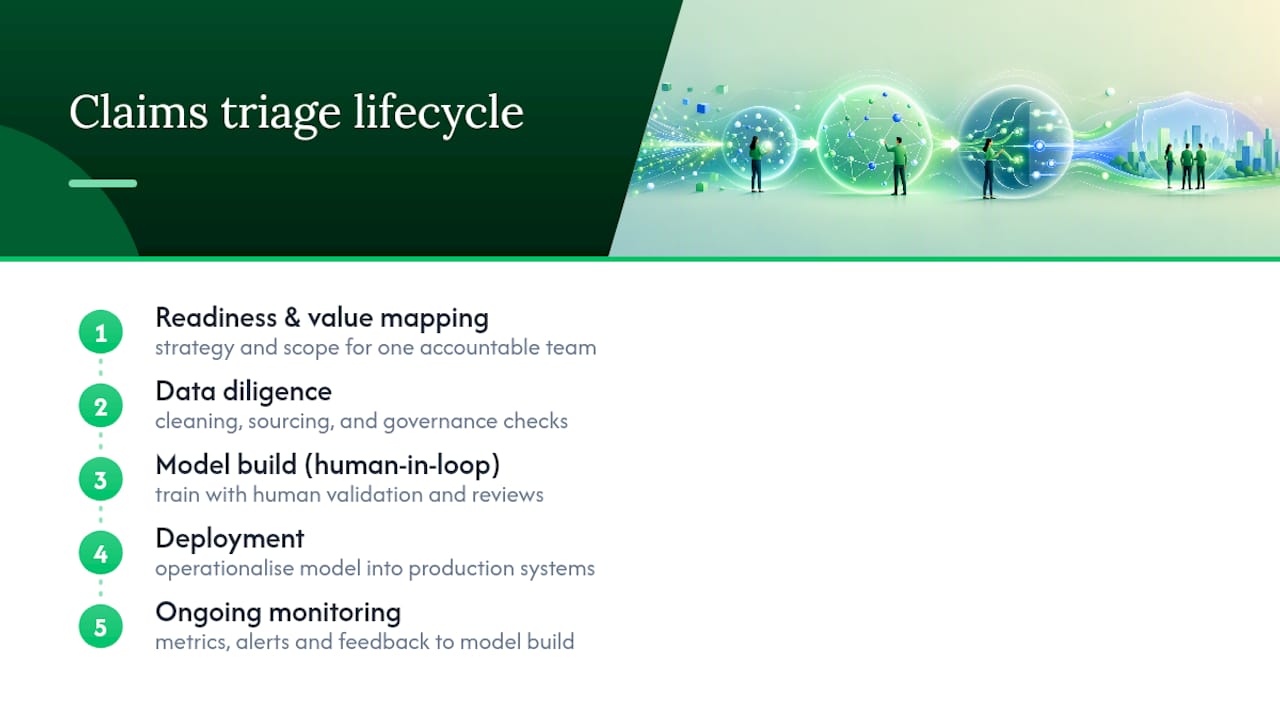
Most claims triage projects stall at the handoff between the team that built the model and the team left running it. Sentient Concepts avoids that by keeping one team accountable from strategy through to managed operations, mapping directly onto the phases above: readiness and value mapping, data diligence, model build with human-in-the-loop validation, deployment, and ongoing monitoring.
— Thomas Samuel
Ready to pilot claims triage analytics?
An alternative to piecing together triage analytics from disconnected vendors and internal teams is having one accountable team carry the project from strategy through to running the model in production, avoiding handoffs where accuracy can get lost.
That matters most in claims operations, where a model that scores well offline but drifts unmonitored in production is worse than no model at all. Our Readiness & Data Diligence work assesses whether your FNOL data and document pipelines can support a triage model before you commit budget to building one, and our full services cover the build and run phases that follow. If a 90-day pilot on a single high-volume claim type sounds like the right next step, get in touch to scope a readiness review.
Sources
FAQ
What is claims triage analytics?
Claims triage analytics is the use of predictive models, drawing on both structured claim fields and unstructured text, to estimate severity and complexity at first notification of loss. It routes files to the right handler and prioritises the ones needing urgent attention.
How does multimodal analysis improve severity prediction?
Fusing structured policy data with text embeddings from claim narratives improves severity regression accuracy, with the strongest gains appearing in high-severity cases. Structured-only models tend to miss risk signal that only appears in adjuster notes or claimant statements.
Why does explainability matter in automated triage?
Adjusters and compliance teams need to see why a model flagged a claim as severe, not just the score itself. Runtime SHAP attribution paired with drift monitoring is what makes a severity signal auditable rather than a black box.
How long does a claims triage analytics pilot take?
A focused pilot on a single high-volume claim type typically runs around 90 days, long enough to compare a control group against a treated group and calculate real unit economics. Scoping narrow keeps integration complexity manageable for one team.
What does Sentient Concepts charge for claims triage analytics work?
Pricing depends on scope, from a readiness assessment through to full deployment and managed operations, and current details are available on the services page. Engagements are structured around the phase a business needs, rather than a single fixed package.
Recommended