Cut Hallucinations and Leaks: Engineering Taxonomy of LLM Guardrails
Effective LLM guardrails combine several technique families rather than one silver bullet: rule-based filters, prompt engineering, LLM-based judges, and RAG-driven grounding, wrapped in continuous behavioural monitoring. Each layer catches what the others miss. The strongest production systems apply defence in depth, cascading cheap checks before expensive ones, accepting a modest latency and compute cost in exchange for far lower rates of hallucination, data leakage, and policy violation.
TL;DR:
Most effective guardrail systems employ multiple layers, including rule-based filters, judges, grounding, and prompt engineering, working together for maximum safety.
Input checks are fastest and cheapest but can be bypassed; expensive layers like judges and grounding should be used only when simpler filters are inconclusive.
Retrieval-augmented generation significantly reduces hallucinations by conditioning responses on trustworthy documents, especially when combined with groundedness checks.
Continuous measurement of relevance, groundedness, and user trust, along with regular adversarial testing, is essential to maintain guardrail effectiveness over time.
Adaptive guardrails that adjust strictness based on context improve efficiency and safety, but require careful logging and versioning to avoid operational complexity.
Table of Contents
What are LLM guardrails and where do they sit in the stack?
Guardrails are runtime controls, not model properties. They intercept inputs, monitor outputs, and orchestrate decisions across a pipeline, which is distinct from evaluation metrics that measure model performance after the fact. A model’s underlying accuracy is a property of its training and architecture; guardrails exist to enforce policy and safety on top of whatever that model produces, which is why strategy around model selection has to stay coordinated with guardrail placement rather than treated as a separate concern.
Three control points matter in a typical LLM application:
Input guardrails screen what enters the model: prompt injection attempts, jailbreak phrasing, personally identifiable information, or requests outside the system’s remit.
Model-side guardrails shape generation itself, through system prompts, constrained decoding, or fine-tuning that biases the model towards refusal or citation.
Output guardrails inspect what comes back before it reaches a user: toxicity scoring, groundedness checks against source documents, format validation, and redaction of sensitive data.
Each control point maps to a specific threat. Prompt injection, where a malicious instruction hides inside user input or a retrieved document, is best caught at the input layer or through structural separation of instructions and data, as OWASP’s GenAI guidance details. Data leakage, where a model exposes system prompts or training data, needs both model-side constraints and output redaction. Hallucination, arguably the hardest problem, responds best to grounding techniques applied mid-pipeline. Toxicity and bias usually get caught cleanest at the output stage, where a classifier can score the finished response against a policy threshold before it ever reaches a user.
Understanding this map matters because teams often over-invest in one layer, typically prompt engineering, while leaving the other three exposed. A jailbreak that slips past your system prompt still has to clear an output classifier, and that redundancy is the entire point of a layered approach.
Rule-based checks and lightweight filters
Rule-based filters are the cheapest and fastest layer, and they should run first in any pipeline. Regex patterns, length and format checks, and deny/allow lists catch a surprising share of low-effort attacks and malformed inputs before anything touches the model.
Typical implementations include:
Regex matching for known injection phrases (“ignore previous instructions”, encoded payloads, suspicious system-prompt requests).
Deny-lists for banned topics, competitor names, or regulated terms that must never appear in output.
Format and schema validation, rejecting responses that don’t match expected JSON or structured output.
Length and character-set checks that flag anomalies before they consume model compute.
These checks are also the easiest to evade. Paraphrasing, homoglyph substitution, and Unicode obfuscation defeat a naive regex within minutes of a determined attacker probing it. The fix is normalisation: canonicalise Unicode, strip zero-width characters, lowercase and lemmatise before matching, and keep the deny-list itself under version control so it can be patched as fast as new evasion patterns appear.
The design pattern that matters most here is cascading. Run the cheap checks first, and only pass input through to expensive model-side or LLM-judge checks if it clears the rule-based layer. This is not just an efficiency trick, it is a resilience strategy: combining cheap filters before expensive checks, and ensuring detection diversity across layers, catches adversarial inputs that a single mechanism would miss.
Pro Tip: Log every rule-based rejection with the matched pattern and raw input. That log becomes your adversarial test corpus for the next red-team cycle, and it’s far cheaper than commissioning a corpus from scratch.
LLM judges, secondary models and semantic scoring
Rule-based filters can’t catch everything, which is where LLM-based metrics and judge models come in. A judge model, often a smaller or cheaper LLM than the one generating the primary response, scores output against defined criteria: relevance, groundedness, toxicity, or policy adherence. Natural Language Inference (NLI) models and semantic similarity checks serve a related purpose, verifying that a claim in the output is actually entailed by a source document rather than just topically similar to it.
Judges earn their place in pipelines that need nuanced evaluation regex can’t express, things like “does this response contradict the retrieved passage” or “is this tone appropriate for a regulated financial disclosure.” They’re expensive relative to rule-based checks, so most production systems sample rather than judge every single response, or batch judgments asynchronously and flag outliers for review rather than blocking every response in real time.
Calibration is the hidden cost. A judge model trained or prompted loosely will drift, flagging too many false positives (frustrating users) or too few true positives (defeating the point). Teams should:
Set explicit confidence thresholds rather than binary pass/fail, and route borderline scores to a secondary check or human reviewer.
Re-calibrate judges against a held-out labelled set whenever the primary model or prompt changes.
Track judge agreement with human review scores over time, not just at launch.
When a judge flags an output, the fallback matters as much as the detection. Blocking outright with no explanation erodes trust faster than a well-worded refusal. Better fallback rules regenerate the response with tighter constraints, substitute a templated safe answer, or escalate to a human reviewer, depending on the severity of the flag.
Grounding with RAG to cut hallucinations at the source
Retrieval-augmented generation conditions the model’s answer on retrieved passages, so instead of generating from parametric memory alone, the model is instructed to answer only from the documents placed in its context window. This is the single most effective structural technique for reducing hallucination and improving factual reliability, because it shifts the burden from “does the model know this” to “can the model faithfully report what’s in front of it,” a much easier task.
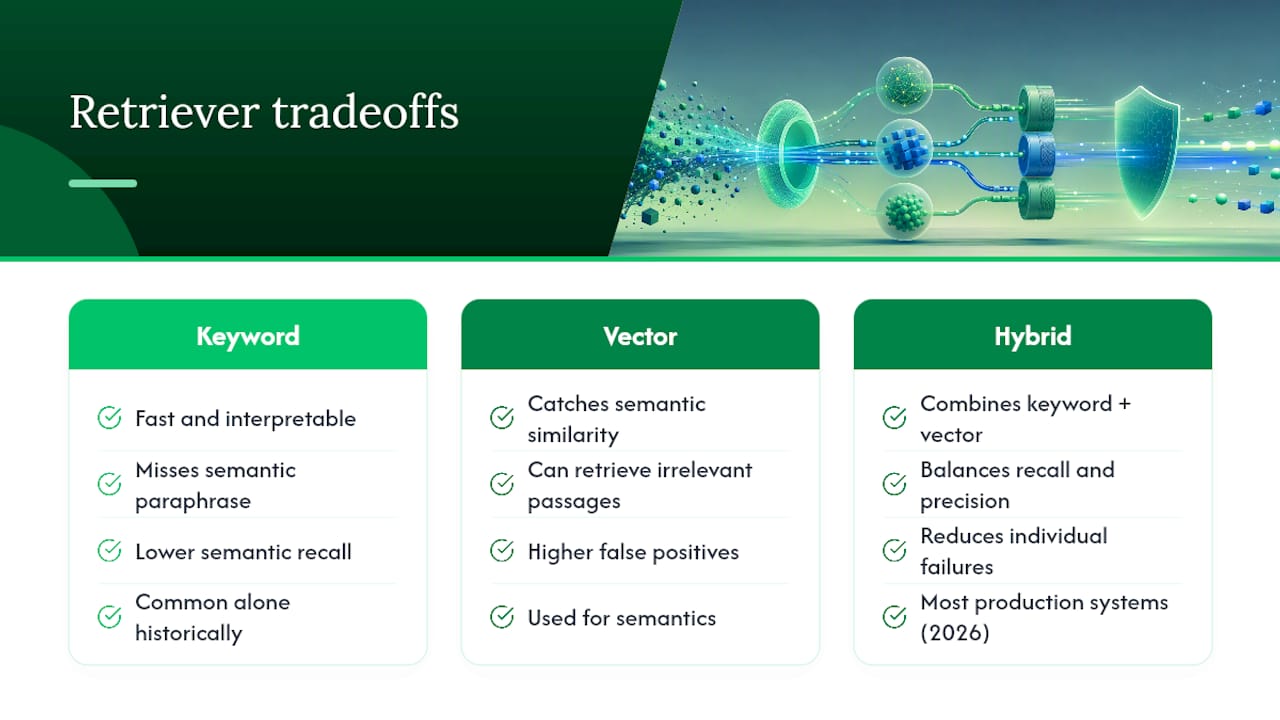
Retriever choice shapes everything downstream. Keyword search (BM25-style) is fast and interpretable but misses semantic paraphrase. Vector search catches semantic similarity but can retrieve confidently irrelevant passages. Most production systems in 2026 run a hybrid retriever, combining both, and apply metadata filtering (document date, source authority, access tier) to narrow candidates before ranking. Chunking strategy matters just as much as retriever choice: chunks that are too large dilute relevance scoring, while chunks that are too small strip out the context a judge model needs to verify groundedness.
Document integrity deserves its own attention. A poisoned or outdated document in the retrieval index will confidently “ground” a wrong answer, which is arguably worse than an ungrounded hallucination because it looks authoritative. Mitigations include source authentication, periodic re-indexing with freshness checks, and flagging retrieved passages whose provenance can’t be verified.
A layered defence combining prompt-level controls, retrieval grounding, and behavioural fine-tuning reduces hallucination more reliably than any single technique applied alone, according to a three-layer reference architecture proposed for high-stakes applications.
Sentient Concepts’ guide to retrieval-augmented generation design choices covers chunking and retriever selection in more depth for teams building this layer from scratch.
Prompt engineering, metaprompts and graceful fallbacks
Prompt engineering is the cheapest lever available, and the most commonly misapplied. The ICE method, Instructions, Constraints, Escalation, gives a repeatable structure:
Instructions state what the model should do, in plain, unambiguous terms, ideally with an example of correct output.
Constraints state what the model must never do, placed both at the start of the system prompt and repeated near the end of the context window, since repeating key constraints at both boundaries measurably improves adherence compared to stating them once.
Escalation defines what happens when the model can’t comply confidently, rather than leaving it to guess.
That third step is the one most teams skip, and it’s the one that matters most for trust. A model that says “I don’t know” or “I can’t verify this from the documents available” when it genuinely can’t answer builds more user confidence over time than one that blocks silently or, worse, fabricates a plausible-sounding answer. Allowing a model to admit uncertainty and layering in iterative verification steps outperforms blunt blocking strategies in nearly every trust metric teams track.
Design your fallback behaviours deliberately: a request for clarification, a partial answer with a caveat, or an escalation to human review, chosen based on the confidence score and the stakes of getting it wrong. Sentient Concepts’ guide to prompt injection prevention has worked examples of constraint placement that hold up against common jailbreak patterns.
Cascading checks and defence in depth in your pipeline
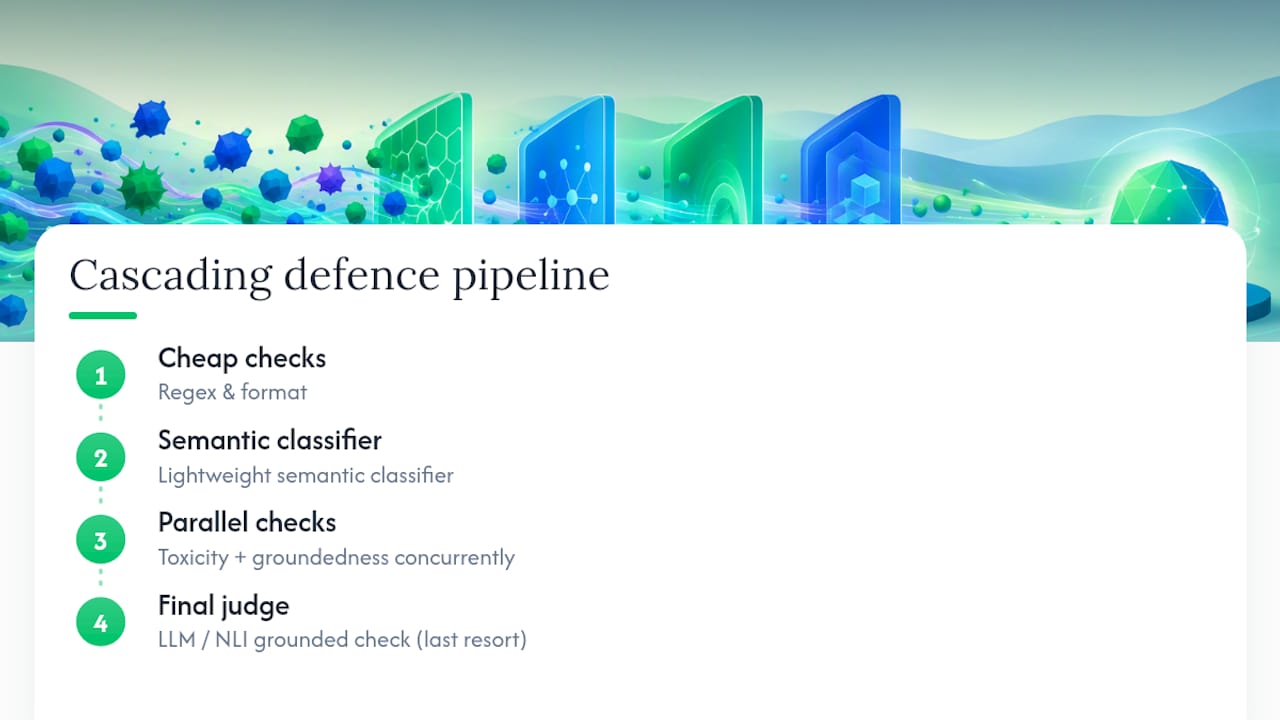
The architecture question every team eventually faces is ordering: which checks run first, which run in parallel, and where you accept latency to buy safety. The standard pattern cascades from cheap to expensive: regex and format checks first, a lightweight classifier second, and an LLM-judge or NLI groundedness check last, reserved for cases the earlier layers couldn’t resolve confidently.
This ordering isn’t just about cost. It’s about independence. A regex filter and a semantic classifier fail differently, so an input crafted to defeat one is unlikely to defeat both. Diversity across detection mechanisms is what makes a layered defence resilient against adversarial inputs specifically engineered to slip past a single well-known filter.
Where checks can run independently of each other, parallelise them. A toxicity classifier and a groundedness check don’t depend on each other’s output, so running them concurrently rather than sequentially can shave meaningful latency off the total response time. The pattern to apply here: fire both checks the moment generation completes, and if either fails, discard the generation immediately rather than waiting for the second check to finish, a technique sometimes called “fail-fast cancellation.”
Failing to integrate prompt-level, retrieval, and behavioural layers together, rather than treating them as separate bolt-ons, leaves systems vulnerable to sophisticated attacks that exploit the gaps between layers. Three-tier defence, applied consistently, closes most of those gaps.
Pro Tip: Budget your latency backwards from your user experience target, not forwards from your check list. If your target response time is two seconds, decide which checks fit inside that budget before you add a fourth layer “just in case.”
Measuring whether your guardrails actually work
Guardrails without measurement are a hope, not a system. Three metrics matter most: relevance (does the response address the query), groundedness (is every claim traceable to a retrieved source or verified fact), and user trust (measured through explicit feedback, repeat-usage rates, or escalation frequency). Each needs a confidence threshold, not a binary pass/fail, because the trade-off between false positives (blocking safe responses) and false negatives (letting unsafe ones through) is where most tuning effort goes.
Metric | What it measures | Typical method |
Relevance | Response addresses the actual query | LLM-judge scoring against query intent |
Groundedness | Claims traceable to retrieved source | NLI entailment check against passages |
User trust | Confidence and repeat engagement | Feedback signals, escalation frequency |
False positive rate | Safe responses wrongly blocked | Sampled human review against judge flags |
Adversarial red-team testing should run continuously, not just at launch. Effective testing combines synthetic adversarial prompts with production-sampled queries, tracking how groundedness and trust scores shift after each mitigation rather than assuming a fix works because it passed a one-off test.
Bake these checks into CI/CD: run your adversarial prompt suite against every model or prompt change before deployment, and pull a weekly sample of production responses for human review regardless of what automated checks report. Sentient Concepts’ guide to LLM evaluation metrics breaks down scoring methodology for teams building this from scratch.
Latency, cost, security and governance trade-offs
Every guardrail layer costs something, usually latency, sometimes compute spend, occasionally both. Budgeting matters more than avoiding the cost outright. Place cheap checks early and unconditionally; reserve expensive LLM-judge calls for cases that survive the earlier filters, and consider async or sampled judging where real-time blocking isn’t strictly necessary.
Security controls sit alongside functional guardrails, not instead of them:
Role-based access control (RBAC) limiting who can modify prompts, retrieval indices, or guardrail thresholds in production.
Network isolation through VNETs or Private Link where the deployment platform supports it, keeping model traffic off the open internet.
Secret management for API keys and credentials, rotated on a schedule rather than left static.
Logging and provenance capture aren’t optional extras, they’re what makes an incident reviewable after the fact. Every guardrail decision, block, flag, escalation, or pass, should log the input, the triggering rule or score, and the action taken. That audit trail is what regulatory frameworks in finance and insurance increasingly expect, and it’s the difference between a defensible system and one that simply hopes nothing goes wrong.
Feeding user feedback back into your guardrail policy
Static guardrails decay. Thresholds tuned against last quarter’s traffic drift out of calibration as user behaviour, attack patterns, and business requirements shift, which is why the strongest deployments treat feedback as a first-class input rather than an afterthought.
The mechanism is straightforward in principle: capture explicit feedback (thumbs up/down, correction flags, escalation outcomes) alongside implicit signals (session abandonment, repeat rephrasing, time-to-resolution), and route both into a regular re-calibration cycle for your judge models and confidence thresholds. A guardrail that blocks 40% of legitimate queries in a given category is a tuning failure, not a safety success, and feedback loops are the only reliable way to catch that drift before it damages user trust.
Escalation outcomes deserve particular attention. When a human reviewer overturns a guardrail’s flag, that reversal is a labelled training example for your next calibration pass. Teams that discard these reversals rather than feeding them back into judge re-training or threshold adjustment are effectively throwing away their highest-quality signal.
The cadence matters as much as the mechanism. Monthly review of aggregate metrics catches slow drift; real-time alerting on sudden spikes in escalation rate catches acute failures, like a prompt-injection technique going viral or a retrieval index becoming stale. Sentient Concepts’ work on LLM observability covers the instrumentation needed to close this loop without drowning the team in noise.
What successful guardrail deployments have in common
The deployments that hold up under real production traffic share a pattern rather than a single technique. Financial services firms processing loan documentation typically pair strict output redaction (blocking any generated response that includes an unredacted account number or identifier) with a groundedness check tying every extracted figure back to the source document, so a hallucinated number simply can’t clear the pipeline.
Conversational agents handling customer queries in regulated industries lean harder on escalation design than on blocking. Rather than refusing outright when confidence drops, the strongest implementations route the query to a human agent with the model’s partial answer attached as context, which keeps the interaction moving instead of dead-ending the user.
Manufacturing and logistics deployments processing structured documents (invoices, shipping manifests, compliance forms) rely heavily on format and schema validation as a first-pass filter, catching malformed extractions before they ever reach a judge model, which keeps the expensive layer reserved for genuinely ambiguous cases rather than obvious parsing errors.
What ties these together isn’t the specific technique, it’s the discipline of matching the guardrail to the actual failure mode of the use case, rather than applying a generic safety stack and hoping it fits. A document-processing pipeline and a conversational agent fail in different ways, and their guardrail architecture should reflect that rather than converge on identical settings.
Where current guardrail techniques still fall short
No current technique closes every gap, and it’s worth being direct about where the limits sit. Rule-based filters remain trivially evadable by anyone willing to paraphrase or obfuscate, which means they’re a floor, not a ceiling, on safety. LLM judges introduce their own failure mode: they can be fooled by the same adversarial techniques that fool the primary model, since they’re built on similar architectures with similar blind spots.
Grounding through RAG reduces hallucination but doesn’t eliminate it. A model can still misrepresent a correctly retrieved passage, and distinguishing mitigation from prevention matters here: mitigation catches errors after generation, while prevention through training-time data quality and structural constraints addresses the root cause. Most production systems lean almost entirely on mitigation because prevention requires retraining investment few teams can justify for a single deployment.
Latency and cost remain unresolved tensions rather than solved problems. Every additional check adds milliseconds and dollars, and no architecture has eliminated that trade-off, only managed it more or less gracefully. Research directions worth watching include cheaper judge models distilled specifically for safety scoring, and structural approaches that bake constraints into decoding rather than checking output after the fact. Neither is mature enough yet to replace the layered approach in production.
Adaptive guardrails that adjust to context and risk
Static thresholds treat every query identically, which wastes compute on low-risk interactions and under-protects high-risk ones. Adaptive guardrails vary strictness based on context: a customer asking about store hours doesn’t need the same scrutiny as one asking for financial advice, and treating them the same is inefficient at best.
Context signals worth building into adaptive logic include user role or access tier (an internal analyst querying financial data warrants different scrutiny than an external customer), query category (open-ended creative requests versus factual lookups), and historical risk score for a given session (a user who’s already triggered several flags warrants tighter scrutiny on subsequent queries). Confidence-based routing extends this further, sending high-confidence responses straight through while routing borderline scores to a secondary judge or human reviewer.
The operational payoff is real: tighter scrutiny where it matters, lower latency and cost where it doesn’t. The risk is complexity creep, since adaptive rules multiply faster than static ones, and a poorly documented adaptive policy becomes nearly impossible to audit after the fact. Treat every adaptive rule as a logged, versioned policy decision, not an ad hoc adjustment, and review the ruleset on the same cadence you review your core thresholds.
Building this with Sentient Concepts
There’s real value in getting your architecture principles right on paper. Turning that into a production pipeline that actually holds under adversarial traffic, regulatory scrutiny, and real user volume is a different undertaking entirely, and it’s where most internal teams run out of runway. Specialist firms build and operate that pipeline end to end, from readiness assessment through deployment and ongoing management, without the handoffs that leave guardrail ownership scattered across three teams and nobody accountable when something slips through.
For finance, manufacturing, logistics, and insurance teams, that means one senior team designing the guardrail architecture, engineering the RAG and monitoring layers, and staying on to operate and retune thresholds as production traffic evolves. Sentient Concepts’ Deployment & MLOps service covers exactly this handover, from staged rollout through the monitoring runbooks that catch drift before it becomes an incident.
If your team is weighing a pilot, the sensible first step is a scoped readiness assessment, checking your data quality, retrieval infrastructure, and threat surface before committing engineering time to a full build. Explore the full range of AI strategy and implementation services to see where a pilot engagement would fit your current stack.
Key resources and standards to consult
Guardrail architecture moves fast, and a handful of sources are worth returning to as your policies evolve:
OWASP GenAI’s LLM risk documentation, the closest thing the field has to a shared threat taxonomy.
Microsoft’s hallucination mitigation guidance, for RAG and prompt-pattern specifics.
AWS’s guardrails architecture blog, covering platform-level tooling like Amazon Bedrock Guardrails and NeMo Guardrails.
BabyLoveGrowth’s multi-LLM audit tool, useful for cross-checking guardrail behaviour across several models at once.
A practitioner’s take on where guardrails are heading
Most teams treat guardrails as a launch checklist item rather than a system that needs the same iteration discipline as the model itself. That’s backwards. The pipelines that hold up are the ones where thresholds get retuned monthly, adversarial testing runs continuously rather than once before launch, and escalation reversals feed straight back into calibration. Guardrails aren’t a wall you build once. They’re a system you keep measuring, and the measurement is the part most roadmaps quietly skip.
— Thomas Samuel
Sources
FAQ
What are the main types of LLM guardrails?
The main types are input guardrails (screening prompts for injection or policy violations), model-side guardrails (system prompts and fine-tuning), and output guardrails (toxicity, groundedness, and format checks). Most production systems combine all three in a cascading pipeline, running cheap checks before expensive ones, as described in guardrail architecture guidance.
How do guardrails prevent LLM hallucinations specifically?
Retrieval-augmented generation reduces hallucination by conditioning answers on retrieved documents rather than the model’s internal memory alone, paired with groundedness checks that verify each claim against the source text. Combining RAG, prompt engineering, and monitoring is the most effective mitigation approach currently documented.
Are there open-source options for implementing LLM guardrails?
Yes. Open-source toolkits alongside managed services like Amazon Bedrock Guardrails and NVIDIA’s NeMo Guardrails let teams configure filters, deny-lists, and content-safety policies without building the enforcement layer from scratch. Most teams still need to customise thresholds and add domain-specific rules on top.
How much does adding guardrails slow down an LLM application?
It depends entirely on architecture. Cheap rule-based checks add negligible latency, while LLM-judge or NLI groundedness checks can add hundreds of milliseconds per call, which is why cascading design, running expensive checks only when cheap ones don’t resolve confidently, matters so much for keeping response times acceptable.
Does Sentient Concepts help implement guardrails for existing LLM deployments?
Yes. Sentient Concepts offers Deployment & MLOps and AI & GenAI Solutions services covering guardrail architecture, RAG implementation, and ongoing monitoring for production systems. Current service pricing is available directly on the Sentient Concepts services page.
Recommended