Accounts payable automation: the 2026 UK SME guide
- 12 hours ago
- 13 min read

What are the best accounts payable automation tools for UK SMEs in 2026?
The strongest AP automation platforms available to UK small and medium businesses in 2026 are Tipalti, Yooz, Quadient AP (Beanworks), Payhawk, Moss, Precoro, Pleo, Xero, Sage, QuickBooks, Dext, ApprovalMax, Airwallex, NetSuite, SAP Concur, and Rillion. Each addresses a different combination of invoice volume, team size, and integration need, so the right choice depends on where your current process breaks down most.
Accounts payable automation digitises the entire invoice-to-pay process, using AI and OCR to achieve touchless invoice handling with minimal human intervention. For UK finance teams still anchored to manual entry, the cost compounds quietly: missed early-payment discounts, duplicate payments, and audit preparation that consumes days rather than hours.
The table below covers the sixteen platforms by best-fit scenario, pricing model, core features, integrations, ease of use, and support quality.
Platform | Best for | Pricing model | Core features | Key integrations | Ease of use | Support |
Tipalti | Mid-market global payments | Custom (enterprise) | Mass payments, tax compliance, AP workflow | Xero, NetSuite, QuickBooks, SAP | Moderate | Dedicated CSM |
Yooz | High invoice volumes | Subscription per user | AI capture, PO matching, approval routing | Sage, QuickBooks, Xero, NetSuite | High | UK support, live chat |
Quadient AP (Beanworks) | Multi-entity SMEs | Subscription per entity | Automated coding, approval workflows, audit trails | QuickBooks, Xero, Sage, NetSuite | High | Email, phone, onboarding |
Payhawk | Spend management + AP | Subscription per user | Cards, expenses, invoice AP, budgets | Xero, Sage, NetSuite, SAP Concur | High | Dedicated manager |
Moss | Fast-growing UK SMEs | Subscription per user | Cards, invoice capture, approval flows | Xero, DATEV, Sage | High | UK-based support |
Precoro | Procurement-led AP | Subscription per user | PO management, invoice matching, budgets | QuickBooks, Xero, NetSuite | Moderate | Email, chat |
Pleo | Expense-first SMEs | Freemium + subscription | Smart cards, invoice upload, approval | Xero, QuickBooks, Sage, Dynamics | Very high | In-app, email |
Xero | Accounting-first SMEs | Subscription (tiered) | Bill management, bank reconciliation, approvals | Many apps including Stripe, PayPal | Very high | Community, email |
Sage | Established UK businesses | Subscription (tiered) | AP automation, payroll, compliance | Salesforce, Microsoft, banks | Moderate | UK phone, chat |
QuickBooks | Small UK businesses | Subscription (tiered) | Bill pay, bank feeds, basic AP | PayPal, Stripe, Shopify | Very high | Phone, chat |
Dext | Bookkeepers and accountants | Subscription per user | Receipt/invoice capture, auto-coding | Xero, QuickBooks, Sage | Very high | Email, chat |
ApprovalMax | Approval workflow control | Subscription per user | Multi-step approvals, PO matching | Xero, QuickBooks, Dext | High | Email, onboarding |
Airwallex | Cross-border payments | Transaction-based | FX payments, invoice AP, virtual cards | Xero, NetSuite, QuickBooks | High | Dedicated support |
NetSuite | Growing mid-market | Custom (ERP suite) | Full ERP with AP module, automation | Native ERP, Salesforce, custom | Moderate | SuiteSuccess |
SAP Concur | Enterprise and complex AP | Custom (enterprise) | Invoice, travel, expense, compliance | SAP ERP, Salesforce, Workday | Low–moderate | Enterprise SLAs |
Rillion | Invoice-heavy manufacturers | Subscription per user | AI invoice capture, ERP matching, analytics | SAP, Oracle, Dynamics, Infor | Moderate | Dedicated onboarding |
G2 ratings for several of these platforms are publicly listed: Tipalti holds 4.5 stars, Xero 4.4 stars, QuickBooks 4.0 stars, and NetSuite 4.0 stars across thousands of verified reviews, giving a reliable baseline for peer-assessed reliability.
How do the leading AP automation platforms compare in depth?
The sixteen platforms split naturally into three tiers: full AP suites with payment execution, workflow-layer tools that sit on top of existing accounting software, and accounting platforms with built-in AP modules. Understanding which tier you need prevents buying a full suite when a workflow layer would suffice, and vice versa.
Full AP suites with payment execution
Tipalti is the strongest option for UK businesses managing cross-border supplier payments at scale. Its tax compliance engine handles W-8/W-9 forms, VAT, and withholding automatically, which matters when your supplier base spans multiple jurisdictions. The trade-off is price: Tipalti is custom-quoted and positions itself firmly at mid-market and above.
Yooz leads on AI-powered invoice capture, using machine learning to read and code invoices with high accuracy even from non-standard supplier formats. It connects to Sage, QuickBooks, Xero, and NetSuite, and its approval routing is genuinely configurable without requiring IT involvement. For UK SMEs processing hundreds of invoices monthly, Yooz delivers a measurable reduction in manual coding time.

Airwallex approaches AP from the payments side rather than the invoice side. Its strength is foreign exchange: UK businesses paying international suppliers benefit from competitive FX rates and virtual card issuance, with AP invoice management layered on top. The integration with Xero and NetSuite is well-regarded, though its AP workflow depth is lighter than dedicated invoice platforms.
Rillion targets invoice-heavy environments, particularly manufacturing and distribution businesses running SAP, Oracle, Dynamics, or Infor. Its AI capture and ERP matching are built for high-volume, complex PO environments rather than the typical SME accounting stack.
Workflow-layer tools
Quadient AP (Beanworks) sits between your existing accounting software and your approval process, adding automated coding, multi-level approval routing, and immutable audit trails without replacing your ERP. Multi-entity businesses find it particularly useful because it consolidates AP across subsidiaries into a single view.
ApprovalMax is the most focused tool in this group: it does one thing exceptionally well, which is configurable approval workflows for Xero and QuickBooks users. Finance teams that already use Xero but find its native approval controls too limited will find ApprovalMax a natural extension. It also integrates with Dext for end-to-end capture-to-approval coverage.
Precoro adds procurement discipline to the AP process, enforcing purchase order creation before invoices arrive. For businesses where maverick spend is a recurring problem, the PO-first approach closes the gap between what was ordered and what gets paid.
Dext specialises in document capture and auto-coding, extracting data from receipts, invoices, and bank statements before pushing clean records to Xero, QuickBooks, or Sage. Accountants and bookkeepers use it heavily because it removes the data-entry layer entirely.
Accounting platforms with AP modules
Xero, Sage, and QuickBooks each include AP functionality as part of their broader accounting suite. Xero’s bill management, bank reconciliation, and approval workflows cover the needs of most small UK businesses without requiring a separate AP tool. Sage holds 4.3 stars on G2 for its Intacct product, reflecting strong satisfaction among finance teams in established UK businesses. QuickBooks suits smaller operations where invoice volumes are modest and the priority is simplicity over configurability.
NetSuite and SAP Concur occupy the enterprise end. NetSuite’s G2 rating of 4.0 stars reflects its power and its complexity in equal measure: it is a full ERP with a capable AP module, but implementation timelines are measured in months and require specialist resource. SAP Concur is the choice for large organisations needing to unify invoice, travel, and expense management under a single compliance framework.
Spend management platforms
Payhawk and Moss both combine corporate cards, expense management, and invoice AP in a single platform, which suits UK SMEs that want to consolidate spend visibility rather than manage separate tools for cards and invoices. Payhawk integrates with Xero, Sage, NetSuite, and SAP Concur. Moss has a strong following among fast-growing UK technology and professional services firms, with UK-based support that matters when onboarding is time-sensitive.
Pleo takes the most consumer-friendly approach of the group, with an interface that non-finance staff adopt quickly. Its freemium entry point makes it accessible for very small teams, though the AP invoice management features deepen at higher subscription tiers.
Key considerations by platform type:
Full suites (Tipalti, Yooz, Airwallex, Rillion): higher cost, deeper automation, best for complex or high-volume AP
Workflow layers (Quadient AP, ApprovalMax, Precoro, Dext): lower cost, faster deployment, best when your accounting software is already established
Accounting platforms (Xero, Sage, QuickBooks, NetSuite, SAP Concur): AP is one module among many; best when you need a single system of record
Spend management (Payhawk, Moss, Pleo): best when card spend and invoice AP need unified visibility
Pro Tip: Before requesting demos, map your current invoice volume per month and the number of approvers in your workflow. These two figures will immediately eliminate half the platforms on this list and sharpen every vendor conversation.
What are the key features of accounts payable automation software?
The features that separate genuinely useful AP automation from a glorified filing system fall into two distinct layers: capture automation and workflow automation. Understanding this distinction is the single most important step before evaluating any platform, because buying a full workflow suite when you only need better data extraction wastes budget, and buying a capture-only tool when your bottleneck is approval routing solves the wrong problem.
Capture automation covers everything from invoice receipt to clean, structured data:
OCR and AI-powered data extraction, reading supplier name, invoice number, line items, VAT, and due date from PDFs, scanned documents, and emails
Intelligent GL coding, suggesting the correct general ledger account based on historical patterns and supplier rules
Duplicate detection, flagging invoices that match an existing record before they enter the approval queue
PO matching, automatically reconciling invoice line items against purchase orders and goods receipts
Workflow automation covers what happens once the data is clean:
Configurable approval routing, sending invoices to the right approver based on amount, department, cost centre, or supplier
Exception queue management, pulling flagged invoices out of the main workflow into a dedicated queue with defined owners and deadlines, which is where approval bottlenecks most commonly occur
Payment execution, scheduling and releasing payments via BACS, CHAPS, or international wire within the same platform
Reconciliation, matching payment records back to the invoice and updating the accounting system automatically
Beyond these two layers, the features that distinguish mature platforms include:
AI-driven exception handling, where the system flags anomalies (unusual amounts, new suppliers, mismatched VAT) for human review rather than processing them automatically
Immutable audit trails, recording every action from capture through payment with timestamps and user attribution
Analytics and spend reporting, converting AP transaction data into dashboards that show payment timing, supplier concentration, and early-payment discount capture rates
ERP and banking integrations, connecting to Xero, QuickBooks, Sage, NetSuite, and SAP Concur without manual data export
Pro Tip: Ask every vendor to demonstrate their exception handling specifically. A platform that routes exceptions cleanly, with ownership and deadlines, will outperform a technically superior tool that dumps exceptions back into the main queue.
What are the main benefits of AP automation for UK businesses?
The headline benefit is time. AP automation can reduce manual data entry by up to 80%, which translates directly into finance staff hours redirected from keying invoices to reviewing exceptions, managing supplier relationships, and analysing spend. For a UK SME where the finance function is often one or two people, that shift is material.

Accuracy improves alongside speed. Automated duplicate detection and three-way PO matching prevent the overpayments and vendor disputes that manual processes generate. Audit trails generated from capture through payment drastically reduce the time spent preparing for HMRC reviews or external audits, because every decision is logged and retrievable.
Cash flow management becomes more deliberate. When payment timing is automated and visible, finance teams can capture early-payment discounts from suppliers, avoid late-payment penalties, and maintain a clearer picture of upcoming cash commitments. The visibility extends to spend by supplier, department, and cost centre, giving management data that manual AP simply cannot produce.
The strategic dimension is often underestimated. Finance teams that automate AP shift from transactional cost centres to teams that use spend data for supplier negotiation, budget forecasting, and compliance monitoring. The technology does not replace finance professionals; it changes what they spend their time on.
What AP challenges does automation actually solve?
Manual AP processes share a predictable set of failure points, and automation addresses each one directly rather than working around it.
Manual data entry errors are the most visible problem. A miskeyed invoice amount or wrong supplier code creates a chain of downstream corrections: the payment goes to the wrong account, the GL is misstated, and reconciliation takes longer than the original entry. OCR and AI capture eliminate the entry step entirely for the majority of invoices.
Approval delays are the most damaging to supplier relationships. When an approver is on leave and no backup is configured, invoices sit in a queue until someone notices. Automated routing with defined backup approvers and escalation rules removes this dependency on individuals. The best platforms also segregate exceptions into dedicated queues with deadlines, preventing a handful of complex invoices from blocking the entire workflow.
Maverick spend and policy non-compliance occur when purchases are made without a purchase order, leaving AP to reconcile invoices against nothing. Platforms with PO-first enforcement, such as Precoro, close this gap by requiring an approved PO before an invoice can be processed.
Poor audit trails create real risk during HMRC reviews or internal audits. When invoice approvals happen over email or in person, there is no reliable record of who approved what and when. Automated platforms generate a complete, immutable audit record from the moment an invoice arrives, covering every status change, coding decision, and approval action.
Integration failures are a less-discussed but common problem for UK SMEs. When AP software does not connect cleanly to an industry-specific ERP, finance teams end up maintaining two systems manually. Integration with UK-specific ERPs remains a common failure point; thorough pre-purchase integration vetting prevents implementation failures that cost more to fix than the original software.
How do you choose the right AP automation software for your UK business?
Start with invoice volume and complexity, not features. A business processing fifty invoices a month has fundamentally different needs from one processing five thousand, and most platforms are optimised for one end of that range or the other.
Assess your current process first:
How many invoices do you receive monthly, and in what formats (PDF, paper, EDI)?
How many approvers are involved, and do approvals cross departments or entities?
Which accounting or ERP system do you currently use, and how critical is native integration?
Do you have international suppliers requiring foreign currency payments?
What is your current average time from invoice receipt to payment?
Evaluate platforms against these criteria:
Integration depth with your existing ERP or accounting software, not just a listed connection but a tested, maintained one
Scalability as invoice volumes and entity count grow
Pricing model transparency: per-user, per-invoice, or flat subscription, and what happens to cost as you scale
Onboarding timeline and the resources required from your team during implementation
UK-based support availability, particularly for the first ninety days after go-live
Questions worth asking vendors directly:
What is the average time to process a standard invoice end-to-end on your platform?
How does your system handle invoices that do not match a purchase order?
What does your exception queue look like, and how are ownership and deadlines managed?
Can you demonstrate a live integration with our specific ERP version?
What is your standard onboarding timeline for a business of our size?
Red flags to watch for:
Vague answers about ERP integration that rely on “we support Xero” without a live demonstration
Pricing that is only available after a sales call, with no published baseline
Onboarding timelines that require significant IT resource from your side without a dedicated implementation manager
No UK-based support option for a UK-regulated business
Integration complexity with industry-specific ERPs is the most common reason AP automation implementations fail for UK SMEs; robust data security controls for finance firms are essential to ensure compliance and protect sensitive financial data. Custom middleware or higher-tier solutions may be necessary, and that cost should be factored into the total cost of ownership before signing.
Pro Tip: Run a proof-of-concept with your actual invoices, not vendor-supplied samples. The difference between a platform that handles your supplier formats well and one that struggles with them only becomes clear with real data.
How does the AP automation workflow operate in practice?
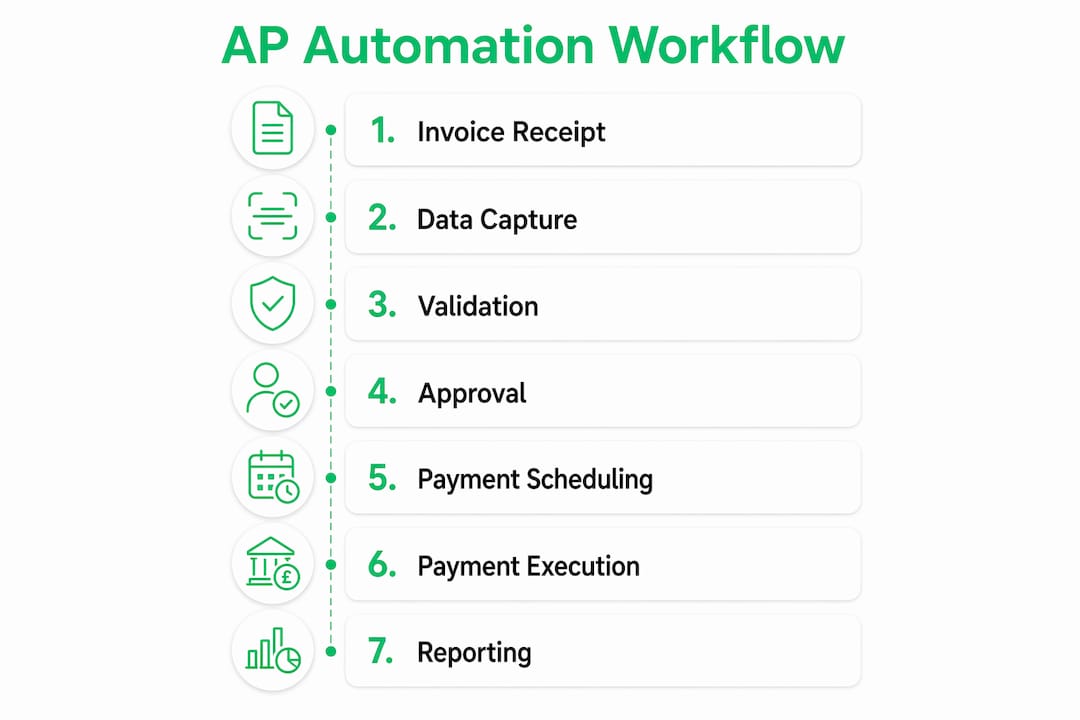
The standard AP automation workflow follows seven sequential steps, each of which can be fully or partially automated depending on the platform and the complexity of the invoice.
Step | What happens | Automation role |
1. Invoice receipt | Invoice arrives by email, supplier portal, EDI, or post | Auto-ingestion from email and portal; scanning for paper |
2. Capture and logging | Data extracted: supplier, amount, line items, VAT, due date | OCR and AI extraction; duplicate detection |
GL coding | Invoice assigned to correct general ledger account and cost centre | AI-suggested coding based on historical rules |
4. PO matching | Invoice matched against purchase order and goods receipt | Automated three-way match; exceptions flagged |
Approval routing | Invoice sent to correct approver based on amount and department | Rules-based routing; escalation for non-response |
Payment execution | Payment scheduled and released via BACS, CHAPS, or international wire | Automated payment runs with human authorisation |
Reconciliation | Payment matched to invoice; accounting system updated | Automated posting; bank feed reconciliation |
Touchless processing, where an invoice moves from receipt to payment without any human intervention, is achievable for straightforward invoices from known suppliers with clean data. In practice, many businesses achieve substantial touchless processing rates for standard invoices, with the remainder requiring human review at the exception queue stage.
The strategic value of this workflow extends beyond efficiency. Finance teams gain access to real-time spend data at every stage, enabling cash flow forecasting, supplier performance analysis, and compliance monitoring that manual processes cannot support. AP automation, at its most effective, converts the accounts payable function from a cost centre into a source of financial intelligence.
Effective AP automation systems maintain human oversight with transparent AI decision-making, where AI recommendations assist but final approval remains with people. This balance is particularly relevant for UK businesses operating under HMRC compliance requirements, where a clear record of human authorisation for payments is both good practice and a regulatory expectation.
Key takeaways
The most effective accounts payable automation strategy for UK SMEs combines AI-powered invoice capture, configurable approval workflows, and deep ERP integration, selected against actual invoice volume and process complexity rather than feature lists.
Point | Details |
Capture vs workflow layers | Identify whether you need data extraction, workflow automation, or both before evaluating any platform. |
ERP integration is critical | Integration failures with industry-specific ERPs are the most common cause of failed AP automation implementations for UK SMEs. |
Automation reduces manual entry | AP automation can reduce manual entry by up to 80%, freeing finance staff for higher-value work. |
Human oversight remains essential | Effective platforms keep AI in an advisory role, with human authorisation retained for payment execution. |
Sentientconcepts for bespoke implementation | Sentientconcepts delivers end-to-end AI implementation for finance document automation, from strategy through to managed operations. |
AP automation is moving faster than most finance teams realise
The platforms covered in this guide represent the current state of the market, but the underlying technology is shifting quickly. AI explainability, where a system can show exactly why it coded an invoice to a particular GL account or flagged a transaction as anomalous, is moving from a differentiating feature to a baseline expectation. UK finance teams operating under HMRC scrutiny and internal audit requirements will increasingly demand this transparency as a condition of adoption, not an optional extra.
What concerns me more than the technology pace is the gap between what AP automation promises and what most implementations actually deliver. The platforms are capable. The failure points are almost always in integration vetting, change management, and the assumption that software alone solves a process problem. A business that automates a broken approval workflow gets a faster broken workflow. The discipline of mapping the current process, identifying where exceptions actually accumulate, and designing the automated workflow around those realities is the work that determines whether an implementation succeeds or stalls.
The broader shift is worth naming plainly. AP automation is not primarily a cost-reduction exercise, though the cost savings are real. It is the foundation for a finance function that operates with current data rather than historical data, that can model cash positions in real time, and that contributes to commercial decisions rather than simply recording them. UK SMEs that treat AP automation as a back-office efficiency project will capture some of the value. Those that treat it as the first step in a broader finance transformation will capture most of it.
The finance professionals who will thrive in this environment are not the ones who resist automation but the ones who understand it well enough to configure it correctly, interrogate its outputs critically, and use the time it returns to do work that software cannot do.
Sentientconcepts helps UK businesses move from manual AP to intelligent automation
Most AP automation projects stall not because the software is wrong but because the implementation lacks the engineering depth to connect it properly to existing systems, data, and workflows. Sentientconcepts addresses that gap directly. As an end-to-end AI firm working across finance, manufacturing, and logistics, Sentientconcepts takes responsibility for the full project lifecycle: from AI strategy and readiness assessment through to custom solution engineering, ERP integration, and managed AI operations once the system is live.
For UK finance teams, this means bespoke intelligent document processing built around your actual invoice formats, supplier base, and approval structure, not a generic configuration applied to your data. Sentientconcepts has delivered measurable operational cost savings in finance, manufacturing, and supply chain environments, with the accountability to maintain and improve those systems over time. If your AP process is costing more than it should, in time, errors, or missed discounts, speak to Sentientconcepts about what a properly engineered automation solution looks like for your business. Get in touch to start the conversation.
Recommended
