Prevent Silent Failures: Model Retraining Strategy for MLOps Engineers
Use drift and performance triggers as the primary decision, backed by a scheduled failsafe so no model goes silent for too long. Every retrained candidate must pass automated evaluation gates and a staged rollout before it reaches production. The essential components are continuous monitoring, a clear data-selection policy, a pipeline that automates the retrain end to end, gated promotion criteria, and safe deployment. Never auto-deploy a retrain without gates.
TL;DR:
Using drift and performance triggers together ensures models are retrained promptly before significant business impact occurs.
Combining leading indicators like PSI and KS tests with lagging metrics such as SLA breaches improves trigger accuracy and reduces false alarms.
Scheduled full retrains with warm-starting are safer for most tabular models than online updates, especially when label lag complicates recent data use.
A robust pipeline requires strict artifact provenance, experiment tracking, automated validation, and staged rollout to prevent silent failures.
Reproducibility must include detailed versioning of code, data, and features, alongside lineage tracking, to enable precise audit and quick rollback.
Table of Contents
Model retraining strategy: when triggers should fire
A workable model retraining strategy rests on two kinds of signal, and confusing them is the most common mistake teams make. Leading indicators tell you the world is changing before performance drops. Lagging indicators confirm the damage has already started.
On the leading side, track feature-level distribution shift using the Population Stability Index (PSI), Jensen–Shannon divergence, or a Kolmogorov–Smirnov (KS) test against your training baseline. These metrics catch data drift in models before it shows up in business numbers. Set two bands rather than one: a warning band that triggers deeper investigation, and an action band that automatically queues a retrain.
Lagging indicators are SLA breaches on outcomes that actually matter, recall dropping below a floor, conversion rate slipping, fraud catch-rate falling. These confirm degradation but arrive later than distribution metrics.
A sensible trigger policy combines three layers:
Drift-based: PSI or KS breach on key features raises a retraining candidate
Performance-based: business metric SLA breach forces an immediate retrain
Time-based failsafe: a maximum interval (weekly or monthly) regardless of drift, so stale data never goes unnoticed
Pro Tip: Calibrate your thresholds by backtesting: inject synthetic drift into historical data and find the point where performance degradation crosses your acceptable margin, then set your action threshold there rather than guessing. Threshold defaults that many production teams use put PSI below 0.10 as stable, 0.10 to 0.25 as a warning, and above 0.25 as an action trigger, though every model needs its own calibration pass.
Choosing what data goes into the retrain
Once a trigger fires, the next decision is which data window trains the challenger model. This is where a surprising number of retraining machine learning models efforts go wrong, because the default (always retrain on everything) is rarely the right answer.
Full retrain: uses the entire historical dataset every time. Simple to reason about and reproducible, but expensive and slow to react to recent shifts. Works well for stable tabular problems with modest data volumes.
Sliding window: trains only on the most recent N days or N records, discarding older data entirely. Reacts fast to change, suits recommenders and demand forecasting, but risks catastrophic forgetting of seasonal patterns if the window is too short.
Growing window: keeps all historical data but weights recent records more heavily. A middle ground that balances stability with recency.
Incremental or online updates: the model adjusts continuously as new labelled data arrives, rather than retraining from scratch. Suited to high-velocity sequence tasks and some LLM fine-tuning pipelines, but harder to govern, audit, and roll back cleanly.
For most tabular production tasks, a scheduled full retrain with warm-starting from the previous model’s weights is safer and easier to govern than true online learning, unless you genuinely need minute-level adaptation. Label lag matters too: if outcomes take 30 days to resolve (loan defaults, churn), your lookback window must exclude the most recent 30 days of “unconfirmed” labels or you will train on incomplete ground truth. Also log the propensity scores behind any recommendation or pricing decision, otherwise your retrain learns from a feedback loop shaped by the previous model’s own choices rather than genuine user behaviour.
Building the retraining pipeline: from trigger to deployment
A production-grade pipeline follows a fixed sequence: trigger detected, data validated, features engineered, model trained, candidate evaluated, artifact registered, deployment attempted, health verified, rollback ready if needed. Skipping any step is how silent failures reach production.
Google Cloud’s MLOps framework calls the automated version of this loop continuous training (CT), and it depends on the same rigour as software CI/CD, just applied to data and models rather than code alone: automated data and model validation, metadata tracking, and reproducible triggers. Persistent metadata stores that track artifact lineage let you compare a new challenger against the exact champion it’s replacing, not an approximation of it.
Four things separate a resilient pipeline from a fragile one:
Provenance on every artifact. Tag each training run with the git SHA of the code, a hash of the dataset, and the config used, so any regression can be traced to its exact cause.
Experiment tracking. Tools like MLflow or Weights & Biases log metrics, parameters, and artifacts for every run, turning “why did this model behave differently” into a five-minute lookup instead of a two-day investigation.
Event-driven orchestration. Whether you use Airflow, Kubeflow Pipelines, or a cloud-native orchestrator, triggers should be idempotent, running the same trigger twice must not corrupt state or double-train a model.
Automated tests at every stage. Schema validation on incoming data, statistical tests on the training set, and sanity checks on model outputs before anything reaches an evaluation gate.
Your operational checklist should cover: data validation tests, model output sanity tests, artifact provenance logging, alerting on pipeline failure, an idempotent retry path, and a written runbook for what an on-call engineer does when a retrain fails at 3am. Sound orchestration design makes the difference between a pipeline that recovers itself and one that pages someone every week.
Monitoring and drift detection: what to measure
You need at least two independent drift signals running in parallel, because a single metric misses different failure modes. PSI is intuitive and widely understood but less sensitive to shape changes in the tail of a distribution. Jensen–Shannon divergence is symmetric and bounded, useful for comparing distributions of different sizes. The KS-test is strong for continuous features but weaker on categorical ones. Running all three against your feature set catches more than any one alone.
Monitor per-slice, not just in aggregate. A model that looks stable overall can be quietly failing for a specific customer segment or region, and aggregate metrics will hide that until it’s a support escalation. Track calibration too, via Expected Calibration Error (ECE), since a model can keep its accuracy while its confidence scores drift, which is dangerous for anything feeding automated decisions.
PSI band | Interpretation | Recommended action |
Below 0.10 | Stable | No action, log for trend |
0.10 to 0.25 | Warning | Investigate, prepare candidate |
Above 0.25 | Action |
For tooling, Evidently handles drift reporting well out of the box, while Prometheus and Grafana suit teams that already run infrastructure monitoring and want model metrics in the same dashboards. Cloud-native alerting (CloudWatch, Azure Monitor) works if your pipeline already lives in that ecosystem.
Safe promotion: gates, champion–challenger and rollout
No retrained model should reach production without clearing an evaluation gate, full stop. The standard pattern is champion–challenger: the new candidate is scored offline against a held-out set, alongside the current production model, on the same metrics and the same slices.
Gate rules typically combine two conditions:
Absolute minima: the challenger must clear a fixed floor (say, recall above 0.85) regardless of how the champion performs
No-regression policy: the challenger must not underperform the champion by more than a small tolerance on any critical slice, not just in aggregate
Calibration check: ECE must stay within an acceptable band, since a model can pass accuracy gates while its confidence scores are unreliable
Once a candidate clears offline gates, promotion follows a staged path: shadow (runs alongside production, no live impact), canary (serves a small percentage of real traffic), then blue-green (full swap with the old version kept warm). Rigorous offline and forward validation before any of these stages catches problems that a single train-test split would miss. Rollback should be a local copy-swap, not a fresh deployment, with an automatic trigger if smoke tests fail post-promotion. Every promotion decision gets logged with the model version, gate results, and approver, so an audit trail exists when someone asks why a specific model went live.
When retraining is worth the cost
Retraining isn’t free, compute, engineering time, and validation overhead all add up, and the decision to trigger one should weigh that cost against the cost of letting degradation continue. Estimate retraining cost in concrete terms: GPU or CPU hours for training, pipeline orchestration overhead, and the engineer time spent reviewing gate results.
Weigh that against degradation cost, which is the business metric drop translated into money: a 2-point recall drop in fraud detection has a very different price tag than the same drop in a content recommendation model. An uncertainty-based forecasting approach, sometimes called UPF, formalises this trade-off by forecasting future model performance probabilistically and comparing expected degradation cost against retraining expense, rather than retraining reflexively every time a metric wobbles.
If forecast degradation cost exceeds retraining cost, retrain now
If the model sits in a low-stakes application, lean toward the scheduled floor and skip reactive retrains for minor drift
Teams on tight budgets should focus compute on the highest-impact models first, not spread retraining evenly across every model in the portfolio
Quick playbook: an engineer’s retraining checklist
Wire up drift and performance monitoring before you need it, not after an incident
Set initial PSI/KS thresholds via backtesting, then revisit them after three months of live data
Build the minimal viable loop: trigger, validate data, train, evaluate against gates, promote or reject
Add observability and an on-call runbook for failed retrains
Stage high-risk models through shadow and canary before any full rollout
Impact of retraining on model reproducibility and versioning
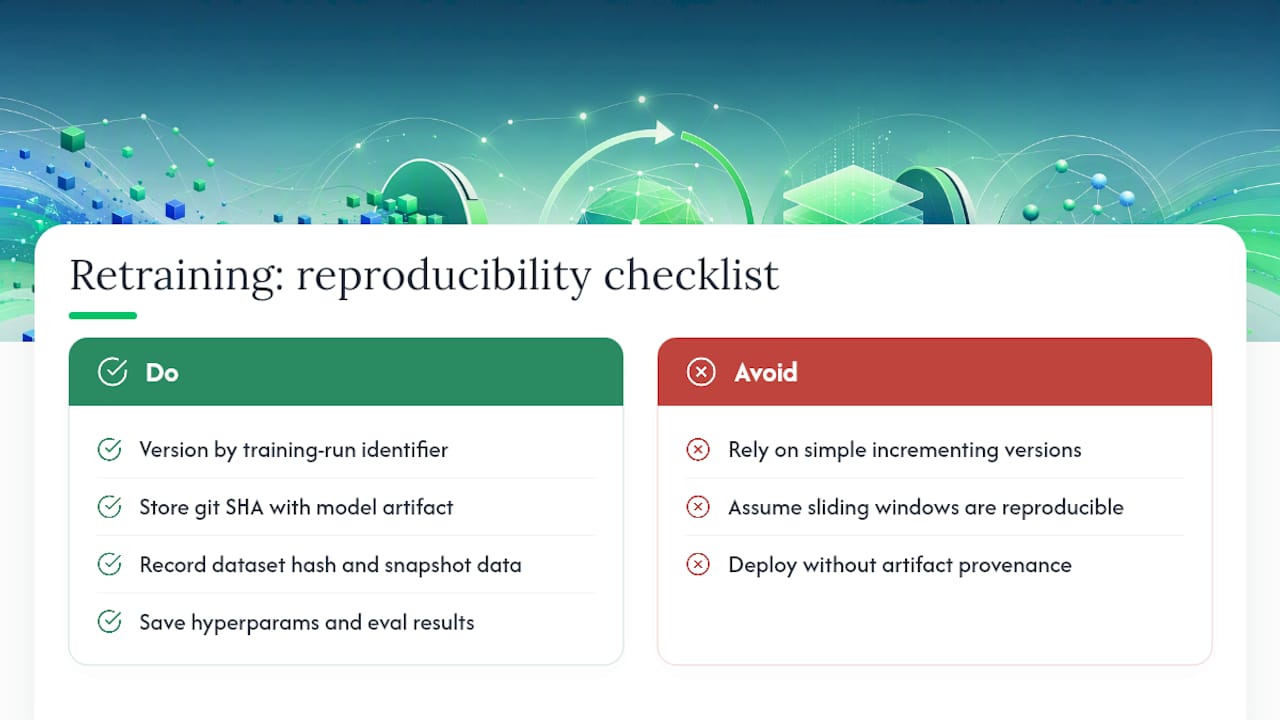
Every retrain creates a new model version, and without discipline, “which version is actually in production” becomes a question nobody can answer confidently. Reproducibility means you could rebuild the exact same model artifact from the same code, data, and configuration, and get the same result, which matters enormously when a regression needs root-causing months later.
Version each model with a semantic identifier tied to its training run, not just an incrementing number. Store the git SHA of the training code, the hash of the training dataset, the hyperparameter configuration, and the evaluation results alongside the model artifact itself. A model registry (MLflow’s registry is a common choice) gives you a single place to see every version’s lineage and promotion history.
The tension is that retraining strategies which favour recency, sliding windows, and incremental updates make exact reproducibility harder, because the training data itself is a moving target. A full retrain on a fixed historical snapshot is trivially reproducible. A sliding window that pulls “the last 30 days” produces a different dataset depending on exactly when you run it. If your retraining strategy uses a moving window, snapshot the actual data used for each run, not just the window definition, so you can reconstruct it later even if the live data has since changed or been deleted.
Versioning discipline also protects rollback. If a new model version causes a regression discovered days after deployment, you need to know precisely which artifact was serving traffic, what data trained it, and what the previous stable version was, so the swap back is immediate rather than a scramble through logs.
Managing model and data lineage during retraining
Lineage tracking answers a different question from versioning: not “what version is this” but “where did every piece of this model come from, and what depended on it downstream.” That distinction matters once a retraining pipeline runs on autopilot for months without a human checking every run.
A metadata store that logs the full chain, raw data source, transformation steps, feature engineering logic, training run, evaluation results, and deployment record, lets you trace a production issue back to its origin. TFX’s research on continuous training describes this as an artifact ontology: every object in the pipeline (dataset, model, evaluation result) is a typed node with recorded relationships to the objects before and after it, which is what makes asynchronous, event-driven retraining safe to run unattended.
Practical lineage management for a retraining pipeline needs three things. First, immutable references, once a dataset or model artifact is logged, its hash never changes, even if the underlying storage location does. Second, bidirectional traceability, you should be able to go from a production incident back to the training run, and from a training run forward to every model version it produced. Third, cross-system consistency, if your feature store, training pipeline, and model registry are separate systems, they need a shared identifier scheme, otherwise lineage breaks at every system boundary.
Maintaining an auditable promotion record, git SHA, dataset hash, and run log for every promoted model, turns lineage from an abstract good practice into something an engineer can actually query during an incident at 2am.
Handling feature store changes and schema evolution
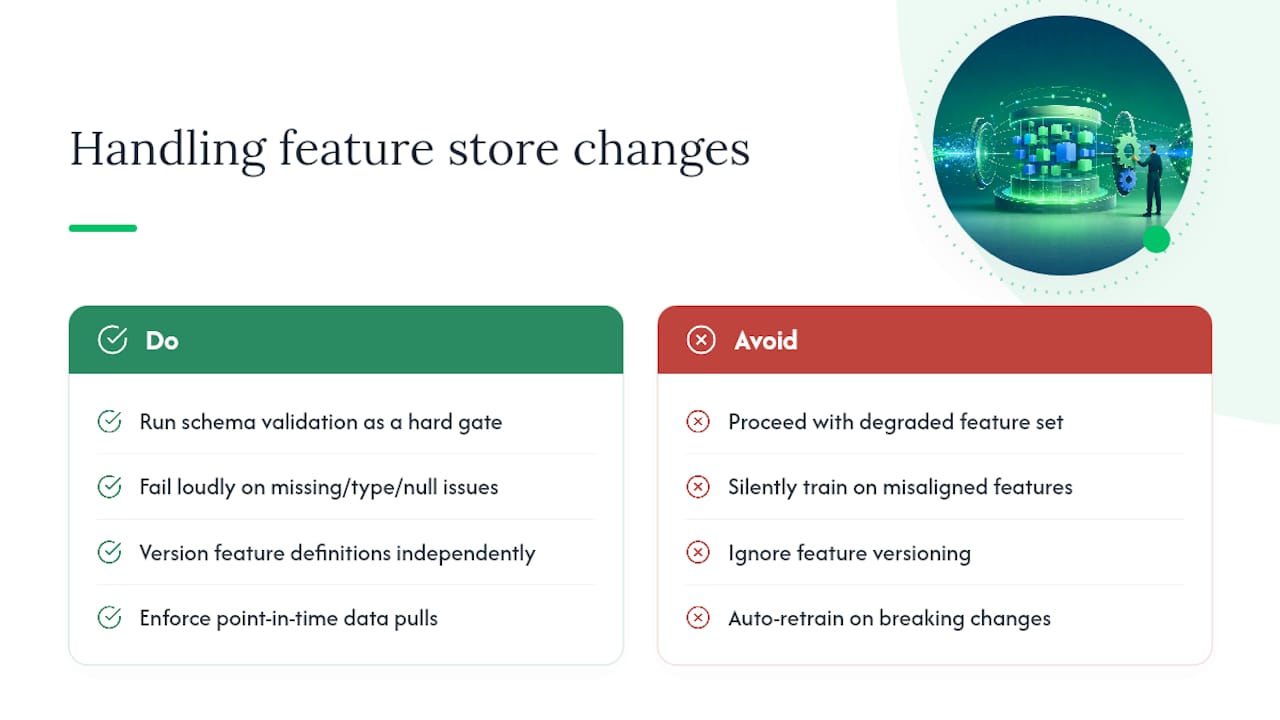
Feature stores drift too, and it’s a different problem from data drift: someone changes a feature definition, deprecates a column, or adds a new upstream source, and your retraining pipeline needs to handle that without silently training on broken or misaligned features.
Schema validation should run as a hard gate before training starts, not as an afterthought. If an expected feature is missing, has shifted type, or shows an unexpected null rate, the pipeline should fail loudly rather than proceed with a degraded feature set. This is one of the data validation steps that continuous training frameworks treat as non-negotiable, alongside statistical checks on the training data itself.
Version your feature definitions independently of your model versions. When a feature’s computation logic changes (a new business rule for calculating “customer tenure,” say), that’s a breaking change for any model trained on the old definition, and your retraining strategy needs to know which feature version each model consumed. Point-in-time correctness matters here too: if your feature store serves a value “as of” a specific timestamp, your retraining data pull must respect that same timestamp discipline, or you risk leaking future information into historical training data.
For gradual schema evolution, additive changes (new optional features) are low-risk and can flow into the next scheduled retrain without disruption. Breaking changes (renamed or removed features, changed units) should trigger a deliberate retraining cycle with explicit validation, not an automatic one, because the model architecture itself may need adjusting to accommodate the change.
Retraining in regulated and privacy-sensitive environments
Regulated sectors, finance, insurance, healthcare, add constraints that a generic retraining strategy doesn’t need to account for. The core challenge is that retraining requires fresh data, but privacy and compliance rules often restrict how that data can be accessed, combined, or retained.
Differential privacy techniques add calibrated noise during training so the resulting model can’t be reverse-engineered to reveal individual records, which matters when retraining on customer transaction or claims data. Data anonymisation and pseudonymisation before the data ever reaches the training pipeline reduces exposure further, though it can also reduce feature richness, a trade-off worth testing explicitly rather than assuming away.
Audit requirements in regulated environments mean every retraining decision needs a documented justification, not just a technical log. Why was this model retrained, what data went into it, who approved the promotion, and what evaluation results supported that approval. This is an extension of the same provenance discipline covered earlier, just with a compliance officer as an additional stakeholder in the sign-off chain.
Data retention limits also shape data-selection strategy directly. If regulation caps how long personal data can be held, a sliding-window or growing-window retraining approach may be mandatory rather than optional, because a full historical retrain simply isn’t legally available as an option. Build that constraint into your pipeline design from the start rather than discovering it after a compliance review flags a retraining job that pulled data older than the permitted retention period.
Sentient Concepts’ production perspective and proof points
Retraining pipelines fail less often from bad models than from weak governance around them. Across engagements, the recurring lesson is that data validation and clear SLA alignment between engineering and the business side prevent more incidents than any single modelling technique. Our manufacturing case study and drift detection guide walk through how that governance holds up under real production load.
— Thomas Samuel
Turning this into a working retraining pipeline
Reading about evaluation gates and champion–challenger patterns is one thing. Building a pipeline that actually runs unattended, catches drift before customers notice, and rolls back cleanly when a candidate underperforms is a different scale of problem, and most in-house teams end up rebuilding half of it twice before it’s reliable.
We design and operate these pipelines directly, rather than handing over a blueprint and stepping away. Our managed AI operations service covers the full loop: monitoring integration, pipeline delivery, evaluation gate design, and a runbook handover your team can actually run without us. For enterprise clients, that means bridging the gap between “the model works in a notebook” and “the model retrains itself safely for years.” If your current retraining setup is manual, fragile, or simply doesn’t exist yet, start with an audit of your monitoring and trigger design, then build a roadmap from there. Reach out to scope an engagement.
Sources
FAQ
How often should models be retrained?
There’s no fixed universal interval. Combine drift and performance triggers with a scheduled failsafe (commonly weekly or monthly) so a model never goes too long without review even if no trigger fires.
What’s the difference between scheduled and trigger-based retraining?
Scheduled retraining runs on a fixed calendar regardless of model health, while trigger-based retraining fires only when drift metrics like PSI or a performance SLA breach signal a real problem. Most production systems use both, with the schedule as a failsafe.
Is machine learning difficult to learn?
Machine learning has a real learning curve, particularly around statistics and the practical engineering of production pipelines, but the fundamentals of model building are accessible with structured study and consistent practice.
Can I learn machine learning in three months?
You can learn the core fundamentals and build simple models in three months with focused daily study, though skills like production retraining pipelines and MLOps typically take longer through hands-on project experience.
What are the typical steps in a machine learning workflow?
A standard workflow covers problem definition, data collection, data preparation, model training, evaluation, deployment, and monitoring, with retraining forming a continuous loop back into training once monitoring detects drift or degradation.
Recommended