RM2M Cap, TRL Ready: Malaysia AI Grants 2026 for Businesses
Six government funding routes matter for AI projects in Malaysia right now: the Malaysia Digital Acceleration Grant (MDAG-AI), the Malaysia Digital Catalyst Grant (MDCG), MOSTI’s Technology Development Fund 2, the National Technology and Innovation Sandbox (NTIS), MRANTI AI Connect, and non-dilutive financing through CapBay–MDEC. The immediate move is simple: check the MDEC or MOSTI portal for open windows and start assembling technology readiness level (TRL) evidence and collaboration letters now.
TL;DR:
MDAG-AI reimburses up to 70% of project costs, capped at RM2 million, but requires Malaysia Digital or MSC status or an active application.
MDCG supports early-stage collaboration with a 50% reimbursement or RM1 million limit, also requiring Malaysia Digital or MSC status.
Applying involves pre-screening of business registration, proof-of-concept, financials, and collaboration letters, with most funds operating on a reimbursement basis.
Acceptance into NTIS sandbox depends on validation and commercial stages, while MRANTI AI Connect facilitates industry pilots and funding support pathways.
Budget 2026 prioritizes AI grants with RM53 million allocated to MDAG and incentives for local AI training, favoring projects aligned with Malaysia-based data and workforce development.
Table of Contents
Which Malaysia AI grants are open right now?
Each programme serves a different stage of the AI journey, from raw proof-of-concept to full commercial rollout, and matching the right one to your project stage matters more than chasing the biggest headline figure.
MDAG-AI (MDEC): Reimburses up to 70% of eligible project costs, capped at RM2 million. Open to Malaysia Digital or MSC Malaysia status companies, or those with an active MD application. Projects typically run 12 months and suit firms moving from pilot to deployment.
MDCG (MDEC): Backs co-creation and commercialisation work, reimbursing up to 50% of costs or RM1 million for locally owned companies over a similar 12 month window. It sits a notch below MDAG-AI in scale but is friendlier to earlier-stage collaboration projects.
TeD 2 (MOSTI): Funds experimental development towards commercialisation. Applicants must be registered in Malaysia with a working proof-of-concept, and SMEs commonly contribute a share of project costs themselves rather than receiving full reimbursement.
NTIS funding tracks: Offer convertible grants and matching funding across validation and commercialisation stages, once accepted into the sandbox itself. Acceptance is the gating step, not the money.
MRANTI AI Connect: Not a grant in the strict sense, but a staged pathway through Studio, Exchange and Ventures that matches companies to industry pilots and fund-raising support.
MD Technology Financing Programme (CapBay–MDEC): Non-dilutive financing rather than a grant, useful when reimbursement timing leaves a cashflow gap.
MDAG-AI and MDCG both require Malaysia Digital or MSC status, or an application already in progress; TeD 2 and NTIS focus more heavily on proof-of-concept validation before commercial scaling begins.
Who can apply and what documents do you need?
Eligibility screening trips up more applicants than the technical review does, largely because paperwork gets treated as an afterthought.
Most programmes require SSM incorporation in Malaysia, evidence of Malaysian ownership or operations, and, for MDAG-AI and MDCG specifically, Malaysia Digital or MSC status (or a live application). Some funds set minimum paid-up capital thresholds, so confirm this against the exact grant you’re targeting rather than assuming a blanket rule.
Assemble these before you start the form, not after:
Proof-of-concept or working prototype evidence, ideally with test data
Recent financial statements and cash flow projections
CVs of key technical and commercial personnel
Letters of Award (LoAs) or collaboration letters from end-user partners or research institutions
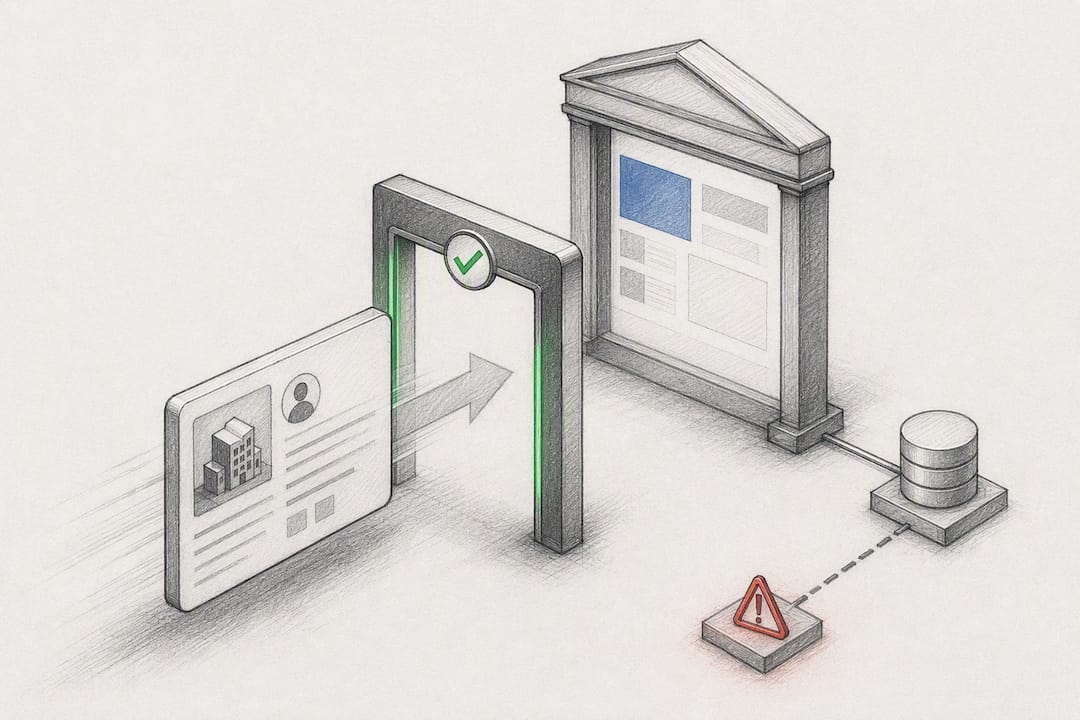
The three disqualifiers that recur most often: no verifiable SSM digital presence, no clear evidence of Malaysian-based operations, and unresolved clawbacks or non-compliance from a previous grant.
Pro Tip: Pull your SSM company profile and check it renders correctly on the relevant government portal weeks before you apply. A stale or unlinked SSM record is one of the most common, and most avoidable, reasons pre-screening rejects an otherwise strong application.
How do you apply and what happens after approval?
The mechanics differ slightly between MDEC, MOSTI, and NTIS, but the shape of the process is consistent across all three.
Start at the official portal. MDEC hosts MDAG-AI and MDCG, MOSTI administers TeD 2, and NTIS runs its own sandbox application.
Clear pre-screening. This checks SSM digital presence, MD/MSC status where required, and basic document completeness.
Pitch or technical assessment. Reviewers evaluate technical feasibility, commercial potential, and TRL positioning; some programmes involve a live pitch session.
Approval and offer letter. Terms, funding cap, and reporting obligations are confirmed in writing.
Claims and reimbursement. Most grants operate on a reimbursement basis, meaning you spend first and claim against receipts and milestones, rather than receiving funds up front.
Reimbursement-based grants demand tight financial discipline. Build audit-ready documentation and clear KPIs into your project plan from day one, since incomplete claims are the single biggest cause of delayed payouts once a grant is approved.
How do you build a genuinely competitive application?
Assessors are looking for evidence of progression, not ambition. Map your project against technology readiness levels and state a concrete deliverable for each stage: validation, pilot, and commercialisation. A vague roadmap reads as unfinished thinking, even when the underlying technology is sound.
Secure at least one end-user partner or industry pilot, and attach LoAs or a test plan that shows real commercial traction, not just interest.
Detail your budget line by line, state who owns the resulting IP, and address data governance compliance explicitly rather than in passing.
Include a short, realistic commercialisation or monetisation roadmap covering the 12 to 24 months after grant completion.
Use ecosystem pathways like MRANTI AI Connect or NTIS acceptance to build technical credibility. Insiders note these routes often act as a practical gateway to larger grants, because they generate verifiable pilots and end-user matchings that assessors prize.
Pro Tip: Reviewers read dozens of applications with identical buzzwords. A one-page technical annexe showing your actual architecture, data flow, and TRL milestone dates does more to convince a panel than three extra pages of market sizing.
What non-dilutive financing complements a grant?
Grants rarely cover everything, and reimbursement timing can leave a gap between spending and being paid back. The MD Technology Financing Programme from CapBay and MDEC offers facilities up to RM3 million to eligible MD-status companies, backed by a RM200 million pool, with digital applications and rates reported from around 6% per annum.
NTIS also runs convertible or hybrid grant mechanisms through corporate partners, which can shift between grant and equity-linked terms depending on the deal structure.
Asset-light AI firms that lack traditional collateral often find CapBay’s credit assessment model more accessible than a conventional bank facility.
Choose financing over waiting on grant disbursement when a signed pilot or client contract needs bridging capital now, not in six months.
How does Budget 2026 shape AI grant priorities?
Belanjawan MADANI 2026 allocates RM53 million specifically to the Malaysia Digital Acceleration Grant, alongside a proposed RM2 billion Sovereign AI Cloud initiative, and a 50% additional tax deduction for MSMEs running accredited AI and cybersecurity training; this reflects regional policy trends highlighted in the Singapore Budget 2026 for businesses, innovators & talent. Together, these signal where panels are likely to focus attention through the year.
The national strategy now pairs direct grants with large infrastructure investment and tax incentives. Panels increasingly favour applications that demonstrate genuine alignment with data sovereignty goals and workforce upskilling, rather than AI adoption for its own sake.
In practice, this means your application should reference how the project uses Malaysia-based data infrastructure or contributes to local AI capability, without inflating the claim beyond what the project actually does. Assessors notice the difference between alignment and decoration.
Why grant readiness needs the right technical partner
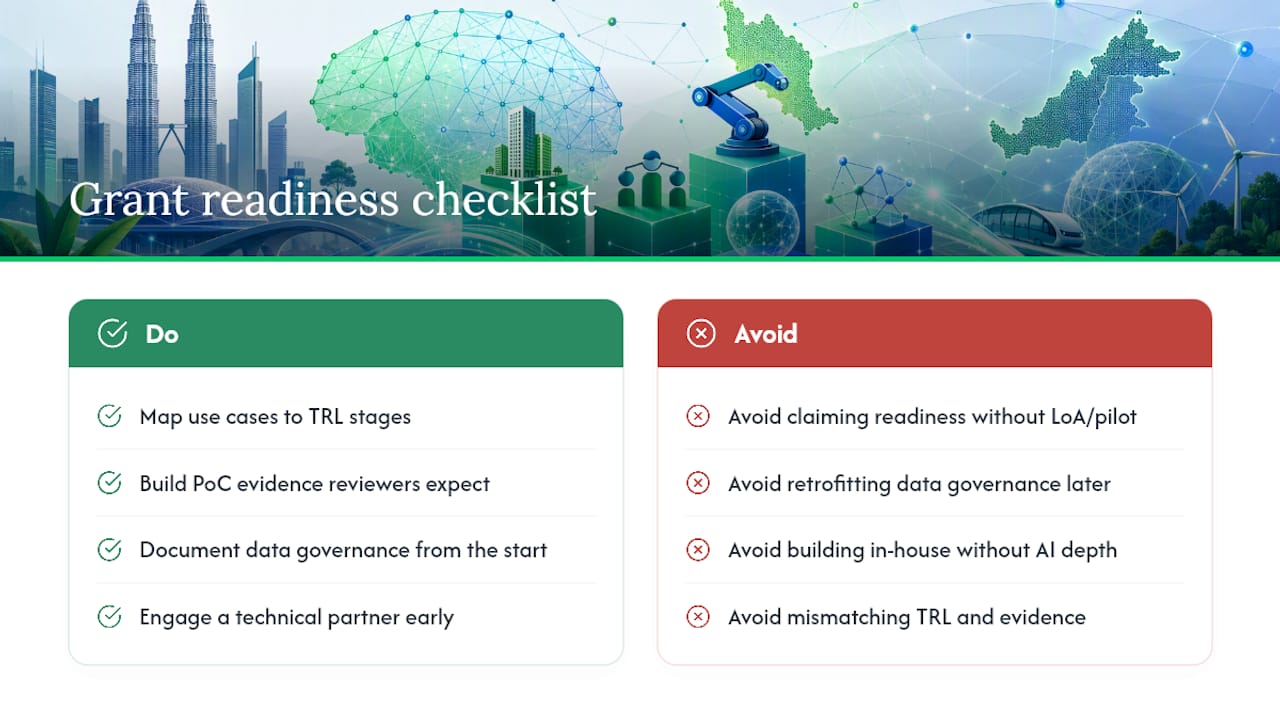
Grant panels reward measurable milestones, not intentions. Sentient Concepts approaches every AI project the same way a grant assessor reads one: by mapping use cases to TRL stages, building the proof-of-concept evidence reviewers expect, and documenting data governance from the start rather than retrofitting it after a rejection letter arrives.
The most common weakness seen in applications is a mismatch between the stated TRL and the actual evidence attached. A pitch describing “commercialisation readiness” with no LoA or pilot data undermines its own credibility before a reviewer reaches the budget page. Building in-house works when a team already has AI engineering depth; bringing in a practical guide to the AI project lifecycle or outside support makes more sense when the gap is technical execution rather than strategic direction.
— Thomas Samuel
Get your AI project grant-ready with Sentient Concepts
An alternative to building a grant application from scratch with no technical proof behind it is to prepare a working prototype, a documented data architecture, and a TRL-mapped roadmap that reviewers can actually verify.
The services that matter most for grant success sit across the project lifecycle: an AI strategy and roadmap engagement that frames your use case in TRL terms from the outset, product and application development to build the proof-of-concept evidence assessors want to see, and data and platform engineering that satisfies the governance questions panels now ask routinely. Each of these reduces the risk of a rejected pre-screening or a stalled claim later in the project. For finance, manufacturing, and logistics leaders weighing whether to pursue MDAG-AI, TeD 2, or an NTIS track this year, the practical next step is a conversation about which of your existing AI use cases is closest to grant-ready.
Where to check current terms and deadlines
Programme terms, funding caps, and application windows change, so verify details on the official portal before you apply.
MDAG-AI and MDCG — MDEC
TeD 2 guidance — MOSTI
Sources
FAQ
What Is the Maximum Funding Under MDAG-AI?
MDAG-AI reimburses up to 70% of eligible project costs, capped at RM2 million per project, for Malaysia Digital or MSC status companies.
Do I Need MD Status Before Applying?
For MDAG-AI and MDCG, you need Malaysia Digital or MSC Malaysia status, or an active application already in progress; TeD 2 and NTIS have separate eligibility routes that don’t require MD status.
How Long Does Grant Approval Typically Take?
Timelines vary by programme, but expect submission, pre-screening, a pitch or technical assessment, and final approval to unfold in stages rather than as a single decision point.
Can Startups Access Non-Dilutive Financing Instead of Grants?
Yes. The MD Technology Financing Programme from CapBay and MDEC offers facilities up to RM3 million to eligible MD-status companies without giving up equity.
Does Budget 2026 Add New AI Funding?
Yes. Belanjawan MADANI 2026 allocates RM53 million to MDAG and introduces a 50% additional tax deduction for MSMEs undertaking accredited AI training.
Recommended