Cut AI project costs 2–6x: 2026 benchmarks and an estimator
Most AI projects fall within a wide cost range, from lower cost solutions like narrow chatbot deployments to higher expenses for enterprise-grade multi-agent platforms, with mid-tier projects such as document automation or predictive analytics typically costing a moderate amount dependent on data readiness. Where your project sits inside that range depends less on ambition than on data readiness: unlabelled, scattered, or inconsistent data pushes any project toward the top of its tier. Before committing to a build, a paid discovery sprint of two to four weeks will tell you which bracket you are actually in.
TL;DR:
Data readiness critically influences project costs, with unstructured or poorly labeled data driving expenses toward the higher end of the budget range.
Most mid-tier projects cost between $95,000 and $130,000 for build, with ongoing monthly operational costs typically between $4,000 and $8,000 once the system is live.
Conducting a paid discovery sprint of two to four weeks before the build can significantly improve schedule predictability and prevent scope-related budget overruns.
Hiring a skilled, well-rounded team—including a solutions architect, ML engineers, and data engineers—also shapes project costs and quality, especially during integration tasks.
Regulatory compliance, data privacy measures, and inference optimization techniques can add substantial costs, but proper planning helps mitigate overruns.
Table of Contents
What determines ai project costs at each complexity tier?
Cost tiers map fairly predictably to what the system needs to do and how much of your existing data it can rely on. Three tiers cover almost every commercial AI initiative that Sentient Concepts encounters across finance, manufacturing, logistics, and insurance.
Entry-level projects typically involve a single-purpose chatbot, a rules-plus-AI document classifier, or a small retrieval-augmented generation (RAG) tool answering questions against a defined document set and usually come with lower-range costs. These run on off-the-shelf APIs, need minimal fine-tuning, and usually ship in four to eight weeks with a team of two to three people.
Mid-complexity projects cover most enterprise client needs, such as document Q&A systems trained on internal knowledge bases, computer vision models for defect detection, and conversational agents integrating with CRM or claims systems, typically involving moderate budgets. Timelines run three to six months with four to seven specialists involved, including at least one data engineer and one integration developer.
Enterprise and multi-agent platforms involve custom model training, multiple integrated agents handling workflow stages, and infrastructure for high-volume, low-latency inference, often reaching high budget levels. Timelines stretch to six to twelve months or longer, with teams of eight or more spanning ML engineering, MLOps, data governance, and solution architecture.
Rough benchmarks by project type indicate costs vary widely depending on complexity and features, with simpler chatbots and FAQ assistants taking less time and budget, and multi-agent enterprise platforms requiring significantly more investment and longer timelines.
Third-party benchmarking from Keyhole Software shows similarly wide spreads, with quoted project totals ranging from low five figures to millions depending entirely on scope and data maturity.
What actually drives the budget line by line?
Four cost categories account for almost all the variance between a $50,000 project and a $250,000 one: data readiness, model approach, integration complexity, and talent mix.
Data preparation and labelling is the single most underestimated line item. Projects starting with clean, structured, well-labelled data can move straight into model work.
Model complexity scales cost in a fairly predictable staircase. Calling a third-party API costs the least, fine-tuning an existing foundation model on your data costs more, and training a custom model from scratch costs the most by a wide margin. CloudZero’s cost analysis puts SaaS/API setup at low five figures, while custom training and dedicated infrastructure scale into high five and six figures depending on compute needs and data volume.
Integration work is where budgets quietly balloon. Connecting a model to a CRM, ERP, or claims platform involves building and testing data pipelines, handling authentication and permissions, and validating edge cases where the source system’s data doesn’t match what the model expects.
Talent mix shapes both quality and cost. A typical mid-tier project team includes:
A solutions architect or technical lead (oversight, architecture decisions)
One or two ML engineers (model selection, training, evaluation)
A data engineer (pipeline construction, labelling coordination)
An integration developer (connecting the model to existing systems)
A project manager (scope, timeline, stakeholder communication)
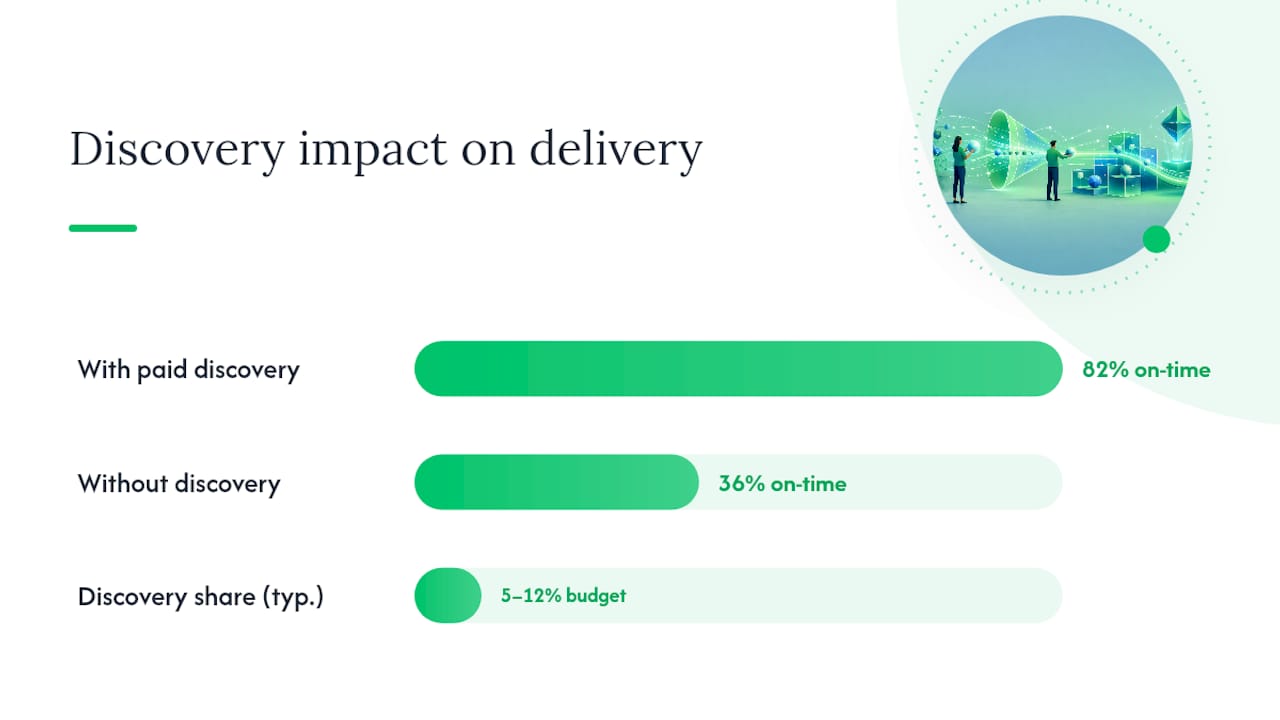
Statistic Callout: Discovery sprints run before full build kick-off show measurable delivery advantages. Projects that began with a paid two to four week discovery phase hit an 82% on-schedule delivery rate, against just 36% for projects that skipped discovery entirely, according to the Pharos Production Research Report. Discovery itself typically runs 5% to 12% of total project budget.
Hosting and inference choices round out the picture. Cloud API calls scale with usage and require no infrastructure investment, while self-hosted models demand upfront GPU or specialised compute spend but lower marginal cost per request at high volume. Which one wins depends on your expected transaction volume, a calculation worth doing before, not after, you commit to an architecture.
Should you buy, fine-tune, or build custom AI?
Three delivery paths exist for almost every AI use case, and choosing the wrong one is the most common way businesses overspend.
SaaS or API integration. You call an existing foundation model (OpenAI, Anthropic, or similar) through an API and build a thin application layer around it. This is the fastest and cheapest route, and it fits use cases where your workflow doesn’t require proprietary training data or unusual domain logic. Hidden costs here are usage-based: per-token or per-call pricing that grows with volume, and vendor lock-in if your workflow becomes deeply dependent on one provider’s quirks.
Fine-tuning an existing model. You take a pretrained model and adjust it on your own labelled data, improving accuracy on domain-specific tasks (industry terminology, document formats, decision logic) without the cost of training from scratch. This is the sensible middle path for most enterprise use cases, balancing cost against performance.
Custom model development. You train a model from the ground up on proprietary data and infrastructure. This is justified only when your data or workflow is genuinely unique enough that no existing model or fine-tune could match it, and the cost premium is often several multiples of the fine-tuning route.
The hidden costs of buying show up as usage bills that creep upward with adoption; the hidden costs of building show up as engineering time, hiring, and the opportunity cost of a longer runway to value. CloudZero’s guidance is blunt on this point: for most organisations, buying or fine-tuning is the faster, lower-risk path to value, and custom training earns its cost premium only when proprietary data truly demands it.
A short decision checklist helps here: does your use case involve genuinely proprietary data or logic? Is your expected volume high enough that per-call API pricing would exceed the cost of self-hosting? Does your team have (or can it hire) the ML engineering capacity to maintain a custom model long-term? If the answer to all three is no, buy or fine-tune. Our own build versus buy guide walks through this decision in more depth for enterprise buyers weighing the trade-offs.
What does an AI system actually cost to run after launch?
Initial build cost is only part of the bill. Recurring operational spend, covering inference, monitoring, retraining, and prompt maintenance, commonly adds a substantial and often underestimated burden to first-year totals. Research from the Pharos Production Research Report finds these hidden operational costs represent roughly 15% to 40% of first-year spend, with some projects seeing hidden costs climb to 28% to 42% of the total.
The recurring cost lines to plan for:
Inference costs, the per-request charge for running the model in production, which scales directly with usage volume
Monitoring and observability tooling, tracking accuracy drift, latency, and failure rates in real time
Retraining and fine-tuning cycles, refreshing the model as your data or business context shifts
Prompt maintenance, adjusting prompts and guardrails as edge cases surface in production
Support and incident response, staff time spent triaging failures and unexpected outputs
For a rough sense of scale: light workloads have relatively low monthly inference and monitoring costs, moderate workloads have higher costs, and heavy enterprise workloads with significant query volumes and multiple integrated agents experience substantial monthly operational expenses before accounting for retraining cycles.
Inference itself deserves particular attention. CloudZero’s analysis documents that inference commonly becomes the dominant ongoing expense in production, sometimes overtaking the entire initial build cost within months of launch if left unmanaged. The good news: optimisation levers exist. Model routing (sending simple queries to cheaper, smaller models and reserving expensive models for complex ones), compression, and batching techniques can cut inference spend by a factor of two to six in practice, based on the same analysis.
Pro Tip: *Budget operational spend as a fixed percentage of your initial build cost from day one, not as an afterthought once the bill arrives.
A hybrid hosting strategy, mixing pay-per-call APIs for unpredictable workloads with self-hosted infrastructure for high-volume, predictable ones, often gives the best balance between flexibility and recurring cost control. Tools like Cost Beacon exist specifically to give finance and engineering teams visibility into where cloud and inference spend is actually going, which is worth having before you optimise blind. Our guide on cutting GenAI inference costs covers the specific routing and compression techniques in more detail.
How do you build a defensible AI project budget?
A repeatable three-phase structure turns a vague cost estimate into something you can defend to a finance director or put into an RFP with confidence.
Discovery (typically 5% to 12% of total budget): scope the use case precisely, audit your existing data for readiness gaps, and map integration points with existing systems. This phase alone determines whether your later estimates are realistic or fantasy.
Build (typically 55% to 70% of total budget): engineering hours for data preparation, model selection or training, application development, and integration testing. Size this by estimating hours per role, then multiplying by your local or benchmark hourly rate; Keyhole Software’s rate comparisons are a reasonable external anchor if you lack your own benchmarks.
Run (typically 20% to 35% of first-year budget): inference, monitoring, retraining, and support, calculated as an ongoing monthly or annual line rather than a one-off.
A worked example for a mid-complexity RAG document Q&A system: discovery runs three weeks at roughly $8,000. Build involves a solutions architect (80 hours), one ML engineer (240 hours), one data engineer (180 hours for labelling and pipeline work), and one integration developer (120 hours), which at blended enterprise consulting rates lands the build phase around $95,000 to $130,000. Run costs for a medium workload settle around $4,000 to $8,000 monthly once live. Total first-year cost, build plus nine months of operations, lands somewhere near $140,000 to $190,000.
Statistic Callout: Gartner’s research found that a substantial share of generative AI projects are abandoned after proof of concept, largely because scope was never properly validated against data reality before the build phase began. A rigorous discovery phase is the single best defence against becoming part of that statistic.
Contingency deserves its own line rather than a vague buffer. When scoping vendors, ask directly: what does your discovery phase actually produce, how is scope creep priced once build begins, and what does the ops handover look like once the initial contract ends? Our AI project lifecycle guide breaks down team roles and phase timing in more granular detail for project managers building their own RFPs. On the accounting side, EisnerAmper’s guidance on US GAAP treatment is a useful starting point if your finance team needs to decide whether development costs get capitalised or expensed, though local accounting rules should always be checked before assuming a US framework applies.
What do real AI cost-optimisation results actually look like?
Two case patterns illustrate where the money actually goes:
Corrosion detection for manufacturing: the dominant cost was computer vision model training and labelling of defect imagery, not the eventual deployment infrastructure, which is a common pattern in industrial computer vision work.
Supplier document automation for finance and manufacturing clients: integration into existing ERP and document management systems consumed the largest share of build cost, more than the document classification models themselves.
In both cases, running a discovery sprint before full build kept schedule predictability high and avoided the scope surprises that typically inflate mid-project budgets. Managed operations after launch, rather than a one-off handover, kept total cost of ownership lower over the following year by catching model drift and inference inefficiency before they compounded. Readers scoping a similar project can review the supplier document automation approach or the enterprise AI strategy playbook for more detail on how these engagements are typically structured.
How do compliance requirements change AI project costs?
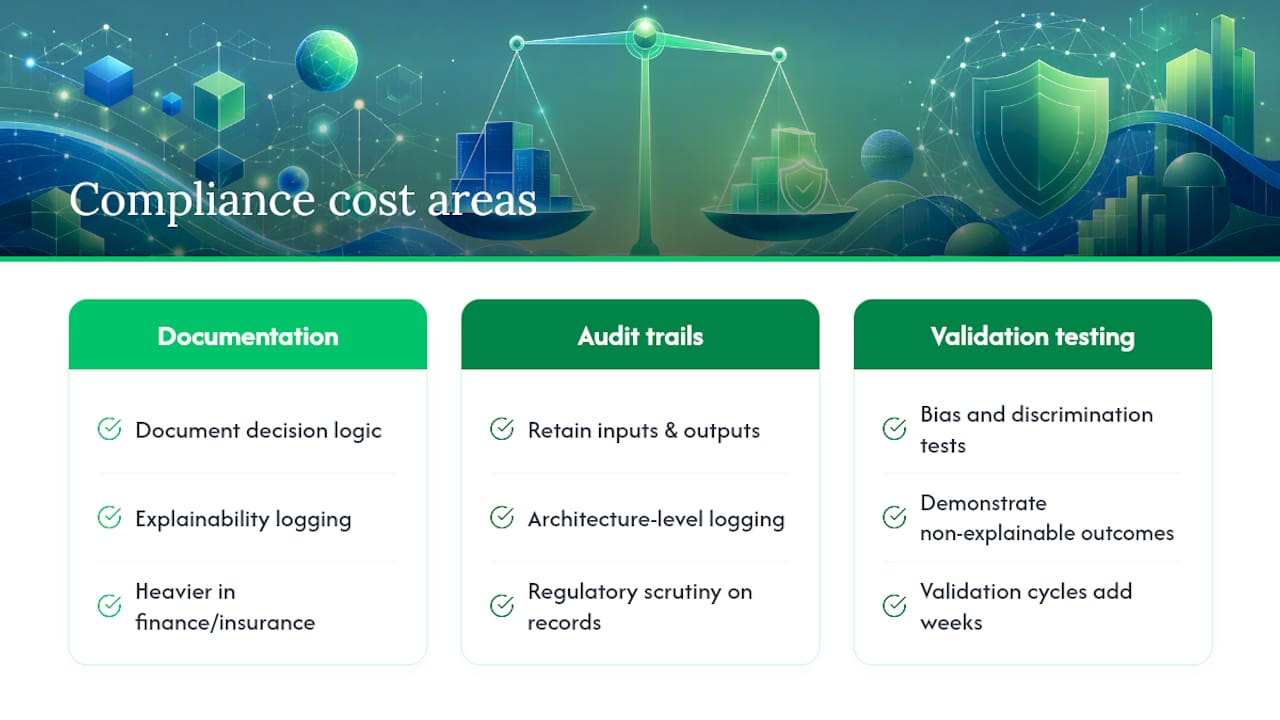
Regulatory obligations add cost in three specific places: model documentation, audit trails, and validation testing. Financial services and insurance clients in particular face requirements to document how a model reaches a decision, retain audit trails of inputs and outputs, and demonstrate the system doesn’t produce discriminatory or unexplainable outcomes.
A conversational agent handling loan pre-screening, for example, needs explainability logging and bias testing baked into the architecture from day one, not bolted on after a compliance review flags a gap.
Compliance costs also extend the timeline. Validation cycles, sign-off from legal and compliance teams, and documentation reviews add weeks that a purely technical project wouldn’t need. Budgeting for this explicitly, rather than treating it as a surprise delay, is the difference between a project that lands on schedule and one that stalls in review. Industries like insurance, where agentic AI is increasingly used in underwriting, face particularly heavy documentation and audit-trail requirements given the regulatory scrutiny around automated decision-making in claims and policy issuance. Where the model touches a decision affecting a customer’s finances or coverage, budget compliance work as a defined phase, not a contingency line.
How much does data privacy add to an AI project budget?
Projects handling personally identifiable information, financial records, or health data need additional engineering time to strip or mask sensitive fields before they reach a model, and often need separate, more restrictive environments for training versus production data. This isn’t optional scope. It’s foundational architecture that needs deciding before build starts, because retrofitting privacy controls into a system already handling live data is considerably more expensive than designing them in from the outset.
Security audits before launch, particularly for systems integrated with core banking, claims, or ERP platforms, add both cost and time. Expect a dedicated security review cycle of two to four weeks for any system touching sensitive customer data, plus the engineering time to remediate whatever the audit finds. Encryption at rest and in transit, role-based access controls, and logging of who accessed what data and when are standard requirements for finance and insurance clients specifically, and all three need to be priced into the build phase rather than assumed as a given. Projects that skip this step in early planning tend to discover the cost later anyway, just at a less convenient point in the timeline.
Why do NLP and computer vision projects carry different cost risks?
Natural language processing (NLP) and computer vision projects fail in different ways, and the cost risk profile for each reflects that.
NLP projects, chatbots, document Q&A, conversational agents, tend to carry risk around ambiguity and edge cases in language. Multilingual requirements compound this significantly, since each additional language often needs its own validation and tuning pass.
Computer vision projects, defect detection, corrosion identification, document image classification, carry a different risk: data volume and labelling cost. Vision models typically need far larger labelled datasets than NLP tasks to reach acceptable accuracy, and labelling images (especially specialised industrial imagery) requires domain expertise that’s expensive and slow to source. A corrosion detection model, for instance, needs labelled examples reviewed by someone who actually understands what corrosion looks like at different stages, not a generic annotation contractor.
Multi-agent platforms combine both risk profiles and add a third: coordination failures between agents, where the cost of debugging why two AI systems disagree or duplicate work can quietly consume weeks of engineering time that never appears in an initial estimate.
Author’s perspective: what actually keeps AI budgets on track
The businesses that keep AI projects on budget in 2026 aren’t the ones with the biggest contingency lines. They’re the ones that pay for discovery and operations planning before writing a single line of code, because that’s where the real cost variance lives, not in engineering hours. Data readiness and integration scoping deserve more budget attention than model selection gets in most conversations I encounter, simply because they’re where projects quietly blow past their original estimate. My advice on vendor selection is unglamorous but effective: choose the partner who asks harder questions during discovery, not the one with the lowest headline quote. The quote that looks cheapest at the proposal stage is rarely the number you actually pay by month six.
— Thomas Samuel
How Sentient Concepts helps you plan and control AI costs
Sentient Concepts runs paid discovery sprints that audit your data, scope integration points, and produce a defensible cost estimate before you sign off on a full engagement, then stays accountable through build and into managed operations rather than handing off and disappearing.
That continuity matters most in the months after launch, when inference costs and model drift start eating into ROI if nobody is watching. Clients typically come for document automation, conversational agents, and predictive analytics builds, and the outcomes to expect are lower operational cost within the first quarter and a schedule that doesn’t slip halfway through. If you want a realistic number before you commit budget, book a discovery sprint through our AI strategy and roadmap service or explore how managed AI operations keeps recurring spend under control once your system is live.
Sources
Cost benchmarks and inference trends draw on CloudZero’s 2026 AI cost guide and Pharos’s production research report. Delivery risk figures come from Gartner, ROI validation from Microsoft, and accounting treatment from EisnerAmper. For project structuring, see our AI project lifecycle guide.
FAQ
Why do 95% of AI projects fail?
Most failures trace back to scope that was never validated against real data before build began, not to model quality. Gartner’s research found a substantial share of generative AI projects are abandoned after proof of concept, largely because the data or workflow assumptions made at the start didn’t hold up in practice.
How expensive is it to build an AI system?
Costs vary widely by project type, from lower cost solutions like simple chatbot deployments to higher expenses for enterprise multi-agent platforms, with mid-tier projects such as document automation or predictive analytics typically costing a moderate amount dependent on data readiness.
How much does AI actually cost per month to run?
Ongoing costs depend heavily on workload, with light workloads incurring relatively low monthly inference and monitoring expenses, moderate workloads costing more, and heavy enterprise deployments facing substantial monthly operational expenses mainly driven by inference volume and model complexity.
Is it cheaper to buy an AI solution or build one?
Buying or fine-tuning an existing model is almost always cheaper and faster than custom training, and CloudZero’s analysis shows SaaS/API setup starting at low five figures against high five and six figures for custom-trained systems.
Recommended