UK AI governance framework: a guide for 2026

The UK’s AI governance framework is a structured system of policies, decision rights, technical controls, and oversight mechanisms designed to manage the entire AI lifecycle, from initial design through to live deployment and continuous monitoring. It is not a single piece of legislation but a coordinated architecture spanning multiple regulatory bodies, government departments, and sector-specific guidance. The core components include:
Policy development and risk assessment
Compliance alignment and technical controls
Ethical guidelines and human oversight mechanisms
Continuous lifecycle monitoring and accountability structures
The Department for Science, Innovation and Technology and the Office for Artificial Intelligence provide central leadership, coordinating governance across regulators and industry. The framework integrates regulatory principles directly into operational practice, with accountability built in at every stage rather than applied retrospectively. For UK professionals and policymakers, understanding this architecture is the starting point for any credible AI deployment.
What are the core regulatory principles underpinning UK AI governance?
The UK Government has adopted five foundational AI principles: accountability, transparency, fairness, security, and a risk-based approach to regulation. These principles do not operate in isolation. They are designed to work together, with each reinforcing the others across the full AI lifecycle.

A risk-based approach is the structural backbone. It classifies AI applications by impact level, applying proportionate governance controls rather than blanket rules. High-impact systems in healthcare or financial services face more rigorous scrutiny than low-risk administrative tools. Transparency and accountability then operate within that risk-tiered structure, requiring organisations to document decisions, maintain audit trails, and demonstrate that human oversight is genuinely embedded.
Fairness and data privacy sit alongside these principles, requiring that AI systems avoid discriminatory outputs and handle personal data in line with UK GDPR obligations. The ISO/IEC 42001:2023 standard offers a global AI management system framework that informs UK governance design and provides a recognised benchmark for demonstrating due diligence to regulators and clients alike.
How do UK regulators put AI governance principles into practice?
UK regulators implement AI governance through sector-specific guidelines, compliance monitoring, and coordinated enforcement, rather than through a single centralised authority. The Financial Conduct Authority, the Medicines and Healthcare products Regulatory Agency, and the Information Commissioner’s Office each apply the five core principles within their own regulatory remit.
Practical implementation tools include:
Sector-specific guidance documents and codes of practice
Compliance reviews and model audits
Enforcement actions for material breaches
Cross-regulator coordination forums led by the Department for Science, Innovation and Technology
In financial services, the FCA’s guidance on model risk management requires firms to document AI model assumptions, validate outputs against real-world performance, and maintain clear escalation procedures when a model behaves unexpectedly. In healthcare, the MHRA applies conformity assessment processes to AI-enabled medical devices, with post-market surveillance requirements that mirror the continuous monitoring expectations of the broader governance framework.
Pro Tip: Map your AI systems against the relevant sector regulator’s published guidance before conducting an internal compliance review. The FCA, ICO, and MHRA each publish specific AI-related expectations that go beyond the cross-sector principles.
Accountability and escalation procedures are explicit requirements, not implied expectations. Organisations must define who is responsible for each AI system, what triggers a review, and how non-compliance is reported upward. The numbered steps below reflect the standard escalation sequence most UK regulators expect:
Identify the accountable owner for each deployed AI system.
Define risk thresholds that trigger a formal review.
Document the review outcome and corrective action taken.
Report material failures to the relevant sector regulator within the prescribed timeframe.
Update the model governance policy to reflect lessons learned.
How does the UK government’s pro-innovation AI policy work in practice?
The UK government’s AI regulation policy is explicitly outcome-focused and future-proof, designed to support emerging technologies without locking in rules that become obsolete as the technology evolves. The approach delegates regulatory responsibility to existing sector bodies rather than creating a new AI-specific regulator, which keeps compliance pathways familiar for industry while preserving flexibility.
| Policy milestone | Significance | |—|—|—| | National AI Strategy published | Set a long-term ambition for AI leadership | | Pro-Innovation AI Regulation White Paper | Established five cross-sector principles | | AI Safety Institute launched | Created frontier AI evaluation capability | | Implementing Regulatory Principles guidance | Directed regulators on practical application | | AI Opportunities Action Plan | Committed to accelerating public sector AI adoption |
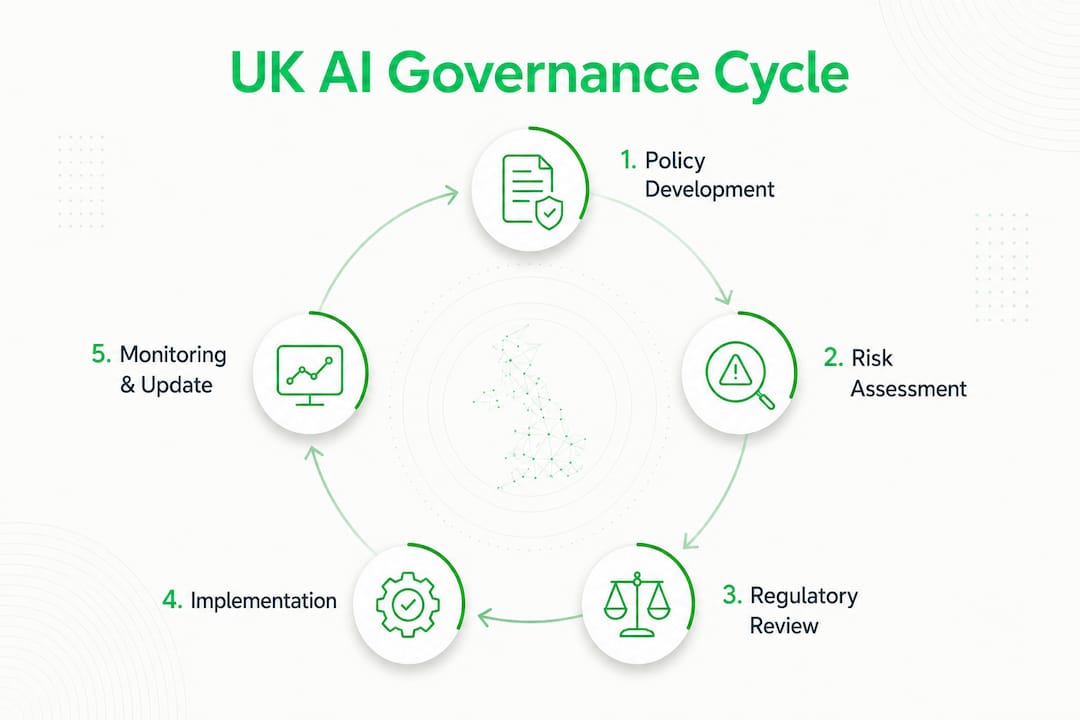
The government’s planned regulatory reviews follow a structured cycle, with regulators expected to report on their implementation progress and identify gaps where existing powers are insufficient. The numbered sequence below reflects the intended policy update cycle:
Regulators publish implementation reports against the five principles.
The Department for Science, Innovation and Technology reviews cross-sector consistency.
Government consults on whether primary legislation is required to address identified gaps.
Updated guidance or legislation is issued, with industry consultation built in.
This cycle is designed to keep the framework adaptive. The deliberate avoidance of prescriptive legislation means the government can respond to developments in generative AI, agentic systems, and frontier models without requiring parliamentary time for every update.
What challenges shape AI governance in the UK political context?
Balancing innovation with regulatory oversight amid a rapidly evolving technology environment is the central tension in UK AI governance. The absence of a single AI Act, unlike the EU’s Regulation 2024/1689, creates both flexibility and fragmentation. Different regulators interpret the five principles differently, and organisations operating across sectors face the practical difficulty of satisfying multiple, sometimes inconsistent, expectations simultaneously.
Key challenges include:
Regulatory fragmentation across sector-specific bodies with differing risk tolerances
Rapid AI evolution outpacing guidance update cycles
Aligning UK governance with international standards post-Brexit, particularly the EU AI Act and the NIST AI Risk Management Framework
Securing consistent stakeholder engagement from industry, academia, and civil society
Establishing enforceable accountability in domains where AI decision-making is opaque
Parliamentary debate has reflected these tensions. The House of Lords Communications and Digital Committee has called for clearer accountability structures, particularly for high-impact AI applications in public services. The government’s response has been to maintain the principles-based approach while committing to legislative review if voluntary compliance proves insufficient. Public engagement mechanisms, including open consultations on AI regulation, have drawn broad participation, though translating that input into binding policy changes remains slow.
How Sentientconcepts approaches end-to-end AI governance accountability
Effective AI governance reduces operational risk, reputational damage, and regulatory liability, especially when supported by AI RFP software for project teams that integrates risk management throughout AI development. Sentientconcepts builds accountability into every stage of the AI lifecycle, from initial strategy through engineering to live operations, rather than treating governance as a compliance layer applied at the point of deployment.
In a financial services context, Sentientconcepts has applied this approach to document processing automation, where model risk management requirements are particularly demanding. Governance controls are embedded at the model design stage, with validation protocols, audit trails, and human review checkpoints built into the workflow architecture. The result is a system that satisfies FCA model risk expectations without requiring a separate compliance retrofit.
Best practices Sentientconcepts applies across client engagements include:
Conducting AI readiness and data diligence assessments before any model development begins
Defining accountability owners and escalation paths as part of the operating model design
Embedding continuous monitoring and model performance evaluation into MLOps pipelines
Aligning technical controls with the relevant sector regulator’s published AI expectations
Maintaining governance documentation that supports both internal audit and external regulatory review
Pro Tip: Treat your AI governance checklist as a living document. Regulatory expectations in the UK are updated through guidance rather than legislation, so a checklist that was current in 2023 may already be incomplete.
For organisations assessing where to begin, Sentientconcepts recommends starting with an AI maturity assessment to identify governance gaps before committing to a full implementation programme.
Data privacy and security under UK AI regulation
UK AI regulation treats data privacy and security as non-separable from governance. The UK GDPR and the Data Protection Act 2018 apply directly to AI systems that process personal data, requiring lawful basis for processing, data minimisation, and the right to explanation for automated decisions that have legal or similarly significant effects.
Security requirements extend beyond data protection law. Organisations must protect AI systems against adversarial inputs, model inversion attacks, and unauthorised access to training data. The National Cyber Security Centre publishes guidance on securing machine learning systems, covering supply chain risks, model integrity, and incident response. For regulated sectors, these security obligations layer on top of sector-specific requirements: the FCA’s operational resilience rules, for instance, require firms to demonstrate that AI-dependent services can withstand and recover from disruption.
The intersection of privacy and AI model governance is particularly acute in generative AI deployments, where training data provenance and output traceability are both live regulatory concerns. Organisations deploying large language models in client-facing applications need documented data lineage, clear retention policies, and output monitoring to satisfy both the ICO’s expectations and their own audit requirements.
How UK AI governance affects industry sectors and innovation
UK AI governance has a measurable effect on how organisations in finance, healthcare, manufacturing, and logistics approach AI adoption. The principles-based model gives sectors the flexibility to develop AI applications suited to their specific risk profiles, but it also places the burden of interpretation on individual organisations and their legal teams.
In financial services, the combination of FCA model risk guidance and UK GDPR obligations has accelerated investment in enterprise AI governance infrastructure, particularly around model validation, explainability, and audit trail management. Manufacturing and logistics firms, operating under less prescriptive regulatory regimes, have generally moved faster on AI adoption but face growing pressure to demonstrate supply chain transparency and algorithmic fairness as customer and investor expectations rise.
The government’s pro-innovation stance has supported the growth of the UK AI sector, with the AI Safety Institute providing a credible international signal that the UK takes frontier AI risk seriously without defaulting to prohibition. For organisations looking to build AI capabilities that will withstand regulatory scrutiny as the framework matures, embedding governance from the outset is the most cost-effective path. Sentientconcepts offers AI strategy and roadmap services specifically designed to help UK enterprises build that foundation before deployment, not after.
Key takeaways
The UK’s AI governance framework is a principles-based, sector-delegated system that requires organisations to embed accountability, transparency, and risk management across the full AI lifecycle.
Point | Details |
Five core principles | Accountability, transparency, fairness, security, and a risk-based approach underpin all UK AI regulation. |
Sector-specific implementation | The FCA, ICO, and MHRA each apply the principles within their own remit, creating layered compliance obligations. |
Pro-innovation policy design | The UK avoids prescriptive legislation, using guidance and regulatory review cycles to keep the framework adaptive. |
Data privacy is integral | UK GDPR and the Data Protection Act 2018 apply directly to AI systems processing personal data, including automated decision-making. |
Governance from strategy to operations | Embedding controls at the design stage, not the deployment stage, is the most effective way to satisfy UK regulatory expectations. |
Recommended