LLMOps best practices for reliable production systems
Reliable LLM systems in production come down to five disciplines: version everything, run an eval gate before any change ships, trace every request with its prompt and model pin attached, layer in guardrails and hallucination detection, and control token spend through routing and budgets. Teams that skip any one of these tend to discover it the hard way, usually during an incident review at 2am.
If you’re deploying your first LLM application this quarter, or hardening one that’s already live, here’s what to fix before your next release:
Pin your model version in the deployment manifest rather than trusting a floating alias.
Build a small golden dataset (50 to 100 representative examples) and block deployments that regress against it.
Enable prompt and model tracing on every request, not just a sample, until volume forces you to sample.
Set a token budget per route or per user, with a hard cap that fails safely rather than draining spend.
Write a rollback runbook and test it before you need it, not during the incident.
The rest of this article walks through why each of these matters and how to implement them properly, from CI/CD gating through to cost attribution and governance.
Key Takeaways
Reliable LLM systems in production depend on versioning every artefact, gating deployments on evaluation results, and tracing every request back to its exact prompt and model configuration.
Point | Details |
Version as one manifest | Bundle prompt version, model pin, retrieval config and embedding model into a single deployable unit. |
Gate on evaluation | Run a 50 to 100 example golden dataset before every deployment and block regressions in CI. |
Trace every request | Log prompt version, model pin, tokens, and a quality score to catch silent regressions early. |
Control cost with routing | Send easy tasks to cheap models, cache repeat queries, and enforce per-route token budgets. |
Consider managed operations | Sentient Concepts runs the full checklist as an ongoing service, from readiness through daily monitoring. |
Table of Contents
What are the key LLMOps components, and how do they differ from MLOps?
What are the core best practices for running LLMOps in production?
What are the most effective cost controls for LLMs in production?
What guardrails and governance controls does an LLM system need?
How do prompts and retrieval quality affect hallucination risk?
What are the key LLMOps components, and how do they differ from MLOps?
LLMOps is the discipline of managing large language models through their production lifecycle, and it borrows heavily from MLOps while adding a set of artefacts and failure modes that traditional machine learning pipelines never had to deal with. Where MLOps optimises around model weights, training data and batch retraining, LLMOps introduces prompts as code, retrieval quality as a primary input, and token-based cost tracking as first-class concerns.
A working LLM system typically has six components you need to manage independently:
Prompt registry — versioned prompt templates, ideally stored in the same version control system as your application code.
Model or foundation model pin — the exact model version and provider endpoint in use, not a rolling alias.
Retrieval pipeline (RAG) — the logic that fetches context before generation, including chunking and ranking rules.
Vector store and embedding model — the index and the model that produced its embeddings, which must stay in lockstep.
Runtime gateway — the layer that routes requests, enforces budgets and applies guardrails.
Monitoring and audit trail — logs that capture what was asked, what was retrieved, what was generated, and why.
The core difference from MLOps is non-determinism. The same prompt against the same model can produce different outputs on different days, especially when a provider updates a model silently behind a version alias. That single behaviour, more than anything else, is why prompt versioning and model pinning need the same rigour you’d apply to a database schema migration. Cost is also structural rather than incidental: every request has a token cost that scales with input and output length, which means cost management belongs in the architecture from day one, not bolted on after a billing shock. From the outset, version your prompts, your retrieval config, your embedding model, and your model pin together as a single deployable unit.
What are the core best practices for running LLMOps in production?
Five practices form the backbone of dependable LLM operations, and they build on each other in a specific order. Skipping the earlier ones makes the later ones far less effective.
Version everything as a single manifest. Bundle the prompt version, retrieval configuration, embedding model identifier, vector index snapshot, model pin, and any generation parameters (temperature, max tokens) into one config manifest per deployment. Tie every production release to a manifest ID, so when something breaks you can answer “what exactly was running?” in seconds rather than reconstructing it from scattered logs.
Gate every change on evaluation, not intuition. Before any prompt or model change reaches production, run it against a golden dataset. A frozen golden dataset combined with continuous evaluators sampling live traffic is what prevents silent regressions from reaching users. Start with a modest number of representative examples covering your highest-risk use cases, score outputs with an LLM-as-judge approach, and calibrate that judge against human ratings on a subset so you trust its scores. Block deployment in CI if quality drops below an agreed threshold.
Monitor what actually predicts failure. Log the prompt version, resolved model pin, token counts, and a quality score for every request. Track latency percentiles, error rates, and cost per request as KPIs, and set alert thresholds around meaningful drops: a 5 to 10% dip in rolling quality score, a sudden doubling in token usage on a route, or a latency regression past your p95 baseline.
Automate rollback rather than relying on someone noticing. Keep a pointer to the last known good manifest and wire your monitoring alerts to trigger an automatic revert when thresholds breach, with a human notified rather than paged into a manual fix. Rollback should be a one line change to the gateway configuration, never a redeployment from scratch.
Keep an immutable audit trail. Capture prompt diffs, who approved each change, eval results at time of deployment, and the manifest ID for every release. This matters for incident triage as much as for compliance. When a regulator or an internal auditor asks why a specific output was generated on a specific date, the audit trail is the only honest answer you’ll have.
Pro Tip: Treat your golden dataset as a living asset, not a one-off setup task. Every production incident that reveals a gap should add a new test case, so the dataset grows more representative of real failure modes over time.
How should CI/CD work for prompts and model changes?
Prompt changes deserve the same CI discipline as code changes, because in practice they are code changes with production consequences. Treating prompts as first-class artefacts, versioned and tested through CI gating before staged rollout, is one of the clearest differentiators between mature and immature LLMOps practice.
A sensible CI pipeline for LLM changes runs these checks on every pull request:
Static checks on prompt syntax and template variables.
Deterministic format validation, confirming JSON or schema outputs parse correctly every time.
A full golden-dataset evaluation run, comparing scores against the current production baseline.
Estimated cost per request for the new prompt or model, flagged if it exceeds a set threshold.
Schema compliance checks for any structured output your downstream systems depend on.
For rollout, three patterns cover most situations. Shadow testing runs the new version alongside production without serving its output, useful for validating behaviour on real traffic before anyone is exposed to it. Canary releases serve the new version to a small slice, typically 1 to 5% of traffic, and promote automatically if quality and cost stay within bounds over a defined window. Blue-green switching keeps two full environments live and flips traffic at the gateway, which suits changes too risky for gradual exposure, such as a full model provider swap.
Gate every release on explicit rules: fail the deploy if the golden-dataset score drops more than your agreed tolerance, if token cost per request rises sharply without a corresponding quality gain, or if latency regresses past your p95 baseline. Meta’s guidance on production deployment pipelines for large models reinforces the same principle from the infrastructure side: layered validation and checkpointing matter as much for LLMs as for any large-scale service.
Pro Tip: Rehearse your rollback procedure quarterly, not just document it. A rollback that only exists on paper tends to fail exactly when you need it most, usually because a manifest reference went stale months earlier.
How do you monitor an LLM system for silent regressions?
Silent regressions are the defining risk of running LLMs in production, because output can degrade in quality without ever throwing an error. Tracing every request with prompt resolution and model pin attached is the single highest-leverage investment for operational debugging and for growing your evaluation dataset over time.

Every trace should capture: a request ID, the resolved prompt version, the model pin in use, the embedding model if retrieval was involved, tokens in and out, the provider, and a quality score where feasible. At high volume, sample rather than trace everything, but always trace 100% of low-traffic or high-stakes routes.
Track five metrics as your baseline:
Quality score, via LLM-as-judge scoring on sampled traffic.
Latency percentiles — p50, p95, and p99, because averages hide the tail that users actually feel.
Token counts by route, which double as an early cost signal.
Error and refusal rates, which often spike before quality scores visibly move.
Cost per request, tracked continuously rather than reviewed only at month end.
For alerting, favour anomaly detection over static thresholds where you can. A rolling p95 quality drop, a token-cost spike on a specific route, or a surge in provider errors should each fire independently, because they point to different root causes. FutureAGI’s production guidance notes that online evaluators scoring sampled live traffic are what catch the regressions a static test suite misses entirely, since real user inputs rarely match your golden dataset exactly. Feed the traces flagged as low-quality back into your golden dataset. Over a few months, that loop turns your evaluation set from a static checklist into a genuinely representative model of what your users actually ask.
What are the most effective cost controls for LLMs in production?
Token spend scales with usage in a way traditional infrastructure costs don’t, so cost controls need to be architectural rather than reactive. FinOps guidance for AI workloads recommends tracking cost per model, per route, and against embedding token budgets as the baseline for predictable AI spend.
Four levers give you the most control with the least engineering effort:
Route by task difficulty. Send classification, routing, and simple extraction tasks to smaller, cheaper models, and reserve frontier models for genuinely hard reasoning tasks. Most production traffic is easier than teams initially assume.
Cache aggressively where responses repeat. Semantic caching returns a stored response when a new query is close enough in meaning to a previous one, while prompt caching reduces cost on repeated system prompts and context. Decide upfront which routes tolerate a cached answer and which always need a fresh generation.
Enforce token budgets per route and per user. Set soft caps that trigger alerts and hard caps that block further spend, with a clear quota policy so a single runaway process can’t blow through a monthly budget in an afternoon.
Attribute cost properly. Tag every request with the feature and team responsible, and run a monthly cost review against those tags. Chargeback discipline is what turns “AI is expensive” into “this specific feature costs this much, and here’s whether it’s worth it.”
What guardrails and governance controls does an LLM system need?
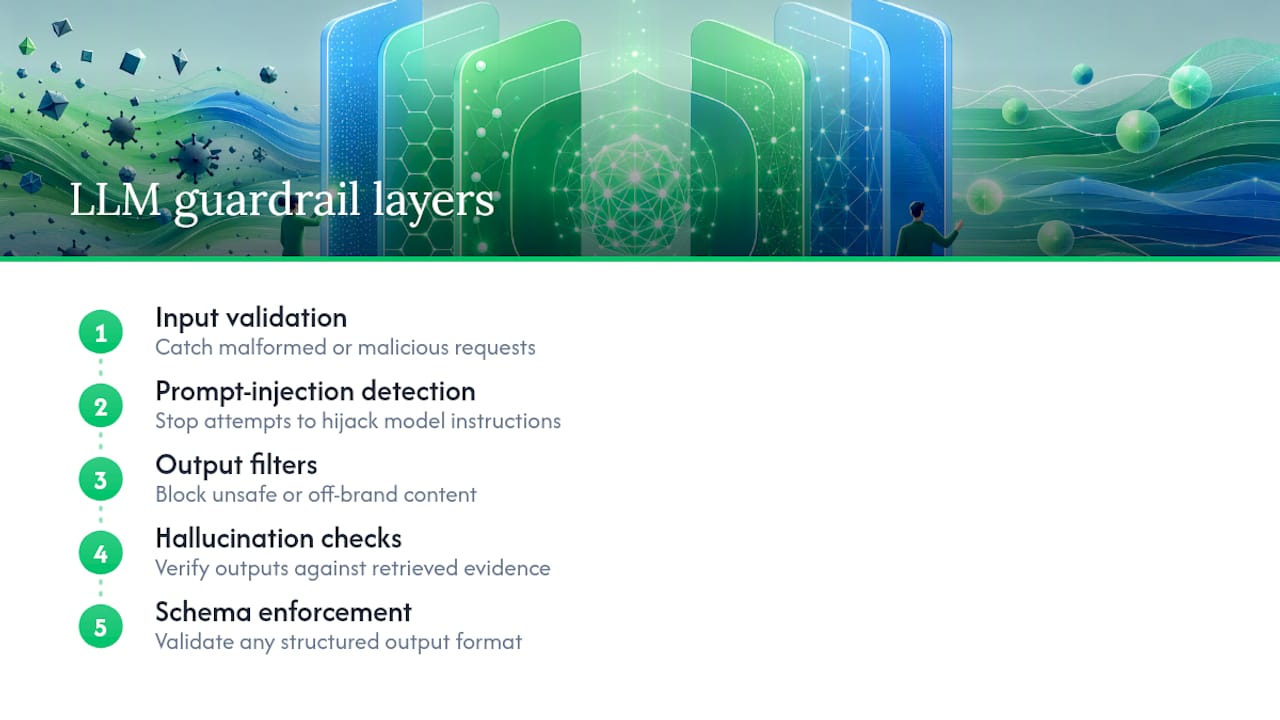
Guardrails work in layers, and no single check catches everything on its own. A production system needs input validation to catch malformed or malicious requests, prompt-injection detection to stop attempts to hijack the model’s instructions, output filters to catch unsafe or off-brand content, hallucination checks against retrieved evidence, and schema enforcement for any structured output.
Data privacy needs explicit decisions, not defaults. Detect and redact personally identifiable information before it reaches a third-party model, and where regulatory or client requirements demand it, bring your own key (BYOK) or consider self-hosting to keep data residency within a required jurisdiction. Sentient Concepts’ guide to AI security controls covers this trade-off in more depth for teams weighing self-hosting against managed providers.
Audit logging should follow a tiered retention strategy: hot storage for recent traces you query often, warm storage for the medium-term compliance window, and cold storage for long-term retention at lower cost. Finally, organisational controls matter as much as technical ones. Define who can approve a prompt change, who owns the eval gate thresholds, and what the incident runbook looks like when a model starts hallucinating in production. Sentient Concepts’ AI governance framework sets out a practical structure for assigning these roles.
How do prompts and retrieval quality affect hallucination risk?
Prompt quality and retrieval quality are the two biggest levers on hallucination risk, and both are testable rather than a matter of guesswork. Store prompts in version control, review changes through pull requests, run prompt-specific CI tests, and pin the exact prompt version inside your production deployment manifest, the same discipline DEV Community’s LLMOps pipeline guide recommends for treating prompts as production code.
Retrieval hygiene deserves equal attention. Your chunking strategy determines how much context the model actually sees, your embedding model choice determines how well semantically related content gets matched, and precision@k testing tells you whether your top results are actually relevant before you ever generate a response. Reindex on a defined cadence rather than only when something visibly breaks.

For evaluating RAG specifically, run citation checks to confirm generated claims trace back to retrieved sources, score groundedness explicitly, and route high-stakes traces through human review rather than trusting an automated score alone. Detailed guidance on designing evaluation gates stresses matching metrics to the task, semantic similarity scores for summarisation, schema compliance for structured outputs, and calibrating any judge model against human labels before trusting it in CI.
On fine-tuning versus RAG: fine-tune when you need consistent behaviour or tone baked into the model itself and can absorb the training cost, and use RAG when your knowledge base changes frequently or you need traceable citations. RAG typically wins on cost and update speed, while fine-tuning can win on latency, since there’s no retrieval step to wait on.
Pro Tip: Test precision@k on your retrieval pipeline before you touch your prompts. A hallucination often turns out to be a retrieval failure wearing a generation problem’s clothes.
Where does Sentient Concepts fit into an LLMOps rollout?
Sentient Concepts runs end-to-end managed AI operations, which means the handoffs that usually break down between the team that builds a model and the team that runs it simply don’t happen. One team stays accountable from readiness through to daily operation.
A practical starting engagement typically covers:
A readiness check and data diligence pass to confirm your data and infrastructure can support the checklist above.
Setting up the golden dataset, runtime gateway, and eval gate together, rather than as separate later projects.
Enabling full request tracing before the first production release, not retrofitted after an incident.
Most clients see a working, monitored pipeline within an 8 to 12-week window, covered under managed AI operations.
What does a realistic LLMOps adoption roadmap look like?
The hardest part of LLMOps adoption isn’t the tooling. It’s the cultural shift: getting engineering and product teams to treat prompts with the same discipline as code, and building an evaluation culture where nobody ships a change on gut feel.
A realistic roadmap runs roughly 12 weeks. Week one covers readiness and basic tracing. Weeks two to four build the golden dataset and wire up the eval gate. Week six introduces canary rollout on real traffic. By week twelve, the team should have a tested rollback runbook and a working incident process. Measure progress through quality score trends, cost per request, and incident count, not through how many features shipped.
Get help running your LLMOps checklist end-to-end
Most of what’s covered above is straightforward to describe and genuinely hard to run consistently once you have several models, prompt versions, and teams shipping changes in parallel. Sentient Concepts’ managed AI operations service exists precisely for that gap: one accountable team handling evaluation gates, tracing, rollback procedures and cost governance as ongoing operations, not a one-off setup project you inherit six months later.
Unlike hiring a specialist for the initial build and a separate team for ongoing operations, Sentient Concepts keeps the same team accountable from readiness diligence through to daily monitoring, which removes the handoff gap where most LLMOps failures actually originate. For finance, manufacturing, logistics or insurance teams weighing whether to build this capability internally or bring in a partner, the fastest way to find out where your current setup falls short is a direct conversation. Request an operational readiness assessment through Sentient Concepts and get a concrete view of what your first 90 days of managed LLMOps would look like.
Sources
FAQ
What is the difference between LLMOps and MLOps?
MLOps manages traditional model training and batch retraining, while LLMOps adds prompt versioning, retrieval quality management, and token-based cost tracking specific to large language models.
How big should a golden dataset be to start?
Start with 50 to 100 representative examples covering your highest-risk use cases, then grow it using real production traces flagged as low quality.
What should every LLM request trace include?
A request ID, resolved prompt version, model pin, token counts, provider, and a quality score, so regressions can be traced back to an exact configuration.
How do you control LLM costs without hurting quality?
Route simple tasks to smaller models, cache repeated queries, and enforce per-route token budgets, while reserving frontier models for genuinely hard reasoning tasks.
Should we build LLMOps in house or bring in a managed partner?
Both work, but Sentient Concepts’ managed AI operations model removes the handoff gap between build and run teams, which is where most LLMOps failures originate.
Recommended