Trade finance document automation: the agent-led approach
- 17 hours ago
- 8 min read
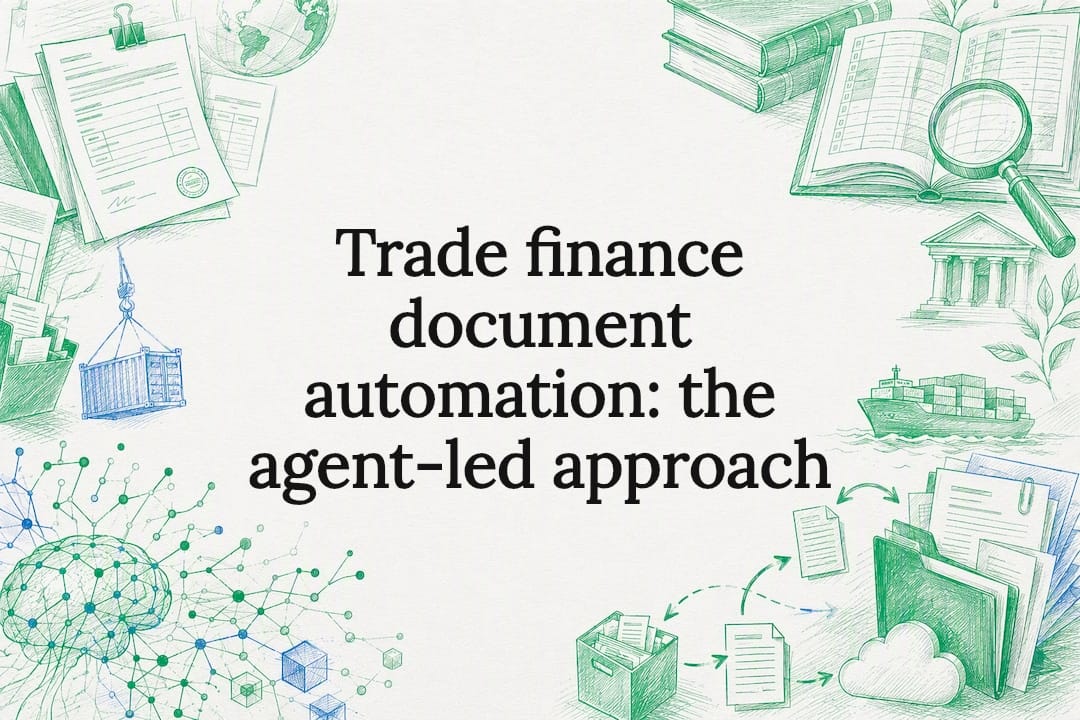
Favour an agent-led, hybrid AI–human model for trade finance document automation. Full autonomy remains impractical for letter-of-credit examination, given the trust, regulatory, and contextual complexity involved, but pairing intelligent document processing with structured human oversight cuts cycle times without sacrificing defensibility.
Any credible project needs four building blocks working together:
OCR/IDP for ingestion and extraction from scanned or image-based documents
A rules engine mapped to UCP and ISBP articles for discrepancy checks
LLM-based reasoning or agents for contextual judgement calls
Human exception queues and a full audit trail for every automated decision
Pro Tip: Start your pilot with a single, high-volume document type, commercial invoices or bills of lading work well, rather than trying to automate an entire letter-of-credit package at once.
Key Takeaways
Agent-led, hybrid AI–human automation is the most defensible way to speed trade finance document processing while keeping regulatory judgement in human hands.
Point | Details |
Start narrow | Pilot a single high-volume document type, such as commercial invoices, before expanding scope. |
Build in layers | Combine OCR/IDP, a UCP/ISBP-mapped rules engine, LLM reasoning, and workflow orchestration. |
Keep humans in the loop | Route low-confidence discrepancies to role-based review queues with logged rationale. |
Measure against a baseline | Track STP rate, processing time, and cost per transaction before and after the pilot. |
Choose an accountable partner | Sentient Concepts delivers pilot scoping through managed operations without handing the project off to a separate team. |
This article is general information, not a substitute for advice from a qualified financial advisor. Consult a qualified financial professional about your own circumstances before acting on anything here.
Table of Contents
What is trade finance document automation?
Trade finance document automation is the use of software and AI to ingest, classify, extract, normalise, and examine trade documents against contractual and regulatory rules, then route the results through a workflow engine to operations, compliance, and customer-facing teams. It covers everything from reading a bill of lading to flagging a clause that conflicts with a letter of credit’s terms.
Most implementations draw on established frameworks rather than inventing new logic:
UCP 600 governs documentary credit rules that most LC examinations still follow
ISBP 745 provides the ICC’s interpretive standards for what counts as a discrepancy
Bank examiners, operations staff, compliance officers, and the customer all touch the workflow at different points
Automation speeds extraction and rule-based checks. It does not replace the contractual judgement a human examiner applies when a discrepancy is ambiguous or a clause reads unusually.
Core trade finance documents and where automation gets tested
Every automation project has to earn its keep against a defined document set, and each document carries its own failure patterns.
The core set includes letters of credit, bills of lading, commercial invoices, packing lists, inspection and insurance certificates, and certificates of origin. Discrepancies tend to cluster into recognisable classes: mismatched amounts, dates, or party names across documents; non-standard clause language that doesn’t match LC wording; altered or manipulated images; handwritten fields that resist OCR; and missing stamps or signatures.
Discrepancy type | Typical impact |
Amount or date mismatch | Payment delay pending clarification |
Non-standard clause wording | Manual review, possible rejection |
Altered document image | Shipment release hold, fraud investigation |
Handwritten or illegible fields | Extraction failure, forced manual entry |
Missing stamp or signature | Discrepancy notice, delayed negotiation |
A single mismatched date between an invoice and a bill of lading can hold up payment for days. That’s the practical stake behind getting the extraction and rules logic right the first time.
How the technology layers fit together
The stack behind reliable automation runs in sequence, and each layer has its own failure mode.
Ingestion starts with OCR or ICR, which converts scanned documents into machine-readable text. Document classification sorts incoming files by type. Field extraction and normalisation pull structured data out of unstructured text. A rules engine then checks that data against UCP and ISBP mappings. Agentic reasoning, often built on large language models, handles the contextual judgement calls that pure rules can’t resolve. RPA and workflow orchestration push results into core banking, sanctions screening, and AML systems via APIs.
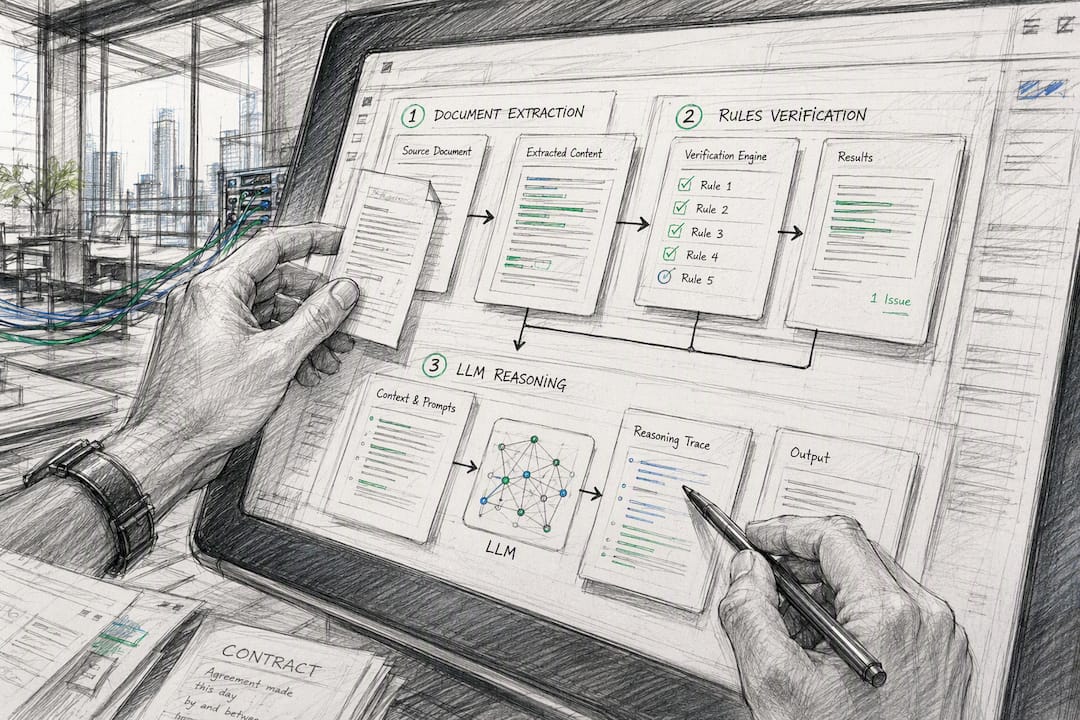
OCR tends to struggle on low-quality bills of lading, particularly faxed or heavily stamped copies. LLM outputs can drift semantically when a clause is paraphrased rather than copied verbatim from an LC. Industry commentary points to combining IDP, RPA, and contextual AI as the practical way to reduce these failure points across trade back offices. Building this properly means treating intelligent document processing as the foundation layer, not an afterthought bolted onto legacy scanning tools.
Pro Tip: Insist on an explainability layer that logs which rule or article triggered every automated decision, not just the final outcome. Examiners and auditors need to trace the “why”, not just the “what”.
What benefits should you actually expect?
Automation delivers real, measurable gains, but the size of those gains depends heavily on your starting point.
Typical wins include faster turnaround on document examination, fewer manual transcription errors, higher straight-through processing rates, lower cost per transaction, and a stronger audit trail for regulatory defence. Reported percentage improvements vary widely by document quality, the age of legacy systems, and whether the surrounding human process gets redesigned alongside the technology.
Persistent, unmet demand across global trade corridors is well documented, and the ADB Global Trade Finance Gap Survey frames throughput and scalability improvements as a genuine business case for automation investment, not just an efficiency exercise.
Banks that treat automation purely as a cost-cutting tool tend to under-deliver. The ones that redesign the surrounding workflow, exception routing, escalation rules, and examiner training, alongside the technology see the larger gains.
How discrepancy detection and exception routing work
Detection runs on cross-document reconciliation, checking that names, dates, and amounts agree across the full document set. Semantic checks flag clause wording that departs from LC terms. Forensic signals catch image tampering or inconsistent metadata. Each flag carries a confidence score.
Exception routing then triages: high-confidence matches auto-approve, clear violations auto-reject, and anything in between lands in a human review queue. Role-based queues route sanctions-adjacent flags to compliance and contractual ambiguities to senior examiners.
A working exception process needs:
Defined SLAs for each queue tier
Audit logs capturing the decision rationale, not just the outcome
Standardised exception metadata so patterns are analysable later
A feedback loop that feeds resolved exceptions back into model retraining
Without that feedback loop, the same discrepancy type keeps landing in the human queue indefinitely, and the automation never actually learns.
Building a pilot: timeline and cost considerations
A realistic rollout moves through four phases, and skipping any of them tends to show up as rework later.
Discovery (2–4 weeks). Select a single document type and trade corridor. Define success metrics up front, not after the pilot starts.
Pilot build and test (8–12 weeks). Assemble 6–12 months of ground-truth samples and stand up a sandbox integration against a non-production environment.
Production hardening (8–16 weeks). Harden error handling, connect to core banking and sanctions screening, and run parallel processing against the manual baseline.
Scale and optimisation (ongoing). Extend to additional document types and corridors, retraining models as exception patterns emerge.
Cost drivers worth budgeting for early include data labelling effort, integration work against core banking and screening systems, cloud compute for model inference, licence costs, and the change management required to get examiners comfortable trusting the automated output. A minimal viable dataset needs enough labelled ground-truth examples, typically hundreds rather than dozens, to cover the common discrepancy classes your chosen document type actually produces. Reference architecture for enterprise-grade document processing systems is worth reviewing before committing to a specific vendor or build approach.
Keeping automation defensible: governance and controls
Regulated trade finance leaves little room for a black-box decision. Governance has to be built in from day one, not retrofitted after an audit finding.
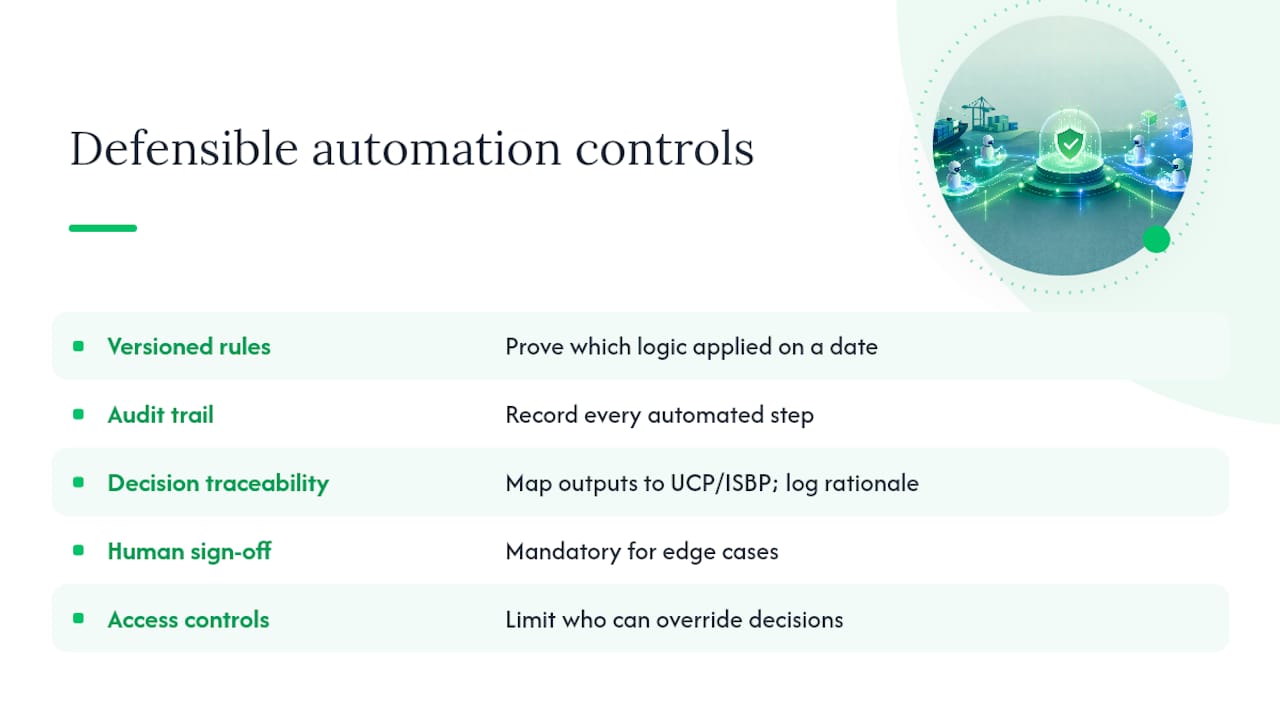
Essential controls include versioned rules so you can prove what logic applied to a given transaction on a given date, a full audit trail covering every automated step, model explainability, mandatory human sign-off for edge cases, and role-based access controls limiting who can override a decision.
Every automated output should map back to a specific UCP or ISBP article, log the decision rationale for examiners, and keep retraining records showing when and why a model changed. Regulators and auditors increasingly expect this level of traceability as automated decisioning scales.
Pro Tip: Build a discrepancy rationale format that names the exact article breached or matched, for example “ISBP 745, paragraph A19, non-conforming description of goods”, rather than a generic “discrepancy found” flag. It saves enormous time during examiner review and regulatory audit.
Which KPIs prove the project is working
The metrics that matter most: straight-through processing rate, processing time per transaction, error rate, cost per transaction, exception rate, employee hours saved, and time-to-decision for letters of credit specifically.
Run a before/after comparison during the pilot, normalising for transaction volume and complexity so you’re not comparing a quiet month against a busy one. Tie these operational metrics back to commercial outcomes that finance leadership actually cares about: days sales outstanding, release-to-ship times, and the compliance cost avoided by fewer manual review escalations.
An agent-led deployment in practice
A typical Sentient Concepts deployment structures the workflow around discrete agents rather than one monolithic system: a document ingestion agent, an extraction agent tuned to the specific document type, a discrepancy detection agent applying UCP and ISBP logic, and a human-exception orchestration layer that routes anything below the confidence threshold to the right reviewer.
Sentient Concepts supports the full lifecycle: pilot scoping, sandbox integration, production hardening, and managed operations once the system is live. That continuity matters, because the model that works in week one of a pilot needs retraining as exception patterns shift over the following year, and that ongoing tuning is where most standalone builds quietly fail.
Readers weighing up a pilot for their own document set can review how a comparable agentic AI operating model works in another regulated financial context before scoping their own workshop.
Setting realistic expectations for automation
Automation genuinely cuts manual document handling, but full autonomy in letter-of-credit examination remains rare, and the academic roadmap on AI-driven trade finance transformation backs an agent-led model over a fully autonomous one for exactly that reason.
Get help scoping your automation pilot
Sentient Concepts runs end-to-end AI engagements for finance teams, from initial strategy and pilot scoping through to managed operations once your document automation system is live. That continuity means the same team that designs your discrepancy detection logic is still accountable for it eighteen months later, no handoff to a separate support desk.
For finance and operations leaders exploring automating supplier and trade document processing, the practical next step is a discovery conversation rather than another vendor demo. Get in touch through Sentient Concepts’s contact page to scope a pilot around your highest-volume document type and see what a realistic timeline looks like for your own corridor.
Sources
ADB global trade finance gap survey
FAQ
What is the difference between an LC and a DLC?
A standard letter of credit (LC) commits a bank to pay once compliant documents are presented, while a deferred letter of credit (DLC) delays that payment to a set future date after document acceptance.
What is the process of trade finance automation?
It typically runs through ingestion and OCR, document classification, field extraction, rules-based examination against UCP and ISBP standards, and workflow routing, with human review handling any discrepancy the system flags as uncertain.
What is the best trade finance software?
There’s no single best platform. The stronger question is whether a solution offers agent-led automation with human exception handling, full audit trails, and integration with your core banking and screening systems. Sentient Concepts designs this architecture around each client’s specific document mix rather than a fixed product.
What are the four types of letter of credit?
The commonly cited categories are revocable, irrevocable, confirmed, and standby letters of credit, though usage varies by market and most modern trade finance relies almost exclusively on irrevocable LCs.
How long does a trade finance automation pilot take?
Discovery typically runs 2 to 4 weeks, followed by an 8 to 12 week pilot build and test phase, before moving into production hardening.
Recommended