Mortgage document automation for lenders: a practical guide
- 11 minutes ago
- 15 min read
Mortgage document automation, properly implemented, delivers faster time-to-close, materially fewer processing errors, and a complete audit trail that satisfies FCA expectations. The technology combines intelligent document processing (IDP) with agentic workflow orchestration to replace the manual handling that currently anchors most UK lending operations to slow, error-prone cycles. If you are evaluating this now, the single most useful next step is to assess your current loan origination system (LOS) integrations and scope a bounded pilot on one document class. The core capabilities that produce the outcomes above are:
Capture and ingest: multi-channel document receipt (portal upload, email, scan)
Classification: automatic identification of document type (payslip, bank statement, title deed, ID)
Extraction: structured data pulled from unstructured or semi-structured content using IDP models
Validation and cross-document matching: extracted values checked against LOS data and other documents in the file
Human-in-the-loop exception handling: low-confidence extractions routed to reviewers with full context
LOS and downstream integration: validated data written directly into your origination or servicing platform
Key takeaways
Mortgage document automation, built on IDP and agentic workflow orchestration, is the most direct lever UK lenders have to reduce processing time, lower compliance risk, and improve borrower experience simultaneously.
Point | Details |
Start with a scoped pilot | Deploy on one document class with a representative sample of live files before expanding to the full document set. |
Define KPIs before go-live | Instrument extraction accuracy, straight-through processing rate, and exception clearance time from day one. |
Require auditability by contract | Insist on immutable audit logs with a minimum seven-year retention period to satisfy FCA record-keeping expectations. |
Govern the model, not just the output | Assign a model owner, document training data and version history, and define a retraining schedule before launch. |
Sentient Concepts delivers end-to-end | Strategy, custom IDP engineering, LOS integration, and managed operations under one accountable team. |
Table of Contents
What mortgage document automation actually means (and why IDP changes everything)
How mortgage document automation works in a lending pipeline
What to demand from mortgage automation software before you sign anything
A practical roadmap for implementing mortgage document automation
Why the timing for UK mortgage automation is better than most firms realise
Sentient Concepts: from pilot to production mortgage automation
What mortgage document automation actually means (and why IDP changes everything)
Mortgage document automation is the application of intelligent document processing, workflow orchestration, and system integration to replace manual document handling across the mortgage lifecycle. It is not template-based mail merge or basic optical character recognition (OCR). The distinction matters: legacy OCR reads pixels and returns raw text; IDP goes further, applying machine learning classification, named-entity recognition, and contextual validation to produce structured, verified data that can flow directly into downstream systems.
Intelligent Document Processing (IDP): a technology layer that combines OCR, natural language processing, machine learning classification, and rules-based validation to convert unstructured mortgage documents into structured, auditable data records.
The technical components of a complete mortgage document automation system are:
Capture and ingest layer: APIs, email connectors, portal integrations, and scanner feeds that receive documents in any format (PDF, image, XML, structured data)
Classification engine: a trained model that identifies document type and routes it to the correct extraction template or model
Extraction models: IDP models (often transformer-based) that locate and extract specific fields: income figures, account numbers, property addresses, dates of birth
Validation and cross-document matching rules: logic that compares extracted values across documents and against LOS records, flagging discrepancies for review
Exception handling and human-in-the-loop (HITL) workflows: a reviewer interface that presents low-confidence or flagged items with the source document, so a human can correct or approve with a full audit record
Integration layer: connectors to your LOS (e.g. Mortgage Brain, Iress, or a proprietary platform), servicing systems, and data warehouses
Audit and governance layer: immutable logs of every extraction, validation decision, and human override, with timestamps and user attribution
Agentic augmentation is the next evolution. Open-source toolkits such as LlamaIndex on GitHub now provide building blocks for LLM-based orchestrators that can handle complex triage, multi-step reasoning across documents, and dynamic exception routing. For most UK mortgage operations, the practical starting point remains a well-configured IDP pipeline; agentic layers add value once the core extraction and validation logic is stable.
How mortgage document automation works in a lending pipeline
The workflow is sequential, with defined handoff points and measurable quality gates at each stage. Here is how a typical UK mortgage file moves through an automated pipeline.
Capture and ingest. Documents arrive via borrower portal, broker email, or back-office scan. The system ingests them, converts to a normalised format, and logs receipt with a timestamp. Typical documents at this stage: passport or driving licence, recent payslips, three to six months of bank statements, employer references.
Classification. The classification model identifies document type and sub-type. A payslip from a PAYE employee is routed differently from a self-employed SA302 or a P60. Confidence scores below a defined threshold trigger immediate escalation rather than proceeding to extraction.
Extraction. Field-level extraction models pull the specific data points required for underwriting: gross income, net pay, employer name, account sort code and number, property address, title number. For enterprise IDP architectures, extraction models are typically trained on vertically adapted datasets that reflect the specific document variants a lender receives, which reduces exception rates significantly.
Validation and cross-document matching. Extracted values are checked against each other and against LOS data. Income figures on payslips are compared with bank statement credits. Declared address on the application is matched against ID documents. Any mismatch above a defined tolerance is flagged, not silently passed.
Human-in-the-loop exception handling. Flagged items are queued for a human reviewer with the source document, the extracted value, the conflicting value, and the rule that triggered the flag. The reviewer approves, corrects, or escalates. Every action is logged. Mortgage tech trend analysis consistently identifies HITL design as a critical differentiator between automation programmes that sustain accuracy and those that drift.
Data mapping and LOS integration. Validated data is mapped to the LOS field schema and written via API or direct integration. The file status updates automatically. Downstream systems (credit decisioning, valuation instruction, compliance reporting) receive the structured data without manual re-keying.
Audit and reporting. Every step produces an immutable log entry. Compliance teams can reconstruct the full processing history of any file, including which model version extracted which value, which rule triggered a flag, and which reviewer approved the exception.
Pro Tip: Design your exception routing before you configure your extraction models. Define SLA targets for human reviewers (e.g. four-hour turnaround for flagged items during business hours) and build escalation paths for items that breach that SLA. An exception queue with no SLA becomes a bottleneck that erodes the time-to-close gains automation was meant to deliver.
What measurable benefits should your firm expect?
The business case for automated mortgage processing rests on four outcome categories, each with trackable KPIs.
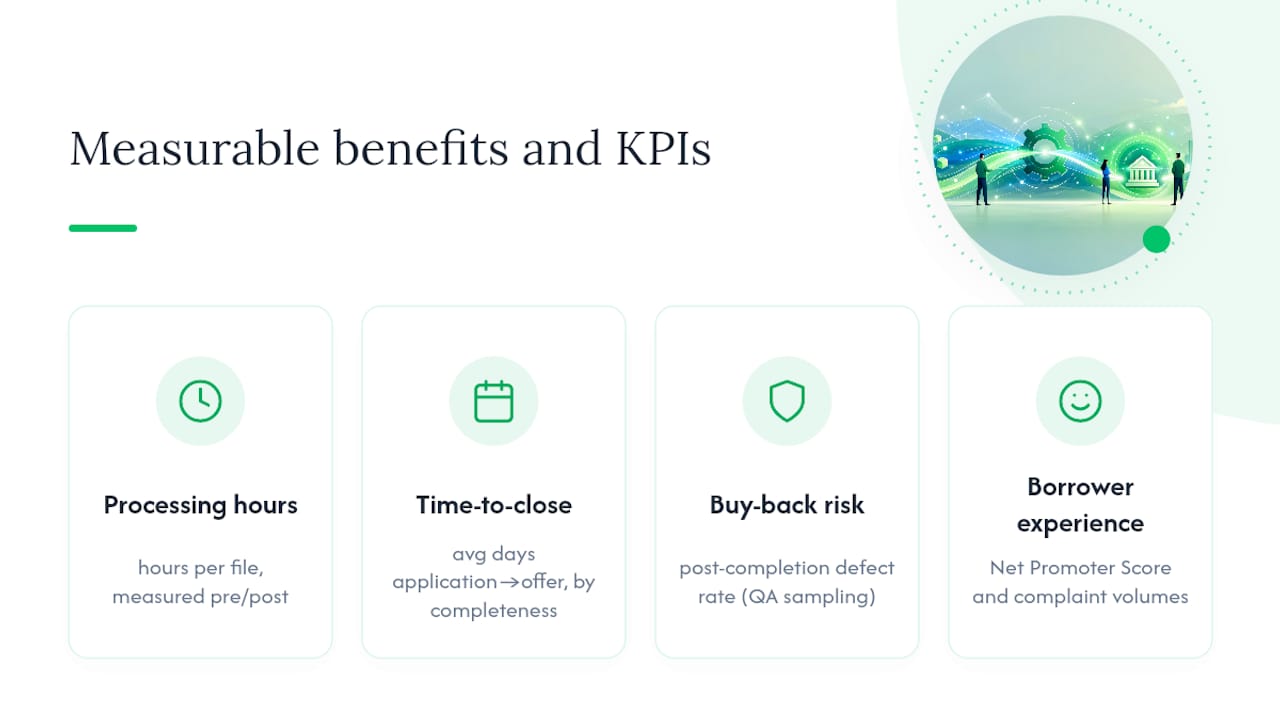
Reduced manual processing hours. Document handling, data entry, and exception chasing account for a disproportionate share of operations headcount in most UK mortgage firms. Automating the extraction and validation stages frees processors to focus on genuine judgement calls. The relevant KPI is hours per file for document processing, measured before and after deployment.

Faster time-to-close. When documents are classified, extracted, and validated within minutes of receipt rather than hours or days, the overall origination cycle shortens. Track average days from application to offer, segmented by document completeness at submission.
Lower buy-back and repurchase risk. Errors in income verification, identity checks, and property data are a primary driver of buy-back demands in the secondary market. Systematic cross-document validation catches discrepancies that manual review misses under volume pressure. The KPI here is the rate of post-completion document defects identified in quality assurance sampling.
Improved compliance and auditability. The FCA’s supervisory expectations around mortgage conduct require firms to demonstrate that their processes are controlled and auditable. An IDP pipeline with immutable logs satisfies that requirement structurally, rather than relying on individual processor discipline. Track the percentage of files with a complete, machine-generated audit trail.
Better borrower experience. Faster processing and fewer requests for re-submission of documents that were already received translate directly into borrower satisfaction. Net Promoter Score and complaint volumes are the relevant measures.
An ICE Mortgage Technology survey reported a momentous surge in technology adoption among borrowers and lenders, with mortgage participants showing strong appetite for digital processes that reduce friction and processing time.
The KPIs to instrument from day one: average time to clear document exceptions, field-level extraction accuracy rate, percentage of files processed end-to-end without human intervention (the “straight-through processing” rate), and post-completion defect rate. Sentient Concepts’ work on IDP and hyper-automation in finance documents how these metrics shift once a well-configured pipeline is in production.
What to demand from mortgage automation software before you sign anything
The supplier ecosystem for document automation is broad and mature, as software directory listings confirm. That breadth makes procurement discipline more important, not less. The following criteria belong in every RFP and demo script.
Functional requirements:
Native or certified integration with your LOS and any downstream servicing or credit systems
Configurable extraction models that can be retrained on your own document corpus without vendor lock-in
Template and clause management for standard mortgage document types (ESIS, KFI, offer letters, title deeds)
Validation rule engine that supports cross-document logic, not just field-level format checks
HITL reviewer interface with document viewer, field correction, and approval workflow built in
Immutable audit trail covering every extraction event, validation decision, and human override
Operational and security requirements:
Data residency options that keep borrower data within the UK or EEA, satisfying UK GDPR obligations under the UK Data Protection Act 2018
Deployment options: cloud (UK-region hosted), private cloud, or on-premises, depending on your data governance policy
Documented SLAs for extraction accuracy and processing latency, with contractual remedies
Role-based access controls and multi-factor authentication for reviewer and admin interfaces
Penetration testing evidence and ISO 27001 certification (or equivalent)
UK compliance considerations:
Questions to ask vendors in demos: Can you show us a complete audit log for a sample file, from ingest to LOS write? How are model updates communicated, and can we freeze a model version during a regulatory review period? Where, precisely, is borrower data stored and processed? What is your process for handling a UK GDPR data subject access request that touches extracted document data?
A practical roadmap for implementing mortgage document automation
Implementation risk is highest when firms treat mortgage document automation as a technology project rather than an operational change programme. The phased approach below addresses both dimensions.
Phase | Objective | Key activities | Success criteria |
Discovery | Baseline and scope | Map current document volumes, types, error rates, and LOS field schema | Agreed pilot scope, KPI baseline, integration architecture confirmed |
Pilot | Validate accuracy and integration | Deploy on one document class (e.g. payslips), run against a representative sample of live files | Extraction accuracy above agreed threshold; LOS write confirmed; HITL queue manageable |
User acceptance | Confirm operational fit | Reviewer team validates HITL interface; compliance team reviews audit logs | Sign-off from operations and compliance leads |
Phased rollout | Expand document coverage | Add document classes sequentially; monitor exception rates per class | Straight-through processing rate improving per class; no regression in accuracy |
Continuous improvement | Sustain and optimise | Retrain models on exception data; refine validation rules; monitor for drift | Monthly accuracy reports; exception rate trending down |
Governance roles to define before pilot launch:
Data owner: accountable for the quality and completeness of training data and ongoing data governance
Model owner: responsible for extraction model performance, retraining schedules, and version control
Operations lead: owns the HITL queue, SLA compliance, and reviewer capacity planning
LOS integrator: manages the API connections and field mapping between IDP outputs and the origination system
Change management lead: coordinates training, communications, and adoption tracking across the processing team
Pilot duration for a single document class typically runs four to eight weeks from first document ingestion to sign-off, assuming the LOS integration is scoped in advance. Escalation criteria should be defined before go-live: if extraction accuracy falls below the agreed threshold on more than a defined percentage of files in any week, the pilot pauses for root-cause analysis rather than continuing to accumulate errors.
Agentic AI toolkits can be evaluated during the pilot phase as an augmentation layer for complex exception triage, but they should not be in scope for the initial accuracy validation. Introduce them in the continuous improvement phase once baseline IDP performance is stable.
Sentient Concepts’ AI strategy and roadmap service covers the discovery and governance design phases, including data readiness assessment and operating model design, which are the two workstreams most commonly underestimated in early-stage automation programmes.
Common implementation challenges and how to mitigate them
Most mortgage document automation programmes that underperform do so for one of four reasons. Recognising them early is the difference between a controlled pilot and an expensive reset.
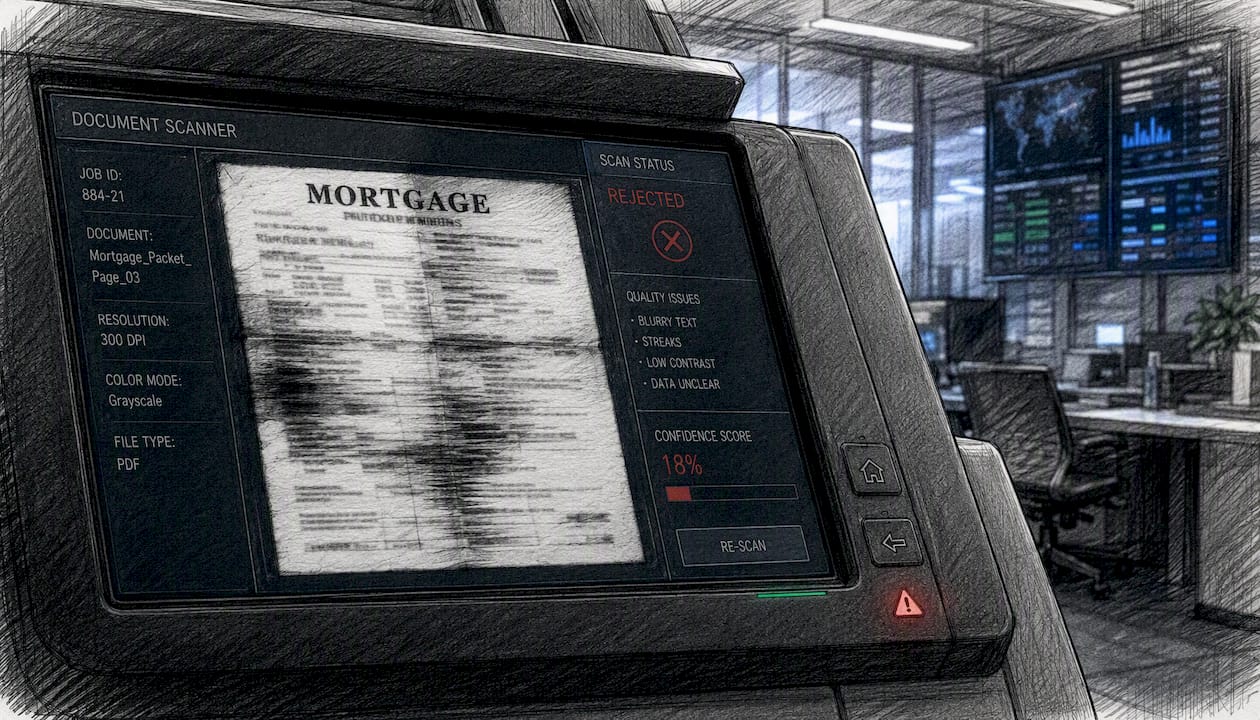
Poor source data quality. Documents arrive blurred, rotated, partially completed, or in non-standard formats. IDP models trained on clean samples perform poorly on real-world intake. Mitigation: run a data quality audit on a representative sample of historical documents before configuring extraction models. Set minimum image quality thresholds at the ingest layer and reject documents that fall below them, prompting re-submission rather than attempting extraction on unusable inputs.
Legacy LOS constraints. Many UK mortgage firms operate on origination systems that were not designed for API-driven data ingestion. Field schemas may be undocumented, integration points limited, or change management processes slow. Mitigation: map the LOS field schema in detail during discovery, identify the integration method (API, database write, file-based), and test the integration in a non-production environment before the pilot begins.
Highly variable document formats. Payslips from different employers, bank statements from different institutions, and SA302 documents from different tax years all present differently. A single extraction model rarely handles all variants at production accuracy. Mitigation: segment your document corpus by variant during training, and build separate extraction models or model branches for high-volume variants. Verticalised automation approaches that tailor extraction logic to specific document populations consistently outperform generic models on exception rates.
Staffing and change resistance. Processors who have managed document review manually for years often perceive automation as a threat rather than a tool. Mitigation: involve the operations team in pilot design, frame automation as handling the mechanical work so reviewers can focus on judgement-intensive exceptions, and track reviewer satisfaction alongside accuracy metrics.
Pro Tip: When evaluating vendor demos, ask to see the exception handling interface under realistic conditions: a blurred payslip, a bank statement with a non-standard layout, and a document where the extracted income figure conflicts with the LOS application data. A vendor whose demo only shows clean, high-confidence extractions is showing you the best case, not the operating reality.
Red flags in vendor contracts: no contractual commitment to audit log retention periods, opaque model update processes with no freeze option, extraction accuracy SLAs that exclude document types you actually receive, and exit clauses that do not guarantee data portability in a format your team can use.
How Sentient Concepts delivers mortgage document automation
Sentient Concepts approaches mortgage document automation as an end-to-end programme, not a software licence. The engagement model follows a defined sequence: strategy and data readiness, custom IDP engineering, LOS integration, and managed operations. Each phase has clear deliverables and a defined handover, but the same team carries accountability throughout, which eliminates the gap between what a system is designed to do and what it actually does in production.
The typical engagement for a UK mortgage automation programme follows this sequence:
Strategy and data readiness (weeks 1–4): document volume and type analysis, LOS field mapping, data quality assessment, pilot scope definition, and governance design
Custom IDP engineering (weeks 5–12): extraction model development and training on client document corpus, validation rule configuration, HITL interface build, and integration architecture design
LOS integration and pilot (weeks 10–16): API or file-based integration to the origination system, pilot deployment on agreed document class, accuracy validation against agreed thresholds
Managed operations and continuous improvement (ongoing): model monitoring, retraining on exception data, SLA reporting, and quarterly optimisation reviews
Client-facing deliverables include a compliance-by-design audit trail (immutable logs from ingest to LOS write), an operations playbook covering HITL queue management and escalation procedures, and a model governance register documenting training data, version history, and retraining schedules. These are not optional add-ons; they are standard outputs of every engagement.
Sentient Concepts’ IDP and hyper-automation work in finance demonstrates how this approach reduces manual processing effort and improves control quality in regulated financial operations. The AI and GenAI solutions capability covers the full engineering stack required to build, integrate, and operate a production-grade mortgage automation system.
Final vendor selection checklist before you commit
Whether you are evaluating an off-the-shelf platform or a custom build, the following scoring dimensions should govern your final decision. Apply them at proof-of-concept stage, not after contract signature.
Integration risk (weight heavily):
Does the vendor have a documented, tested integration with your specific LOS version?
Is the integration API-based with versioned endpoints, or file-based with manual mapping?
What is the rollback procedure if the integration fails in production?
Accuracy and error handling:
What is the contractual extraction accuracy SLA, and which document types does it cover?
How are low-confidence extractions handled: silent pass, flag, or reject?
What is the vendor’s process for model updates, and can you freeze a version?
Maintainability and model ownership:
Do you own the trained models and training data, or does the vendor retain them?
Can your team retrain models without vendor involvement, or is retraining a paid service?
What is the process for adding a new document type to the pipeline?
Security and compliance:
Where is data processed and stored? Is UK data residency guaranteed contractually?
What certifications does the vendor hold (ISO 27001, Cyber Essentials Plus)?
How are UK GDPR data subject access requests handled for extracted document data?
Total cost of ownership:
What are the per-document, per-user, or per-volume pricing components?
Are model retraining, integration updates, and audit log storage included or billed separately?
What does the exit clause guarantee in terms of data portability and transition support?
The mature supplier ecosystem for document automation means there is no shortage of vendors willing to demo a polished proof of concept. The firms that avoid costly mid-programme replacements are those that scored vendors on integration risk and model ownership before they signed, not after.
Contractual points to insist on: minimum audit log retention of seven years (aligned with FCA record-keeping expectations), guaranteed data portability on exit in a documented format, model explainability documentation for any model used in a regulated decision, and uptime SLAs with defined remedies for breach.
Why the timing for UK mortgage automation is better than most firms realise
The conventional wisdom in UK mortgage operations is that automation is a long-term aspiration, perpetually deferred by legacy system constraints and regulatory caution. That framing is increasingly wrong.
IDP technology has matured to the point where extraction accuracy on standard mortgage document types is genuinely production-grade, not pilot-grade. The regulatory environment, far from being a barrier, actively rewards firms that can demonstrate controlled, auditable processes. The FCA’s ongoing supervisory focus on operational resilience and consumer outcomes creates a structural incentive to replace manual, error-prone document handling with systematic, logged automation.
Borrower expectations have also shifted. The surge in technology adoption documented across the mortgage market reflects borrowers who now expect the speed and transparency of digital processes. A lender whose document handling is still manual is not just operationally inefficient; it is competitively exposed.
The firms that will extract the most value from mortgage document automation over the next three years are not those waiting for a perfect technology moment. They are the ones scoping a pilot now, defining their KPIs, and building the governance infrastructure that makes automation sustainable. The technology is ready. The regulatory context supports it. The question is whether your operations team has the mandate and the implementation partner to act on it.
Sentient Concepts: from pilot to production mortgage automation
For UK mortgage firms that need more than a software licence, Sentient Concepts delivers the full programme: strategy, custom IDP engineering, LOS integration, and managed AI operations that keep the system performing in production. The concrete advantage over a platform-only approach is accountability across the entire lifecycle. There are no handoffs between a strategy consultant, a systems integrator, and a managed services provider. One team designs, builds, integrates, and runs the solution, with contractual SLAs covering accuracy, uptime, and compliance deliverables.
Firms that have engaged Sentient Concepts on document automation programmes receive a compliance-by-design audit trail, a model governance register, and an operations playbook as standard deliverables, not optional extras. The engagement can begin with a scoped discovery covering your LOS integration options, document volume profile, and pilot design. To start that conversation, contact Sentient Concepts directly or review the AI and GenAI solutions service to understand the full engineering capability behind the programme.
Sources
The following sources informed this guide and are recommended for further reading during procurement and implementation planning.
Note: vendor claims in any procurement process should be validated through a structured proof of concept against your own document corpus, not accepted on the basis of demo performance alone.
FAQ
What is mortgage document automation?
Mortgage document automation is the use of intelligent document processing (IDP), machine learning classification, and workflow orchestration to capture, extract, validate, and integrate mortgage document data without manual re-keying. It replaces manual document handling across origination, underwriting, and servicing with a controlled, auditable pipeline.
What is an example of document automation in a mortgage context?
A borrower uploads payslips and bank statements via a portal. The IDP system classifies each document, extracts income figures and account details, validates them against the loan application data in the LOS, and writes the verified values directly into the origination system, flagging any discrepancies for a human reviewer.
Which mortgage document processing approach is most effective?
IDP-based automation, configured with vertically adapted extraction models and cross-document validation rules, consistently outperforms generic OCR or template-based approaches on accuracy and exception rates. Sentient Concepts builds custom IDP pipelines tailored to a lender’s specific document corpus and LOS integration requirements.
What is the 3-7-3 rule in mortgage processing?
The 3-7-3 rule refers to US federal disclosure timing requirements (three days for initial disclosure, seven days before closing, three days for the closing disclosure). It is a US regulatory framework and does not apply directly to UK mortgage regulation, which is governed by FCA conduct rules and the Mortgage Credit Directive as implemented in UK law.
How long does a mortgage document automation pilot typically take?
A pilot covering one document class, from first document ingest to sign-off, typically runs four to eight weeks, assuming LOS integration is scoped in advance and a representative document sample is available for model training and validation.
Recommended