AI centre of excellence for enterprises: build & scale
Updated: Sep 11
An AI centre of excellence (CoE) is a cross-functional organisational unit that centralises AI strategy, standards, reusable assets, and governance to scale safe, measurable AI across the enterprise. If multiple lines of business are running disconnected pilots, costs and compliance risk are rising, or you cannot point to a single owner of AI standards, the answer is almost certainly yes: you need one. The first concrete step is to appoint an executive sponsor and run a structured prioritisation workshop to surface five candidate use cases before any further investment is committed.
An estimated 37% of large US companies already have an AI or machine learning CoE in place. For UK enterprises in finance, manufacturing, logistics, and insurance, the pressure is compounded by the Information Commissioner’s Office (ICO) and GDPR obligations that demand documented governance, audit trails, and demonstrable data minimisation. A CoE provides the structural answer to all three.
Pro Tip: Before commissioning a full CoE design, run a one-day workshop with representatives from IT, legal, and two business units to surface five candidate use cases. That single session typically reveals both the highest-value opportunities and the governance gaps that need addressing first.
Table of Contents
What must an AI CoE actually deliver?
The CoE’s remit spans five core activities, each of which produces a tangible output rather than a policy document.
Use-case identification and prioritisation sits at the centre. A repeatable evaluation framework scores candidates against four criteria: business value, regulatory risk, data readiness, and implementation complexity. This prevents the loudest stakeholder from winning the budget.

Governance and risk management means owning the intake workflow, model review gates, privacy assessments aligned to ICO guidance, and incident reporting. The CoE does not approve every model in production, but it sets the standards every team must meet.
Reusable infrastructure is where the CoE earns its keep. Publishing compliance checklists, reference architectures, prompt libraries, and approved data sets stops business units from reinventing foundational components at cost. An internal catalogue with versioning and search is the delivery mechanism.
MLOps and deployment support covers pipeline templates, observability tooling, model drift detection, and rollback procedures. The CoE provides the pattern; delivery teams execute it.
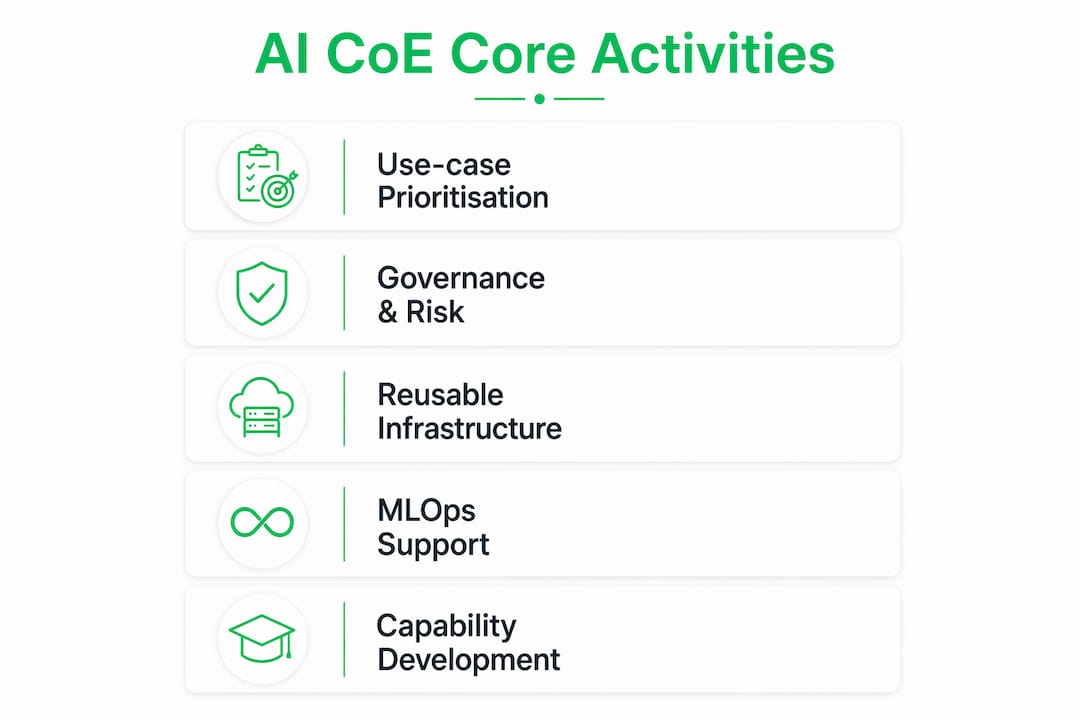
Capability development rounds out the remit: structured learning pathways, practitioner workshops, and coaching so that AI competence spreads beyond the CoE itself.
CoE activity | Primary output | Who benefits |
Use-case prioritisation | Scored backlog with governance flags | Business units, CFO |
Reusable asset catalogue | Prompt libraries, reference architectures | Engineering teams |
Governance and compliance | Model review gates, audit trails | Legal, risk, ICO alignment |
MLOps patterns | Pipeline templates, drift monitoring | Delivery and ops teams |
Capability development | Learning pathways, certified practitioners | All business units |
Pro Tip: Store the asset catalogue in a tool with version control and a search interface. A SharePoint folder with no taxonomy is not a catalogue; it is a graveyard.
What does the business case look like in practice?
Finance and operations leaders need concrete metrics before approving a CoE budget. The right KPIs are: time-to-production for pilots, cost per model lifecycle, number of reusable assets published, compliance incidents per quarter, adoption rate across business units, and ROI timeline per use case. Formal intake workflows and KPI measurement are not optional extras; they are the mechanism by which the CoE justifies its own existence.
Typical benefits for UK enterprises include faster time-to-value through reuse, lower duplication of effort across business units, centralised cost control, and a materially improved risk posture. Evidence from the AWS Generative AI Innovation Center suggests many AI initiatives move from proof of concept to production when structured delivery support is in place, with some solutions reaching production rapidly.
A rough timeline and cost framework for UK enterprises:
Phase | Duration | Primary cost categories |
Pilot CoE | 3–6 months | Staffing, tooling, platform access |
Scale | 6–18 months | Platform engineering, change management |
Embed (advisory) | Ongoing | Governance, training, managed operations |
On cost allocation, a showback model (reporting consumption back to business units without charging) works well in the first year. A chargeback model, where units pay for CoE services consumed, becomes appropriate once the catalogue is mature and adoption is measurable.
How should you staff and govern an AI CoE in the UK?
Governance starts with four structural roles: an executive sponsor who holds budget authority, a steering committee that includes security, legal, and data owners, a CoE leader accountable for day-to-day delivery, and a cross-functional advisory board. Without the executive sponsor, the CoE becomes a technical function that business units route around.
Securing executive sponsorship and assembling a multidisciplinary team are the two actions most strongly correlated with early CoE success. The placement decision — centralised versus federated — matters less than getting those two elements right.
Role | Core responsibility |
CoE Lead | Strategy, stakeholder management, budget |
AI/ML Architects | Reference architecture, platform standards |
Data Scientists | Model development, evaluation frameworks |
MLOps Engineers | Pipelines, deployment, drift monitoring |
Governance & Compliance Lead | ICO/GDPR alignment, audit trails, risk gates |
Product Liaisons | Business unit translation, use-case intake |
A governance checklist for UK enterprises should cover: intake and prioritisation workflow documented and published; approved vendor list maintained; model review gates with sign-off criteria; privacy impact assessments aligned to ICO guidance; incident reporting procedure with defined escalation paths; and audit trails retained per GDPR requirements. The World Economic Forum’s Centre for AI Excellence frames responsible AI governance as a cross-sector obligation, not a compliance checkbox, which is the right framing for a steering committee conversation.
Pro Tip: Assign a named data owner to every approved data set in the catalogue. Ambiguous ownership is the single most common cause of GDPR incidents in AI projects.
What technical foundations does the CoE need to provide?
The reference architecture has six layers: a data platform with governed access, a model registry and LLM catalogue, MLOps pipelines for training and deployment, observability and cost tracking, secure inference endpoints, and an integration layer connecting to enterprise systems. Portability matters. Vendor-neutral patterns prevent lock-in and allow the organisation to move workloads between cloud providers or on-premises infrastructure as requirements evolve.
Reusable components the CoE should publish from day one include prompt libraries with version history, approved data sets with lineage documentation, model evaluation suites, configuration-as-code templates, and secure agent frameworks. For enterprises exploring agentic AI workflows, the agent framework component deserves particular attention given the governance complexity involved.
Effective CoEs integrate MLOps, observability, and lifecycle management to ensure production reliability, detect model drift, and simplify rollback. Without these controls, a model that degrades silently in production creates both operational and regulatory exposure.
The most expensive AI mistake is not a failed pilot. It is a production model that no one is monitoring, running on data no one has reviewed, in a business unit that assumed someone else was responsible.
How do you launch a CoE and pick the right first pilots?
A phased roadmap prevents the CoE from trying to do everything at once.
Discover (2–4 weeks): Map existing pilots, assess data readiness, identify governance gaps, and appoint the executive sponsor.
Prove (6–12 weeks): Run two or three structured pilots using the prioritisation matrix. Instrument each for measurement from day one.
Industrialise (3–9 months): Publish the first version of the asset catalogue, formalise the intake workflow, and establish MLOps patterns.
Embed (ongoing): Transition the CoE from a delivery function to an advisory model as business unit competence grows.
The prioritisation matrix plots business value against implementation complexity on two axes, with compliance readiness and data availability as gating criteria. A use case that scores high on value but fails the data readiness gate does not proceed until the data issue is resolved. This prevents the most common failure mode: committing engineering resource to a use case that cannot reach production.
For the first 90-day sprint, the checklist is: executive sponsor confirmed; two to three use cases scored and approved; data owners assigned; governance gates documented; pilot instrumented with KPIs; and a handover plan to operations drafted before the pilot ends.
Pro Tip: Instrument every pilot as if it will go to production. Teams that treat measurement as an afterthought consistently struggle to build the business case for the next phase.
How do you build the skills and culture to make the CoE last?
Capability building follows a four-stage pathway: awareness sessions for all staff, practitioner workshops for business analysts and product managers, certified technical tracks for engineers and data scientists, and on-the-job labs with CoE coaching. The agile AI development lifecycle provides the iterative delivery model that underpins the practitioner and technical tracks.
Hiring should balance senior AI engineers with product-facing data leads and a governance specialist. The governance role is frequently underweighted in early CoE designs, which creates ICO exposure as the model portfolio grows.
Culture change requires three things: visible wins communicated across the organisation, incentives for reusing catalogue assets rather than building from scratch, and a clear internal communications plan that explains what the CoE does and does not do. An AI CoE is as much a cultural beacon as a technology hub; organisations that treat it purely as an engineering function consistently see fragmented adoption persist.
For finance, manufacturing, logistics, and insurance teams, sector-specific training content accelerates adoption. The industry-specific use cases available across these sectors provide a practical starting point for tailoring learning content to business context.
Key takeaways
A successful AI CoE requires executive sponsorship, a reusable asset catalogue, formal governance gates, and a phased transition from centralised delivery to an advisory model as enterprise capability matures.
Point | Details |
Start with sponsorship | Appoint an executive sponsor before any other CoE activity begins. |
Publish a catalogue early | Reusable assets prevent duplication; version-controlled catalogues are the delivery mechanism. |
Govern from day one | ICO/GDPR alignment, model review gates, and audit trails must be in place before production deployment. |
Phase the roadmap | Discover, prove, industrialise, and embed: each phase has defined gates before the next begins. |
Partner for delivery | Sentient Concepts provides end-to-end CoE delivery from strategy through managed operations, removing handoff risk. |
The CoE model most organisations build is not the one they need
The default CoE design is a centralised team that reviews everything and approves nothing quickly. It becomes a bottleneck within six months, and business units begin routing around it. The organisations that avoid this outcome plan the transition to an advisory model from the start, not as a future aspiration.
The second underestimated factor is the asset catalogue. Most CoE designs include it as a deliverable. Few treat it as a product with an owner, a roadmap, and a user experience. A catalogue that is hard to search or lacks version history does not get used, and the duplication problem the CoE was created to solve persists at full cost.
The third is governance specificity. Generic AI ethics principles do not constitute a governance framework. UK enterprises need documented intake workflows, named data owners, ICO-aligned privacy assessments, and model review gates with defined sign-off criteria. The data governance framework that underpins these controls deserves the same engineering rigour as the model pipeline itself.
The CoEs that deliver sustained value share one characteristic: they shift from gatekeeper to adviser as adoption matures, and they measure that transition using adoption rates and reuse metrics rather than headcount.
Sentient Concepts: from CoE strategy to managed operations
Organisations that have read this far typically face the same decision: build the CoE capability internally over 12–18 months, or accelerate with a partner who has already solved the architecture, governance, and delivery problems described above.
Sentient Concepts delivers end-to-end CoE programmes for UK enterprises in finance, manufacturing, logistics, and insurance, covering AI strategy and roadmap, readiness and data diligence, operating model design, custom solution engineering, MLOps, and managed AI operations. The managed operations model means no handoff to an internal team that is not yet ready: Sentient Concepts retains accountability across the full lifecycle. Clients in document-intensive sectors have seen material reductions in processing time and operational cost through CoE-built reusable components. To discuss your organisation’s readiness and a practical first step, contact Sentient Concepts directly.
Useful sources
The following authoritative resources support the governance, architecture, and prioritisation work described in this article.
UK regulatory and governance: Microsoft’s Cloud Adoption Framework for AI CoE guidance provides staffing, placement, and asset catalogue templates directly applicable to UK enterprise programmes. The ICO’s published guidance on AI and data protection is the primary reference for GDPR alignment in model development and deployment.
Architecture and delivery: The AWS AI/ML CoE guidance covers MLOps integration, lifecycle management, and KPI frameworks. Oracle’s AI CoE overview provides a concise summary of core activities and evaluation criteria.
Responsible AI and cross-sector standards: The WEF Centre for AI Excellence publishes governance frameworks and cross-sector collaboration models relevant to regulated industries. For data ownership and stewardship controls, the practical guidance on data ownership for business success provides a grounded treatment of the access and accountability questions every CoE must resolve.
FAQ
What is an AI centre of excellence?
An AI centre of excellence is a cross-functional unit that centralises AI strategy, governance, reusable assets, and standards to enable consistent, compliant AI deployment across an enterprise.
How long does it take to build an AI CoE?
A pilot CoE typically takes several months to establish; scaling to full enterprise coverage requires additional months depending on organisational complexity and data readiness.
What roles does an AI CoE need?
Core roles include a CoE lead, AI/ML architects, data scientists, MLOps engineers, a governance and compliance lead, and product liaisons embedded in business units.
How does an AI CoE align with UK GDPR and ICO requirements?
The CoE owns privacy impact assessments, model review gates, and audit trails that document data minimisation and processing lawfulness, directly satisfying ICO expectations for AI systems handling personal data.
Can Sentient Concepts help build and run an AI CoE?
Sentient Concepts delivers end-to-end CoE programmes covering strategy, operating model design, engineering, and managed AI operations for UK enterprises in finance, manufacturing, logistics, and insurance.
Recommended