AI security controls: a UK guide for IT leaders

What are AI security controls and which UK providers lead the field?
AI security controls are the technical and organisational measures that protect AI systems from threats that traditional cybersecurity was never designed to address. Prompt injection, data poisoning, model theft, and shadow AI exposure sit outside the scope of conventional application security, and they require a distinct set of defences applied across the entire AI lifecycle, from initial design through to decommissioning. The UK NCSC and ETSI EN 304 223 both structure their guidance around five lifecycle phases: secure design, secure development, secure deployment, secure maintenance, and secure end of life, with a secure-by-default approach throughout.
For UK organisations, three providers stand out for their depth of capability in this space.
AISOC is the most technically specialised option for security operations teams. Its AI-native platform delivers 24/7 threat monitoring, automated alert triaging, and AI SOC analyst capabilities, with certified recognition across MITRE ATT&CK®, ATLAS™, and D3FEND™. No other provider on this list carries that combination of framework certifications.

Sentient Concepts covers the full AI lifecycle from strategy and data diligence through to managed operations, with security by design embedded at every stage. Its end-to-end accountability model means a single team owns governance, engineering, and ongoing optimisation, removing the handoff risk that often creates security gaps in multivendor arrangements.
A I S Security Solutions serves organisations that need AI security products and support from a local UK supplier with an established market presence.
Pro Tip: Before engaging any provider, confirm whether their security controls address AI-specific attack vectors such as prompt injection and data poisoning explicitly, not just standard network and application threats.
How do leading UK AI security providers compare?
The five providers below serve distinct needs. Matching the right one to your organisation depends on whether you need a dedicated security operations platform, end-to-end AI consulting, or product supply and support.
Provider | Core services | Specialisations | Certifications and standards | Service availability | Ratings |
AI-native SOC, 24/7 threat monitoring, automated alert triaging, incident response | AI-specific threat detection and response, security operations automation | MITRE ATT&CK®, ATLAS™, D3FEND™ | UK-based, remote delivery | 5★ (4 reviews) | |
AI strategy, readiness and data diligence, custom AI engineering, deployment, MLOps, managed operations | End-to-end AI lifecycle with security by design; finance, manufacturing, logistics | Security-by-design, governance integration, NCSC-aligned lifecycle | UK-based, serves UK enterprises | 5★ (2 reviews) | |
AI security product supply and support | Security product procurement and local support | — | UK-based local supplier | 4.3★ (4 reviews) | |
AI-related automation solutions for manufacturing | Industrial AI automation | — | UK-based manufacturer | 5★ (7 reviews) | |
AI Security | — | — | — | UK | — |
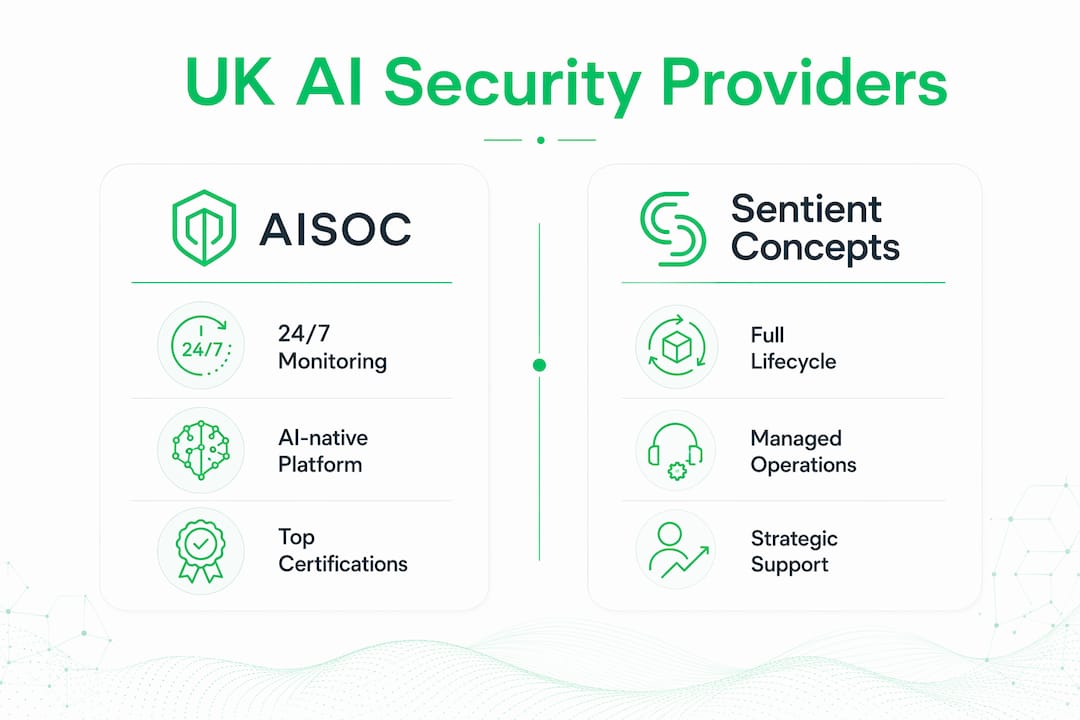
AISOC is the clearest choice for cybersecurity teams that need a dedicated, always-on AI security operations capability. Its MITRE ATT&CK®, ATLAS™, and D3FEND™ certifications are the strongest independent validation on this list, and its automated triaging reduces the analyst burden that typically compounds during high-volume threat events.
Sentient Concepts occupies a different position. Rather than monitoring for threats after deployment, it embeds security controls from the earliest strategy and architecture decisions, through engineering, and into managed AI operations. For enterprises building or scaling AI systems in finance, manufacturing, or logistics, that lifecycle coverage addresses the governance and accountability gaps that point solutions leave open.
A I S Security Solutions suits organisations that need a local UK supplier for AI security products and hands-on support, without the consulting overhead of a full-service firm. Ai Automation’s focus is industrial manufacturing automation rather than cybersecurity per se, making it relevant for operational technology environments where AI-driven automation intersects with physical security requirements.
How should you implement AI security controls across the full lifecycle?
The three-layer framework that structures effective AI security
Effective AI security operates across three concurrent layers: infrastructure security, identity and data security, and AI application security. Infrastructure security covers the compute, network, and storage environment in which models run. Identity and data security governs authentication, access controls, encryption, and data boundaries. AI application security addresses the model itself, including prompt handling, output validation, and behavioural monitoring.
These layers are not sequential. A weakness at the infrastructure layer can undermine even well-designed application controls, and vice versa. The US DoD guidance on deploying AI systems securely recommends applying Zero Trust principles across all three, with role-based or attribute-based access controls limiting exposure at every tier.
AI-specific vulnerabilities that standard controls miss
Prompt injection lets an attacker override a model’s system instructions through malicious user input, potentially triggering unauthorised API calls or data exfiltration. Data poisoning corrupts training data before a model is ever deployed, embedding backdoors that persist invisibly through the model’s operational life. Model theft allows adversaries to reconstruct a model’s functionality by querying it repeatedly, even without direct access to the weights.
Traditional application security tools do not detect these attack vectors. New AI application firewalls and semantic classifiers are now considered necessary to defend against prompt injection specifically, and the OWASP AISVS provides 14 testable requirement categories covering training data integrity, adversarial robustness, and human oversight, among others.
Shadow AI is a related risk that many organisations underestimate. Models deployed by individual teams without IT oversight create blind spots that standard discovery tools often miss. A complete AI asset inventory, maintained through automated scanning and regular validation, is a prerequisite for any coherent security posture.
Integrating AI security controls with existing infrastructure
Security gates embedded directly into CI/CD pipelines catch vulnerabilities before they reach production. Shift-left practices that include static prompt scanning, model hash verification, and adversarial test suites in the build process reduce the cost and complexity of remediation compared with post-deployment discovery. Augmenting your existing SIEM with AI telemetry and anomaly detection extends coverage to runtime threats such as model drift and adversarial input patterns.
Thinking about agentic AI entering workflows adds further complexity: autonomous agents that chain multiple actions require additional controls around authorisation scope and output validation.
Compliance and regulatory context for UK organisations
The NCSC’s guidelines align closely with ETSI EN 304 223, which mandates baseline security requirements across all five lifecycle phases. UK organisations deploying high-risk AI systems must also account for the EU AI Act’s conformity assessment requirements, which apply to systems used in regulated sectors regardless of where the deploying organisation is headquartered. AI security accountability should sit with the organisation’s cybersecurity leadership, not with a separate AI team, to prevent siloed governance and ensure consistent asset management.
Pricing for AI security implementation in the UK reflects the scope of engagement. Strategy and readiness assessments typically form the entry point, with ongoing managed operations and monitoring representing the longer-term cost. Organisations should budget for both the initial controls architecture and the continuous monitoring that keeps those controls effective as models evolve.
Sentientconcepts covers the full scope of AI security, not just part of it
Most AI security engagements address one layer well and leave the others to chance. Sentientconcepts is built differently. From AI strategy and readiness through data and platform engineering, custom solution development, deployment, and ongoing optimisation, a single integrated team holds accountability across the entire lifecycle. There are no handoffs between a strategy consultancy, a build partner, and an operations vendor, which is precisely where security gaps tend to form.
Sentientconcepts works with enterprises in finance, manufacturing, and logistics where the cost of an AI security failure is operational, regulatory, and reputational simultaneously. Security by design is not a bolt-on; it is embedded from the first architecture decision. If your organisation is building or scaling AI systems and needs a partner that owns the outcome rather than a phase of it, Sentientconcepts is worth a direct conversation.
Key takeaways
Effective AI security controls require lifecycle-wide governance, AI-specific threat defences, and organisational accountability that sits with cybersecurity leadership, not a siloed AI team.
Point | Details |
Lifecycle coverage is non-negotiable | NCSC and ETSI both require security controls across all five phases: design, development, deployment, maintenance, and end of life. |
AI threats need AI-specific defences | Prompt injection, data poisoning, and model theft require dedicated controls beyond standard application security tools. |
Asset visibility underpins everything | Shadow AI models without IT oversight create exploitable blind spots; automated inventory scanning is the baseline fix. |
Shift-left reduces remediation cost | Embedding security gates in CI/CD pipelines catches vulnerabilities before deployment, where fixing them is far less costly. |
Sentientconcepts | Offers end-to-end AI lifecycle coverage with security by design, serving enterprises in finance, manufacturing, and logistics across the UK. |
Recommended